
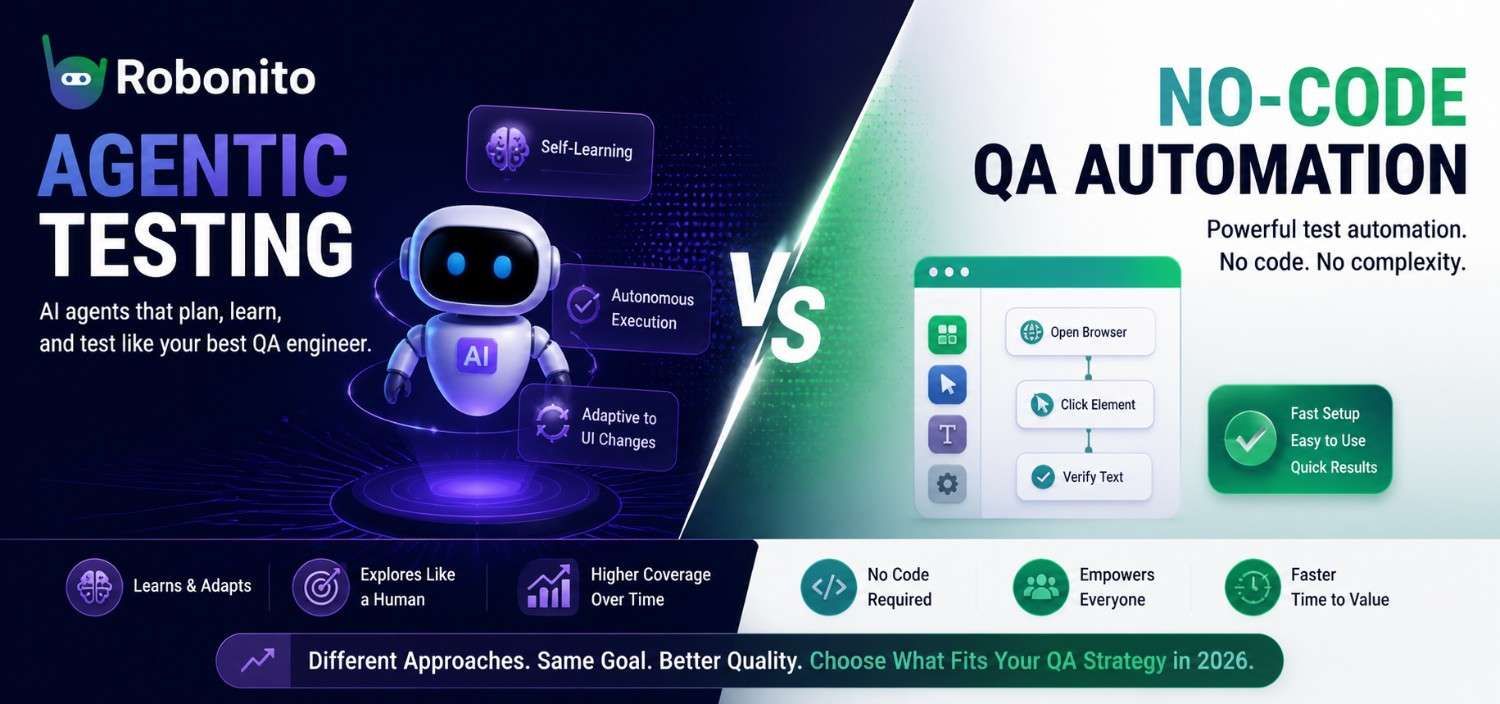
Every few years, a new paradigm promises to change QA forever. In 2026, that paradigm is agentic testing — the idea that AI agents can autonomously explore your application, generate tests, and catch bugs without human involvement. Vendors like Applitools are leading the charge, leveraging analyst recognition to push the narrative that fully autonomous testing is here and ready for prime time. But here's the uncomfortable truth most QA leaders discover after the demo ends: the gap between an impressive proof of concept and a reliable, production-grade QA pipeline is enormous. Most teams don't need autonomous agents roaming their applications unsupervised. They need fast, dependable automation that ships with their sprints — not after them. This post is a clear-eyed look at what agentic automation QA actually delivers today, where no-code test automation tools fit, and how to build an AI QA automation strategy that works for your team this quarter.
The Rise of Agentic Testing: What It Means and What's Hype
Agentic testing refers to AI systems that can autonomously navigate a web application, identify testable scenarios, generate and execute test cases, and report results — all with minimal or no human input. Think of it as moving from "AI-assisted" testing to "AI-directed" testing. Instead of a human defining every step, an agent decides what to test, how to test it, and when something looks broken.
The concept is genuinely exciting. In theory, an agentic system could discover edge cases humans miss, continuously test in the background, and adapt to application changes in real time. Applitools has been vocal about this vision, especially following their inclusion in the Forrester Wave™ for autonomous testing platforms, positioning their tooling as the future of QA.
But here's where hype and reality diverge.
Most agentic testing demos show agents exploring relatively simple flows — login pages, search functions, form submissions. When you introduce complexity that real-world applications demand — multi-step workflows with conditional logic, applications behind authentication walls with role-based access, integration points between multiple services, domain-specific validation rules that only a human understands — autonomous agents start to struggle. They generate noisy results, flag false positives, and miss the business-critical paths that actually matter to your users.
The analogy is self-driving cars. The technology is remarkable in controlled environments. On an unpredictable highway during a snowstorm, you still want a human behind the wheel. QA at most organisations is that snowstorm — messy, context-dependent, and high-stakes.
The hype isn't that agentic testing doesn't work at all. It's that it works well enough to demo but often not well enough to trust as your primary QA strategy. For QA leaders evaluating their 2026 roadmap, the question isn't "Is agentic testing impressive?" — it's "Can I bet my release pipeline on it today?"
Why Most QA Teams Aren't Ready for Fully Autonomous Testing
Let's talk about the teams actually buying QA tools — not Silicon Valley R&D labs, but the 5-to-30-person QA teams at mid-market SaaS companies, fintechs, healthtech firms, and e-commerce platforms. These teams face a common set of constraints:
- Limited bandwidth. They're already struggling to keep manual regression from bottlenecking releases.
- Mixed skill levels. The team includes manual testers, SDET-lites, and maybe one or two engineers who can write Selenium scripts.
- Existing technical debt. Test suites are brittle, flaky, and poorly maintained — if they exist at all.
- Compliance and auditability. In regulated industries, you need to know exactly what was tested and why. "The agent decided to" isn't an acceptable answer during an audit.
Dropping a fully autonomous testing agent into this environment is like handing the keys to a Formula 1 car to someone who needs a reliable daily commuter. The team doesn't need more intelligence in their testing — they need more coverage, speed, and predictability.
Consider a real scenario: a 12-person QA team at a mid-size fintech company evaluated an autonomous testing platform in late 2025. After a two-month pilot, the agents had generated over 400 test cases. The problem? Roughly 60% were redundant or tested trivial UI states. Only 15% covered the critical transaction flows that actually caused production incidents. The team spent more time triaging agent-generated results than they would have spent building targeted tests themselves.
This isn't an edge case. It's a pattern. Autonomous testing platforms often optimise for breadth of coverage rather than depth of business-critical validation — because the agent doesn't inherently understand what matters to your business. That understanding requires human direction, and that's exactly what no-code QA automation is designed to preserve.
Teams making the switch from manual to automated QA often follow a predictable pattern — learn more in why QA teams choose no-code automation over Selenium.
No-Code QA Automation: The Practical Path to AI-Powered Testing
No-code test automation tools represent a fundamentally different philosophy: give humans the power to automate without requiring them to code, while using AI to make those automated tests smarter and more resilient.
This isn't a lesser approach. It's a more honest one.
With a platform like Robonito, a manual QA tester can create an end-to-end automated test by describing the workflow in natural language or by walking through the application. There are no CSS selectors to inspect, no XPath expressions to debug, no test scripts to maintain. The AI handles element identification, and the self-healing engine adapts when the UI changes — so a button moving from the header to a sidebar doesn't break your entire regression suite.
Here's what this looks like in practice:
Scenario: An e-commerce platform redesigns its checkout flow. Under a traditional coded automation approach, this breaks 30+ Selenium tests. An SDET spends two sprint cycles fixing selectors. Under an agentic approach, the autonomous agent may or may not recognise the new flow correctly — results are unpredictable, and the team spends time validating the agent's work. Under a no-code approach with Robonito, the self-healing engine automatically adjusts to the new UI. The QA team reviews a handful of flagged changes, confirms they're intentional, and moves on. Total disruption: hours, not weeks.
The key differentiator is human-directed, AI-powered. You decide what to test based on your knowledge of the business. The AI handles the tedious parts — element location, test maintenance, cross-browser execution. You stay in control. The machine does the heavy lifting.
This is why no-code QA automation isn't a stepping stone to agentic testing. For most teams, it's the destination. It delivers 80-90% of the value of full automation at a fraction of the complexity, cost, and risk.
For a deeper look at how the self-healing engine detects and recovers from UI changes, see how self-healing tests eliminate flaky QA without code.
Agentic vs No-Code: A Feature-by-Feature Comparison for QA Leaders
When evaluating your QA automation strategy for 2026, abstract narratives don't help. Concrete comparisons do. Here's how agentic testing and no-code QA automation stack up across the dimensions that actually matter:
| Capability | Agentic Testing Platforms | No-Code QA Automation (Robonito) |
|---|---|---|
| Setup time | Weeks to months (training agents, tuning models) | Hours to days (point-and-describe) |
| Test creation | AI-generated autonomously | Human-directed with AI assistance |
| Business logic coverage | Broad but shallow — agents lack domain context | Targeted — testers encode what matters |
| False positive rate | High (agents flag cosmetic or irrelevant changes) | Low (tests are purpose-built) |
| Maintenance burden | Variable — agent outputs require ongoing triage | Minimal — self-healing handles UI drift |
| Skill requirement | Data science/ML knowledge helpful for tuning | None — manual testers are productive immediately |
| Auditability | Opaque — hard to explain why agent tested X | Transparent — every test has clear intent |
| CI/CD integration | Often requires custom orchestration | Native integration with major pipelines |
| Cost | Premium pricing, often usage-based at scale | Predictable, team-based pricing |
| Best for | R&D teams with mature automation already in place | QA teams needing fast, reliable coverage now |
The takeaway: Agentic testing excels as an exploratory supplement for teams that already have robust automation foundations. No-code QA automation is the foundation itself. If you're choosing between the two as your primary strategy, the pragmatic choice for most teams in 2026 is no-code — with the option to layer in agentic capabilities later as the technology matures.
What the Forrester Autonomous Testing Wave Means for Mid-Size Teams
Forrester's recognition of autonomous testing platforms has given the category significant credibility. Vendors included in the Wave — most notably Applitools — are using this validation to accelerate enterprise sales conversations. And for Fortune 500 companies with dedicated test infrastructure teams and seven-figure QA budgets, exploring autonomous testing makes strategic sense.
But Forrester reports evaluate technology capability, not organisational readiness. There's an important distinction between "this technology is powerful" and "this technology is right for your team."
For mid-size teams (let's say 50-500 person engineering organisations), the Forrester Wave should be read as a signal of where the market is heading, not a prescription for what to buy today. The criteria Forrester evaluates — vision, roadmap, platform breadth — favour large, well-funded vendors building for enterprise buyers. They don't necessarily reflect the deployment realities of a 10-person QA team that needs to automate regression testing for a product with 200+ user flows and a two-week sprint cycle.
A practical example: A healthtech company with 80 engineers read the Forrester report and shortlisted two autonomous testing platforms alongside Robonito. After evaluating all three, they chose the no-code approach. Why? Their compliance requirements meant every test needed documented intent and traceable coverage. The autonomous platforms couldn't guarantee which flows would be tested in any given run. Robonito gave them deterministic, auditable test suites that their compliance team could sign off on — and their QA analysts were creating tests within the first week.
If you're a QA leader at a mid-size company, treat analyst reports as market intelligence, not buying guides. Your evaluation should be grounded in your team's skills, your release cadence, and your tolerance for unpredictability.
How to Evaluate Whether Your Team Needs Agents or Automation
Before signing a contract with any vendor, run through this honest assessment:
You might benefit from agentic testing if:
- You already have comprehensive automated test coverage (70%+ of critical paths)
- You have dedicated SDETs or test infrastructure engineers who can tune and manage agents
- Your primary gap is exploratory testing and edge-case discovery, not regression coverage
- You operate in a low-regulation environment where non-deterministic test runs are acceptable
- Your QA budget can absorb a 6-12 month experimentation period
You likely need no-code QA automation if:
- Your team is still doing significant manual regression testing
- You've tried coded automation (Selenium, Cypress, Playwright) and struggled with maintenance
- Your testers are domain experts but not developers
- You need to show measurable ROI within one quarter
- Your release pipeline is blocked or slowed by insufficient test coverage
- You operate in a regulated industry requiring test traceability
Most teams fall firmly in the second category. That's not a criticism — it's a reflection of where the industry actually is. According to Capgemini's World Quality Report, manual testing still accounts for the majority of QA effort in most organisations — a proportion that has remained stubbornly high despite years of automation investment. The biggest unlock for these teams isn't more AI intelligence — it's removing the barriers to basic automation.
Think of it this way: if your house doesn't have plumbing yet, you don't need a smart water management system. You need pipes. No-code QA automation is the plumbing. Agentic testing is the smart system you might add later.
Getting started with Robonito — quick start guide
Building an AI QA Strategy That Ships This Quarter, Not Next Year
The best QA automation strategy for 2026 isn't the most technologically ambitious one — it's the one that delivers results on your current timeline with your current team. Here's a framework for building that strategy:
Step 1: Audit your current coverage gaps
Identify the top 20 user flows that generate the most revenue, support tickets, or compliance risk. How many are covered by automated tests today? For most teams, the answer is surprisingly few.
Step 2: Deploy no-code automation on critical paths first
Use a tool like Robonito to automate those top 20 flows. With natural language test creation and zero selector management, your existing QA team can have these running in your CI/CD pipeline within one to two sprints.
Step 3: Expand coverage systematically
Once critical paths are covered, extend to secondary flows — onboarding, settings, edge cases in core features. Assign ownership so tests stay current as features evolve. Robonito's self-healing minimises maintenance, but human review of flagged changes keeps tests aligned with intentional product updates.
Step 4: Measure and report
Track the metrics that matter: test coverage percentage, time saved versus manual regression, defect escape rate, release cycle time. These are the numbers that justify continued investment to your engineering leadership.
Step 5: Evaluate agentic augmentation (when ready)
Once you have a solid automation foundation — say, 70%+ critical path coverage — consider layering in agentic tools for exploratory testing. At this point, you have the baseline to compare agent-discovered issues against your existing coverage, and the team maturity to manage non-deterministic outputs.
This isn't an anti-agentic strategy. It's a sequenced strategy. It acknowledges that most teams need to walk before they run, and that running without a foundation leads to expensive stumbles.
Frequently Asked Questions
What is agentic testing and how is it different from traditional test automation?
Traditional automation requires a human to define every test step. Agentic testing uses AI to autonomously navigate an application, decide what to test, generate test cases, and report results — with minimal human input. The distinction matters because agentic systems introduce non-determinism: the same agent may test different flows on different runs, which creates auditability and reliability challenges that don't exist in human-directed automation.
Is agentic testing like Applitools ready for production QA pipelines today?
For enterprise teams with mature automation foundations and dedicated test infrastructure engineers — yes, as an exploratory supplement. For most mid-market QA teams still building foundational coverage, the answer is not yet. The false positive rate and unpredictability of agent-generated test runs require significant human triage time that most teams don't have. The technology is advancing quickly, but production readiness depends heavily on your team's existing maturity.
How long does it take to get no-code QA automation running?
With Robonito, most teams have their first automated test running within an hour and critical-path regression coverage within one to two sprints. There are no selectors to inspect, no test scripts to write, and no training period for the AI. A manual QA tester with no coding experience can create and run an end-to-end test by describing the workflow in natural language.
Can no-code automation handle complex multi-step workflows?
Yes. No-code automation handles complex conditional logic, multi-step transactional flows, authentication walls, and role-based access scenarios — because the human tester encodes that business context directly. This is the key advantage over autonomous agents: you define what matters, and the AI executes it reliably. Autonomous agents must infer what matters, which breaks down in domain-specific or compliance-heavy workflows.
What is the difference between self-healing tests and agentic testing?
Self-healing refers to a test's ability to recover from UI changes without breaking — when a button moves or a CSS class changes, the self-healing engine finds the element using alternative signals and continues the test. Agentic testing refers to autonomous test generation and exploration. They solve different problems: self-healing reduces test maintenance burden; agentic testing attempts to replace human test authorship. Robonito provides self-healing for tests you write; agentic platforms attempt to write tests for you.
When should a team consider adding agentic tools on top of no-code automation?
Once you have reliable automated coverage of 70% or more of your critical user paths, it becomes worth experimenting with agentic tools for exploratory coverage — finding edge cases your structured tests miss. At that point, you have the baseline to evaluate what agents discover against what you already cover, and the team maturity to manage non-deterministic outputs. Before that threshold, the overhead of managing agentic results typically outweighs the discovery value.
Start Automating What Matters — Today
The agentic testing narrative is compelling. Fully autonomous QA is a vision worth pursuing long-term. But visions don't fix the production bug your team missed because regression testing took too long, or the release that slipped because flaky Selenium tests needed another round of selector fixes.
Robonito gives your QA team the automation they need right now — no code, no fragile selectors, no months-long onboarding. Your manual testers create end-to-end tests in natural language. Self-healing AI keeps those tests running as your UI evolves. Native CI/CD integration means your tests ship with your code, every time.
You don't need to bet your QA strategy on autonomous agents that aren't quite ready. You need reliable, AI-powered automation that your team can use today.
Try Robonito free → See your first automated test running in under an hour. No credit card. No code. No selectors.
Automate your QA — no code required
Stop writing test scripts.
Start shipping with confidence.
Join thousands of QA teams using Robonito to automate testing in minutes — not months.