RobonitovsCypress

Robonito vs Cypress: AI-Native Testing vs Developer Framework

This examines whether embedding quality assurance directly within the codebase improves speed and reliability, or if maintaining an independent QA system ensures stronger governance, scalability, and cross-team quality standards.

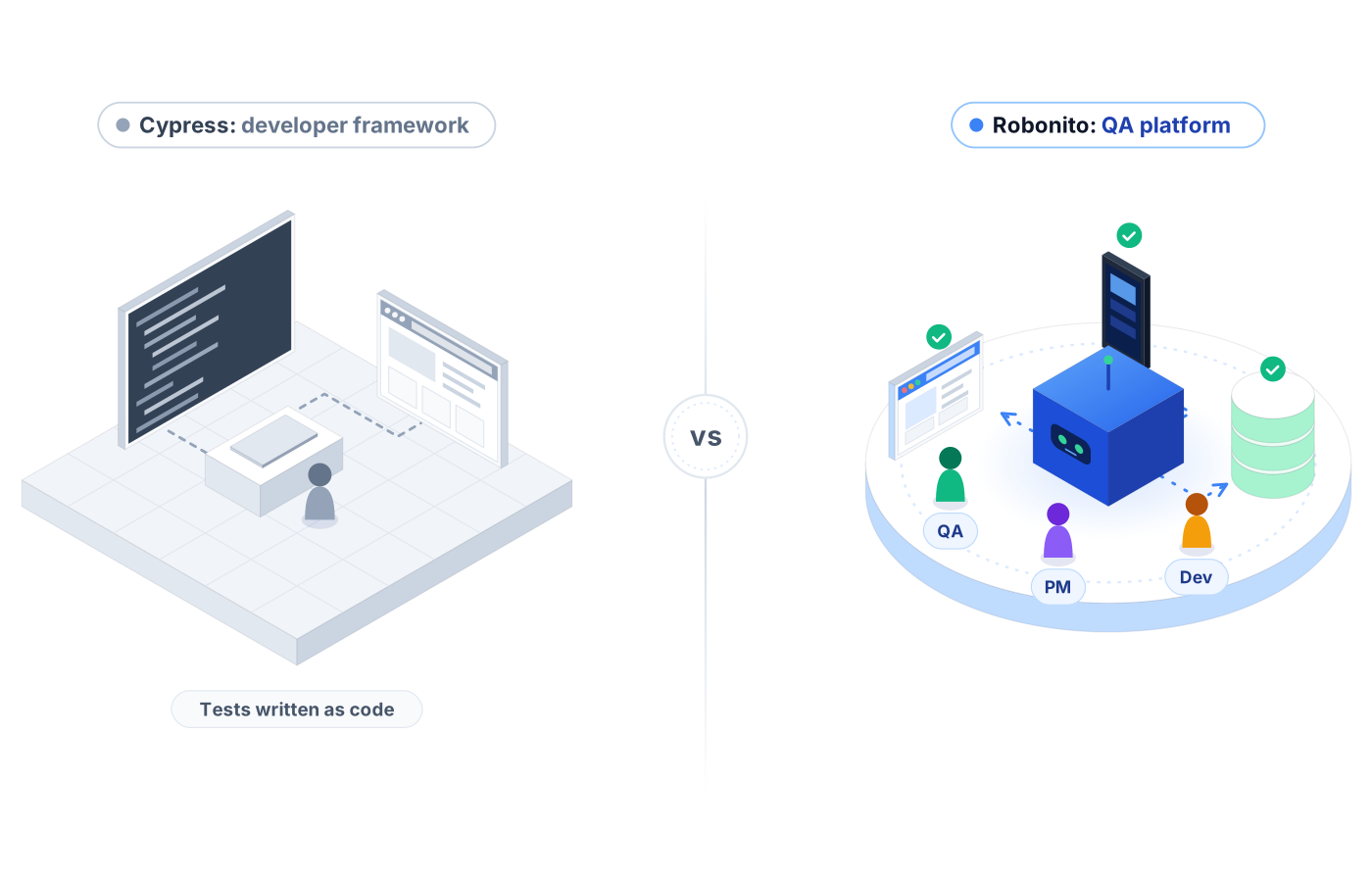
Isometric comparison of the Cypress approach and the Robonito AI agent approach to test automation

Feature Comparison at a Glance

This is not a tooling difference, it’s an operating model difference.

CapabilityRobonitoCypress
Primary UserQA teams, PMs, org-wide teamsDevelopers
Test CreationAI-generated from user behaviorHandwritten code
Script OwnershipNoneMandatory
Test ScopeEnd-to-end user journeysPrimarily frontend
Maintenance EffortLow (AI-driven healing)High (manual updates)
Handling UI ChangesAdaptiveFragile without fixes
Scaling ModelPlatform executionEngineering effort
Modern App SupportDynamic, AI-generated flowsSensitive to UI changes

The core difference

The Core Difference

They solve different problems at different stages of software maturity.

Cypress’ Approach

Cypress is a developer-first testing framework designed to validate frontend behavior during development.

  • Tests are written as JavaScript code
  • Owned and maintained by developers
  • Optimized for fast feedback during coding
  • Best suited for frontend validation
  • QA scale depends on developer bandwidth

Robonito’s Approach

Robonito is an AI-native, organizational QA platform designed to validate complete user journeys independently of code ownership.

  • AI agents understand end-to-end user flows
  • Tests generated from application behavior
  • No test code required or maintained
  • Independent QA execution across environments
  • QA scales through orchestration, not engineering effort

Operating model

AI-Assisted vs AI-Native Testing

Cypress does not natively own intelligence.

Cypress relies on humans to:

People do it
  1. 01Decide what to test
  2. 02Write and maintain assertions
  3. 03Debug failures
  4. 04Expand coverage

Robonito uses AI to:

AI agents do it
  1. 01Generate test scenarios
  2. 02Execute and heal tests
  3. 03Adapt coverage as flows evolve
  4. 04Decide what needs re-validation after every change
  5. Repeats on every change

Who does the work in each model, based on how Cypress and Robonito are designed.

Total cost of ownership

The Hidden Cost Most Teams Discover Too Late

Cypress itself is free. The organizational cost is not.

01

Developers

Developers deprioritize test upkeep under delivery pressure

02

QA coverage

QA coverage remains frontend-heavy

03

End-to-end failures

End-to-end failures surface late

04

Testing velocity

Testing velocity becomes tied to sprint capacity

Robonito is designed to remove script ownership as a liability, not optimize it. Release velocity, QA team burnout, Long-term total cost of ownership

Enterprise

Enterprise, Compliance & IP Considerations

From a US enterprise and legal perspective:

Cypress

  • Test code becomes part of the application codebase
  • High dependency on developers who understand test logic
  • Risk during re-orgs, attrition, or team scaling

Robonito

  • No persistent test code embedding business logic
  • Reduced IP exposure during team changes
  • Independent QA execution model
  • SOC2-aligned architecture for regulated industries

This distinction matters for enterprise SaaS, healthcare, and compliance-driven teams.

Which one fits

When to Choose Each Platform

When Cypress Is a Good Fit

Cypress is an excellent developer testing tool.

  • Developers fully own QA
  • Testing scope is primarily frontend
  • UI change velocity is manageable
  • You prioritize fast feedback during development

When Robonito Is the Better Choice

  • QA must scale independently of engineering headcount
  • You need end-to-end user journey validation
  • Releases are frequent or continuous
  • You want QA confidence without increasing developer load
  • You want testing aligned with organizational outcomes

Call to Action

If you’re evaluating Robonito vs Cypress, don’t compare frameworks.

Reduce developer load, Increase QA confidence across your organization

FAQ

Frequently asked questions

Does Robonito replace Cypress?

Robonito removes the need to manage Cypress-style test code while still using proven execution engines under the hood. Cypress can continue to exist for developer-level testing.

Is Robonito enterprise-ready?

Yes. Robonito is built with SOC2-aligned security, role-based access, and enterprise execution controls.

Is this a drop-in replacement?

Robonito works best when introduced via a focused PoC on real user journeys rather than replacing existing tests all at once.