
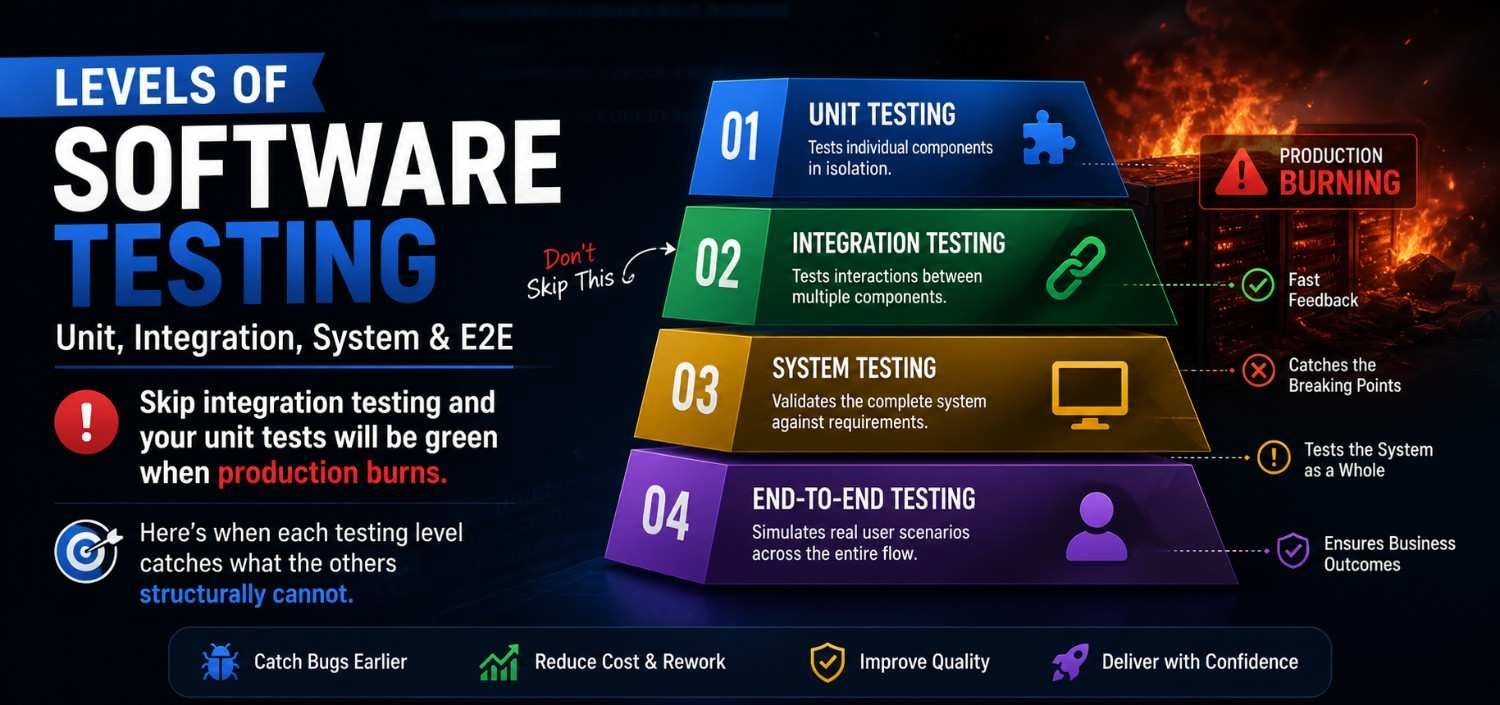
A fintech startup shipped a payment feature that passed every unit test. Two weeks after launch, transactions started failing at random — but only when three specific services ran in sequence. The culprit: an integration gap no unit test had ever touched. The fix took three sprints and cost a major client.
Most teams know about unit testing, integration testing, and system testing. Fewer understand when to apply each, who owns it, and what breaks when a level gets skipped or rushed. This guide gives you the practitioner's map — not the textbook one.
Levels of Software Testing Explained
Each testing level reveals something the others structurally cannot. That's not redundancy — it's intentional separation of concerns.
Unit Testing catches logic errors inside a single function or class. It runs in milliseconds, gives developers instant feedback, and scales to thousands of tests. What it cannot see: whether two components agree on what data they'll exchange.
Integration Testing catches the disagreements between components — the payment service expecting a string when the order service sends an integer, the API returning a null when the UI expects an empty array. These bugs don't exist inside any single unit. They exist in the contract between units, and they're invisible until you remove the mocks.
System Testing validates the full system under realistic conditions. Load, security, data volume, configuration — none of these are exercisable at the unit or integration level. System tests are slower and costlier, but they're the only level that catches performance degradation before it hits users.
End-to-End (E2E) Testing simulates a real user navigating through the application. It catches the final class of bugs: the UI-to-backend disconnects that exist nowhere in the codebase individually but emerge when everything runs together. E2E tests are the most expensive to write and maintain, which is why teams that over-invest in them end up with fragile, slow pipelines.
Comparison of Testing Levels
| Level/Type | What It Tests | Runs When | Who Owns It | Speed | Defect Catch Rate | Coverage Scope |
|---|---|---|---|---|---|---|
| Unit Testing | Individual units/code | During development | Developers | Fast | High | Narrow |
| Integration Testing | Integrated components | After unit testing | Developers/QA | Medium | Medium | Moderate |
| System Testing | Entire system | Before deployment | QA Team | Slow | Low | Broad |
| E2E Testing | Entire application flow | Before deployment | QA Team | Slow | Low | Broad |
Decision Framework for Testing Levels
Not every situation needs every level. Here is when each level earns its place — and when it doesn't.
IF a bug could exist entirely within a single function — a calculation error, a null check, a wrong conditional — THEN unit test it. Unit tests are the cheapest form of quality assurance that exists. If you are skipping them to "save time," you are borrowing against your next production incident.
IF two components owned by different developers (or different teams) exchange data — THEN write an integration test for that boundary before either component ships. The fintech bug at the start of this article had no integration test on the boundary between the payment service and the order service. That is the exact gap integration testing exists to close.
IF your system has performance requirements, security constraints, or behaviour that only emerges under realistic data volume — THEN system testing is the only level that can validate it. Unit and integration tests run against mocked or minimal data. System tests do not.
IF your E2E test suite takes longer than 15 minutes to run — THEN you have too many E2E tests and not enough integration tests. Move coverage down the pyramid: replace each slow E2E test with a faster integration test that covers the same contract. Reserve E2E tests for the 5–10 critical user journeys that cannot be validated any other way.
IF an integration test is flaky — THEN the flakiness is almost always a timing assumption or a shared-state problem between components, not a test infrastructure problem. Fix the assumption, not the test.
IF you are in a microservice architecture and full integration environments are expensive to spin up — THEN use contract testing (see the Pact section above) rather than skipping integration tests entirely. Skipping integration tests in microservices is the fastest way to create the untested space between services where production bugs live.
Senior-Level Depth: What the Testing Pyramid Doesn't Tell You
The Pyramid Ratio Has a Reason
The testing pyramid prescribes roughly 1,000 unit tests for every 100 integration tests for every 10 E2E tests. This isn't arbitrary — it reflects the cost of execution, the cost of debugging, and the determinism at each level. Unit tests are deterministic: the same input always produces the same output. E2E tests are probabilistic: timing, network state, and browser rendering introduce randomness. Teams that violate the pyramid ratio don't just slow CI — they import probability into a system that should be deterministic. (Martin Fowler's original testing pyramid first articulated this ratio in 2012 — it remains the canonical reference.)
Contract Testing for Microservices Integration
Standard integration testing requires spinning up both services in a shared environment — expensive, slow, and prone to environment-specific failures. Senior engineers in microservice architectures use contract testing instead: each service defines the contract it expects from its dependencies (input shape, response format, error codes), and tests verify those contracts independently. Tools like Pact allow Consumer-Driven Contract testing, where the consumer defines the contract and the provider runs it. This makes integration testing fast, parallelisable, and environment-independent.
Flakiness is Not Evenly Distributed
Unit tests, when written correctly, are essentially never flaky. Integration tests have low flakiness if dependencies are controlled. E2E tests are inherently flaky — timing assumptions, DOM rendering order, and network latency all introduce non-determinism. Google's internal research on flaky tests found the majority of flakiness originated at the UI/E2E layer, not unit tests. Senior engineers treat E2E flakiness as a structural property to manage (via retry policies, test quarantine, and explicit waits) rather than a bug to fix. The mistake is applying E2E reliability expectations to unit tests — or blaming the test framework when the problem is architectural.
Teams that want to minimise E2E flakiness without rewriting test infrastructure often move to no-code test automation where the tool manages locator resilience rather than the test author.
Real-World Scenario: A SaaS Team Rebuilds Their Test Strategy
A 12-person engineering team at a B2B SaaS company was shipping 3 releases per week. Their test suite had 400 E2E tests, 80 unit tests, and zero integration tests. CI pipeline runtime: 52 minutes. Flakiness rate: 23%. Engineers were merging without waiting for CI to pass.
The change they made: they inverted the pyramid over two sprints.
- Sprint 1: Wrote unit tests for all service-layer functions. Identified 14 functions with zero test coverage — three of which had production bugs that had never surfaced.
- Sprint 2: Added integration tests for all inter-service API calls using a shared test database. Found 6 contract mismatches — all places where one service's output didn't match another's expected input. All 6 had been silent in production, causing intermittent errors that the team had attributed to "flakiness."
After the two sprints: CI runtime dropped to 18 minutes. Flakiness rate dropped to 4%. The team started trusting the pipeline again and resumed waiting for green before merging. Production incident rate dropped by roughly half in the following quarter — not because they wrote more tests, but because they wrote them at the right level.
How Testing Levels Work Together in a Real Sprint
Most teams treat testing levels as sequential checkboxes. Senior engineers treat them as overlapping safety nets — each catching what the previous one misses.
Here's how they interlock:
- Unit tests run on every commit. They catch logic errors in under 60 seconds but tell you nothing about how components communicate.
- Integration tests run after unit tests pass. They catch contract mismatches — the payment service expecting a string, the order service sending an integer.
- System tests run on staging before release. They validate full workflows under realistic data volumes — the conditions where load-related bugs surface.
- E2E tests simulate a real user clicking through the application. They catch UI-to-backend disconnects that unit and integration tests structurally cannot reach.
The classic mistake: treating each level as a replacement for the previous one rather than a complement. Teams that skip integration testing don't save time — they convert cheap unit test failures into expensive production incidents. For a deeper look at how each testing level fits into a modern CI/CD pipeline, the integration points and trigger conditions vary significantly by team size and release cadence.
Where Teams Go Wrong
Mistake 1: The Testing Pyramid Inversion
Teams under pressure skip unit tests and write E2E tests instead — they're more satisfying to watch, they "test the real thing," and non-technical stakeholders understand them. The result is a test suite with 200 E2E tests and 50 unit tests. CI pipelines that take 45 minutes. Flakiness rates above 20%. Teams start skipping the suite rather than fixing it, which defeats the purpose entirely.
The correct ratio is roughly 10:1:0.1 — for every E2E test, you need 10 integration tests and 100 unit tests. The pyramid is wide at the bottom because cheap, fast, deterministic tests should do as much of the work as possible.
Mistake 2: No Integration Testing Between Team-Owned Services
In microservice architectures, each team owns their service and writes their own tests. Unit test coverage is high. But the integration between Service A (owned by Team 1) and Service B (owned by Team 2) often has no test at all. Each team assumes the other's API contract is stable. It isn't. This is where the fintech payment bug at the start of this article lives — not inside any service, but in the untested space between them.
Mistake 3: Treating E2E as the Only Pre-Release Gate
When E2E tests are the only tests that run before a release, failures are found too late. A bug found in E2E testing costs 5–10× more to fix than a bug found in integration testing. Teams that rely exclusively on E2E tests for quality assurance aren't testing earlier — they're just paying more for the same information they could have gotten sooner. Teams looking to reduce E2E maintenance overhead often turn to self-healing test automation — a no-code approach where tests automatically recover from UI changes without manual locator updates.
Implementation Checklist
Planning Phase
- Define the scope of each testing level before sprint planning.
- Identify the necessary resources and tools for each level.
- Determine the metrics to measure the effectiveness of each testing level.
Execution Phase
- Execute unit testing for all new code.
- Perform integration testing after unit testing.
- Conduct system and E2E testing before deployment.
Review and Improvement
- Review test results and defect reports to identify areas for improvement.
- Refine testing strategies based on lessons learned.
- Continuously monitor and adjust the testing process to ensure it remains effective and efficient.
Common Misconceptions
Misconception: More test coverage equals higher quality. Reality: Test coverage measures whether code is executed, not whether the behavior is correct.
Misconception: Automated testing replaces manual testing. Reality: Automated testing complements manual testing but does not replace the need for human judgment and exploratory testing.
Frequently Asked Questions
How many unit tests are enough before moving to integration testing?
There is no fixed number — coverage percentage is a misleading metric here. The signal to move to integration testing is behavioural coverage: every significant execution path through a component has a test. If adding more unit tests no longer reveals new failure modes, you have hit the ceiling of what unit testing can tell you. That's when integration testing starts earning its keep.
Why do integration tests catch bugs that unit tests miss even when unit coverage is high?
Because unit tests test components in isolation — dependencies are mocked or stubbed. A unit test for a payment function might mock the database call as always returning success. Integration testing removes those mocks and uses real dependencies. The bugs that surface are almost always in the assumptions each component makes about what it will receive — data types, null handling, timing — things a mock can never reveal.
Can E2E testing replace system testing?
No. E2E testing simulates real-user scenarios through the UI. System testing validates non-functional requirements — load capacity, security posture, data integrity under volume — that no amount of UI simulation can exercise. You need both.
What breaks when you skip integration testing?
Contract mismatches between components go undetected. A service that returns a null where another expects an empty array will pass all unit tests and fail in integration. These bugs reach production silently, surface as intermittent errors, and take multiple sprints to diagnose because they don't reproduce in unit test environments.
Why does system testing take so much longer than unit testing?
System tests exercise the full stack under realistic conditions — provisioning environments, seeding data volumes, running load simulations. Unit tests exercise a single function in memory. The difference isn't inefficiency; it's scope. System testing is slow by design because the conditions it validates can't be approximated at a smaller scale.
Conclusion
The fintech team at the start of this article had high unit test coverage and still lost a major client. The gap wasn't code quality — it was a missing layer in the testing strategy. Every level in this guide catches something the others structurally cannot. Remove one and you create a blind spot. For teams looking to reduce the maintenance burden of keeping E2E tests green as applications change, Robonito offers AI-powered, no-code test automation that adapts to UI changes automatically — live in under 20 minutes, no locator rewrites required.
Automate your QA — no code required
Stop writing test scripts.
Start shipping with confidence.
Join thousands of QA teams using Robonito to automate testing in minutes — not months.