
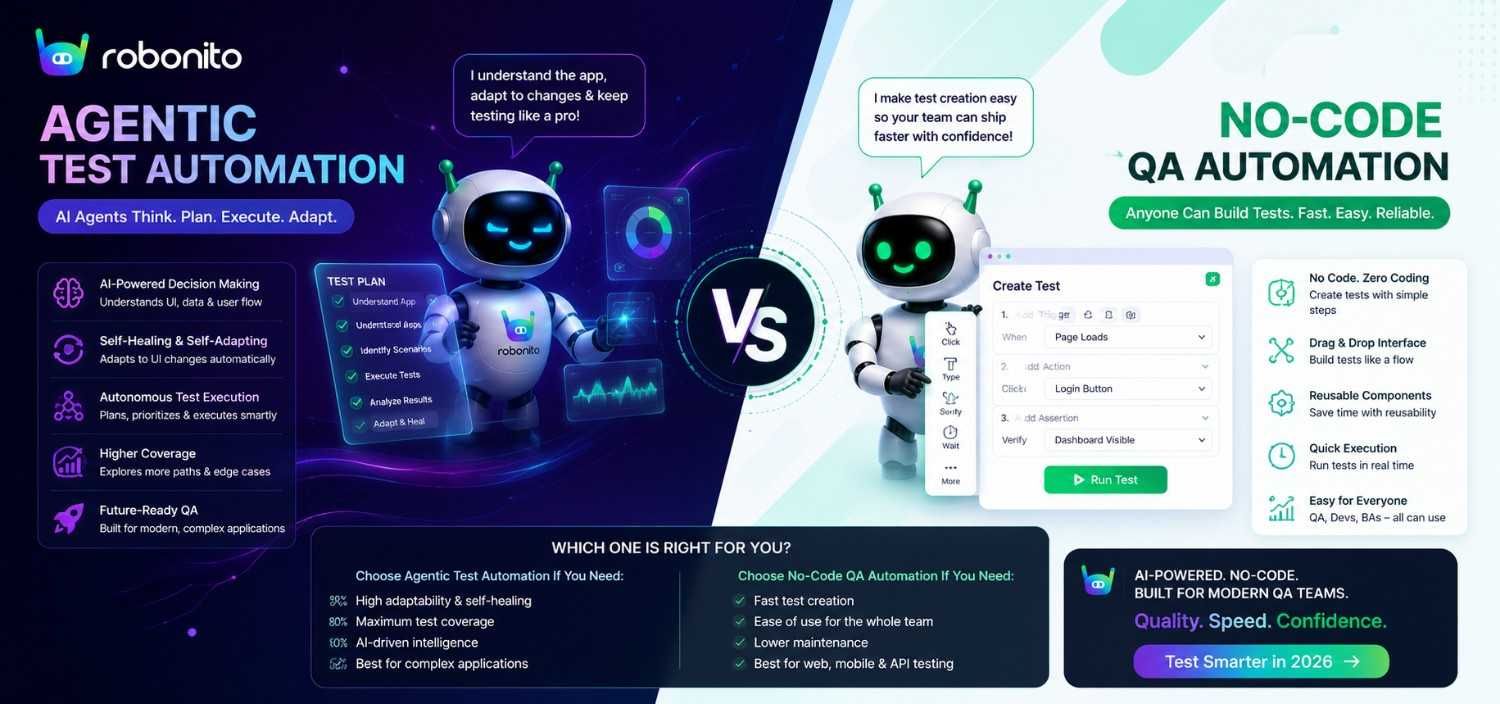
Every few years, the QA industry gets a new buzzword that promises to change everything. In 2025, that buzzword is agentic test automation — the idea that AI agents can autonomously explore your application, decide what to test, write their own test cases, and maintain them without human intervention. It sounds incredible. It also sounds like something we've heard before. The truth is, most QA teams aren't struggling because their automation isn't autonomous enough. They're struggling because test creation is slow, maintenance is brutal, and half the team can't contribute because the tools require code. Before you chase the next frontier, it's worth asking a harder question: what does your team actually need to ship reliable software today?
What Is Agentic Test Automation and Why Is Everyone Talking About It?
Agentic test automation refers to AI-driven testing systems that can independently make decisions about what to test, how to test it, and when to adapt — without explicit human instructions for every step. Unlike traditional automation (where a human scripts each action) or even standard no-code tools (where a human records each flow), agentic systems aim to act as autonomous QA engineers.
The concept borrows from the broader "agentic AI" movement in software development, where large language models are given tools, memory, and goals, then set loose to accomplish tasks. In a QA context, that might look like:
- Autonomous exploration: The agent crawls your app, identifies testable flows, and generates test cases on its own.
- Self-directed maintenance: When the UI changes, the agent doesn't just heal a broken selector — it re-evaluates whether the test itself is still valid.
- Intelligent prioritization: The agent decides which tests to run based on code changes, risk analysis, or historical failure data.
Companies like Applitools have been aggressively pushing this narrative, positioning agentic QA automation as the inevitable next step beyond traditional tools. And they're not wrong that the direction is compelling. The question is whether the destination is reachable today — or whether teams are being asked to buy a vision while their current testing problems go unsolved.
The search volume for "agentic test automation" has tripled since late 2024 according to Google Trends data. The conversation is real. But conversations and production-ready solutions are different things entirely.
The Hype vs. Reality: What Agentic AI Can and Cannot Do for QA Today
Let's be fair to the technology: agentic AI has made genuine progress. Modern LLMs can read a web page, understand UI context, and even generate plausible test steps from a natural language description. That's not nothing.
But here's what the marketing materials tend to leave out:
What agentic testing can do reasonably well today:
- Generate exploratory test suggestions for simple workflows
- Identify visual regressions when paired with screenshot comparison
- Propose test cases from documentation or user stories
What it still struggles with:
- Complex business logic. An agent can click through a checkout flow. It cannot reliably validate that a prorated subscription discount was calculated correctly across tax jurisdictions — unless a human tells it exactly what "correct" means.
- Stateful workflows. Tests that depend on specific data states, third-party integrations, or sequenced operations remain notoriously difficult for autonomous agents to manage reliably.
- Determinism. QA teams need tests that produce consistent, trustworthy results. Agentic systems, powered by probabilistic LLMs, can produce different results on different runs. A test that passes Monday and fails Wednesday — for no clear reason — is worse than no test at all.LLM non-determinism research
- Debugging failures. When an agentic test fails, why it failed can be opaque. The agent made a chain of decisions, and tracing those decisions back to a root cause is harder than debugging a deterministic script.
Consider a hypothetical mid-size e-commerce team that adopted an autonomous testing platform early in 2025. Their agent generated 200+ test cases in a week. Impressive — until the team realized 40% of those tests were redundant, 15% tested flows that didn't match actual user behavior, and debugging the false positives consumed more time than manual testing had. They didn't have a test quantity problem. They had a test trust problem.
The technology will improve. But adopting it prematurely means absorbing its instability into your release pipeline — the one place you can least afford instability.
Why No-Code QA Automation Still Solves 90% of Real Testing Pain
Step back from the agentic narrative for a moment and look at what actually blocks QA teams in practice:
- Test creation is too slow. Writing Selenium or Playwright scripts takes hours per flow.
- Maintenance is a treadmill. A single UI refactor breaks dozens of tests.
- Only developers can automate. Manual QA engineers — the people who best understand user workflows — are locked out of the automation process.
- CI/CD integration is fragile. Tests that work locally break in pipelines.
No-code QA automation solves all four of these problems without requiring you to trust an AI agent with autonomous decision-making. When a manual QA engineer can create a full regression test in minutes — without writing CSS selectors, XPath, or scripts — you've eliminated the biggest bottleneck in most QA organizations: the dependency on developer time for test creation.
Here's a concrete scenario: A fintech startup with three QA engineers and no SDET was spending 60% of each sprint on manual regression testing. They didn't need an autonomous agent to "discover" tests. They already knew exactly what needed testing — they'd been doing it by hand for months. What they needed was a way to automate those known flows without learning a programming language. After moving to a no-code platform like Robonito, they automated 80% of their regression suite in under two weeks. Sprint velocity for the development team increased because releases were no longer gated by a three-day manual testing cycle. how Robonito eliminates manual regression testing
The point isn't that agentic AI is bad. It's that solving known problems with proven tools delivers more value faster than chasing emerging capabilities with unproven ones. Most teams haven't fully exploited no-code automation yet. Jumping to agentic before you have is like buying a self-driving car when you haven't finished building the road.
Self-Healing Tests: The Practical Middle Ground Between Manual and Agentic
If the appeal of agentic QA automation is that tests adapt to change without human intervention, then self-healing tests deserve far more attention than they get. They deliver the specific benefit teams actually want — resilience to UI changes — without the complexity and unpredictability of fully autonomous agents.
Here's how self-healing works in practice: When a button's ID changes from #submit-btn to #checkout-submit, a traditional Selenium test breaks immediately. A self-healing test recognizes that the button's text, position, surrounding context, and behavioral role haven't changed — and automatically adjusts the locator. The test passes. The QA engineer gets a notification that a healing occurred. No emergency maintenance session. No pipeline blockage.
This is not theoretical. Robonito's self-healing engine handles exactly this scenario, and it does so deterministically. There's no LLM guessing at what the right element might be. The system uses multiple locator strategies, weighted context signals, and historical interaction data to make a precise, auditable decision.Playwright's actionability model
Compare this to the agentic approach to the same problem: the agent might re-explore the page, decide the flow has fundamentally changed, generate a new test case, and deprecate the old one — all without asking. That sounds efficient until it silently deprecates a test that was catching a real bug because it misinterpreted a UI redesign as intentional.
The practical difference:
- Self-healing: "The UI changed, but the intent of this test is the same. I'll adapt the locator and flag it for review."
- Agentic: "The UI changed. I'll decide what to do about it."
For most teams, the first option is dramatically more trustworthy. how Robonito's self-healing tests work
## Agentic test output: opaque, probabilistic
## Agent decision log (what you get when debugging):
{
  "action": "click",
  "element_identified_by": "agent_model_v2",
  "confidence": 0.73,
  "reasoning": "Element appears to be the primary CTA based on visual prominence",
  "result": "FAIL",
  "agent_note": "Element may have changed context"
}
## When this fails: which decision in the chain was wrong?
## How do you reproduce it? The agent may not make the same decision again.

## Robonito self-healing output: deterministic, auditable
{
  "action": "click",
  "element": "Place Order button",
  "signals_matched": {
    "aria_role": "button",           ## confidence: 1.00
    "accessible_name": "Place Order", ## confidence: 0.97
    "visual_position": "form-bottom", ## confidence: 0.91
    "surrounding_context": "payment-section" ## confidence: 0.89
  },
  "combined_confidence": 0.93,
  "healing_applied": true,
  "old_selector": ".checkout-btn-v2",
  "new_selector": ".ds-action-button",
  "result": "PASS"
}
## When this heals: exactly which signal changed, from what to what
## Fully reproducible: same inputs → same decision every time
Head-to-Head: Agentic Platforms vs. No-Code AI Tools Like Robonito
To make the agentic vs no-code testing comparison concrete, let's look at the dimensions that actually matter to QA teams evaluating tools in 2025:
| Dimension | Agentic Platforms | No-Code AI Tools (Robonito) |
|---|---|---|
| Test creation speed | Variable — agent may need multiple iterations to produce a usable test | Minutes — record a flow or describe it in natural language |
| Reliability / determinism | Lower — LLM-driven decisions introduce variability | High — deterministic execution with self-healing |
| Maintenance burden | Theoretically low, but debugging agent decisions is complex | Low — self-healing handles most UI changes automatically |
| Learning curve | Moderate to high — teams must learn to prompt, constrain, and audit agents | Minimal — QA engineers are productive in hours |
| Business logic validation | Weak without significant human guidance | Strong — humans define assertions; the tool executes reliably |
| CI/CD integration | Emerging — some platforms have limited pipeline support | Mature — integrates with all major CI/CD pipelines |
| Cost predictability | Often usage-based (LLM token costs), hard to forecast | Predictable subscription pricing |
| Team accessibility | Typically requires technical users to manage agents | Any QA team member can create and maintain tests |
| Production readiness (2026) | Early — reliability improving but not yet stable for all CI/CD gating | Mature — stable, deterministic, auditable |
For example, imagine a healthcare SaaS company recently evaluated both approaches for their HIPAA-compliant application. The agentic platform generated test cases quickly but couldn't reliably handle their complex role-based access control scenarios — the agent kept conflating admin and clinician permissions. Robonito's no-code approach let their manual QA lead (who understood the permission model deeply) build precise, reliable tests in plain language without writing a single line of code. The tests ran correctly on the first CI/CD integration. getting started with Robonito
The takeaway isn't that agentic platforms are useless — they're just solving a different problem than the one most teams have right now.
How to Evaluate What Your QA Team Actually Needs Right Now
Before you get swept up in any vendor's narrative, run this honest assessment of your current QA state:
Ask these five questions:
-
What percentage of your known regression flows are automated today? If it's under 70%, you have a coverage problem that no-code tools solve immediately. An agentic tool might generate more tests, but quantity without trust isn't coverage.
-
How many hours per week does your team spend on test maintenance? If it's more than 20% of your QA capacity, self-healing is the highest-leverage investment you can make — not autonomy.
-
Who creates your automated tests? If the answer is "only developers" or "only the SDET," then accessibility is your bottleneck. No-code tools unlock your entire QA team. Agentic tools often create a different dependency: someone who knows how to manage the agent.
-
How stable are your CI/CD test runs? If flaky tests are a significant problem, adding an LLM-powered agent to the pipeline will likely make flakiness worse, not better. Deterministic execution is what you need.
-
What's your timeline? If you need measurable improvement in test coverage and release confidence this quarter, you need a tool your team can adopt in days — not a platform that requires months of tuning and trust-building.
For most teams, the honest answers to these questions point toward reliable, accessible, no-code automation with intelligent maintenance — not toward autonomous agents making unsupervised decisions in your release pipeline.
When Agentic Testing Makes Sense
Agentic testing may be the better investment if:
- Your regression suite is already highly automated.
- You have mature CI/CD pipelines.
- Your QA engineers are comfortable supervising AI-generated output.
- You want AI-assisted exploratory testing rather than deterministic regression testing.
- Your goal is accelerating test discovery rather than replacing existing test execution.
For these organizations, agentic capabilities can complement—not replace—a strong automated testing foundation.
The Future Is Incremental: Building Toward Autonomy Without Gambling on It
Here's the nuanced position that the agentic hype cycle tends to obscure: the future of QA automation probably does include more autonomy. AI agents will get more reliable. LLMs will become more deterministic. The tooling around agentic systems will mature.
But that future arrives incrementally, not all at once. And the teams that will benefit most from agentic capabilities in 2027 or 2028 are the ones that have their fundamentals locked down today:
- Comprehensive automated coverage of critical user flows
- Self-healing infrastructure that keeps tests green without constant human intervention
- CI/CD integration that gates releases on trustworthy test results
- Cross-team accessibility so QA knowledge isn't siloed in one engineer's scripts
These fundamentals are exactly what a platform like Robonito delivers. And they're not stepping stones you'll throw away when agentic tools mature — they're the foundation those tools will build on. An autonomous agent that can explore and generate tests is far more valuable when it's layered on top of a stable, well-maintained, comprehensive test suite than when it's dropped into an organization that hasn't automated its known flows yet.
Think of it like self-driving cars (the real kind, not the vaporware kind). Tesla didn't ship full autonomy on day one. They shipped lane assist, then adaptive cruise control, then highway autopilot — each layer building on the reliability of the last. The teams that skip ahead to "full self-driving QA" are the ones most likely to crash.
The pragmatic path forward — four steps
-
Automate known critical flows with no-code tools (this week) You already know what needs testing. Record those flows in Robonito. No scripts, no selectors, no developer dependency.
-
Implement self-healing so tests stay reliable as your app evolves UI changes should not cause emergency maintenance sessions. Self-healing handles routine locator changes automatically.
-
Gate releases on CI/CD with deterministic test results Tests that sometimes pass and sometimes fail cannot gate a deployment. Deterministic execution is the prerequisite for trustworthy automation.
-
Add agentic capabilities on top of a stable foundation Autonomous agents are most valuable when they complement a mature test suite — not when they are dropped into a testing vacuum.DORA's State of DevOps 2025
Frequently Asked Questions
What is agentic test automation?
Agentic test automation is an AI-driven testing approach where software agents independently decide what to test, how to test it, and when to adapt — without explicit human instructions for each step. Unlike traditional test automation (where a human scripts every action) or no-code tools (where a human records each flow), agentic systems use large language models equipped with tools, memory, and goals to autonomously explore applications, generate test cases, and maintain them. In 2026, the technology shows genuine promise for exploratory test generation and visual regression but remains unreliable for complex business logic validation, stateful workflows, and deterministic CI/CD gate execution.
What is the difference between agentic test automation and no-code test automation?
No-code test automation lets humans define what to test — by recording flows or describing them in plain language — and automates the execution and maintenance of those human-defined tests. Agentic test automation removes the human from the test definition stage entirely: the AI agent decides what to test, generates the test, and chooses how to handle changes. The practical difference is control and predictability. No-code produces deterministic, auditable tests where a human defined the intent. Agentic produces AI-generated tests where the reasoning behind test decisions can be opaque and the results probabilistic. For CI/CD deployment gates where consistent, trustworthy results are required, no-code tools are currently the safer choice.
Is agentic test automation ready for production use in 2026?
Partially. Agentic test automation is production-ready for specific use cases: exploratory test discovery, visual regression identification, and test case suggestion from user stories or documentation. It is not yet reliably production-ready for complex business logic validation (prorated discounts across tax jurisdictions, role-based access control), stateful workflows with third-party dependencies, or deterministic CI/CD gating where tests must produce consistent results across every run. Teams adopting agentic automation in 2026 typically use it as a discovery and suggestion layer on top of a deterministic no-code or scripted test suite, not as a replacement for it.
What are the limitations of agentic AI in software testing?
The four primary limitations of agentic AI in software testing in 2026 are: (1) Inability to validate complex business logic without detailed human-defined expectations — agents can verify visible outcomes but not whether underlying calculations are correct. (2) Non-determinism — LLM-powered agents can produce different decisions on different runs, making test results unreliable as deployment gates. (3) Opaque failure debugging — when an agentic test fails, tracing the chain of agent decisions to a root cause is significantly harder than debugging a deterministic script. (4) Stateful workflow fragility — tests requiring specific data states, sequenced operations, or third-party API coordination remain difficult for autonomous agents to manage reliably at scale.
When should a QA team use agentic testing instead of no-code automation?
A QA team should consider agentic testing as a complement to (not a replacement for) existing automation when: the regression suite is already highly automated (70%+ of known flows covered), CI/CD pipelines are stable and mature, QA engineers are comfortable supervising and auditing AI-generated output, the primary goal is accelerating test discovery rather than replacing existing test execution, and the application has relatively simple business logic where agent-generated assertions are likely to be correct. Teams that have not yet automated their known critical flows, that have significant test maintenance overhead, or whose QA members cannot write code should solve those problems first with no-code tools before adopting agentic capabilities.
Ready to Solve Your QA Problems Today — Not Someday?
The agentic test automation conversation is worth following. But your users aren't waiting for the industry to figure out autonomous testing. They're waiting for your next release to work.
Robonito gives your QA team the ability to create reliable, self-healing, end-to-end automated tests in minutes — no code, no CSS selectors, no PhD in AI required. Your team will be productive in hours, your regression suite will be comprehensive in days, and your releases will be faster and more confident by the end of the month.
That's not a future promise. That's a Tuesday.
Start your free trial of Robonito →
Automate your QA — no code required
Stop writing test scripts.
Start shipping with confidence.
Join thousands of QA teams using Robonito to automate testing in minutes — not months.