
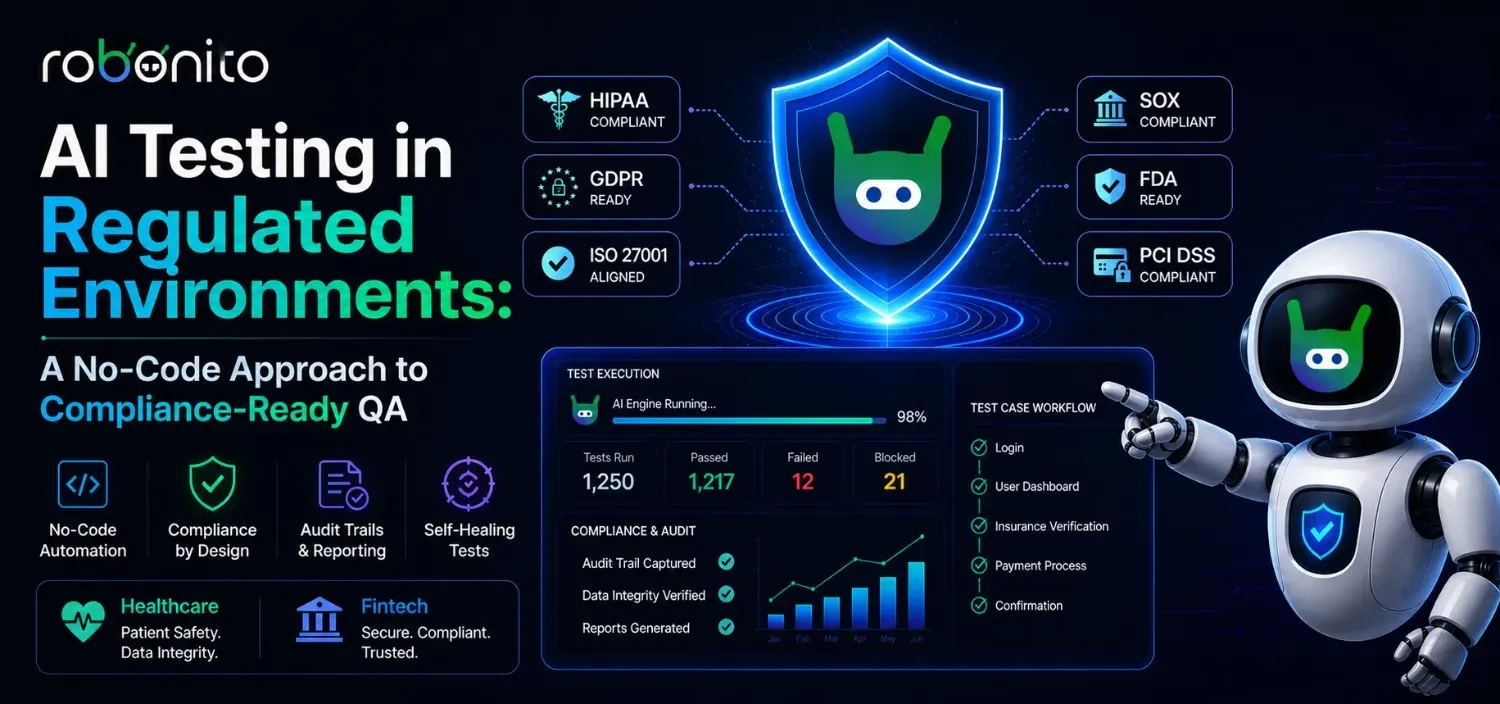
AI testing in regulated environments requires more than accuracy it requires proof. A single audit failure can trigger a $2.3M HHS penalty, a 483 observation from the FDA, or a full production hold. Yet most QA teams still rely on opaque test scripts that validators cannot read, compliance officers cannot sign off on, and auditors will not accept. The result: teams pass every test in CI, then fail the audit anyway because the evidence was never there.
Key Takeaways
- Manual testing can't validate 300+ regression cases before bi-weekly fintech releases
- FDA's 2022 CSA guidance explicitly encourages automated, risk-based QA approaches
- No-code tests are readable by auditors Selenium/Cypress scripts are not
- Self-healing tests must log every adaptation to satisfy traceability requirements
- Compliance test suites can be operational in 4–6 weeks using the phase framework below
Why Regulated Industries Are the Next Frontier for QA Automation
Regulated industries healthcare, fintech, insurance, government, and pharmaceuticals have historically been among the slowest to adopt QA automation. The reasons are understandable: when a software defect can trigger a HIPAA violation, a SOX audit finding, or a misprocessed insurance claim, the perceived risk of "automated anything" feels higher than the reward.
But the math has changed.
Manual testing can't keep pace with modern release cycles. A mid-size fintech company shipping bi-weekly releases might need to validate 300+ regression test cases before every deployment. Done manually, that's based on 15 min/test case avg. Done with automation, it's a few hours of execution time and human effort drops to test maintenance and review.
Regulatory bodies are increasingly expecting automation not just tolerating it. The FDA's guidance on Computer Software Assurance (CSA), updated in 2022, explicitly encourages risk-based, automated approaches over exhaustive manual documentation. Similarly, financial regulators operating under SOX and PCI-DSS frameworks expect organizations to demonstrate repeatable, consistent testing processes exactly what automation provides.
The cost of not automating is now the bigger risk. Consider a healthcare SaaS platform that processes electronic health records. A manual tester might miss a regression in a patient data export feature. That undetected defect could expose protected health information (PHI), triggering breach notification requirements, OCR investigations, and penalties that start at $100 per violation and can reach $1.9 million per category annually.
The market is responding. Analyst firms and vendors like Applitools have published multiple guides and buyer checklists specifically targeting regulated environments a clear signal that demand is surging. The question is no longer whether regulated organizations should automate QA, but how they can do it in a way that satisfies both engineering velocity and compliance requirements.
The Compliance Challenge: What Auditors Look for in Test Automation
Before selecting any QA tool, it's essential to understand what auditors and compliance officers actually evaluate. Their concerns are rarely about the technology itself they care about evidence, traceability, and human accountability.
Here's what a typical audit review of your test automation practice will examine:
- Traceability from requirement to test to result. Can you map a specific regulatory requirement (e.g., "user sessions must timeout after 15 minutes of inactivity") to a specific test case, and show the pass/fail history of that test across releases?
- Change control and versioning. When a test is modified, is there a record of who changed it, when, and why? Is the previous version preserved?
- Understandable test logic. Can a compliance officer not a developer read the test and understand what it validates? This is where most scripted automation frameworks fail spectacularly.
- Consistent execution evidence. Are test results timestamped, stored immutably, and linked to the specific build or release they validated?
- Separation of duties. Can you demonstrate that the person who wrote the code being tested is not the same person who authored or approved the test?
In practice, this means that a Selenium test written in Python with complex page object models, custom assertions, and abstracted helper classes while technically excellent can become a compliance liability if no one outside the engineering team can verify what it does.
A real-world example: a fintech startup preparing for its SOC 2 Type II audit discovered that its 400+ Cypress test scripts were essentially unreadable to the compliance team. The auditor flagged the test suite as "insufficient evidence of control validation" because the tests couldn't be independently verified without developer involvement. The company spent six weeks creating supplemental documentation manually mapping each script to a control just to satisfy the audit.
That's the problem no-code testing solves at its root.
Why No-Code Testing Is Inherently More Auditable Than Scripted Automation
The fundamental advantage of no-code testing in regulated environments isn't speed or convenience it's transparency.
When a test case reads like a plain-language description of business logic, the entire compliance chain benefits:
Business analysts can author tests that directly mirror requirements. Instead of a developer interpreting a requirement document and translating it into code (introducing a layer of potential misinterpretation), the person closest to the requirement creates the test. In a healthcare context, this might mean a clinical compliance specialist writing a test that says: "Navigate to Patient Records → Search for patient by MRN → Verify that PHI fields are masked for users without the 'Clinical' role." No CSS selectors. No XPath. No ambiguity about what's being validated.
Compliance officers can review tests without technical translation. This is critical for separation of duties. When an auditor asks, "Show me the test that validates your password complexity requirement," a no-code platform provides a test that reads like a checklist not a 200-line script with imported dependencies.
Test modifications are transparent and human-readable in version history. When a no-code test changes, the diff is meaningful to non-engineers. "Changed expected session timeout from 15 minutes to 10 minutes" is infinitely more auditable than a code diff showing modified integer values buried in a configuration file.
Consider the insurance industry, where state-by-state regulatory variations mean that claims processing rules differ across jurisdictions. An insurance QA team using no-code automation can create test suites organized by state, with each test plainly describing the rule it validates: "For California claims, verify that the Explanation of Benefits includes the mandated appeals disclosure language." A compliance officer reviewing that test knows exactly what it does and whether it maps to the correct regulation.
This transparency doesn't just make audits easier; it fundamentally reduces the risk of misaligned testing. When everyone in the compliance chain can read the tests, errors in test logic are caught before they become audit findings.
| Compliance Requirement | Selenium / Cypress | No-Code (Robonito) |
|---|---|---|
| Auditor can read test logic | Requires developer | Plain English |
| Separation of duties | Hard — needs documentation | Compliance officer authors tests |
| Change log readability | Code diffs only | Human-readable diffs |
| Self-healing with audit trail | Tests break silently | Every adaptation logged |
| Setup time | Weeks–months | Hours |
| Non-engineer participation | Requires developer | QA managers, compliance officers can write tests |
| Traceability matrix generation | Manual effort | On demand |
How Robonito's natural language test creation works
Key Requirements: A Buyer's Checklist for Regulated QA Tools
If you're evaluating QA automation tools for a regulated environment, generic feature comparisons won't cut it. You need to assess each tool through a compliance-specific lens. Here's a practical checklist:
Must-Have Capabilities
- Immutable, timestamped test execution logs. Every test run must produce an unalterable record of what was tested, when, against which build, and what the result was. This is non-negotiable for SOX, HIPAA, and SOC 2.
- Role-based access control (RBAC). You need granular permissions: who can create tests, who can modify them, who can approve changes, and who can trigger execution. This supports separation of duties requirements.
- Full version history with human-readable diffs. Every change to a test must be tracked with the identity of the person who made it and a clear description of what changed.
- Requirement-to-test traceability. The tool should allow you to tag or link tests to specific regulatory requirements, user stories, or control objectives and generate traceability matrices on demand.
- Data handling compliance. If tests interact with real or synthetic patient data, financial records, or PII, the tool must support data masking, secure environments, and appropriate data residency options.
Strong Differentiators
- No-code or low-code test creation. As discussed above, this dramatically improves auditability and enables non-engineer participation in test validation.
- Self-healing tests with change logs. Tests that automatically adapt to UI changes reduce false failures but in regulated environments, every self-healing action must be logged and reviewable. (More on this below.)
- CI/CD integration with gated deployments. The tool should integrate with your pipeline and support quality gates blocking a deployment if compliance-critical tests fail.
- Exportable audit reports. One-click generation of audit-ready documentation: test coverage by requirement, execution history, failure trends, and change logs.
When evaluating vendors, don't just ask for feature lists ask them to walk through an audit scenario. Say: "Show me how an external auditor with no technical background would verify that our PCI-DSS Requirement 8.2.3 (minimum password length) is being continuously tested." The answer will tell you everything you need to know.
Robonito's CI/CD integration capabilities
Self-Healing Tests and Traceability: Maintaining Compliance at Speed
Self-healing tests that automatically adapt when UI elements change are one of the most valuable features of AI-powered testing platforms. But in regulated environments, they introduce a legitimate concern: if a test silently changes what it's validating, how do you maintain traceability?
This concern is valid but solvable. The key is distinguishing between what a test validates (the business logic) and how it locates elements on the page (the technical mechanism).
When a developer renames a button's ID from btn-submit-claim to submit-claim-button, the intent of the test hasn't changed it still validates that submitting a claim produces the correct confirmation. A self-healing engine that recognizes the button based on context (its label, position, surrounding elements) and updates the locator automatically is preserving test integrity, not undermining it.
The compliance requirement is that this adaptation is logged and visible. A well-implemented self-healing system should produce an entry like:
"Test 'Submit Insurance Claim Happy Path': Element locator updated. Previous: button#btn-submit-claim → New: button#submit-claim-button. Matched by label text 'Submit Claim' with 97% confidence. Test logic unchanged. [Timestamp] [Build #4521]"
That log entry gives an auditor everything they need: evidence that the test adapted, the reason why, the confidence level, and confirmation that the validated behavior didn't change.
Without self-healing, the compliance picture is actually worse. Tests that break on trivial UI changes create a cascade of problems: mass false failures flood the results, real defects get lost in the noise, and teams either waste days fixing locators or more dangerously start skipping broken tests. In a regulated environment, a skipped test that maps to a compliance control is a finding waiting to happen.
The right approach is self-healing with full transparency: adapt automatically, log completely, and flag any adaptation that changes test behavior (not just locators) for human review.
How Robonito's self-healing tests work
Case Study Framework: Deploying No-Code QA in a Compliance-First Organization
While every organization's regulatory landscape is unique, the deployment pattern for no-code QA in compliance-first environments follows a consistent framework. Here's a practical roadmap based on common patterns across healthcare, fintech, and insurance deployments:
Phase 1: Map Compliance Controls to Testable Scenarios (Week 1–2)
Start with your regulatory requirements not your application features. Pull your control matrix (SOX controls, HIPAA safeguards, PCI-DSS requirements) and identify which controls are testable through the UI. For example:
- HIPAA § 164.312(a)(1): Access control validate that unauthorized users cannot view PHI
- PCI-DSS 6.5.7: Cross-site scripting validate that input fields reject script injection
- SOX ITGC: Change management validate that deployment approvals are enforced in the pipeline
Phase 2: Build a Compliance Test Suite with Cross-Functional Ownership (Week 2–4)
This is where no-code pays its biggest dividend. Pair a QA engineer with a compliance analyst. The compliance analyst defines what must be validated; the QA engineer builds the test in the no-code platform. The compliance analyst then reviews the test directly no translation layer needed. For a fintech team, this might look like a compliance analyst confirming that a test labeled "Verify transaction amount limits for Tier 1 accounts" actually navigates to the correct screen, enters a transaction exceeding the limit, and validates the rejection message.
Phase 3: Integrate Into CI/CD With Compliance Gates (Week 4–6)
Connect your test suite to your deployment pipeline. Configure compliance-critical tests as mandatory gates if they fail, the build doesn't deploy. This provides continuous evidence that every release was validated against regulatory requirements.
Phase 4: Establish Ongoing Audit Readiness (Ongoing)
Generate traceability reports monthly. Review self-healing logs quarterly. Update the compliance test suite whenever regulations change or new controls are added. The goal is to make audit preparation a non-event because the evidence is being generated continuously.
A mid-size pharmaceutical company with 12 FDA-regulated systems replaced its manual regression cycle with a no-code test suite in 5 weeks. Pre-audit documentation time dropped from 3 weeks to 4 hours because every test was already linked to its corresponding 21 CFR Part 11 control.
How Robonito Meets Regulatory QA Requirements Out of the Box
Robonito was built on the principle that powerful test automation shouldn't require writing or maintaining code and that principle aligns directly with the needs of regulated organizations.
Natural language test creation eliminates the auditability gap. Tests created in Robonito read like business requirements, not code. When an auditor asks to see the test that validates a specific control, you show them a test they can actually understand. No interpreter needed. No supplemental documentation.
Cypress (what the auditor sees):
cy.get('#btn-submit-claim').click()
cy.get('.confirmation-modal').should('be.visible')
cy.get('[data-testid="claim-id"]').should('match', /CLM-\d{8}/)
Robonito (what the auditor sees):
# Robonito natural language test
Navigate to /patient-records
Search for patient with MRN "MRN-12345"
Verify that PHI fields are masked for users without the "Clinical" role
Verify that the access attempt is logged with timestamp and user ID
The compliance officer can verify the second one without calling a developer.
Self-healing with full traceability. Robonito's AI engine adapts to UI changes automatically, but every adaptation is logged with before/after details and confidence scores. Your tests stay green without silent changes and your audit trail stays intact.
Works on any web application out of the box. Whether you're testing an EHR system, a trading platform, or a claims processing portal, Robonito requires no custom setup, no CSS selectors, and no brittle XPath expressions. Your team is productive in hours, not weeks which matters when you're operating under compliance deadlines.
CI/CD integration with quality gates. Robonito integrates with all major CI/CD pipelines, enabling you to enforce compliance-critical test gates on every deployment. No release ships without evidence of validation.
Fast onboarding preserves compliance momentum. Regulated organizations can't afford a six-month tool rollout. Robonito's learning curve is measured in hours, which means your compliance-focused test suite can be operational within the framework timeline described above not next quarter.
The result: your QA automation doesn't just make testing faster. It makes compliance demonstrable, continuous, and transparent to every stakeholder in the chain from the engineer writing the feature to the auditor reviewing the evidence.
Frequently Asked Questions (FAQs)
Q1. What is the FDA Computer Software Assurance (CSA) guidance?
The FDA’s 2022 CSA guidance replaces the older CSV approach with a risk-based model. Instead of documenting every test, it focuses validation on high-risk areas. This makes automated testing more effective, as consistent execution provides stronger evidence than manual testing.
Q2. Can automated tests satisfy HIPAA audit requirements?
Yes, if three conditions are met: tests must map to HIPAA safeguards, results must be timestamped and stored immutably, and test logic must be understandable to compliance officers. No-code testing platforms help meet these requirements.
Q3. What does SOX compliance require from QA automation?
SOX requires traceability, change control, and consistent execution evidence. Test automation must log what was tested, when it was tested, and which build was validated, along with version history and access controls.
Q4. What is a test traceability matrix in compliance testing?
A traceability matrix links regulatory requirements to specific test cases and their execution results. It provides auditors with clear evidence that each compliance requirement is continuously validated.
Q5. What is the difference between CSV and CSA?
CSV requires exhaustive documentation of all testing activities, regardless of risk. CSA replaces this with a risk-based approach, focusing validation efforts on high-risk areas and allowing automation to reduce documentation overhead.
Q6. How do self-healing tests maintain compliance?
Self-healing tests log every change, including the original locator, updated locator, method used, confidence score, and timestamp. This ensures full transparency while keeping tests stable despite UI changes.
Q7. How do you enforce separation of duties in test automation?
Separation of duties ensures that developers are not the only ones creating or approving tests. With no-code tools, compliance officers or analysts can author or review tests, supported by role-based access controls (RBAC).
Q8. What features are required for PCI-DSS compliant QA automation?
PCI-DSS requires testing for vulnerabilities like XSS and authentication flaws, consistent execution across releases, and immutable logs. Automation tools must provide audit-ready evidence of all test activities.
Ready to see how no-code, compliance-ready QA automation works in practice? Start a free trial of Robonito and build your first auditable test suite in under an hour. No code, no complex setup just transparent, self-healing tests that your entire team (and your auditors) can trust.
Automate your QA — no code required
Stop writing test scripts.
Start shipping with confidence.
Join thousands of QA teams using Robonito to automate testing in minutes — not months.