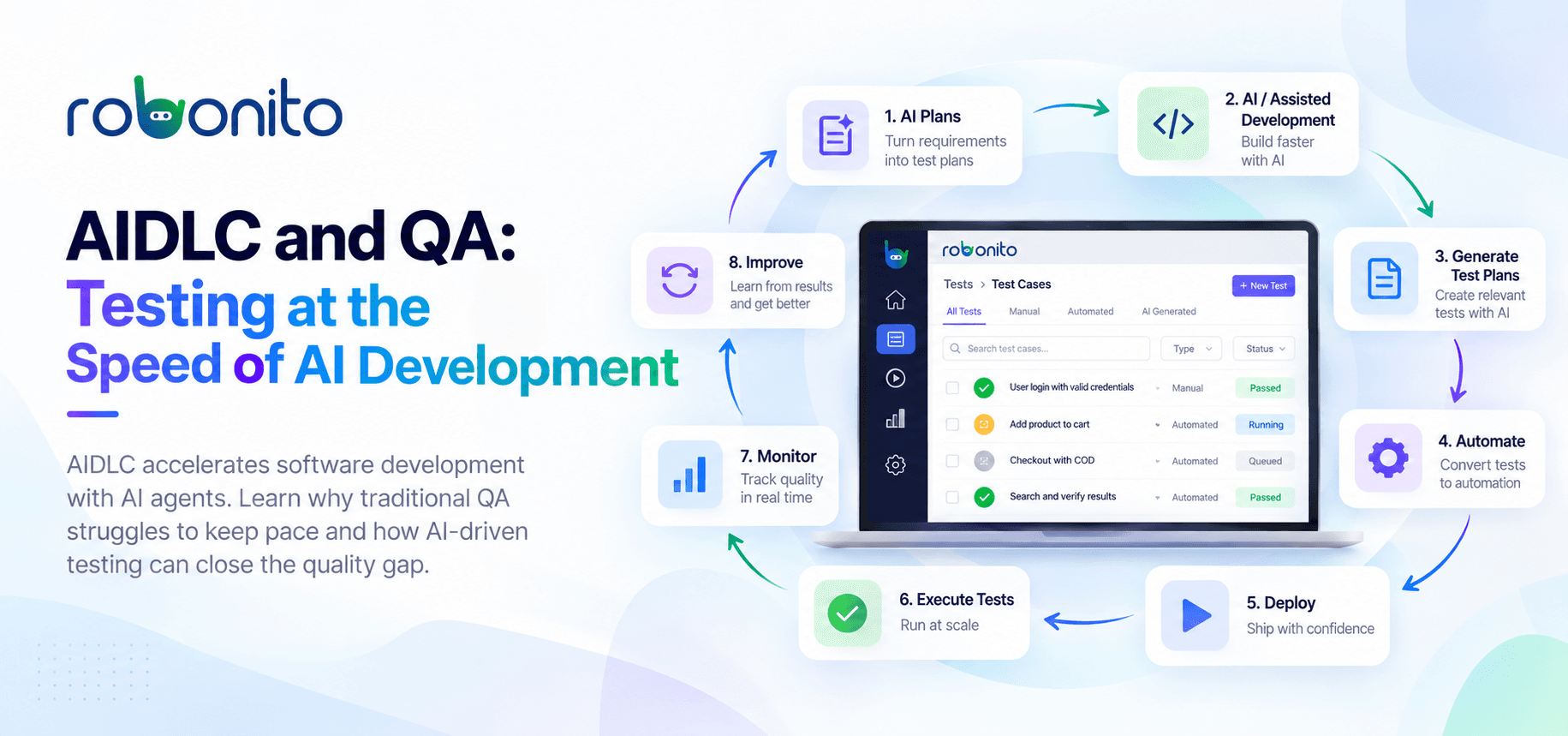
Software development has a new bottleneck.
For years, engineering organizations worked to make developers faster. Better IDEs, reusable frameworks, CI/CD pipelines, cloud infrastructure, and automation steadily shortened the path from idea to production.
Then AI coding agents changed the pace again.
A developer can now describe a feature, ask an AI agent to plan the implementation, generate code, create supporting files, fix errors, and prepare a pull request in a fraction of the time many of those tasks once required.
This shift is helping drive interest in AIDLC, or AI-Driven Development Life Cycle (AI-DLC): an approach where AI is integrated throughout software delivery rather than used only as an autocomplete tool.
AWS describes AI-DLC around two important ideas: AI-powered execution with human oversight and dynamic collaboration between humans and AI. Its current open-source AI-DLC workflows extend that idea into structured stages connecting requirements, implementation, testing, operations, human approval gates, and traceability.
That changes an important equation:
If AI can produce software faster than QA can validate it, development velocity becomes quality risk.
The challenge facing engineering teams is therefore no longer simply:
How do we use AI to write software faster?
It is:
How do we verify AI-generated software at the same speed without sacrificing confidence?
That is where QA becomes one of the most important parts of the AI-driven development lifecycle.
Key Takeaways
- AIDLC changes the speed of software creation. AI agents can participate across requirements, design, implementation, testing, deployment, and operations.
- Faster code generation creates a QA throughput problem. More changes can reach validation in less time, increasing the amount of behavior QA must evaluate.
- AI-generated tests alone are not sufficient evidence of quality. Tests can reproduce the same assumptions or omissions present in generated implementation.
- QA must move from execution toward orchestration. Humans increasingly define risk, intent, acceptance criteria, and escalation rules while automation handles repeatable execution.
- Continuous testing becomes essential. Validation must happen throughout the lifecycle rather than waiting for a final QA phase.
- Human oversight remains a quality gate. Current AI-DLC implementations emphasize human approvals and verification rather than unrestricted autonomous delivery.
What Is AIDLC?
AIDLC stands for AI-Driven Development Life Cycle, also commonly written as AI-DLC.
It describes a software development approach in which AI participates throughout the development lifecycle instead of appearing only during coding.
In a traditional workflow, a team might move through:
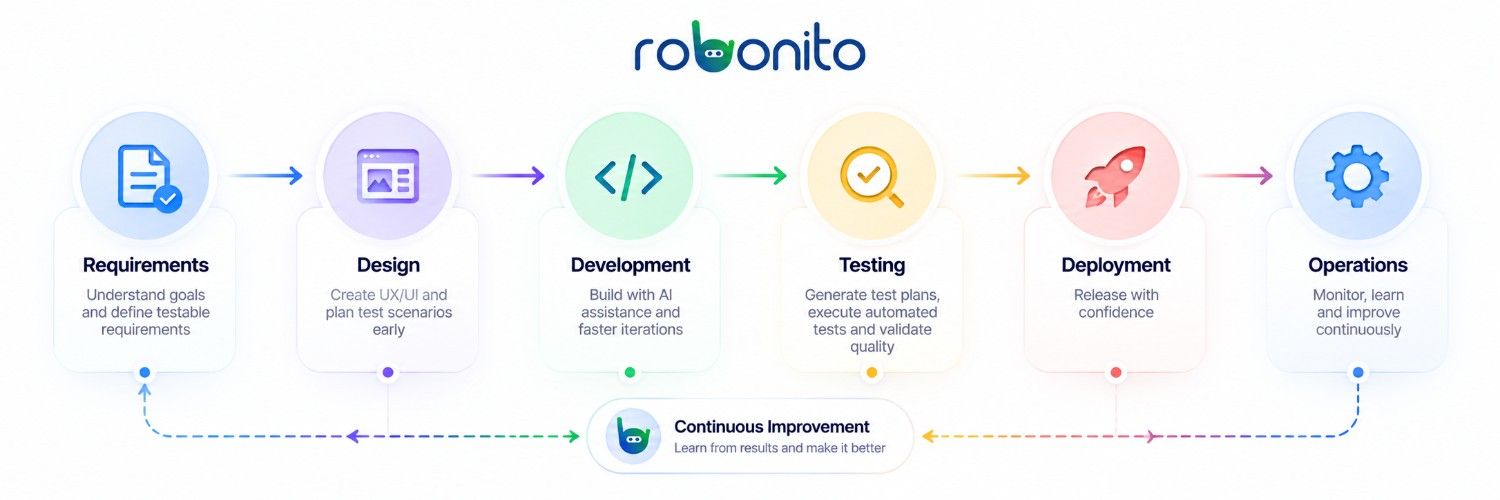
AI may assist with individual tasks, but the underlying process remains largely human-driven.
An AI-driven lifecycle looks different:
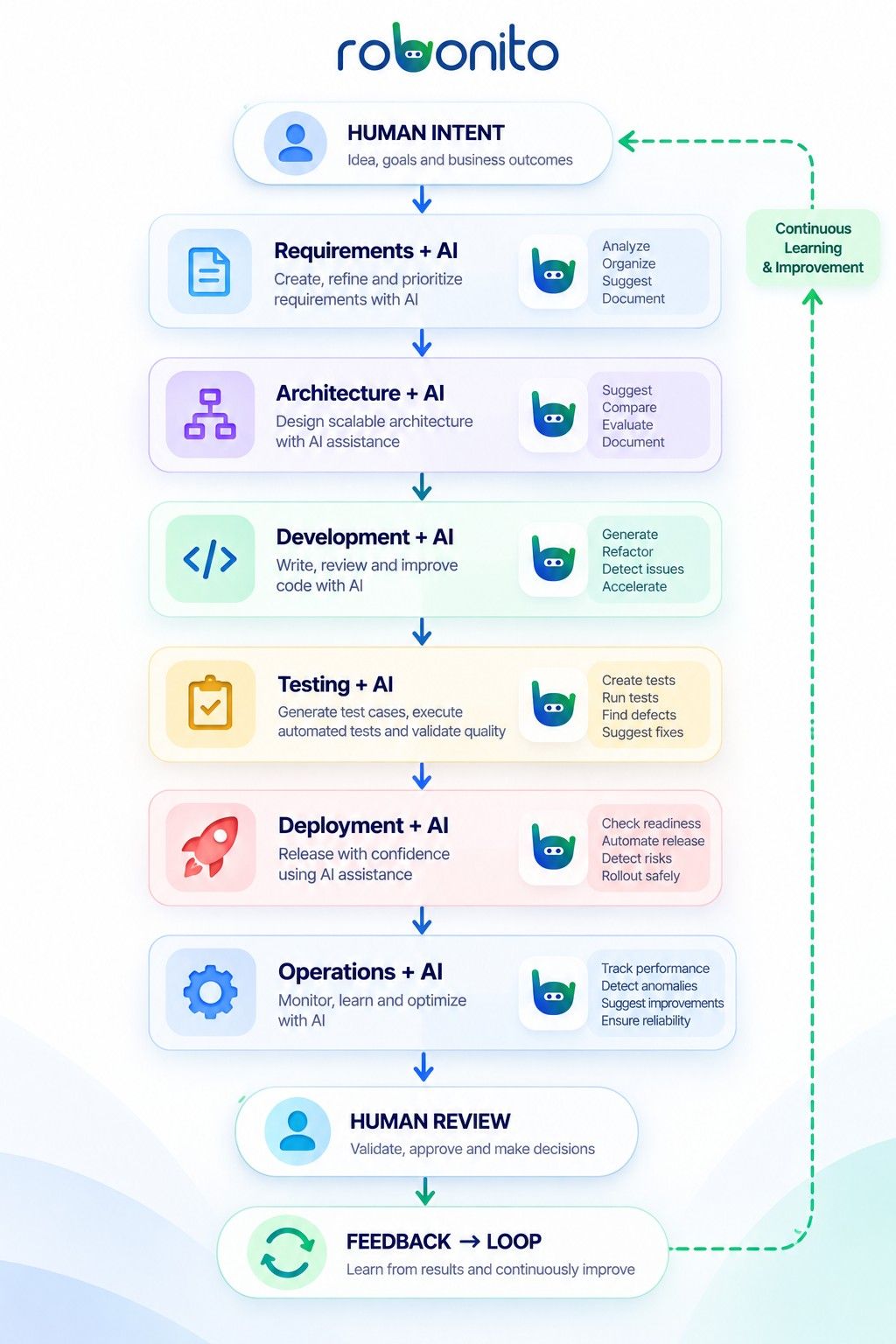
AI is no longer simply helping someone type code.
It can help interpret requirements, propose designs, implement features, generate tests, investigate failures, prepare deployment artifacts, and respond to operational feedback.
AWS's current AI-DLC tooling connects requirements, decisions, implementation, tests, and operational work through a structured lifecycle with human approval gates and an audit trail.
That structure matters because generative AI can make mistakes.
Current AI-DLC implementations themselves emphasize reviewing AI-generated output rather than treating autonomous execution as automatically trustworthy.
And that brings us directly to QA.
Why AIDLC Creates a New Challenge for QA
The biggest QA problem in AIDLC isn't simply that AI sometimes generates bad code.
Developers have always written bugs.
The bigger problem is velocity asymmetry.
AI can increase the amount of software a team can generate or modify within a given period.
But traditional QA capacity doesn't automatically increase with it.
Imagine a conventional team where developers complete five meaningful changes for QA during a release cycle.
Now introduce coding agents capable of helping the same team produce many more changes, experiments, refactors, and pull requests during that period.
If validation capacity remains roughly the same, QA becomes a queue.
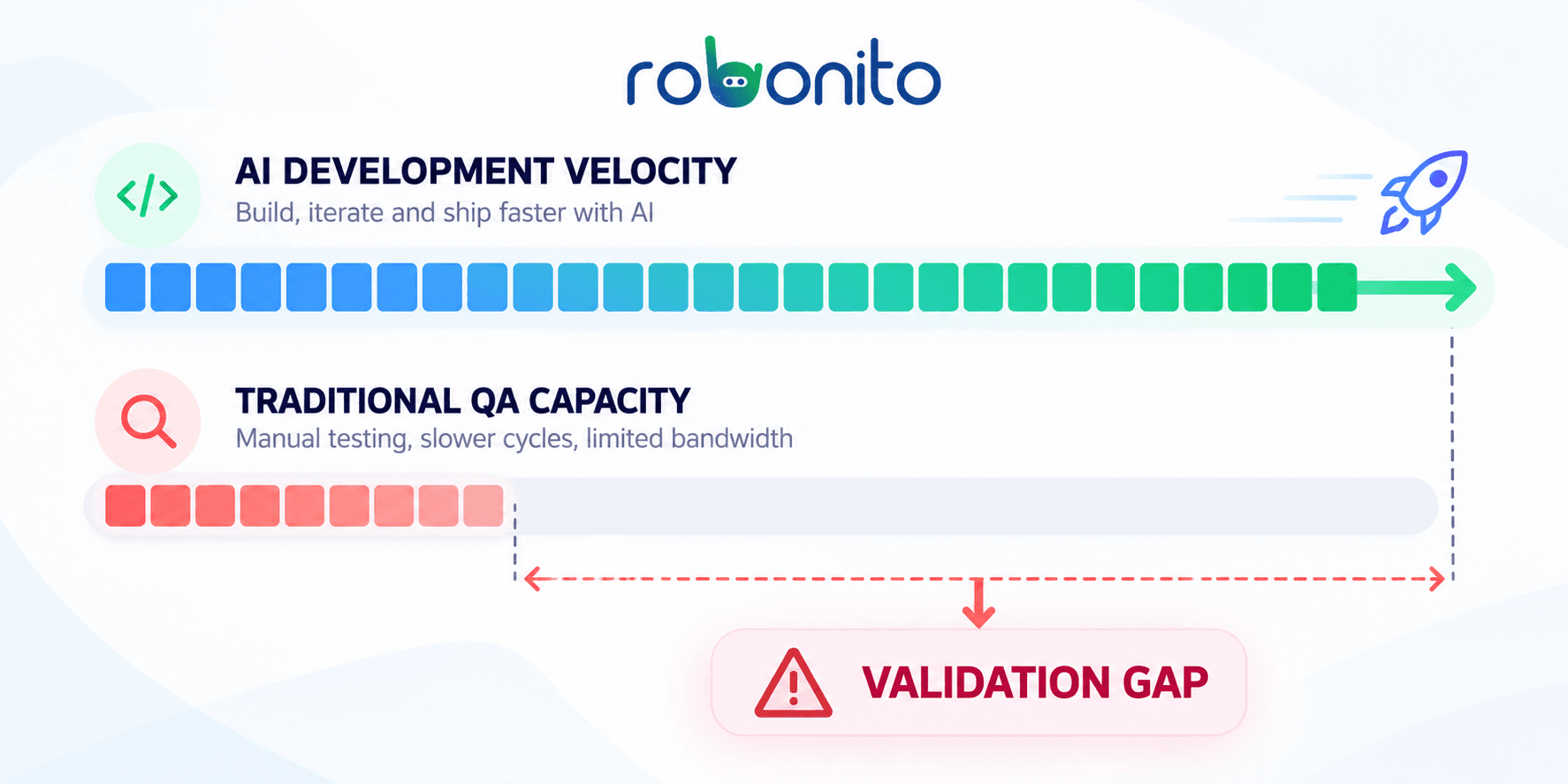
That gap is one of the defining quality challenges of AI-driven software development.
The solution cannot simply be:
Hire enough manual testers to match AI-generated development volume.
The economics and speed of that model eventually break down.
QA itself has to become more automated, adaptive, and agentic.
Challenge 1: AI Can Generate More Code Than Humans Can Review
AI coding agents reduce the effort required to produce implementation.
That is valuable—but generated code still needs verification.
An agent can produce code that:
- compiles successfully,
- passes its generated unit tests,
- looks structurally correct,
- follows the requested architecture,
and still misunderstands the business requirement.
Consider a checkout requirement:
Premium customers receive free delivery on orders above $50.
An AI agent may implement:
if order.total > 50:
    shipping = 0
The code works.
The unit test passes.
But the implementation forgot:
customer.plan == "premium"
The failure isn't syntax.
It isn't compilation.
It isn't necessarily something static analysis will detect.
It is a business-intent failure.
That is precisely where QA remains essential.
Challenge 2: AI Can Test Its Own Assumptions
One of the most subtle risks in AI-driven development appears when the same context influences both implementation and test generation.
Suppose an AI agent misunderstands a requirement.
It generates the wrong implementation.
Then it generates tests based on the same misunderstanding.
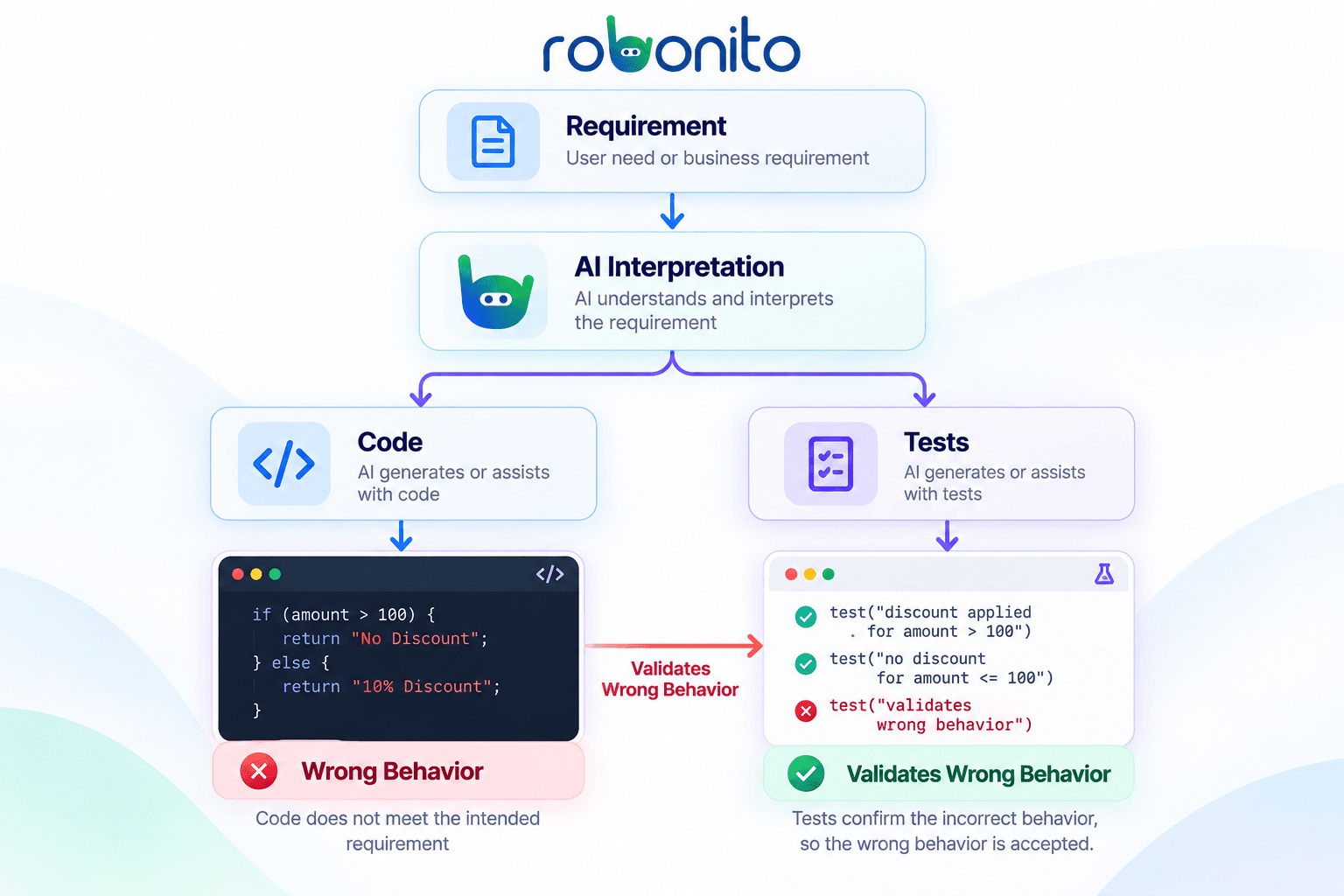
The result can be dangerous:
Green tests validating the wrong thing.
This is why test generation cannot be treated as synonymous with independent validation.
A passing test proves that the observed behavior satisfies the test.
It does not automatically prove that the test represents the correct customer requirement.
QA has to preserve independent quality judgment.
Challenge 3: More Code Means More Test Surface
AI doesn't only accelerate new feature creation.
It makes changes cheaper.
Developers can refactor modules, regenerate components, experiment with alternative implementations, update APIs, modify schemas, and make broader changes faster.
Every change potentially expands the regression surface.
A seemingly small request can affect:
UI
 ↓
Frontend State
 ↓
API
 ↓
Business Logic
 ↓
Database
 ↓
Third-Party Service
Testing only the newly generated function isn't enough.
QA has to ask:
What else could this change have broken?
That requires impact analysis, regression intelligence, integration testing, and risk-based prioritization—not simply more generated unit tests.
Challenge 4: AI-Generated Software Can Fail in Unexpected Ways
Deterministic software already produces edge cases.
AI-assisted development adds another layer because the implementation process itself can involve probabilistic systems.
Agents can:
- misunderstand ambiguous requirements,
- use outdated assumptions,
- choose inappropriate dependencies,
- produce unnecessary complexity,
- overlook edge cases,
- implement technically valid but incorrect behavior,
- change more code than necessary.
That means QA has to validate not just whether the generated code runs, but whether the resulting product behaves correctly under real-world conditions.
Challenge 5: Traditional Regression Testing Cannot Become the Bottleneck
Traditional regression suites often assume a relatively predictable development cadence.
AIDLC changes that cadence.
If agents can generate and modify software continuously, waiting hours for every possible regression test after every change becomes inefficient.
The testing strategy therefore needs multiple layers.
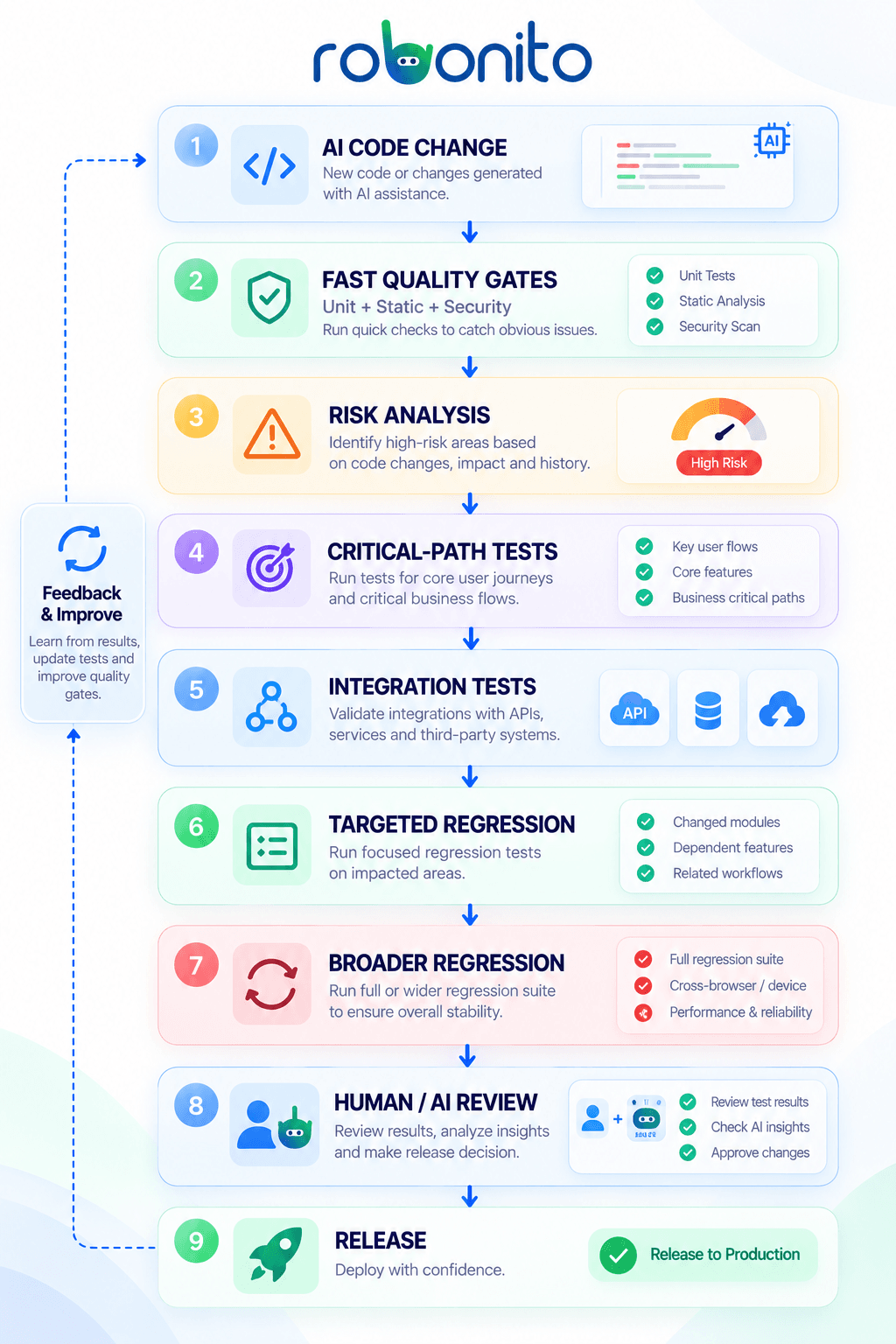
The key isn't running every test after every change.
It is running the right tests at the right time.
QA Must Evolve With AIDLC
AIDLC doesn't eliminate QA.
It changes where QA creates value.
In a traditional model, much of QA's time can be spent manually executing predefined test cases.
In an AI-driven lifecycle, that doesn't scale.
The QA engineer increasingly becomes the person who defines:
- what must be tested,
- what risk matters,
- what evidence is sufficient,
- what an agent may handle autonomously,
- when an agent must escalate,
- which failures block release,
- whether a passing test actually proves the intended behavior.
That moves QA from:
Test execution
toward:
Quality orchestration
The New QA Model: Humans Set Intent, Agents Scale Execution
The most practical testing model for AIDLC is not fully manual QA.
It also isn't unrestricted autonomous testing.
It is human-directed agentic testing.
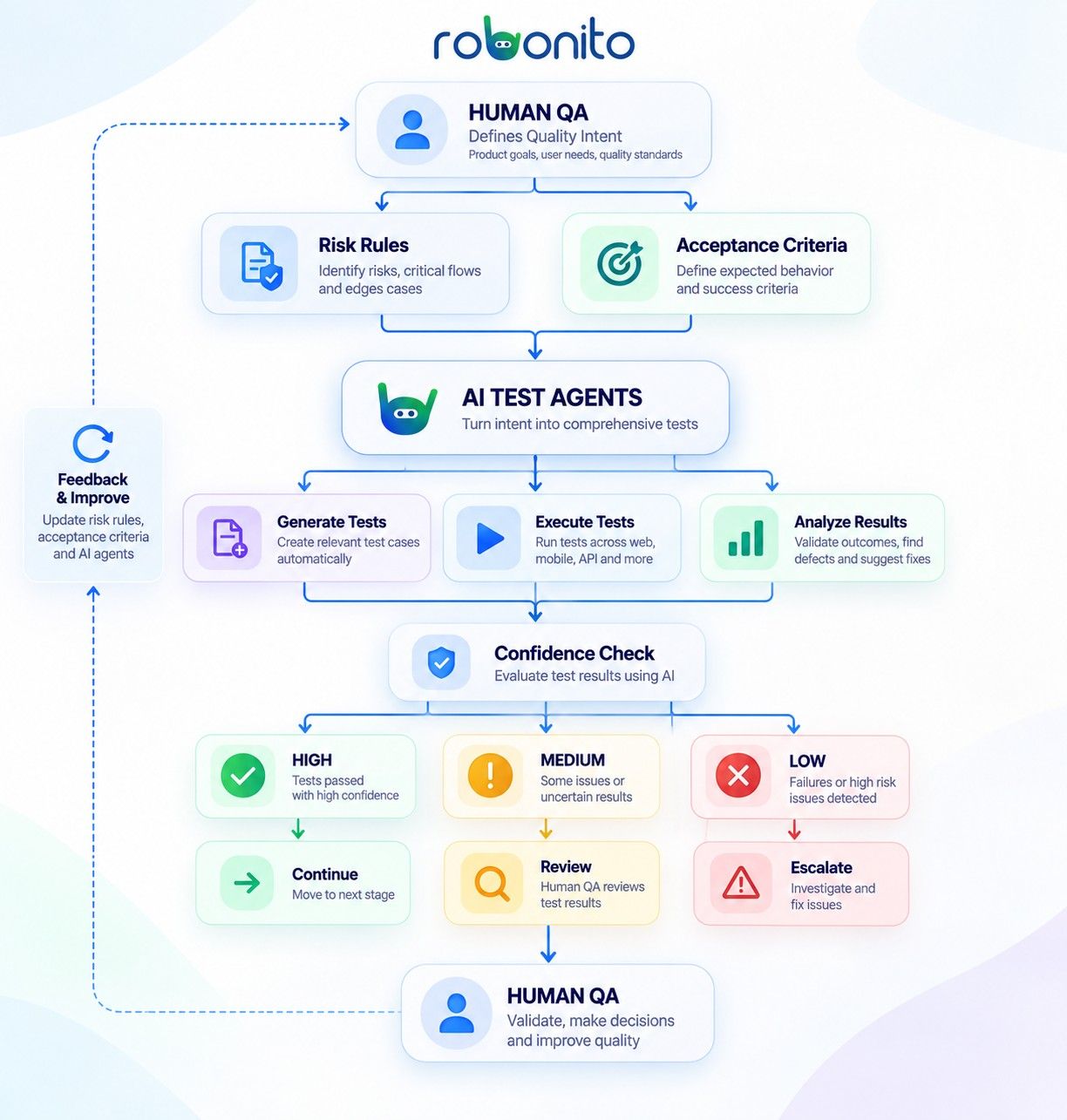
AI handles scale.
Humans retain judgment.
What QA Should Validate Across the AIDLC
Testing should no longer appear only after implementation.
Quality gates should exist throughout the lifecycle.
| AIDLC Stage | QA Responsibility |
|---|---|
| Requirements | Validate ambiguity, acceptance criteria, risk, and testability |
| Architecture | Identify quality, security, performance, and integration risks |
| Development | Unit tests, static analysis, implementation checks, and code review |
| Integration | Validate service boundaries, APIs, contracts, and dependencies |
| Testing | Functional, API, UI, integration, and end-to-end validation |
| Release | Critical-path and risk-based regression |
| Production | Monitoring, synthetic testing, observability, and feedback |
| Evolution | Turn production findings into new tests, context, and guardrails |
The important shift is simple:
Quality becomes a lifecycle concern instead of a final testing phase.
Why Agentic Testing Fits AIDLC
Traditional automation waits for someone to explicitly create and maintain tests.
Agentic testing can operate closer to the development loop.
For example:
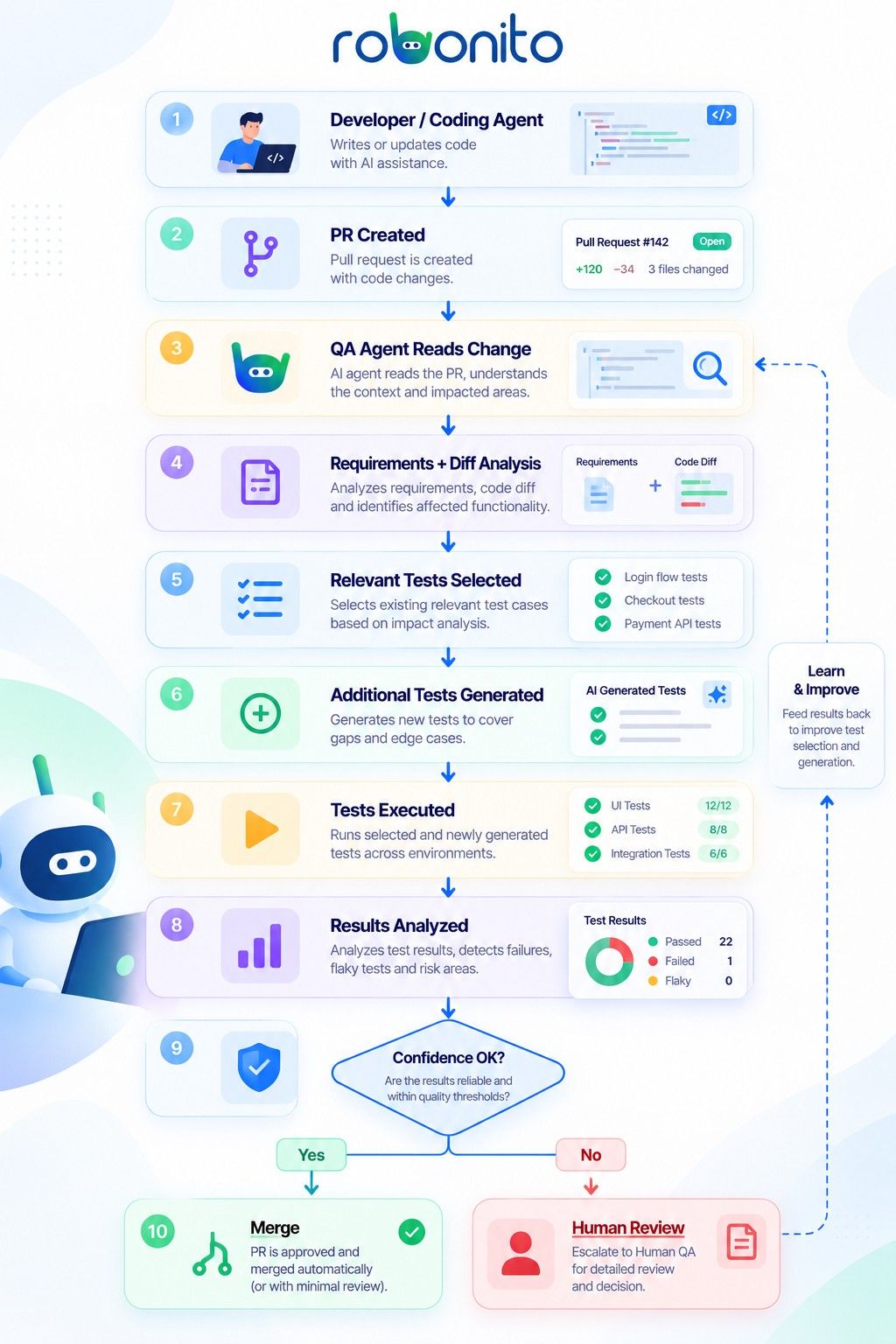
The QA system becomes an active participant in development rather than a downstream destination for completed code.
That is a much better match for AIDLC velocity.
Self-Healing Tests Become More Important
AI-driven development can produce frequent UI and implementation changes.
Traditional automation tied too closely to implementation-specific selectors can require frequent maintenance when the application changes.
AI-assisted self-healing can reduce some of this locator-related maintenance by evaluating multiple signals such as:
- semantic roles,
- accessible names,
- visible text,
- DOM context,
- element relationships,
- historical behavior,
- visual context.
But self-healing should not mean:
Find something similar and keep going.
A trustworthy system needs confidence thresholds.
Original Element Not Found
          ↓
Multi-Signal Analysis
          ↓
   Confidence Score
          ↓
 ┌────────┼─────────┐
 ↓        ↓         ↓
HIGH    MEDIUM      LOW
 ↓        ↓         ↓
Heal    Human      Fail
        Review
This matters because a genuinely missing checkout button could represent a product defect.
Automatically “healing” to the wrong element would hide the bug rather than solve the test.
The Human-in-the-Loop Becomes a Feature, Not a Limitation
The goal of AIDLC should not be to remove humans from every decision.
The goal should be to use human attention where it has the highest value.
Current AI-DLC approaches emphasize human oversight and approval gates rather than treating unconstrained autonomous execution as the objective.
QA teams can apply the same principle.
Let AI handle:
- repetition,
- scale,
- test generation,
- execution,
- initial failure classification,
- repetitive maintenance.
Keep humans responsible for:
- intent,
- risk,
- ambiguity,
- judgment,
- business context,
- accountability.
That is not less automation.
It is better automation.
How Robonito Fits Into an AIDLC Testing Strategy
AIDLC requires QA to operate closer to the speed of AI-assisted development.
That is where an agentic QA platform such as Robonito can fit.
Instead of requiring QA engineers to manually translate every new workflow into automation scripts, Robonito is designed around intent-driven and AI-assisted testing.
The objective is simple:
As development becomes agentic, testing needs to become agentic too.
Robonito supports teams moving toward this model across web, API, mobile, and desktop testing while keeping QA professionals involved in decisions that require human judgment.
1. Intent-Based Test Creation
QA teams can define the behavior they want validated rather than spending most of their time translating business intent into low-level automation code.
This helps keep testing closer to the requirement being validated.
2. Agentic Test Execution
AI agents can execute repeatable workflows and evaluate outcomes, helping validation capacity scale alongside development.
The objective is not to remove QA engineers.
It is to reduce the repetitive execution work competing for their attention.
3. AI-Assisted Self-Healing
When implementation details change, self-healing can reduce locator-related maintenance while preserving the intended test objective.
Ambiguous changes should still be treated differently from high-confidence locator updates.
4. Human-in-the-Loop Control
When a test encounters ambiguity, the safest outcome isn't always for the agent to guess.
Escalating uncertain decisions to a human helps prevent automation from silently validating the wrong behavior.
5. Continuous QA
Testing can become part of the delivery loop instead of waiting at the end of development.
AI Development
      ↓
AI Testing
      ↓
Human Judgment
      ↓
Release
      ↓
Production Feedback
      ↓
New Quality Context
      └──────────→ AI Development
That's the QA architecture AIDLC increasingly demands.
AIDLC Does Not Make QA Less Important
There's an understandable assumption that if AI writes both software and tests, QA becomes less necessary.
The opposite risk deserves more attention.
The faster software can be produced, the more important independent validation becomes.
If an AI agent writes incorrect code slowly, you have one problem.
If an AI agent can produce incorrect code, tests, configuration, and deployment artifacts quickly, errors and incorrect assumptions can propagate faster too.
Velocity amplifies both good engineering and bad assumptions.
QA provides an independent quality layer.
What QA Engineers Should Learn for the AIDLC Era
The valuable QA engineer in an AI-driven lifecycle isn't necessarily the person who can manually execute the most test cases.
Nor is it simply the person who can write the most automation code.
The highest-value skills increasingly include:
Test Strategy
Knowing which behaviors deserve validation and which risks matter most.
Risk Analysis
Understanding what can fail, how likely that failure is, and what the business consequence would be.
Agent Orchestration
Giving AI systems useful context, constraints, tools, acceptance criteria, and escalation rules.
AI Output Review
Recognizing tests that execute successfully but prove very little.
A generated test is useful only if its assertions meaningfully validate the requirement.
Domain Expertise
Understanding the business rules, customer expectations, regulatory requirements, and edge cases that may not be obvious from source code.
Exploratory Testing
Investigating unexpected behavior outside predefined paths and discovering risks that weren't included in the original specification.
Automation Architecture
Building maintainable testing systems rather than simply accumulating test scripts.
Observability
Using production signals to discover what pre-release testing missed and turning those findings into better future validation.
AI makes test generation cheaper.
That makes knowing what deserves testing more valuable.
What Engineering Leaders Should Do Now
Engineering leaders adopting AI coding agents should avoid measuring success only by development throughput.
If AI allows developers to create significantly more changes while QA capacity remains unchanged, the organization hasn't necessarily increased delivery velocity by the same amount.
It may simply have moved the queue downstream.
A better AIDLC transformation measures the whole system:
Requirement
    ↓
Implementation
    ↓
Verification
    ↓
Release
    ↓
Production Outcome
The objective isn't maximum code generation.
It is:
Maximum reliable delivery.
That means investing in AI-assisted QA alongside AI-assisted development.
Engineering leaders should ask:
- Can our testing capacity scale with AI-assisted development?
- Are AI-generated tests independently validating requirements or repeating implementation assumptions?
- Which quality decisions require human approval?
- Can we select tests based on change risk instead of running everything after every change?
- Can our automation adapt safely when the application changes?
- Can QA agents explain what they tested and why?
- What happens when an agent is uncertain?
- Are production signals feeding back into our testing strategy?
Those questions are increasingly as important as asking which coding agent developers should use.
AIDLC Testing Maturity Model
Organizations are unlikely to move directly from traditional QA to autonomous agentic testing.
A more realistic progression looks like this:
| Level | Development Model | QA Model |
|---|---|---|
| Level 1 | Human development | Manual QA |
| Level 2 | AI-assisted coding | Scripted automation |
| Level 3 | AI-assisted development | AI-assisted test creation |
| Level 4 | Agentic development | Agentic testing with human review |
| Level 5 | Multi-agent AIDLC | Continuous quality orchestration with governance |
The goal should not necessarily be maximum autonomy.
The appropriate level depends on:
- application risk,
- regulatory requirements,
- customer impact,
- automation maturity,
- system complexity,
- quality of available context,
- confidence in agent decisions.
For high-risk workflows, more human oversight may be desirable even when greater automation is technically possible.
The Future: Agent-to-Agent Software Delivery
The logical evolution of AIDLC is not necessarily one giant autonomous agent building everything.
A more resilient model uses specialized agents working within controlled boundaries.
Product Agent
     ↓
Architecture Agent
     ↓
Coding Agent
     ↓
QA Agent
     ↓
Security Agent
     ↓
Release Agent
     ↓
Observability Agent
     ↓
       HUMAN
  GOVERNANCE LAYER
A coding agent shouldn't be the sole authority on whether its own implementation is correct.
Independent QA agents can challenge implementation assumptions.
Security agents can evaluate vulnerabilities.
Observability agents can identify production anomalies.
Humans define boundaries, escalation policies, quality standards, and high-consequence decisions.
This creates something closer to an AI-native engineering organization than a traditional SDLC with an AI coding assistant attached.
AIDLC vs Traditional SDLC: What Changes for QA?
| Area | Traditional SDLC | AIDLC |
|---|---|---|
| Development pace | Primarily human-paced | Human + AI accelerated |
| Code generation | Developer-led | Developer + AI agents |
| Test creation | Manual or scripted | Human + AI-assisted |
| Regression strategy | Scheduled suites | Continuous, risk-based validation |
| Test maintenance | Manual updates | AI-assisted maintenance + review |
| Failure analysis | Primarily human | AI-assisted classification + human investigation |
| QA role | Tester / automation engineer | Quality orchestrator |
| Human oversight | Throughout workflow | Focused on intent, risk, ambiguity, and approvals |
| Feedback loop | Often stage-based | Continuous |
| Quality objective | Validate completed software | Continuously validate AI-driven change |
The biggest difference is not simply the presence of AI.
It is the speed and continuity of the feedback loop.
Common QA Mistakes to Avoid in AIDLC
1. Trusting AI-Generated Tests Without Reviewing Assertions
A test that runs successfully can still validate the wrong thing.
Review what the test actually proves.
2. Using the Same AI Context for Implementation and Validation
When possible, give validation systems independent requirements, acceptance criteria, and risk context.
This helps reduce correlated assumptions.
3. Automating Every Test at the Same Priority
Not every workflow carries the same risk.
Prioritize authentication, payments, permissions, core transactions, data integrity, and other business-critical paths.
4. Treating Self-Healing as Permission to Ignore Failures
Self-healing should reduce maintenance—not hide genuine product defects.
Use confidence thresholds and review ambiguous changes.
5. Removing Humans From High-Risk Decisions Too Early
Automation maturity should determine autonomy.
High-impact or ambiguous outcomes should remain reviewable.
6. Measuring AI Success Only by Code Output
More generated code is not necessarily more delivered customer value.
Measure verified releases, escaped defects, feedback speed, test reliability, and production outcomes.
Frequently Asked Questions
What is AIDLC in software development?
AIDLC, or AI-Driven Development Life Cycle (AI-DLC), is an approach to software development where AI participates across multiple stages of delivery, including requirements, design, implementation, testing, deployment, and operations. Humans continue to provide business context, oversight, validation, and approval for important decisions.
How does AIDLC affect software testing?
AIDLC can increase the speed and volume of software changes reaching QA. Testing therefore needs to move closer to development through continuous automation, risk-based test selection, AI-assisted test generation, agentic execution, and human review of uncertain or high-risk outcomes.
What is the biggest QA challenge with AI-generated code?
One of the biggest challenges is validating software at the same pace AI can generate it. Another is correlated error: if an AI misunderstands a requirement, tests generated from the same interpretation may validate the incorrect behavior. Independent quality criteria and human oversight help reduce this risk.
Can AI agents replace QA engineers in AIDLC?
AI agents can automate significant portions of test generation, execution, maintenance, and analysis, but QA still requires contextual judgment. Humans remain important for risk analysis, exploratory testing, ambiguous requirements, meaningful assertions, business-critical decisions, and determining whether automated evidence is sufficient for release.
Why is continuous testing important in AIDLC?
AI-assisted development can generate frequent code changes, making a large testing phase at the end of development inefficient. Continuous testing validates changes throughout the lifecycle, allowing teams to detect problems closer to when they are introduced.
What is agentic testing?
Agentic testing uses AI agents to perform multi-step QA tasks such as interpreting requirements, generating test scenarios, executing workflows, analyzing outcomes, and adapting tests. Unlike simple scripted automation, agents can reason over context and decide which actions to take within defined constraints.
What is human-in-the-loop testing?
Human-in-the-loop testing combines AI automation with explicit human decision points. AI handles repetitive or scalable work, while humans review ambiguous outcomes, define testing intent, assess risk, and make high-consequence quality decisions.
How does self-healing test automation support AIDLC?
Self-healing automation can reduce maintenance when implementation details such as element locators change. Reliable self-healing should use multiple signals and confidence thresholds so ambiguous changes are escalated for review rather than silently accepted.
How should QA teams test AI-generated code?
QA teams should validate AI-generated code using independent acceptance criteria, unit and integration tests, risk-based regression, end-to-end testing, exploratory testing, security checks, and human review. Tests should verify business intent rather than simply confirming that generated code behaves consistently with its own implementation assumptions.
What skills do QA engineers need for AIDLC?
QA engineers working in AIDLC environments benefit from test strategy, risk analysis, automation architecture, exploratory testing, domain expertise, agent orchestration, AI-output review, CI/CD knowledge, and observability. The ability to determine what should be tested becomes increasingly valuable as AI makes test generation and execution easier.
Conclusion: Development Became AI-Driven. QA Has to Catch Up.
AIDLC changes more than how developers write code.
It changes the economics and velocity of software delivery.
When AI can help teams plan, generate, modify, test, and deploy software faster, QA cannot remain a manual checkpoint waiting at the end of the pipeline.
It has to become part of the AI-driven lifecycle itself.
The future of QA is therefore not simply more test automation.
It is a combination of:
- AI-generated tests
- Agentic execution
- Risk-based validation
- Self-healing automation
- Continuous testing
- Independent quality signals
- Human judgment
AIDLC gives development teams AI agents.
The next challenge is giving QA the same leverage—without giving up the independent judgment that makes quality assurance valuable in the first place.
Ready to Bring QA Up to AIDLC Speed?
Robonito helps QA and engineering teams move from script-heavy automation toward AI-assisted, agentic testing.
Build tests from intent, automate repetitive execution, reduce locator maintenance, and keep humans involved where judgment matters.
Written by the Robonito Engineering Team. This article draws on current AI-DLC concepts and software quality engineering principles to examine the QA implications of AI-driven software development.
References
Automate your QA — no code required
Stop writing test scripts.
Start shipping with confidence.
Join thousands of QA teams using Robonito to automate testing in minutes — not months.