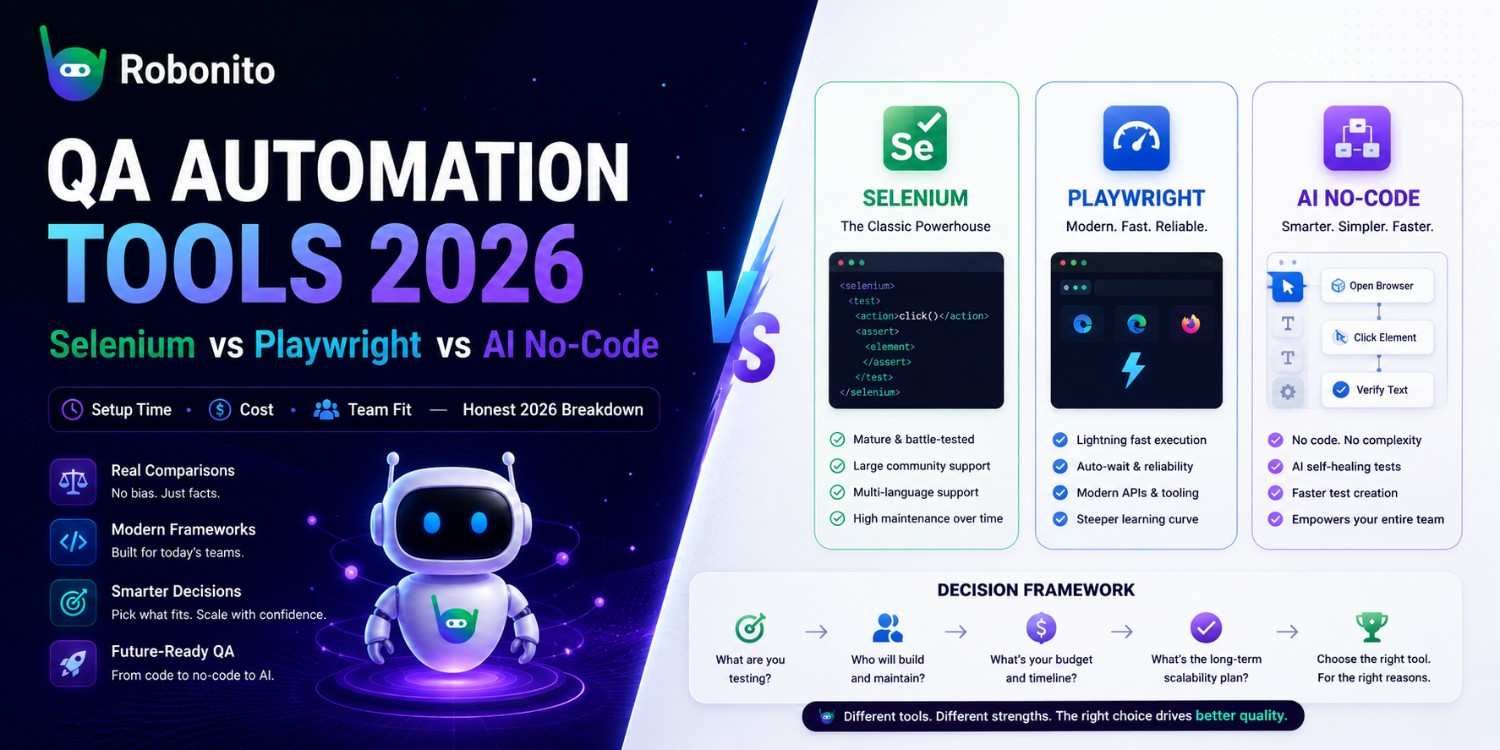
If you're comparing QA automation tools in 2026, the decision looks nothing like it did two years ago. Selenium is still everywhere. Playwright has become the default for developer-heavy teams. And a new wave of no-code AI testing tools is dismantling the assumption that automated testing requires an engineer to build and maintain it. The question isn't just "which framework is best?" — it's "which approach actually fits my team's skills, my budget, and my release velocity?" This guide breaks down the honest trade-offs across all three categories so you can make a decision based on evidence, not vendor marketing.
Key Takeaways
- Selenium's real cost isn't the license — it's the 30–40% of QA time spent on maintenance
- Playwright wins on developer experience but creates team bottlenecks when QA is non-technical
- No-code AI tools cut time-to-first-test from days to under 30 minutes and reduce maintenance overhead by up to 70%
- The hybrid approach (Playwright for API/component tests + no-code AI for E2E UI) is the most practical answer for most teams in 2026
- Run your own PoC — break something on purpose and time how long it takes each tool to recover
How Long Until Your Team Has a Passing Test?
| Tool | Time to First Test | Who Can Do It |
|---|---|---|
| Selenium | 1–3 days | SDET / Developer only |
| Playwright | 2–4 hours | Developer / Technical QA |
| No-Code AI | 15–30 minutes | Anyone on the team |
The QA Automation Landscape in 2026: What's Changed
Three macro shifts have reshaped automated web testing in the past 18 months.
First, release cycles got faster — again. Teams that shipped weekly in 2023 are shipping daily or multiple times a day in 2026. That compresses the window for manual regression testing to near zero. If your QA process can't keep pace with CI/CD, it becomes the bottleneck.
Second, the QA talent gap widened. According to the 2025 World Quality Report, over 60% of organizations report difficulty hiring QA engineers with strong coding skills. This is the core tension: the demand for automation testing tools for web applications has never been higher, but the supply of engineers who can build and maintain those test suites hasn't kept up.
Third, AI stopped being a buzzword in testing. In 2023, "AI-powered testing" mostly meant smart locators or auto-generated assertions. In 2025, tools use AI for test creation, self-healing maintenance, and natural language interaction — changing who on the team can actually own QA automation
The practical result: engineering managers and QA leads are no longer choosing between Selenium and Playwright. They're evaluating an entirely new category alongside them. Your automation testing tools list in 2026 should include at least one no-code AI option, even if you ultimately choose a code-based framework.
Selenium in 2026: Strengths, Weaknesses, and True Cost of Ownership
Selenium remains the most widely adopted web testing framework in the world. It supports every major browser, runs in virtually every programming language, and has a community ecosystem that's unmatched. If you're inheriting an existing test suite at a large enterprise, there's a good chance it's built on Selenium WebDriver.
Where Selenium still wins:
- Language flexibility. Java, Python, C#, JavaScript, Ruby — Selenium doesn't lock you in.
- Community and documentation. Almost any problem you hit has a Stack Overflow answer.
- Enterprise adoption. Many compliance and audit frameworks already account for Selenium-based test artifacts.
Where Selenium hurts in 2026:
- Setup and configuration overhead. Getting Selenium Grid running with proper browser drivers, waits, and parallel execution still takes days of engineering effort. A mid-size e-commerce team we spoke with estimated 40+ hours just to get their initial CI-integrated Selenium setup stable.
- Flakiness. Selenium tests are notoriously brittle. Element locators break when the UI changes, implicit waits cause race conditions, and debugging a flaky test in a 500-test suite can consume an entire sprint.
- Maintenance tax. Industry data suggests teams spend 30-40% of their total QA automation effort on maintaining existing Selenium tests — not writing new ones. For a team with 1,000 tests, that's essentially one full-time engineer doing nothing but fixing broken selectors and updating locators.
The real cost of Selenium isn't the license (it's free). It's the ongoing engineering hours. If your team has dedicated SDETs who enjoy working in code, Selenium is a viable choice. If your QA team is lean or non-technical, the total cost of ownership becomes difficult to justify.
Why test maintenance is the hidden cost of QA automation
Playwright in 2026: Developer Experience vs. Team Accessibility
Playwright, developed by Microsoft, has earned its reputation as the modern alternative to automated web testing with Selenium. It's fast, reliable, and comes with features — auto-waits, trace viewer, built-in parallelism — that Selenium requires plugins or custom code to achieve.
Where Playwright excels:
- Auto-waiting and reliability. Playwright automatically waits for elements to be actionable before interacting with them, dramatically reducing flaky tests compared to Selenium.
- Modern architecture. Native support for multiple browser contexts, network interception, and mobile emulation out of the box.
- Developer experience. The Playwright Test runner, codegen tool, and VS Code extension make it the most developer-friendly framework available.
Scenario: A fintech startup we interviewed migrated 300 Selenium tests to Playwright in six weeks. Their flaky test rate dropped from 15% to under 3%, and CI pipeline run times decreased by 40% due to better parallelization. For a developer-heavy team, that's a clear win.
Where Playwright falls short:
- It's still code. Playwright tests are written in TypeScript, JavaScript, Python, Java, or C#. If your QA team doesn't code, Playwright doesn't help them.
- Locator dependency. While Playwright's locator strategies (role-based, text-based) are more resilient than Selenium's XPath/CSS selectors, they still break when the UI changes significantly. Someone still has to update them.
- Team bottleneck. In organizations where QA is a separate function from engineering, Playwright often creates the same bottleneck as Selenium — QA files tickets for test updates, developers deprioritize them, and coverage erodes over time.
Playwright is genuinely excellent. But "best developer experience" and "best team experience" are not the same thing. If your entire QA team writes code daily, Playwright is probably your best choice among code-based frameworks. If even one or two team members don't, you'll hit the accessibility wall quickly.
The Rise of No-Code AI Testing Tools: A New Category
The best AI testing tool for web apps in 2026 isn't trying to be a better Selenium. It's trying to eliminate the reasons Selenium is hard.
No-code AI testing tools like Robonito are built around a different assumption: that the person who understands what needs to be tested shouldn't need to know how to write a CSS selector to test it. Instead of writing test scripts that interact with the DOM through selectors, you describe what you want to test in natural language or by interacting with your application visually. The AI handles element identification, assertion logic, and — critically — ongoing maintenance.
What defines this category:
- No selectors, no scripting. Tests are created by describing user journeys ("Log in, add item to cart, proceed to checkout, verify order confirmation") rather than writing code.
- Self-healing tests. When the UI changes — a button moves, a class name updates, a form is redesigned — the AI re-identifies elements and adapts the test automatically. This directly attacks the 30-40% maintenance tax that plagues code-based frameworks.
- Accessible to the whole team. Product managers, manual QA testers, and business analysts can create and maintain tests without filing a ticket for an engineer.
Scenario: Consider a SaaS company with a 10-person product team — two developers, one QA engineer, one QA lead, and six product/design/support staff. With Selenium or Playwright, only the developers and possibly the QA engineer can create automated tests. With a no-code AI tool, the QA lead and manual testers can build comprehensive end-to-end test suites themselves, freeing developers to focus on feature work.
Common pushback — and honest answers:
- "No-code tools can't handle complex scenarios." This was true in 2022. In 2026, tools like Robonito handle multi-step workflows, conditional logic, data-driven testing, and API validations without code.
- "We'll be locked into a vendor." Valid concern. Evaluate export options, CI/CD integration breadth, and data portability before committing. Robonito integrates with all major CI/CD pipelines — Jenkins, GitHub Actions, GitLab CI, CircleCI — so your tests run inside your existing workflow, not outside it.
- "AI tools are a black box." Look for tools that provide clear test execution logs, step-by-step screenshots, and failure diagnostics. Trustworthy AI testing tools show their work.
How Robonito's self-healing tests work
Head-to-Head Comparison: Setup Time, Maintenance, Flakiness, and Cost
Here's where the comparison actually matters. Below is a comparison across the dimensions that most directly impact your team's velocity and budget. If you're building your automation testing tools list for a 2026 vendor review, this table is a good starting point — but pair it with your own PoC data (see the framework below).
| Dimension | Selenium | Playwright | No-Code AI (e.g., Robonito) |
|---|---|---|---|
| Time to first test | 1-3 days (setup + scripting) | 2-4 hours (setup + scripting) | 15-30 minutes |
| Learning curve | Steep (language + framework + infra) | Moderate (framework + TypeScript) | Minimal (natural language) |
| Test creation speed | 30-60 min per E2E test | 15-30 min per E2E test | 5-15 min per E2E test |
| Flaky test rate | 10-20% (industry avg) | 3-8% | <2% (self-healing) |
| Maintenance burden | High (30-40% of QA time) | Moderate (15-25%) | Low (5-10%, AI-assisted) |
| Who can create tests | SDETs / Developers | Developers / Technical QA | Anyone on the team |
| CI/CD integration | Manual configuration | Built-in runner + CI support | Pre-built integrations |
| Browser support | All major (via drivers) | Chromium, Firefox, WebKit | All major (cloud-based) |
| Cost model | Free (OSS) + engineer time | Free (OSS) + engineer time | SaaS subscription |
| Total cost (50-person team, 500 tests) | $150K-250K/yr (engineer time) | $100K-180K/yr (engineer time) | $20K-60K/yr (subscription + minimal maintenance) |
Note: Total cost estimates include engineer salaries allocated to test creation, maintenance, and infrastructure management. Actual figures vary by region and team structure.
Estimated Annual QA Cost — 50-Person Team, 500 Tests
| Tool | Annual Cost Range | Cost Driver |
|---|---|---|
| Selenium | $150K – $250K | ██████████████████████ Engineer salaries |
| Playwright | $100K – $180K | █████████████████░░░░░ Engineer salaries |
| No-Code AI | $20K – $60K | ████░░░░░░░░░░░░░░░░░░ SaaS subscription |
80–90% of Selenium/Playwright cost is engineer time — not licenses.
At a Glance: Maintenance Burden by Tool
| Tool | QA Time Spent on Maintenance | |
|---|---|---|
| Selenium | 30–40% | ████████████████░░░░░░░░ |
| Playwright | 15–25% | ████████░░░░░░░░░░░░░░░░ |
| No-Code AI | 5–10% | ███░░░░░░░░░░░░░░░░░░░░░ |
Source: Industry averages from Tricentis State of Testing, 2025 World Quality Report, and Robonito customer data.
The math consistently goes the same direction: code-based frameworks shift cost to labor. No-code AI tools shift cost to subscription fees — which are almost always lower and more predictable.
Scenario: A healthcare SaaS company running 800 Selenium tests was spending roughly $200K/year in SDET time, with a 12% flaky test rate that caused 3-4 false-alarm pipeline failures per week. After migrating their critical path tests (top 200) to a no-code AI platform, they reduced maintenance hours by 70% on those tests and redeployed one SDET to feature development — a net productivity gain that far exceeded the subscription cost.
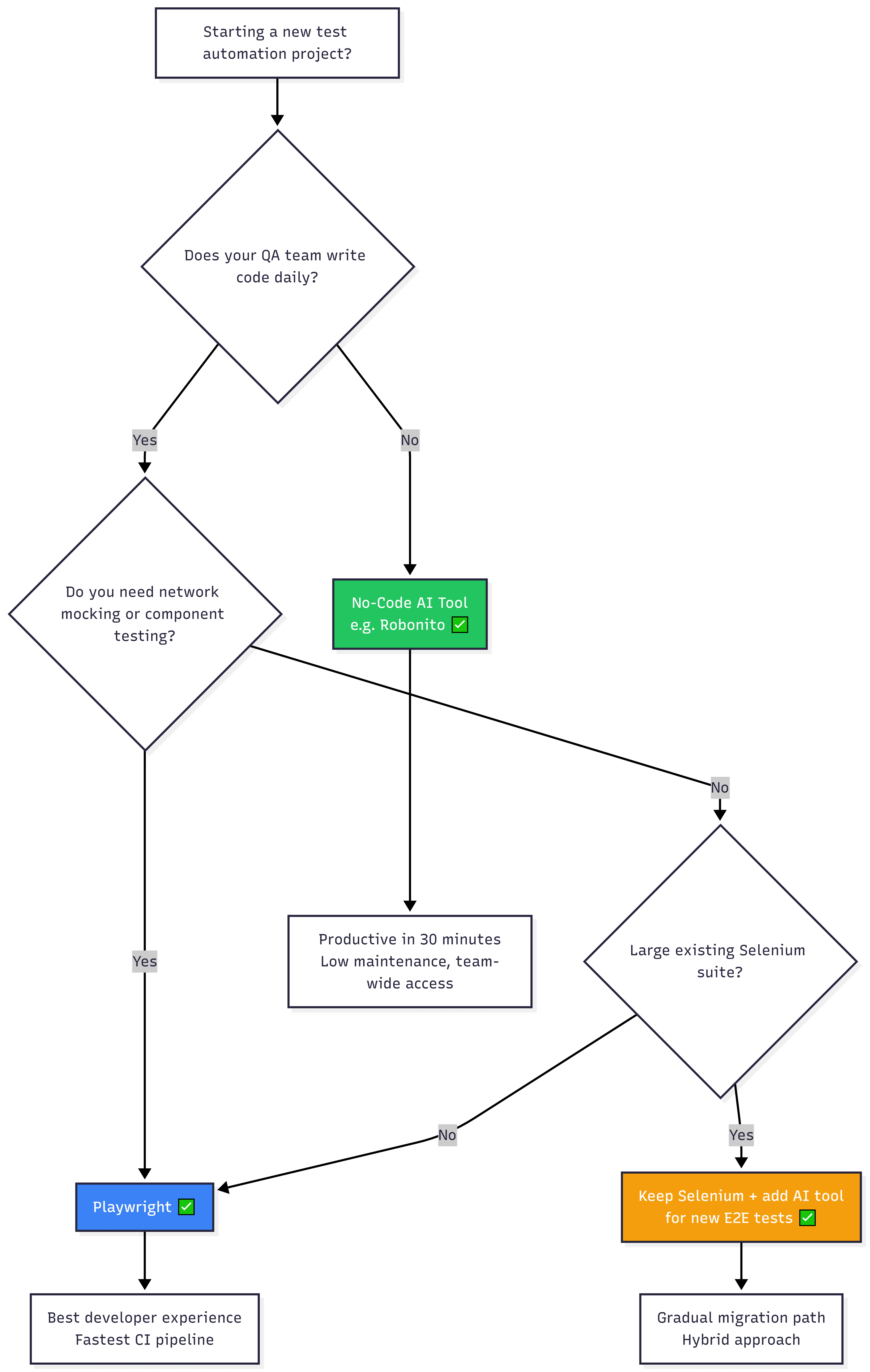 Which QA automation tool fits your team? Follow the decision tree.
Which Tool Fits Which Team: A Decision Framework
There's no universally "best" tool. There's a best fit for your team's skills, constraints, and goals. Here's how to decide.
Choose Selenium if:
- You have a large existing Selenium test suite and migration isn't justified yet
- Your team includes 3+ experienced SDETs who are productive in the framework
- You need deep customization: custom browser profiles, proxy configurations, or niche browser support
- Regulatory requirements mandate a specific open-source framework
Choose Playwright if:
- Your team is developer-heavy and comfortable with TypeScript/JavaScript
- You're starting fresh (no legacy test suite to migrate)
- You need advanced capabilities like network mocking, multi-tab testing, or component testing
- Developer experience and speed are your top priorities
Choose a no-code AI tool (like Robonito) if:
- Your QA team includes manual testers, QA leads, or non-engineers who need to create and own tests
- Test maintenance is consuming more than 20% of your QA team's time
- You need to scale test coverage quickly without hiring additional SDETs
- Fast onboarding matters — your team needs to be productive in hours, not weeks
- You want predictable costs tied to subscription fees rather than unpredictable labor costs
Hybrid approach — the pragmatic answer: Many teams in 2026 use a combination. Developers write Playwright tests for complex API-layer and component tests. The QA team uses a no-code AI tool for end-to-end UI regression tests. This plays to each tool's strengths and avoids forcing non-coders into a code-based workflow.
Getting started with Robonito for QA teams
How to Run a Proof-of-Concept Before Committing to a Tool
Don't trust comparison tables — including this one. Trust your own data. Here's a structured approach to running a PoC that gives you a real answer in 1-2 weeks.
Step 1: Select 10-15 representative test cases
Pick tests that reflect your actual complexity:
- 3-4 simple smoke tests (login, navigation, basic CRUD)
- 3-4 medium-complexity workflows (multi-step forms, conditional UI)
- 3-4 high-complexity scenarios (cross-page flows, dynamic data, third-party integrations)
Step 2: Time everything
For each tool you're evaluating, measure:
- Setup time: From zero to first passing test
- Creation time per test: Average across your 10-15 cases
- Who created the test: Engineer? QA? Product manager? This tells you about team accessibility.
Step 3: Break something on purpose
Change a button label. Move an element. Update a form field name. Then run your tests again. Measure:
- How many tests broke?
- How long did it take to fix each one?
- Could a non-engineer fix them?
This is the maintenance simulation. It's the single most predictive metric for long-term cost of ownership.
Step 4: Integrate with your CI/CD pipeline
A test that can't run in your pipeline is a test that won't run consistently. Verify:
- Trigger tests on pull request
- View results in your existing dashboard (GitHub Actions, Jenkins, etc.)
- Confirm parallel execution and acceptable run times
Step 5: Calculate projected annual cost
Multiply your creation and maintenance time measurements across your full test suite size. Add infrastructure and subscription costs. Compare total cost across tools — not just sticker price.
Most teams that run this PoC honestly are surprised by the results. The tool that "feels" most powerful in a demo isn't always the tool that delivers the best ROI at scale.
Frequently Asked Questions
What is the best QA automation tool in 2026?
The best QA automation tool depends on your team and use case. Selenium is ideal for large enterprises with existing frameworks, Playwright is best for developer-heavy teams needing speed and reliability, while AI-powered no-code tools are best for fast setup, low maintenance, and teams with non-technical members.
Should I choose Playwright over Selenium in 2026?
Playwright is generally the better choice for new projects because of faster execution, built-in auto-waiting, and easier setup. However, Selenium remains valuable for legacy systems, broader language support, and enterprise environments already invested in its ecosystem.
Are AI-powered testing tools better than Selenium and Playwright?
AI-powered testing tools are not always “better,” but they solve different problems. They significantly reduce test maintenance through self-healing and allow non-developers to create tests. However, they work best when combined with unit and API tests rather than replacing traditional frameworks entirely.
Why do Selenium and Playwright tests become flaky?
Test flakiness is usually caused by timing issues, unstable selectors, shared test data, or dependency on external systems. Even with Playwright’s improvements, UI tests remain sensitive to changes. Proper waits, test isolation, and mocking external dependencies are essential to reduce flakiness.
How do I choose the right QA automation tool for my team?
Choose based on three factors: team skills, maintenance capacity, and speed requirements. If your team is highly technical, Playwright is a strong choice. If you already use Selenium, optimizing it may be better than migrating. If you want faster onboarding and lower maintenance, AI no-code tools are the most efficient option.
Try Robonito Free: See the Difference in 30 Minutes
If you're in the middle of evaluating automation testing tools for web applications, we'd rather show you than tell you. Robonito offers a free trial — no credit card, no sales call required.
Here's what you can do in your first 30 minutes:
- Create your first end-to-end test on your own web app using natural language
- See self-healing in action by changing a UI element and watching the test adapt
- Connect to your CI/CD pipeline with pre-built integrations
No CSS selectors. No XPath. No scripting. Just tests that work — and keep working.
Or, if you want to see Robonito applied to your specific use case, [book a 15-minute demo] with our team. We'll use your app, not a canned demo environment.
Automate your QA — no code required
Stop writing test scripts.
Start shipping with confidence.
Join thousands of QA teams using Robonito to automate testing in minutes — not months.