
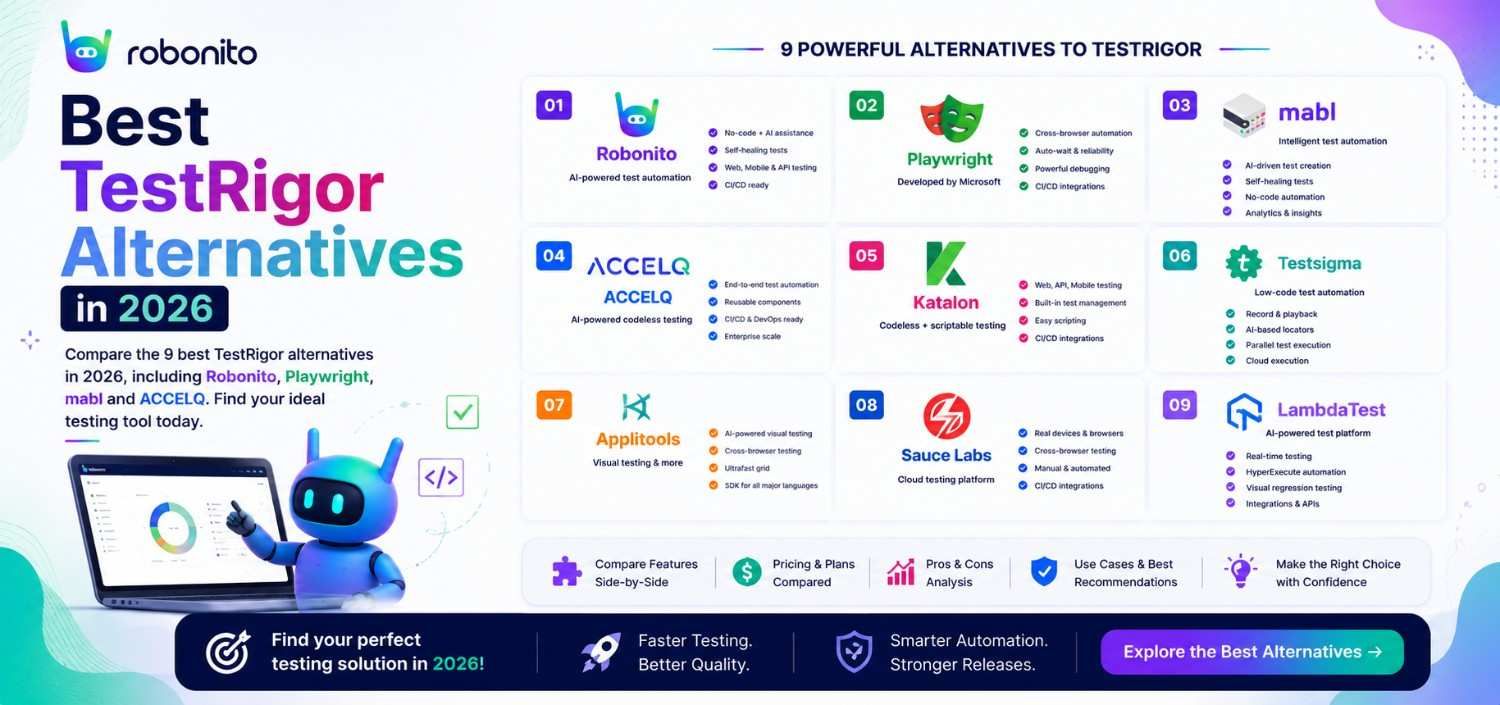
TestRigor made a bold promise: write tests in plain English, never touch a selector, and never maintain broken tests. For some teams, it delivers. For others — the ones who hit the natural language ceiling, ran out of free tier, or needed API testing depth — the promise runs out before the testing does. This guide covers the 9 strongest alternatives, with honest comparisons, real pricing, working code, and a direct TestRigor vs Robonito breakdown.
By Robonito Engineering Team · Updated May 2026 · 19 min read
Quick stats
| Fact | Source |
|---|---|
| No-code test automation adoption grew 340% from 2023 to 2026 | Gartner |
| Teams with self-healing automation spend only 5–10% on maintenance vs 40–60% with scripted tools | Capgemini World Quality Report 2025 |
| 74% of QA teams report that test maintenance is their biggest challenge | World Quality Report 2025 |
| Natural language test authoring reduces initial test creation time by up to 60% | Forrester |
| Teams using AI-powered QA platforms ship 2.4× more frequently with fewer production defects | DORA State of DevOps 2025 |
Why teams look beyond TestRigor
TestRigor is genuinely good at what it does. The teams that look for alternatives have not found TestRigor broken — they have found it insufficient for their specific situation. The honest reasons:
The natural language ceiling — TestRigor's "write tests in plain English" works beautifully for linear user flows. Clicking buttons, filling forms, verifying text — these translate cleanly. Complex conditional logic does not. "If the user's cart total exceeds $500 and they have a loyalty account, verify the discount badge appears and the checkout button is enabled but the express checkout button is hidden" becomes awkward in natural language and requires workarounds that erode the no-code promise.
No free tier — TestRigor has no meaningful free tier for production evaluation. Teams evaluating it must commit budget before fully assessing fit. Several strong alternatives (Robonito, Playwright, Cypress) offer fully functional free options.
Limited API and desktop testing — TestRigor is a web UI-first platform. API testing and desktop application testing are secondary capabilities. Teams with significant API coverage requirements or desktop applications find the platform insufficient.
Self-healing scope — TestRigor's self-healing uses selector fallback strategies. When a button's ID changes, it falls back to class, text, or XPath. When a component is fully rewritten — different structure, different hierarchy, different context — fallback strategies fail. Newer AI-native platforms use intent-based recognition that survives larger changes.
Pricing at team scale — TestRigor's per-user pricing model becomes expensive for QA organisations with many testers. Teams with 10+ users evaluate whether the per-user cost justifies the platform's capabilities versus alternatives.
The TestRigor alternative with stronger AI, broader coverage, and a free tier
Robonito is an AI-driven end-to-end QA platform covering web, mobile web, API, and desktop — with intent-based self-healing that survives full UI redesigns, not just element renames. Try Robonito free →
Quick comparison table
| Platform | Coding | Self-healing | Platform coverage | Free tier | Pricing from | Best for |
|---|---|---|---|---|---|---|
| Robonito | None | ✅ Intent-based AI | Web + Mobile + API + Desktop | ✅ Generous | Free | Broadest no-code coverage |
| TestRigor | None (NL) | ✅ Selector fallback | Web + Mobile | ❌ | ~$500/mo | Plain English authoring |
| Playwright | Yes (multi-lang) | ❌ Manual | Web + Mobile web | ✅ OSS | Free | Engineering teams |
| mabl | None | ✅ Advanced visual | Web | ❌ | Enterprise | Visual regression depth |
| ACCELQ | None (visual) | ✅ | Web + Mobile + API + Desktop | ❌ | Custom | DevOps integration |
| Testsigma | None (NL) | ✅ Selector fallback | Web + Mobile + API | ❌ | ~$499/mo | Natural language + mobile |
| Katalon Studio | Low (Groovy) | ⚠️ | Web + Mobile + API + Desktop | ⚠️ Limited | Custom | Scripting flexibility |
| Cypress | JS/TS only | ❌ | Web | ✅ OSS | Free | JS frontend teams |
| WebdriverIO | JS/TS | ❌ | Web + Mobile | ✅ OSS | Free | Unified web + mobile JS |
| Applitools | Via integration | ❌ | Visual layer only | ✅ | Custom | Visual regression |
Pricing Comparison
| Tool | Free Tier | Starting Price |
|---|---|---|
| Robonito | Yes | Free |
| Playwright | Yes | Free |
| Cypress | Yes | Free |
| TestRigor | No | Contact Sales |
| Testsigma | Limited | Contact Sales |
| ACCELQ | No | Contact Sales |
| mabl | No | Contact Sales |
| Katalon | Limited | Contact Sales |
| Applitools | Limited | Contact Sales |
The 9 best TestRigor alternatives in 2026
1. Robonito — Best AI-powered platform for web, mobile, API, and desktop
robonito.com · Free tier · No coding · AI intent-based · Self-healing
Robonito is the strongest overall TestRigor alternative in 2026. Both platforms target the same problem — giving non-technical QA teams automated test coverage without scripting — but they solve it differently, and the architectural difference matters for long-term reliability.
TestRigor's approach: Write test steps in plain English. The platform converts those sentences into automation actions using NLP. Self-healing falls back to alternative selectors when the primary fails.
Robonito's approach: Record actual user interactions. Robonito's AI captures the intent of each interaction using multiple signals simultaneously — visual position, ARIA role, accessible name, surrounding context, and text content. Self-healing updates the test when any of those signals changes, covering UI changes that selector-based fallback cannot handle.
The real-world difference this makes:
Scenario: Your design team ships a new component library.
Every button changes its CSS class. Every form field gets a new wrapper div.
The entire layout restructures.

TestRigor self-healing:
- Tries original selector (fails — CSS class changed)
- Falls back to XPath (fails — wrapper div changed hierarchy)
- Falls back to text content (works for some, fails for others)
- Result: 30-40% of tests break, require manual fixes

Robonito self-healing:
- "Click the primary checkout button" evaluated against:
  → Visual position: still in the same relative location ✅
  → ARIA role: still role="button" ✅
  → Accessible name: still "Place Order" ✅
  → Surrounding context: still follows the payment form ✅
- Result: Multi-signal match succeeds — test continues running
- Result: Designed to survive major UI redesign automatically
Platform coverage comparison:
TestRigor covers:              Robonito covers:
├── Web (UI, NL authoring)     ├── Web (AI intent, recorded flows)
├── Mobile web                 ├── Mobile web (real viewports)
└── API (secondary)            ├── API (native, comprehensive)
                               └── Desktop (Electron + web-based)
Real CI/CD integration:
## .github/workflows/robonito-testrigor-replacement.yml
name: Robonito QA Suite

on:
  push:
    branches: [main]
  pull_request:

jobs:
  ## Replaces TestRigor's web testing
  web-regression:
    runs-on: ubuntu-latest
    steps:
      - uses: actions/checkout@v4
      - name: Run Robonito web + API regression
        uses: robonito/run-tests-action@v2
        with:
          api-key: ${{ secrets.ROBONITO_API_KEY }}
          suite: full-regression
          environment: staging
          platforms: web,mobile-web,api
          browsers: chrome,safari,firefox,edge
          fail-on: critical
          notify-slack: ${{ secrets.SLACK_QA_CHANNEL }}

  ## Robonito also handles what TestRigor cannot: desktop
  desktop-regression:
    runs-on: ubuntu-latest
    needs: web-regression
    steps:
      - name: Run Robonito desktop app tests
        uses: robonito/run-tests-action@v2
        with:
          api-key: ${{ secrets.ROBONITO_API_KEY }}
          suite: desktop-regression
          environment: staging
          platform: desktop
Data-driven testing without a line of code:
TestRigor supports data-driven testing but requires specific syntax within its natural language format. Robonito connects directly to spreadsheets, CSVs, and API responses — the same recorded test runs against every row automatically, with no syntax to learn.
Honest limitations: Robonito's native mobile app testing (React Native, native Swift, native Kotlin) is more limited than dedicated mobile platforms. For teams whose primary surface is native mobile apps, Detox or XCUITest provide deeper integration. Robonito's strength is web, mobile web, API, and desktop — which covers the majority of SaaS and e-commerce QA needs.
Best for: Agile teams with non-technical QA members, teams experiencing frequent test breakage from UI changes, organisations wanting one AI platform across web + mobile + API + desktop instead of separate tools.
Pricing: Generous free tier. Competitive paid plans — robonito.com/pricing.
2. Playwright — Best for engineering teams wanting code-first control
playwright.dev · Open source · Free · TypeScript/JS/Python/Java/C#
Playwright is the right TestRigor alternative for engineering teams whose frustration with TestRigor is not the scripting — it is specifically that they want deterministic control over test logic, direct database assertions, and the ability to test scenarios that natural language cannot express.
What Playwright does that TestRigor cannot:
// Playwright — complex conditional test logic impossible in TestRigor NL
import { test, expect } from '@playwright/test';
import { db } from '../helpers/database';

test('loyalty discount applied correctly for eligible orders', async ({ page }) => {
  // Set up test data programmatically — not possible in NL authoring
  await db.createUser({ email: 'loyal@test.com', loyaltyTier: 'gold' });
  await db.addLoyaltyPoints('loyal@test.com', 5000);

  await page.goto('/login');
  await page.getByLabel('Email').fill('loyal@test.com');
  await page.getByLabel('Password').fill('TestPass2026!');
  await page.getByRole('button', { name: 'Sign in' }).click();

  // Add items to reach $500 threshold
  await page.goto('/products/enterprise-package');
  await page.getByRole('button', { name: 'Add to cart' }).click();

  await page.goto('/checkout');

  // Complex conditional assertion — impossible in TestRigor plain English
  const cartTotal = await page.getByTestId('cart-total').textContent();
  const totalValue = parseFloat(cartTotal!.replace('$', ''));

  if (totalValue >= 500) {
    // Discount badge must appear
    await expect(page.getByTestId('loyalty-discount-badge')).toBeVisible();
    // Discount amount must be 10% of total
    const discountText = await page.getByTestId('discount-amount').textContent();
    const discount = parseFloat(discountText!.replace('$', '').replace('-', ''));
    expect(discount).toBeCloseTo(totalValue * 0.10, 1);
    // Express checkout hidden for large orders (separate workflow)
    await expect(page.getByRole('button', { name: 'Express checkout' })).not.toBeVisible();
  }

  // Verify database state — cross-layer assertion, impossible in TestRigor
  const order = await db.getLatestOrderByUser('loyal@test.com');
  expect(order.discount_applied).toBe('loyalty_gold_10pct');
  expect(order.loyalty_points_earned).toBeGreaterThan(0);
});
Safari cross-browser coverage Playwright provides that TestRigor lacks depth on:
// playwright.config.ts — runs on all browsers including Safari/WebKit
export default defineConfig({
  projects: [
    { name: 'chromium', use: { ...devices['Desktop Chrome'] } },
    { name: 'webkit',   use: { ...devices['Desktop Safari'] } },  // Real WebKit engine
    { name: 'firefox',  use: { ...devices['Desktop Firefox'] } },
    { name: 'mobile',   use: { ...devices['iPhone 14'] } },
  ],
});
// TestRigor's cross-browser uses cloud platforms — slower, external dependency
// Playwright's cross-browser is native, runs in your own CI, free
Honest limitations: Requires coding — not accessible to non-technical QA. No self-healing — selector updates are manual. No built-in test management or visual dashboard.
Best for: Engineering teams who write their own tests, Python/Java/C# shops, teams needing database assertions alongside UI validation, teams where TestRigor's natural language is insufficient for complex logic.
Pricing: Free and open source.
3. mabl — Best for AI-powered visual regression depth
mabl.com · No-code · Enterprise
mabl is the closest competitor to TestRigor in the no-code AI testing space — both target non-technical teams, both self-heal, both require no scripting. The meaningful difference is depth: mabl's visual AI is significantly more sophisticated than TestRigor's, and mabl's browser coverage via its Ultrafast Grid is faster.
Where mabl beats TestRigor:
- Visual regression — mabl's AI understands visual context, distinguishing meaningful regressions (broken layout, missing button) from irrelevant rendering noise (sub-pixel Safari font differences). TestRigor's visual testing is functional but more basic.
- Test stability analysis — mabl proactively identifies flaky tests and provides root cause analysis. TestRigor flags failures but offers less diagnostic intelligence.
- Browser execution speed — mabl's Ultrafast Grid runs tests across multiple browsers simultaneously in a single execution. TestRigor's cross-browser execution is sequential or slower.
Honest limitations: No free tier — requires enterprise budget before meaningful evaluation. Web-only — no API testing, no desktop testing. Per-seat pricing at scale. For teams whose budget went to TestRigor and is now available for reassignment, mabl is comparable in cost with better visual capabilities.
Best for: Design-critical web applications where pixel-perfect cross-browser rendering is the primary quality concern, enterprise teams with budget who find TestRigor's visual capabilities insufficient.
Pricing: No free tier. Enterprise pricing — contact mabl.
4. ACCELQ — Best no-code platform with deepest DevOps integration
accelq.com · No-code (visual flow) · Commercial
ACCELQ is the TestRigor alternative with the strongest CI/CD and DevOps integration. Where TestRigor uses natural language authoring (type what you want in English), ACCELQ uses visual flow design (drag-and-drop actions onto a canvas). For testers who find natural language ambiguous but visual step sequencing intuitive, ACCELQ's approach is more transparent.
How ACCELQ's visual flow differs from TestRigor's natural language:
TestRigor (natural language):
"Click the Add to Cart button for the first product in the search results"
→ NLP interprets → automation action

ACCELQ (visual flow):
[Navigate to /products] → [Search: "widget pro"] →
[Click: first result "Add to Cart" button] → [Verify: cart count = 1]
→ Each step explicitly defined → no NLP ambiguity

The ACCELQ approach eliminates ambiguity at the cost of slightly more
setup time — but the resulting tests are more predictable.
DevOps integration depth that exceeds TestRigor:
## ACCELQ native integrations (TestRigor has fewer):
CI/CD: Jenkins, GitHub Actions, GitLab CI, Azure DevOps, CircleCI, TeamCity
Test management: Jira, Azure DevOps, ALM, TestRail, qTest
Service management: ServiceNow, Jira Service Management
Release management: UrbanCode, Octopus Deploy
Monitoring: Datadog, Splunk (test results as deployment quality signals)

## TestRigor integrates with: GitHub Actions, Jenkins, Jira
## ACCELQ integrates with: 25+ enterprise tools natively
Honest limitations: Less brand recognition and community than TestRigor. No free tier — pricing requires a sales conversation. Visual flow approach requires more initial setup than TestRigor's "just type what you want." Better suited to larger enterprise teams than individual developers.
Best for: Enterprise DevOps teams wanting codeless automation deeply wired into their full toolchain — from Jira ticket creation through release management.
Pricing: Custom — contact ACCELQ.
5. Testsigma — The closest TestRigor functional equivalent
testsigma.com · No-code (NL) · Commercial
Testsigma is the most direct functional equivalent to TestRigor — same natural language authoring approach, similar target user (non-technical QA), similar pricing model. If a team is evaluating TestRigor, Testsigma should always be in the same evaluation shortlist.
TestRigor vs Testsigma — where they actually differ:
| Dimension | TestRigor | Testsigma |
|---|---|---|
| NL authoring style | Conversational English sentences | English sentences + structured steps |
| Mobile app testing | Mobile web focus | Native iOS + Android stronger |
| API testing | Secondary capability | More developed API layer |
| Self-healing | Selector fallback | Selector fallback (similar) |
| Free tier | ❌ | ❌ |
| Pricing | ~$500/mo team | ~$499/mo team |
| Community | Smaller | Larger, more documentation |
When to choose Testsigma over TestRigor: When native mobile app testing (iOS, Android) is a requirement alongside web testing. Testsigma's mobile capabilities are more mature.
When to choose TestRigor over Testsigma: When the team specifically prefers TestRigor's more conversational NL style and has no native mobile requirement.
When to choose Robonito over both: When the team needs broader platform coverage, stronger self-healing, or wants to start free before committing budget.
Honest limitations: No free tier. Similar ceiling to TestRigor for complex conditional logic. Pricing comparable to TestRigor.
Pricing: ~$499/month for team plans.
6. Katalon Studio — Best when scripting flexibility is needed alongside no-code
katalon.com · Low-code (Groovy) · Commercial
Katalon is the TestRigor alternative for teams that want a no-code starting point but need an escape hatch to scripting for complex scenarios. TestRigor is genuinely no-code with no escape — if natural language cannot express a test, you are blocked. Katalon exposes Groovy (a Java-based scripting language) when the visual interface is insufficient.
// Katalon's Groovy escape hatch — for when no-code is insufficient
// TestRigor has no equivalent

import com.kms.katalon.core.webui.keyword.WebUiBuiltInKeywords as WebUI

// Start with keyword-driven (no-code equivalent)
WebUI.openBrowser('https://yourapp.com/checkout')
WebUI.click(findTestObject('checkout/btn_place_order'))

// Drop into Groovy for complex assertion TestRigor NL cannot express
def order_id = WebUI.getText(findTestObject('checkout/text_order_id'))
def db_record = CustomKeywords.'database.QueryOrder'(order_id)

assert db_record.status == 'pending' :
    "Order status should be 'pending', got: ${db_record.status}"
assert db_record.payment_captured == false :
    "Payment should not be captured immediately"

WebUI.closeBrowser()
Honest limitations: Significant pricing increase post-Perforce acquisition. Groovy barrier for non-technical testers. Self-healing less mature than AI-native platforms. Heavy resource usage locally.
Best for: Teams with mixed technical/non-technical QA who need scripting flexibility when no-code reaches its ceiling — something TestRigor never offers.
Pricing: Free tier with limitations. Paid plans — verify current pricing at katalon.com.
7. Cypress — Best for JavaScript teams who want developer-owned testing
cypress.io · Open source · JavaScript/TypeScript
Cypress is the TestRigor alternative for JavaScript teams who want developers to own test automation alongside QA. TestRigor deliberately removes developers from the test authoring process. Cypress deliberately invites them in — with an interactive test runner, real-time reloading, and a debugging experience designed for developers.
// Cypress — developer-friendly, real-time debugging TestRigor cannot match
describe('Checkout', () => {
  it('completes purchase and verifies order in API', () => {
    // Intercept API calls — impossible in TestRigor NL
    cy.intercept('POST', '/api/v1/orders').as('createOrder');

    cy.visit('/products/widget-pro');
    cy.get('[data-testid="add-to-cart"]').click();
    cy.get('[data-testid="cart-count"]').should('have.text', '1');
    cy.get('[data-testid="checkout-link"]').click();

    cy.get('[data-testid="name-input"]').type('Jane Smith');
    cy.get('[data-testid="email-input"]').type('jane@example.com');
    cy.get('[data-testid="place-order"]').click();

    // Wait for API and verify response — TestRigor cannot do this
    cy.wait('@createOrder').then((interception) => {
      expect(interception.response.statusCode).to.equal(201);
      expect(interception.request.body.customer_email)
        .to.equal('jane@example.com');
    });

    cy.get('[data-testid="confirmation-heading"]').should('be.visible');
  });
});
Honest limitations: JavaScript/TypeScript only. Limited Safari support. No API testing. No self-healing. Cypress Cloud (parallelisation) adds cost.
Best for: JavaScript frontend teams, React/Vue/Angular SPAs, teams wanting developers and QA to collaborate on the same test suite.
Pricing: Free OSS core. Cypress Cloud from ~$75/month.
8. WebdriverIO — Best for Node.js teams needing unified web + mobile
webdriver.io · Open source · Free · JavaScript/TypeScript
WebdriverIO is the TestRigor alternative for Node.js teams wanting the flexibility of a proper framework with the bonus of unified web and mobile testing from one codebase. Where TestRigor separates web and mobile workflows, WebdriverIO uses the same API for both via Appium.
// WebdriverIO — same API for web and mobile
describe('Checkout', () => {
  it('completes purchase on web', async () => {
    await browser.url('/checkout');
    await $('[data-testid="name-input"]').setValue('Jane Smith');
    await $('[data-testid="email-input"]').setValue('jane@example.com');
    await $('[data-testid="place-order"]').click();
    await expect($('[data-testid="confirmation"]')).toBeDisplayed();
  });
});

// Same framework handles native mobile with Appium capabilities swap:
// capabilities: { platformName: 'Android', 'appium:automationName': 'UiAutomator2' }
// The test structure and assertion syntax are identical
Honest limitations: Requires coding — not accessible to non-technical QA. More configuration overhead than Playwright for basic web testing.
Best for: Node.js teams wanting one framework for web and native mobile, teams with existing Appium investment wanting a better JavaScript wrapper.
Pricing: Free and open source.
9. Applitools — Best when visual regression is the specific gap
applitools.com · Free tier · Integrates with any framework
Applitools is not a direct TestRigor replacement — it is a specialised visual testing layer that adds AI-powered visual comparison on top of your existing test framework. If the specific reason your team is leaving TestRigor is insufficient visual regression quality, Applitools solves that specific problem more completely than any full-platform replacement.
// Playwright + Applitools — superior visual testing to TestRigor's visual layer
import { Eyes, Target } from '@applitools/eyes-playwright';

test('checkout renders consistently across browsers', async ({ page }) => {
  const eyes = new Eyes();
  await eyes.open(page, 'YourApp', 'Checkout Visual Regression');

  await page.goto('/checkout');
  await page.waitForLoadState('networkidle');

  // Applitools AI — distinguishes real regressions from rendering noise
  // TestRigor visual: pixel comparison with manual threshold
  // Applitools: contextual AI that knows button misalignment ≠ font subpixel diff
  await eyes.check('Checkout', Target.window().fully()
    .ignoreRegion(page.getByTestId('dynamic-price'))
    .layout(page.getByTestId('promo-banner'))
  );

  await eyes.close(false);
});
Honest limitations: Not a full test platform — adds visual intelligence to tests you run elsewhere. Pricing scales with screenshot volume.
Best for: Teams that specifically need visual regression depth beyond what TestRigor provides, as a complement to any other platform in this list.
Pricing: Free tier available. Enterprise custom pricing.
TestRigor vs Robonito — the direct comparison
The comparison most readers of this article are making. Here it is in full, with honest assessments of both platforms.
| Dimension | TestRigor | Robonito |
|---|---|---|
| Test authoring | Plain English ("click Submit") | AI-generated from recorded flows |
| Self-healing mechanism | Selector fallback (ID → class → XPath → text) | Multi-signal intent recognition (position + role + name + context) |
| Self-healing survives | Selector/ID changes | Selector changes + component rewrites + design system migrations |
| Platform coverage | Web + Mobile web | Web + Mobile web + API (native) + Desktop |
| API testing | Secondary, limited | Native, comprehensive |
| Desktop testing | ❌ | ✅ Electron + web-based |
| Free tier | ❌ None | ✅ Generous |
| Setup time | 2–4 hours | Under 1 hour |
| Non-technical accessibility | ✅ (NL authoring) | ✅ (visual recording) |
| Complex conditional logic | ⚠️ NL ceiling | ⚠️ Similar ceiling |
| CI/CD integration | ✅ GitHub Actions, Jenkins | ✅ Native GitHub Actions, GitLab, Jenkins, CircleCI |
| Cross-browser | ✅ | ✅ Chrome, Safari, Firefox, Edge |
| Pricing | ~$500/mo team | Free tier + competitive paid |
| Best for | Plain English authoring preference | Broader coverage, stronger healing, free start |
The honest verdict:
Robonito's advantages are clear: intent-based self-healing that survives larger changes, broader platform coverage (API and desktop that TestRigor lacks), a meaningful free tier for evaluation, and faster setup.
TestRigor's specific advantage is natural language authoring that reads like sentences — "click the Add to Cart button, then verify the cart count shows 1" — which certain business analyst personas find more natural than recording interactions. If your non-technical testers specifically think in written sentences rather than doing and showing, TestRigor's authoring model may be preferable.
For every other dimension — including long-term test reliability through larger UI changes — Robonito is the stronger platform.
Choosing the right TestRigor alternative
| Your situation | Best choice | Key reason |
|---|---|---|
| Broader platform + stronger self-healing + free start | Robonito | Intent AI, web + mobile + API + desktop |
| NL authoring specifically, or native mobile app testing | Testsigma | Closest TestRigor equivalent with stronger mobile |
| Engineering team wanting code control | Playwright | Free, multi-language, cross-browser |
| Visual regression depth as primary need | mabl or Applitools | Best visual AI in the market |
| DevOps-native, deep CI integration, no-code | ACCELQ | 25+ enterprise tool integrations |
| Scripting flexibility alongside no-code | Katalon Studio | Groovy escape hatch when NL insufficient |
| JS team, developer-owned testing | Cypress | Interactive debugger, network interception |
| Node.js, unified web + native mobile | WebdriverIO | Same API for both platforms |
| Visual regression only (not full replacement) | Applitools | Adds to existing stack, not replaces |
Pre-evaluation checklist before switching from TestRigor
- Specific reason for switching documented — which TestRigor limitation is the real problem?
- Platform coverage requirement confirmed — do you need API, desktop, or native mobile?
- Self-healing requirement assessed — are tests breaking from minor changes or full redesigns?
- Team technical level confirmed — coding possible, or genuinely no-code required?
- Free trial completed against your real application (not a demo app from the vendor)
- Non-technical testers evaluated the alternative independently — can they use it?
- CI/CD integration tested with your actual pipeline before committing
- Pricing modelled at your team size for 12 months — not just entry price
- Migration path for existing TestRigor test cases confirmed
- Sign-off from QA lead that the alternative covers the critical test scenarios
Migrating from TestRigor to Robonito
Most teams complete migration in three stages:
- Identify critical regression tests
- Recreate high-value workflows using Robonito recording
- Run both platforms in parallel for 2–4 weeks
Start with checkout, login, and user onboarding flows before migrating lower-priority suites.
Frequently Asked Questions
What is the best TestRigor alternative in 2026?
Robonito for teams wanting stronger self-healing, broader platform coverage (web, mobile web, API, desktop), and a free tier to start. Playwright for engineering teams needing code-first control. mabl for teams prioritising visual regression depth. Testsigma for teams whose mobile app testing alongside web is critical. The best choice depends on your specific pain point with TestRigor.
What is TestRigor?
TestRigor is a no-code AI test automation platform that lets QA teams write tests in plain English — "click the Sign In button, verify the dashboard heading appears." It targets non-technical testers, provides self-healing, and runs tests across browsers. Its limitations are the natural language ceiling for complex logic, no free tier, and self-healing that breaks on large UI changes.
Why do teams look for TestRigor alternatives?
Pricing (no free tier, per-user model expensive at scale), limited API and desktop testing, the natural language ceiling for complex conditional scenarios, self-healing that relies on selector fallback rather than deep intent recognition, and limited DevOps integration compared to alternatives.
How does Robonito compare to TestRigor?
Both are no-code AI platforms for non-technical QA. Robonito's advantages: intent-based self-healing survives full component rewrites (not just selector changes), covers web + mobile web + API + desktop in one platform, has a generous free tier, and sets up in under an hour. TestRigor's advantage: natural language authoring reads like written sentences, which some business analyst personas specifically prefer. For long-term test reliability and platform breadth, Robonito is the stronger platform.
Is TestRigor worth using in 2026?
Yes, for teams that specifically value plain-English sentence authoring for non-technical testers and primarily test web applications. Teams that outgrow TestRigor cite the natural language ceiling, lack of a free tier, limited API testing depth, and self-healing that breaks on larger UI redesigns.
External references
- TestRigor Documentation — Official TestRigor docs
- Playwright Documentation — Official Playwright docs
- mabl Documentation — Official mabl docs
- ACCELQ Documentation — Official ACCELQ docs
- Applitools Documentation — Official Applitools docs
- Gartner No-Code Testing Forecast — Market data
- DORA State of DevOps 2025 — AI testing performance data
Start where TestRigor stops — stronger AI, broader coverage, free
Robonito covers everything TestRigor covers — and adds API testing, desktop testing, and intent-based self-healing that survives full UI redesigns. Non-technical QA teams are live in under an hour with a free tier that never expires. Start free at Robonito.com →
Automate your QA — no code required
Stop writing test scripts.
Start shipping with confidence.
Join thousands of QA teams using Robonito to automate testing in minutes — not months.