
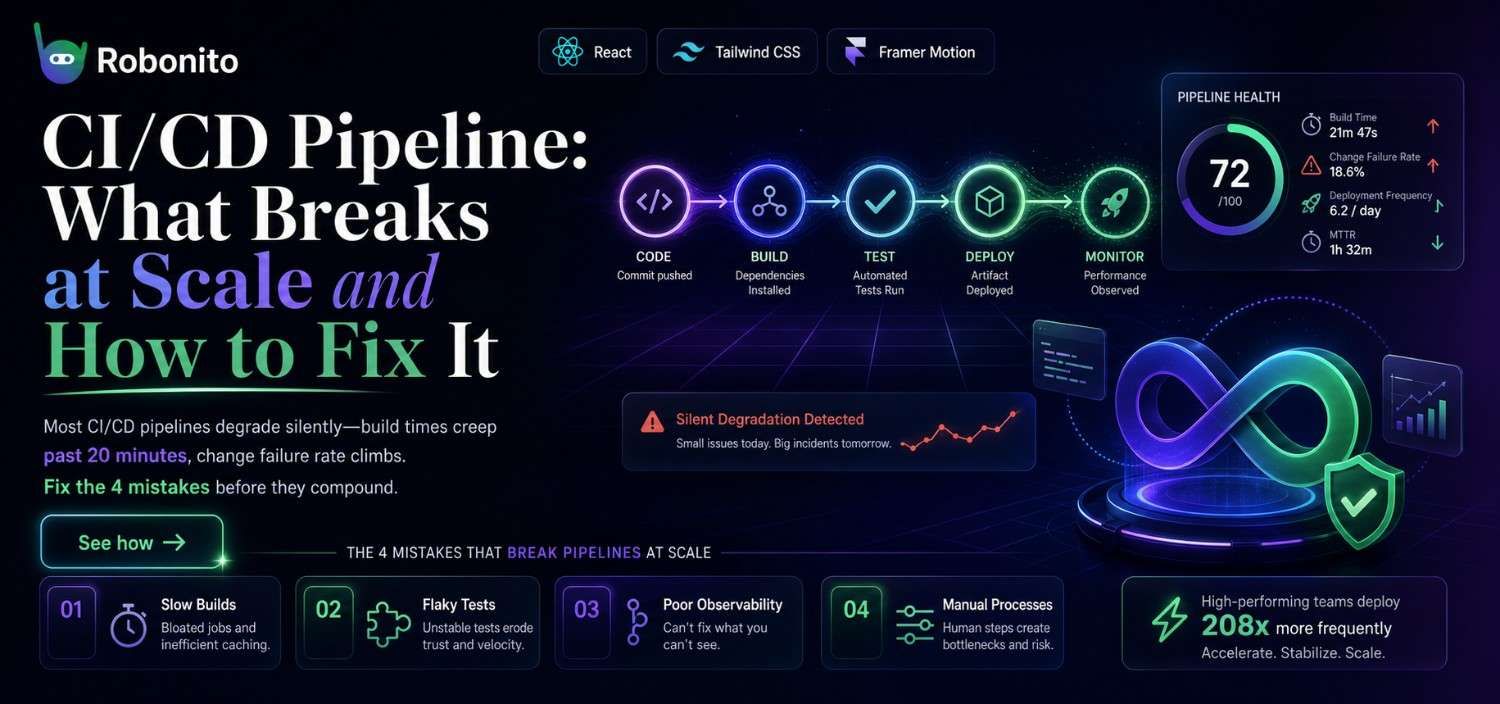
A fintech team had a CI/CD pipeline that worked perfectly for 18 months. Then it did not. A monorepo split into four services caused build times to jump from 8 minutes to 47 minutes. Deployments started failing silently. The on-call rotation went from one incident per month to three per week — not because the code was worse, but because the pipeline had not been designed to scale.
That is the failure mode the best DevOps teams prevent. Not by switching tools — by understanding the architectural decisions that cause pipelines to degrade invisibly.
Key Takeaways
- CI and CD solve different questions — most pipeline problems come from treating them as one stage
- Build time is a vanity metric; false negative rate and change failure rate are what actually matter
- GitHub Actions has replaced Jenkins as the correct default for most teams in 2026 — but not all
- The DORA Four Keys are the only metrics that tell you if your pipeline is working
- Most pipeline failures at scale are test architecture problems, not tool problems
Why CI/CD Pipelines Fail Silently (And Why You Notice Too Late)
The 2024 DORA State of DevOps Report found that elite engineering teams deploy 973× more frequently than low performers and recover from incidents 6,570× faster. But the same report identifies the most common failure pattern: teams build CI/CD pipelines that work at 20 engineers and degrade invisibly as the organisation grows.
Three signals your pipeline is silently failing:
- Build times have crept past 20 minutes without a deliberate decision to accept that cost
- Your change failure rate (deploys that cause incidents) is above 15%
- Engineers are merging to main during off-hours to "avoid" the pipeline — a de facto workaround for a broken process
The underlying cause is rarely the tooling. It is that CI and CD have become coupled in ways that make both slower and less reliable.
CI vs CD: The Architectural Distinction That Changes Everything
Most teams treat CI/CD as one thing. Senior pipeline engineers treat them as two separate disciplines that connect at a single handoff point.
Continuous Integration answers one question: "Is this change safe to merge?"
- Runs on every pull request and commit
- Must complete in under 10 minutes — longer than that and engineers stop waiting
- Failure blocks the merge
- Key metric: false negative rate (how often does green CI let a real regression through?)
Continuous Deployment answers a different question: "Is this change safe to ship?"
- Runs after merge to main
- 20–30 minutes is acceptable for a full deploy pipeline
- Failure triggers automated rollback
- Key metric: change failure rate (how often does a deployment cause a production incident?)
According to the Google Site Reliability Engineering book, the correct test distribution is roughly 70% unit, 20% integration, and 10% end-to-end. That distribution should map directly to where in the pipeline each layer runs — unit tests in the PR gate, E2E tests in the post-merge pipeline. Teams that invest in self-healing test automation find this distribution stays maintainable even as the UI evolves.
Teams that conflate CI and CD end up running the full test suite on every pull request, creating 40-minute feedback cycles that engineers route around. Martin Fowler's original continuous integration principles identified fast feedback as the primary requirement — a principle most pipeline implementations violate at scale.
The Real CI/CD Tool Comparison (Including GitHub Actions)
| Tool | Best For | Hosted vs Self-Hosted | Key Limitation | Right Context |
|---|---|---|---|---|
| GitHub Actions | GitHub-native repos, standard pipelines | Both (hosted runners or self-hosted) | Slower on very large monorepos | Default choice for most teams in 2026 |
| GitLab CI/CD | Full DevSecOps platform, self-hosted orgs | Both | Steeper YAML learning curve | Teams wanting integrated SCM + CI |
| Jenkins | Complex custom pipelines, strict on-prem | Self-hosted only | High maintenance overhead | Compliance-driven on-prem environments |
| CircleCI | Fast Docker builds, high parallelism | Hosted | Cost scales steeply at high volume | Teams with many short parallel jobs |
| ArgoCD | Kubernetes GitOps deployments | Self-hosted | CD only — pairs with CI tools above | Any team deploying to Kubernetes |
The honest 2026 recommendation: If your code is on GitHub and your pipeline needs are standard — test, build, deploy — GitHub Actions is the correct default. The workflow syntax is native to where your code already lives, the marketplace has 20,000+ reusable actions, and hosted runners are competitive with CircleCI on build speed without per-minute billing surprises.
Jenkins is the right choice when you need on-premises execution for compliance or data residency reasons, or when you already have a mature Jenkins setup where migration cost exceeds ongoing maintenance cost. Travis CI, once a common recommendation, has been effectively displaced by GitHub Actions for most use cases.
A Real Pipeline Migration: From 47 Minutes to 9 Minutes
A 130-engineer fintech company presented their CI/CD migration results at a DevOps engineering meetup in late 2024. Their Jenkins pipeline had grown organically over fouryears — no single bad decision, just accumulated shortcuts that made sense at the time. By the time the team flagged it, full CI ran in 47 minutes. Developer satisfaction with CI was 2.1/5 in the internal engineering survey.
That number shocked leadership more than the build times. Engineers had stopped trusting the pipeline — they were just hoping it passed. Engineers had started disabling slow tests locally to get faster feedback. The irony: the tests they were skipping were the ones most likely to catch regressions.
Four changes that fixed it:
-
Split CI from CD. PR pipeline ran only unit tests and targeted integration tests — new total: 8 minutes. Merge-to-main ran the full suite at 21 minutes. Engineers got fast feedback without losing coverage.
-
Migrated to GitHub Actions. Eliminated Jenkins maintenance overhead — 1.5 engineer-days per week. Native dependency caching reduced install time from 4 minutes to 40 seconds per run.
-
Parallelised the test suite. Three parallel shards using GitHub Actions matrix strategy. Full integration suite dropped from 34 minutes to 11 minutes.
-
Added DORA metrics tracking. Measured before and after. Deployment frequency went from 2.1 per week to 8.4 per week within three months.
The metric that mattered most: change failure rate dropped from 18% to 4%. Not because tests improved dramatically — because faster feedback meant engineers caught regressionsbefore merging rather than after deploying. The team lead's note from the post-migration retrospective: "We didn't have a Jenkinsproblem. We had a test architecture problem that Jenkins was making visible."
Where Teams Get CI/CD Wrong: 4 Specific Mistakes
Mistake 1 — Running the full test suite on every pull request. A 2,000-test suite that takes 40 minutes is the wrong shape for a PR gate. Engineers stop waiting, start merging on yellow, and the pipeline becomes ceremonial. Fix: identify which tests catch 80% of regressions in under 5 minutes — those are your PR gate. The rest runs post-merge. If locator failures are inflating your false negative rate, AI-powered self-healing tests eliminate that noise without reducing coverage.
Mistake 2 — No automated rollback trigger. Most teams have rollback runbooks. Fewer have automated rollback. If your change failure rate is above 5%, manual rollback is too slow — by the time an incident is declared and a runbook is followed, MTTR is 45+ minutes. Fix: instrument one key metric per service (error rate, p99 latency) and auto-rollback if it spikes within 5 minutes of deploy.
Mistake 3 — Treating environment promotion as deployment. Pushing to staging is not deploying to production. Teams that use the same pipeline stage for both end up with staging drift — an environment that no longer reflects production behaviour. Fix: separate stages, separate infrastructure, and a deliberate promotion gate with smoke tests between them.
Mistake 4 — Optimising deployment frequency without measuring change failure rate. Teams optimise for the vanity metric — deploys per day — without tracking how often those deploys break production. A team deploying 20 times per day with a 30% change failure rate is worse than a team deploying 5 times per day with a 2% rate. Measure both together, always.
Decision Framework: Matching the Approach to Your Context
IF your code is on GitHub and your pipeline needs are standard → THEN GitHub Actions is the correct default — no infrastructure overhead, native integration.
IF you need on-premises execution (compliance, data residency, air-gapped environments) → THEN Jenkins or GitLab self-hosted. Jenkins for maximum flexibility; GitLab if you want the integrated SCM and CI in one platform.
IF your deployment target is Kubernetes → THEN pair any CI tool with ArgoCD for the CD layer. GitOps model eliminates deploy-script drift and gives you a full audit trail.
IF your CI false failure rate is above 10% and most failures are UI locator errors → THEN address test maintenance automation before tuning pipeline infrastructure — the root cause is in the tests, not the pipeline.
IF your build times exceed 20 minutes on PR → THEN fix the test architecture before switching tools. Migrating from Jenkins to GitHub Actions with a bloated test suite produces a faster-running bloated test suite.
IF your change failure rate is above 15% → THEN add automated rollback before adding deployment speed. Faster CI with no rollback mechanism amplifies the cost of each incident.
IF you have fewer than 3 engineers and a simple deployment target → THEN GitHub Actions with a single workflow file is sufficient — do not build a multi-stage pipeline for a problem that does not yet exist.
Implementation Checklist
- Separate CI pipeline (PR gate, target ≤10 min) from CD pipeline (post-merge, target ≤25 min)
- Instrument DORA Four Keys before starting — baseline measurement required to prove improvement
- Define automated rollback trigger per service before enabling CD to production
- Configure dependency caching on every runner — saves 2–5 minutes per run
- Set a build time SLA: alert if CI exceeds 12 minutes (prevents silent degradation)
- Add change failure rate to weekly engineering metrics — not just deployment frequency
- Audit test distribution: if E2E tests exceed 30% of your suite, the PR gate will never be fast
Frequently Asked Questions
What is the practical difference between CI and CD — not the textbook definition? CI answers "is this safe to merge?" — it runs on every PR and must finish in under 10 minutes or engineers stop waiting for it. CD answers "is this safe to ship?" — it runs after merge and can take longer. The moment you collapse them into one stage, you get a slow feedback loop that engineers route around.
When does it make sense to migrate from Jenkins to GitHub Actions in 2026? When Jenkins maintenance exceeds 4 hours per week, or when your Jenkins version is more than two major releases behind current, or when you have fewer than five engineers managing a complex Jenkins configuration. If none of these apply, the migration cost likely exceeds the ongoing maintenance cost.
What is a realistic CI build time target for a team of 50 engineers? Under 10 minutes for the PR gate pipeline. Under 25 minutes for the full post-merge pipeline. Anything above 30 minutes for PR feedback actively degrades productivity — developers switch context, lose focus, and frequently merge before the build completes.
How do you prevent staging environment drift from production? Use infrastructure-as-code (Terraform or Pulumi) for both environments, differing only in scale parameters. Run a daily diff between staging and production infrastructure configs and alert on divergence. Treat staging drift as a pipeline failure, not a known acceptable state.
Which DORA metric should a team improve first? Change failure rate, if it is above 15%. A high change failure rate means your pipeline is shipping regressions faster than your recovery process can handle. Fix rollback automation and test coverage before chasing deployment frequency gains —frequency without reliability makes incidents more frequent and more expensive.
How do you decide how many parallel test runners to use? Start with two to three parallel shards for suites over 500 tests. If parallelism does not cut total time by roughly 50%, the bottleneck is test startup overhead, not execution — more runners will not help. Most teams plateau at four to six parallel runners before hitting diminishing returns.
Conclusion
CI/CD pipelines are not infrastructure problems. They are product decisions — and like any product, they degrade without deliberate maintenance. The teams running pipelines that still perform at 200 engineers designed them with one principle: separate concerns early, measure change failure rate alongside deployment frequency, and automate the failure path before optimising the happy path.
If your test suite is accumulating false failures and slowing your CI gate, the problem often starts with tests that break when UI elements change — not with the pipeline itself. Robonito's self-healing automation keeps tests aligned with a changing application without manual locator maintenance, removing one of the main sources of CI noise that causes teams to reduce test coverage to get build times back down. Free trial, no credit card required.
Automate your QA — no code required
Stop writing test scripts.
Start shipping with confidence.
Join thousands of QA teams using Robonito to automate testing in minutes — not months.