

The term "agentic AI" has moved from research papers to product roadmaps faster than most QA teams expected. In the past six months, major players like Applitools and Sauce Labs have started positioning "agentic automation" as the next paradigm in software testing — and for good reason. Agentic AI testing promises systems that don't just execute scripts but make decisions, adapt in real time, and expand coverage on their own. That's a compelling vision. But here's the problem: nearly every piece of content about agentic AI in QA is written for engineers, architects, and technical leaders. If you're a manual tester, a QA analyst, or someone who manages a testing team without a deep coding background, you're left wondering — does this apply to me, or is this another trend I'll watch from the sidelines?
This post is for you. We'll break down what agentic AI actually means in practical testing terms, why the industry is converging on this narrative right now, and how no-code AI testing tools like Robonito make agentic workflows accessible to the people who arguably need them most: non-technical QA teams doing hands-on testing every single day.DORA research on deployment frequency
Agentic AI Explained: How It Differs from Traditional Test Automation
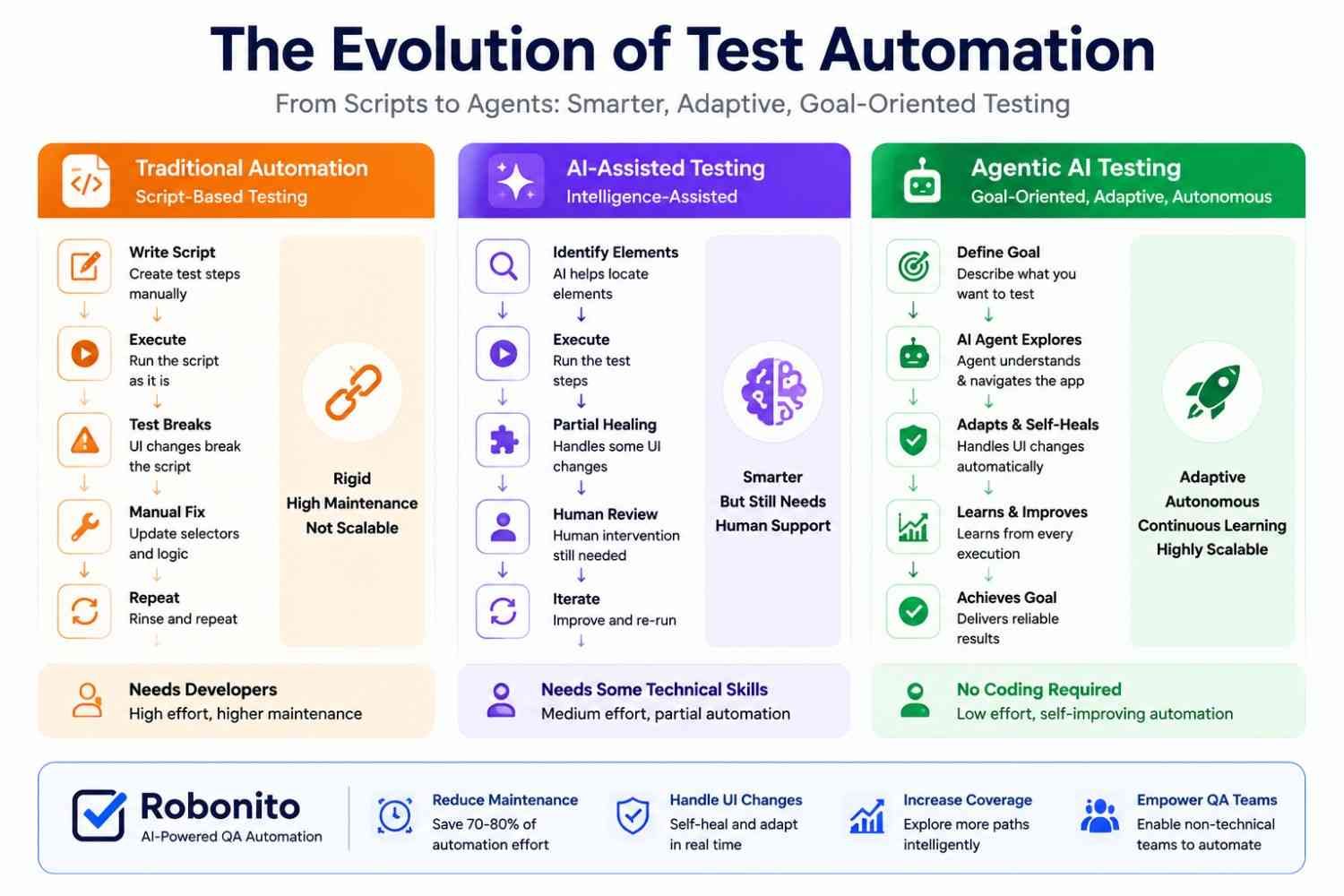
To understand why "agentic" matters, it helps to see what came before it.
Traditional test automation is deterministic. You write a script — or record a flow — and the tool replays it exactly. If a button ID changes, the test breaks. If a new step appears in the workflow, the test doesn't know. You fix it manually, re-run, and hope it holds until the next deploy.
AI-assisted test automation added a layer of intelligence. Tools started using machine learning to identify elements more reliably, suggest locators, or flag visual differences. This was a meaningful improvement, but the AI was still reactive. It helped you do the same things faster.
Agentic AI testing is fundamentally different. An AI agent doesn't just execute instructions — it pursues a goal. You tell it "test the checkout flow," and the agent navigates the application, makes decisions about what to click, handles unexpected modals or loading states, and adapts when the UI looks different than expected. If a new promotional banner appears between the cart and payment page, an agentic system recognizes it as a non-blocking change and continues the test. A traditional script would fail.
Agentic AI augments QA professionals by automating repetitive execution while leaving business judgment, exploratory testing, and risk analysis to humans.
Here's a concrete scenario: imagine your team tests a healthcare scheduling app. Every few sprints, the dev team rearranges the appointment booking wizard — steps get reordered, new fields appear, optional steps become mandatory. In a traditional framework, every change means updating selectors, adjusting wait times, and rewriting assertions. An agentic system, by contrast, understands the intent of the test ("book an appointment for a new patient") and figures out the current path to complete that goal, even when the specifics have changed.
The distinction matters because it determines who can maintain your test suite. Deterministic scripts need engineers. Agentic workflows need people who understand the product — and that's your QA team.
The biggest difference isn't that agentic AI executes tests differently. It's that your QA team spends more time validating quality and less time maintaining scripts.
Traditional Automation vs AI-Assisted vs Agentic AI
| Capability | Traditional Automation | AI-Assisted Testing | Agentic AI |
|---|---|---|---|
| Executes tests | ✅ | ✅ | ✅ |
| Adapts to UI changes | ❌ | Limited | ✅ |
| Makes decisions | ❌ | Limited | ✅ |
| Self-healing | ❌ | Partial | ✅ |
| Natural language | ❌ | Partial | ✅ |
| Coding required | High | Medium | Low / None |
| Best for | Stable apps | Faster automation | Rapidly changing products |
Why QA Leaders Are Talking About Agents in 2026
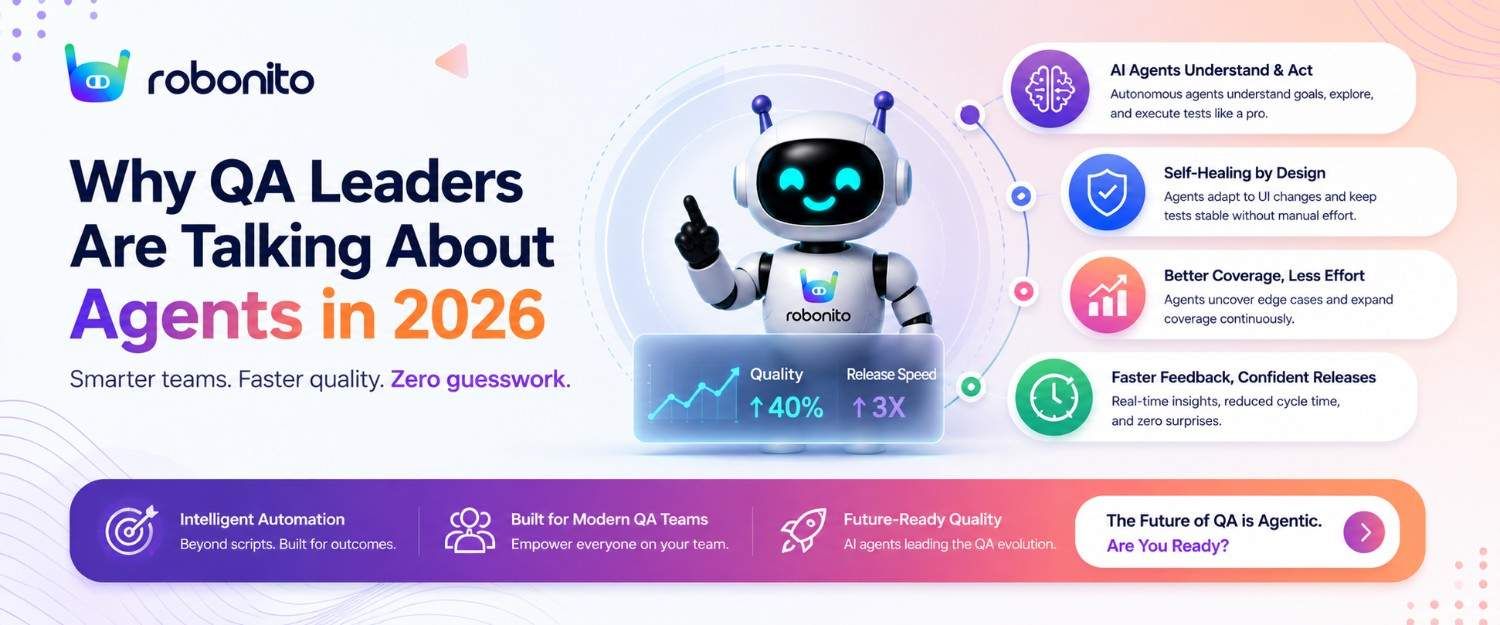
The agentic AI conversation isn't hype for hype's sake. Several real forces are driving the urgency:
Release velocity has outpaced manual testing capacity. Teams shipping weekly or daily simply cannot rely on manual regression passes. But traditional automation hasn't fully closed the gap because maintenance costs scale with every new test.
LLMs made natural language interfaces viable. Before GPT-class models, telling a computer "log in as an admin and verify the dashboard loads" required translation into code. Now, natural language instructions can be interpreted and executed with reasonable accuracy — making AI agents for software testing more than a theoretical possibility.
This evolution reflects broader industry trends rather than a single vendor movement. Gartner has identified AI-augmented software engineering as a major shift across the software development lifecycle, while Capgemini's 2025 World Quality Report highlights ongoing skills shortages in test automation. Together, these trends explain why organizations are investing in agentic AI that enables QA professionals to focus on product quality instead of automation maintenance.
Sources:
- https://www.gartner.com/en/articles/what-is-ai-augmented-software-engineering
- https://www.capgemini.com/research/world-quality-report/
The talent gap is real. There aren't enough SDETs (Software Development Engineers in Test) to staff every team. According to the 2025 World Quality Report, 60% of organizations cite a shortage of skilled test automation engineers. Agentic automation QA tools promise to redistribute testing power to domain experts who understand what to test, even if they can't write the how in Python or Java.
Applitools, among others, has validated the narrative. When a company known for visual AI testing starts publishing about agentic automation as a strategic direction, it signals a shift in how the industry defines modern QA. This isn't a startup pitch — it's becoming the vocabulary QA leaders are expected to understand.
For non-technical testing teams, the takeaway is clear: agentic AI isn't something that will happen to you. It's something being built for teams like yours — if the tooling gets the accessibility layer right. And that's where the current gap lies.
The same test written three ways — showing the progression:

── Traditional automation (Selenium/Cypress): ─────────────────

driver.findElement(By.id("login-email")).sendKeys("user@test.com");
driver.findElement(By.id("login-password")).sendKeys("TestPass123!");
driver.findElement(By.cssSelector(".btn-login-submit")).click();
driver.findElement(By.id("premium-plan-card")).click();
driver.findElement(By.cssSelector("input[data-discount]")).sendKeys("SAVE20");
// Breaks when: any ID changes, class renames, element restructures
// Who can maintain this: only an engineer

── AI-assisted (Playwright with ARIA): ────────────────────────

await page.getByLabel('Email').fill('user@test.com');
await page.getByLabel('Password').fill('TestPass123!');
await page.getByRole('button', { name: 'Sign in' }).click();
await page.getByRole('article', { name: 'Premium Plan' }).click();
await page.getByPlaceholder('Discount code').fill('SAVE20');
// Better: stable ARIA selectors, auto-waits
// Still breaks on: major restructures, new steps, modal popups
// Who can maintain this: engineers or trained QA with scripting

── Agentic no-code (Robonito): ────────────────────────────────

"Log in as a returning customer, select the Premium Plan,
apply discount code SAVE20, and complete checkout."

Agent interprets intent → navigates current UI state →
finds elements by context → handles unexpected modals →
adapts when checkout flow is restructured →
flags only genuine failures, not implementation changes
// Who can maintain this: anyone who knows the product
The Gap: Most Agentic Tools Still Require Engineering Skills
Here's the uncomfortable truth about most agentic AI testing products on the market today: they still assume you're an engineer.
Browse the documentation of leading agentic testing frameworks and you'll find YAML configuration files, API integrations that require scripting, agent orchestration layers that demand an understanding of prompt engineering, and debugging workflows that assume familiarity with developer tools. The concept is accessible. The implementation is not.
Consider a real example. A QA lead at a mid-sized fintech company evaluates a new agentic testing platform. The marketing promises "just describe your test in plain English." But during setup, the team discovers:
- They need to configure environment variables and authentication tokens manually.
- The agent's behavior needs to be tuned through a configuration schema that looks like code.
- When the agent takes a wrong path, debugging requires reading execution logs that resemble stack traces.
- Integrating with their CI/CD pipeline means editing YAML pipeline files directly.
The QA lead — someone with ten years of domain expertise in payment processing — abandons the tool after a week. Not because agentic testing doesn't work, but because the tool wasn't designed for someone like them.
This is the gap Robonito is built to close. The value of agentic AI isn't in the technology; it's in who gets to use it. If only developers can operate AI agents for software testing, you haven't democratized QA — you've just given developers another tool. True democratization means a manual tester with deep product knowledge can build, run, and maintain agentic tests without calling engineering for help.
What a No-Code Agentic Workflow Actually Looks Like in Practice
Let's make this tangible. Here's what an agentic workflow looks like when the tooling is designed for non-technical teams:
Step 1: Describe the test in plain language. You open Robonito and type: "As a returning customer, log in, add the 'Premium Plan' to cart, apply discount code SAVE20, and complete checkout with a saved credit card."
Step 2: The agent explores your application. Robonito's AI agent navigates your web app, identifying the login page, finding the Premium Plan product, locating the discount code field, and proceeding through checkout. It doesn't rely on pre-mapped selectors — it reads the interface the way a human tester would.
Step 3: You review and refine. The platform shows you a visual replay of what the agent did. You see each step, each decision it made. If the agent chose the wrong plan (maybe "Premium Plan" and "Premium Plus Plan" looked similar), you correct it once. The agent learns the distinction.
Step 4: The test runs autonomously going forward. On the next sprint, the dev team moves the discount code field from the cart page to the checkout page. The agent encounters the change, locates the field in its new position, applies the code, and completes the test. No broken selector. No midnight Slack message to the QA lead. No maintenance ticket.
Step 5: The agent flags meaningful changes. The discount code now returns an "Expired" error instead of applying successfully. The agent doesn't just keep going — it flags the failure and provides a screenshot, the expected behavior, and the actual result. This is a real bug, not a broken test.
This is what no-code AI testing tools should deliver: intelligence that handles the mechanics of testing so your team can focus on the judgment — deciding what to test, evaluating whether the results make sense, and communicating risk to stakeholders.
From Record to Self-Heal to Self-Expand: Robonito's Approach to Intelligent Automation
Robonito's evolution mirrors the industry trajectory, but with one crucial design principle: every capability must be usable by someone who has never written code.
Record: The Starting Point
Robonito began as a powerful no-code recorder. You click through your app, and Robonito captures the flow — no CSS selectors, no XPath expressions, no scripting. This alone solves a massive problem: it lets QA teams create automated tests in minutes instead of days.
But recording is still deterministic. A recorded test replays exactly what you did. If anything changes, it breaks.
Self-Heal: The Intelligence Layer
Robonito added self-healing capabilities that go beyond simple locator fallbacks. When the UI changes — a button is renamed, a form is restructured, a new modal appears — Robonito's AI identifies the intent of each step and finds the current way to accomplish it. In practice, this means teams using Robonito report up to 80% fewer test maintenance hours compared to traditional Selenium-based suites.
For example, a SaaS company testing their user onboarding flow found that their Selenium suite broke an average of 12 times per sprint due to UI iterations. After migrating to Robonito, breakages dropped to 1-2 per sprint — and those were genuine bugs, not test fragility.
Self-Expand: The Agentic Future
This is where Robonito is heading — and it's the piece that makes agentic automation QA real for non-technical teams. Self-expanding tests don't just heal when things change. They suggest new test paths based on application changes they observe.
Imagine the agent notices a new "Save as Draft" button on a form it tests regularly. It can flag this to your team: "New UI element detected in the order creation flow. Would you like me to create a test for the draft save functionality?" You approve it, and coverage expands without anyone writing — or even recording — a new test.
This is the practical promise of agentic AI for QA teams: not replacing testers, but amplifying their coverage and judgment.
Robonito CI/CD integration setup
Preparing Your QA Team for Agentic Workflows Without Retraining
One of the biggest fears among manual testers when "AI" enters the conversation is: Will I need to become a developer? The answer, with the right tooling, is no. But you will need to shift how you think about your role.
Here's what changes — and what doesn't:
What stays the same:
- Your domain expertise is more valuable, not less. Agentic systems need well-defined goals, and only someone who deeply understands the product can define what "correct" looks like.
- Exploratory testing remains critical. AI agents are excellent at regression coverage but don't replace the creative, skeptical thinking of a skilled tester probing edge cases.
- Communication skills matter. Translating test results into business risk for stakeholders is still a human job.
What shifts:
- From writing steps to defining intent. Instead of documenting "click the blue button in the top-right corner," you describe outcomes: "Verify that a new user can complete registration and land on the dashboard."
- From maintaining scripts to reviewing agent behavior. Your job becomes quality oversight — watching what the AI does and correcting it when its judgment is off.
- From reactive to strategic. When you spend 70% less time on maintenance, you can invest that time in test planning, risk assessment, and coverage analysis.
A practical example: A QA team at an e-commerce company transitioned from a fully manual regression process (3 days per release) to Robonito-powered agentic workflows. Within one month:
- The three manual testers on the team were running 4x more test coverage.
- None of them wrote a single line of code.
- Their sprint retrospectives shifted from "we couldn't test everything" to "here are the risk areas we want to expand coverage into next."
The retraining isn't technical. It's strategic. And most good QA professionals are already thinking this way — they just haven't had tools that let them act on it.
Practical First Steps: Adopting Agentic QA Without Overhauling Your Stack
You don't need to rip and replace your current testing infrastructure to start benefiting from agentic AI testing. Here's a phased approach that works for most teams:
Phase 1: Start With Your Most Fragile Tests (Week 1-2)
Identify the 5-10 automated tests that break most often. These are usually complex, multi-step flows through frequently changing UI — exactly where agentic intelligence delivers the most immediate value. Recreate them in Robonito using natural language descriptions and let the self-healing engine take over maintenance.
Success metric: Reduction in test maintenance tickets within two sprints.
Phase 2: Automate Your Manual Regression Backlog (Week 3-6)
Most teams have a spreadsheet or test management tool full of manual test cases they've never had time to automate. Pick the top 20 by business criticality. With no-code tools, a single QA analyst can automate 5-10 end-to-end flows per day — no engineering support needed.
Success metric: Percentage of critical flows covered by automated tests.
Phase 3: Integrate Into CI/CD and Close the Loop (Week 6-8)
Connect your Robonito tests to your existing CI/CD pipeline. This doesn't require editing pipeline code — Robonito provides integrations for Jenkins, GitHub Actions, GitLab CI, and others that can be configured through the UI. Now your agentic tests run on every deploy, and your team gets notified of real failures in real time.
Success metric: Time from code merge to test feedback.
Phase 4: Enable Agent Suggestions and Expand Coverage (Ongoing)
As your agentic tests run across multiple releases, they build a model of your application's behavior. Enable Robonito's expansion suggestions and let the system recommend new test scenarios based on observed changes. Review and approve suggestions weekly as a team ritual.
Success metric: Test coverage growth rate without proportional effort increase.
The key insight is that you don't need to adopt "agentic AI" as a big-bang transformation. You adopt it incrementally, starting with the pain points your team already feels today, and let the intelligence compound over time.
Frequently Asked Questions
What is agentic AI testing in simple terms — for non-technical testers?
Agentic AI testing is a testing approach where an AI agent pursues a goal rather than replaying fixed instructions. Instead of scripting "click button ID #submit," you tell the agent "complete the checkout as a returning customer." The agent navigates the application, makes decisions about what to click, adapts when the UI changes between releases, and flags genuine failures rather than breaking on irrelevant implementation changes. Traditional automation executes scripts; agentic testing understands intent. For non-technical QA teams, this matters because domain expertise — knowing what to test — becomes more important than coding skills, and the tools should reflect that shift.
Do non-technical QA teams need to learn coding to use agentic AI testing?
No — provided the agentic testing tool was designed for non-technicalusers. Most agentic testing platforms currently available still require YAML configuration, scripting for CI/CD integration, and engineering involvement to debug agent behavior. This is the gap between the agentic AI concept and current tooling. Platforms like Robonito are specifically designed so that QA analysts with no coding background can describe tests in natural language, review visual replays of agent behavior, and correct misinterpretations without submitting a developer ticket. The key question when evaluating any agentic tool is not "can an engineer use this" but "can a QA analyst with ten years of domain expertise use this independently."
What is the difference between traditional automation, AI-assisted testing, and agentic AI testing?
Traditional automation replays fixed scripts deterministically — if anything in the UI changes, the test breaks. AI-assisted testing adds intelligence to make element identification more reliable and catch visual regressions, but the AI remains reactive. Agentic AI testing is fundamentally different: an agent pursues a goal, adapts to what it finds in the current state of the application, and makes decisions without human instruction for every step. A traditional test says "click element ID #checkout-btn." An agentic test says "complete the checkout flow" and figures out the current path to do so, even when steps have been reordered or new fields have been added.
Will agentic AI testing replace QA professionals?
No. Agentic AI testing replaces repetitive execution — the scripting, the selector maintenance, the manual regression replaying. It does not replace the judgment that experienced QA professionals bring: defining what correct behaviour looks like, evaluating whether test results indicate real risk, designing coverage for edge cases the AI has not encountered, and communicating quality concerns to stakeholders in business terms. The teams that benefit most from agentic automation are those whose QA professionals can redirect time from mechanical execution toward strategic work — test planning, risk analysis, and exploratory testing. Domain expertise becomes more valuable, not less.
How do you start adopting agentic AI testing without overhaulingyour existing test infrastructure?
Start with your five to ten most fragile tests — the ones that break most often due to UI changes rather than genuine bugs. Recreate them in a no-code agentic platform using natural language descriptions. Run them in parallel with your existing tests for two sprints, comparing failure rates and maintenance time. If the agentic tests require significantly less maintenance without missing real bugs, migrate the next batch. CI/CD integration comes after you have confidence in the test quality, not before. The adoption should be incremental rather than a platform-wide switch — you are building confidence in the agent's judgment before extending its autonomy.
Ready to See Agentic AI Testing Without the Code?
The future of QA automation isn't about replacing testers — it's about giving non-technical testing teams the same power that only engineering-heavy organizations have had until now. Agentic workflows, self-healing tests, and natural language test creation aren't buzzwords when they're built into a tool designed for people like you.
Robonito gives your QA team agentic intelligence with zero code required. No selectors. No scripts. Minimal retraining Just describe what you want to test, and let the AI handle the rest.
Start your free trial of Robonito today and see how your first agentic test takes minutes — not sprints — to create.
Automate your QA — no code required
Stop writing test scripts.
Start shipping with confidence.
Join thousands of QA teams using Robonito to automate testing in minutes — not months.