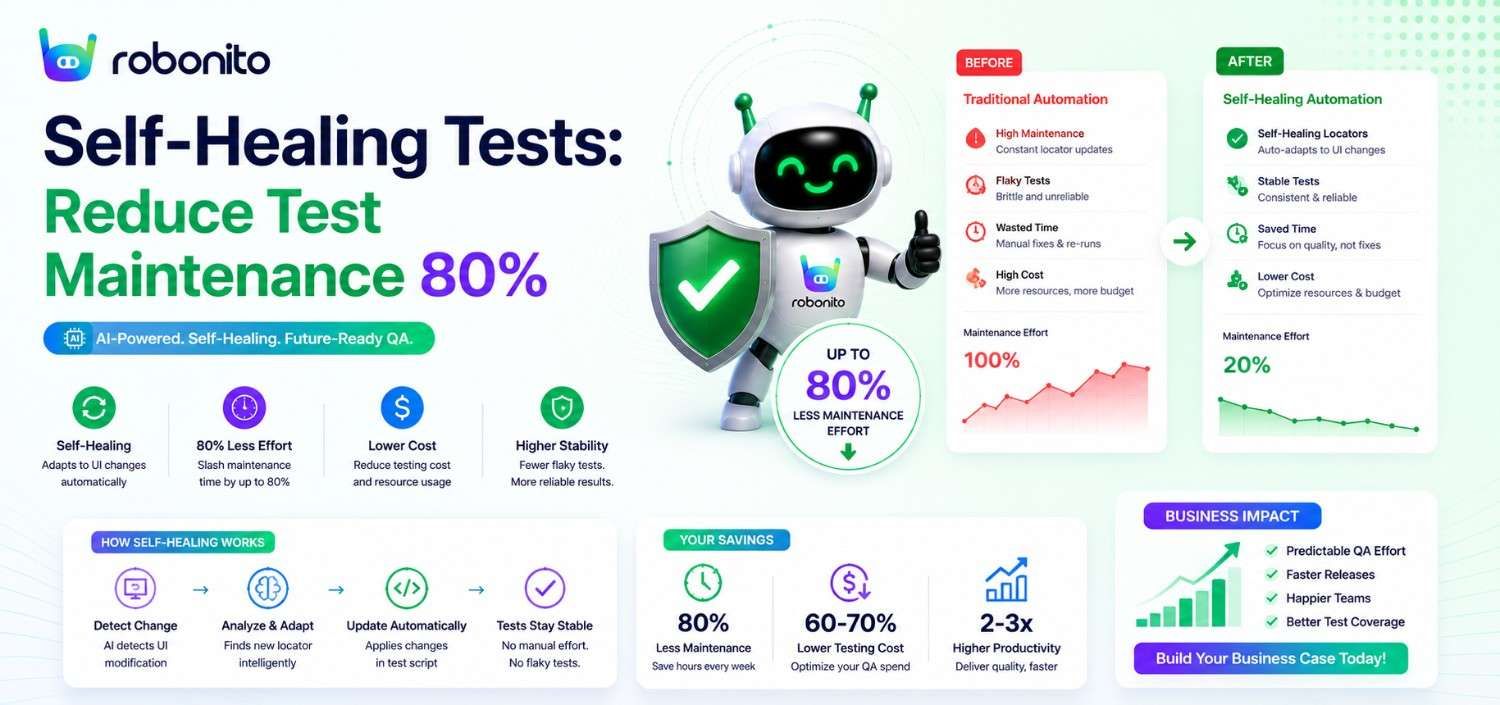
Every QA team knows the feeling: you ship a beautiful suite of 500 automated tests, and within three months, half of them are failing — not because the product is broken, but because a developer renamed a button or moved a modal. You're not catching bugs. You're babysitting scripts. The dirty secret of test automation is that most teams spend more time maintaining tests than writing new ones, and the compounding cost is brutal. What if you could reduce test maintenance cost by 80% and redirect those engineering hours toward work that actually moves the product forward? That's not a hypothetical. It's what happens when you stop patching brittle locators and start using tests that heal themselves.
The Hidden Cost of Test Maintenance: What Teams Actually Spend
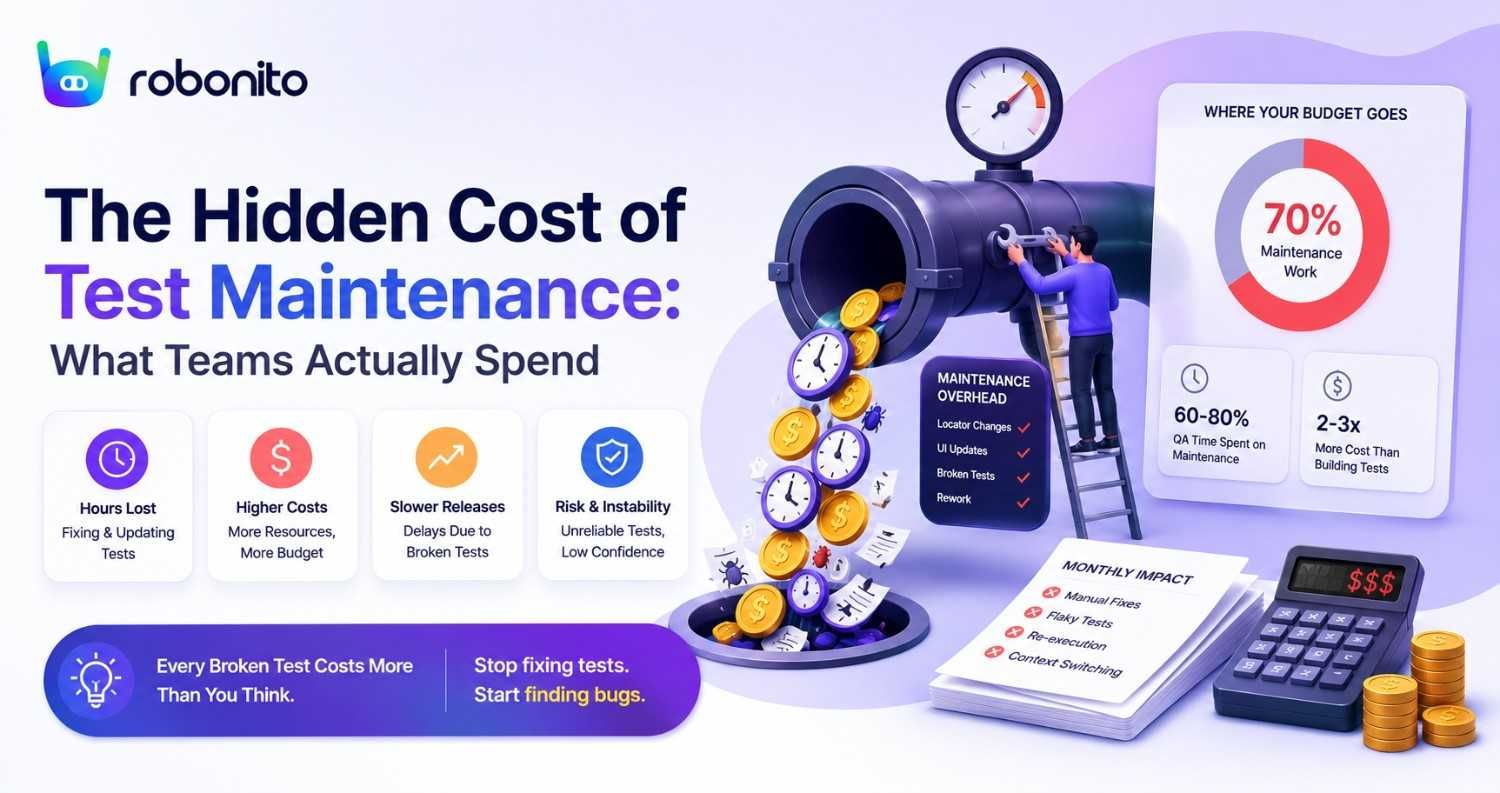
Most organizations often underestimate how much test maintenance costs because the expense doesn't show up on a single line item. It's distributed across sprint cycles as "flaky test investigation," embedded in standup updates as "updating the regression suite," and buried in opportunity cost when QA engineers who could be exploratory testing are instead debugging a Selenium selector that broke because someone changed a div to a section.
Let's put real numbers on it. Industry benchmarks from Capgemini's World Quality Report consistently show that 20–40% of total QA effort goes to maintaining existing automated tests. For a team of five QA engineers at an average fully loaded cost of $120,000/year, that's:
- Conservative (20%): $120,000/year spent on maintenance
- Typical (30%): $180,000/year
- High-churn UI (40%): $240,000/year
And that's just direct labor. Factor in the indirect costs — delayed releases because the regression suite is red, developer time spent triaging false failures, and the slow erosion of confidence that leads teams to skip automated tests entirely — and the real number can double.
Consider a Series B startup with 15 microservices and a React frontend that redesigns its dashboard every quarter. Their QA lead told us they were spending three full days per sprint just keeping existing Cypress tests green. That's not affordable QA automation — that's an automation tax.
The problem isn't that these teams chose the wrong tool from an automation testing tools list. The problem is structural: traditional test automation creates a linear relationship between UI change velocity and maintenance burden. The faster your product evolves, the more your tests break. Why traditional test automation fails fast-moving teams
Why Traditional Test Automation Creates an Ever-Growing Maintenance Backlog
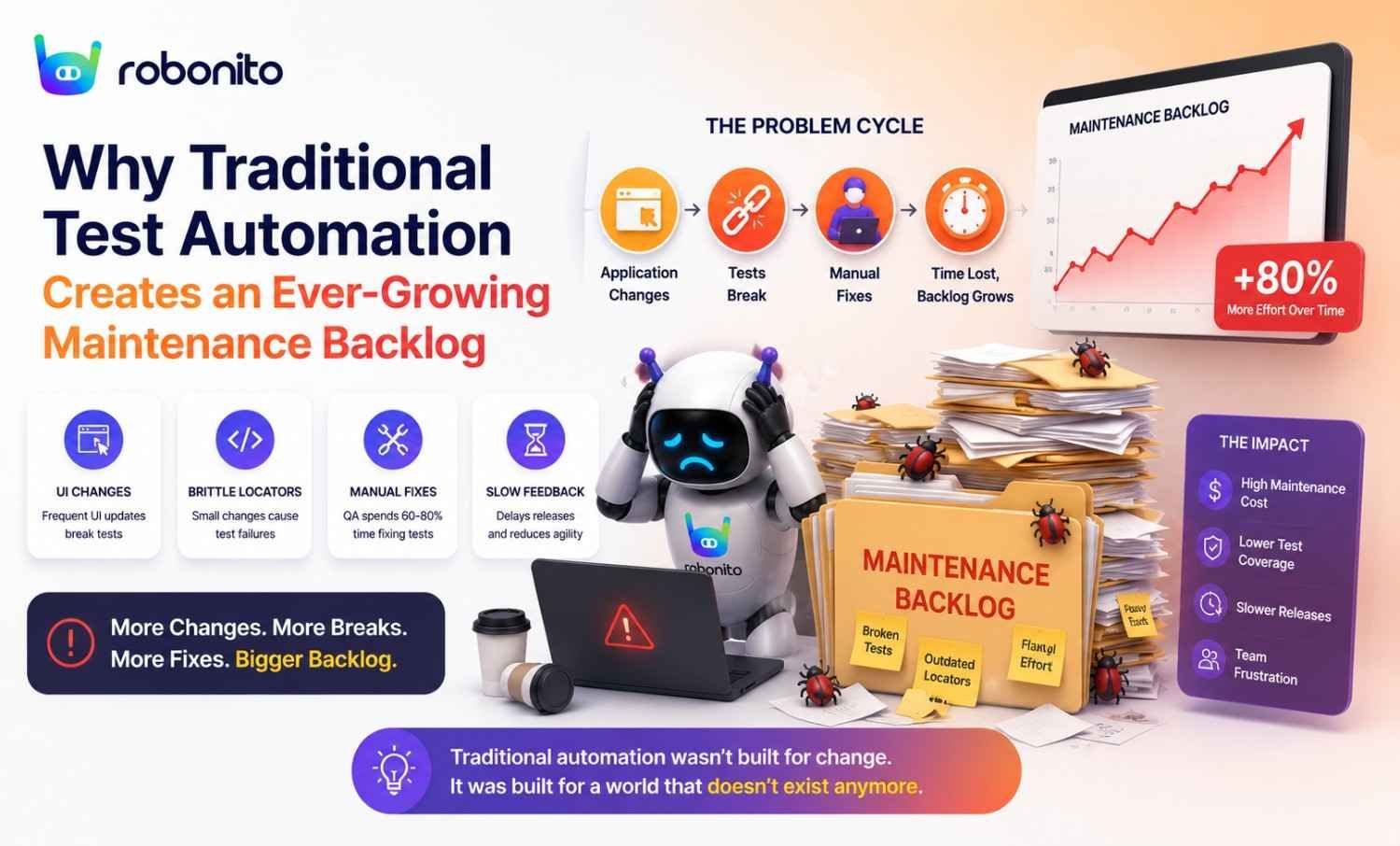
To understand why maintenance costs compound, you need to understand what breaks and why.
Traditional end-to-end test automation tools — Selenium, Cypress, Playwright — rely on locator strategies to find elements on a page. These locators are typically CSS selectors, XPath expressions, or data-test attributes. Every locator is a coupling point between your test and your UI's implementation details.
Here's how the backlog grows:
- Locator fragility. A developer refactors a component, changing
#submit-btntobutton[data-action="submit"]. One test breaks. Multiply by every refactor, every sprint. - Timing dependencies. An API gets 200ms slower. A
waitForElementtimeout expires. The test is now flaky — not broken, not passing, just unreliable enough to erode trust. - Cascade failures. A login flow locator breaks, and suddenly 60% of your suite fails because every test starts with login.
- Maintenance debt prioritization. Teams defer fixes because "it's just a flaky test." Debt accumulates until the suite is more noise than signal.
A mid-size e-commerce team we spoke with had 1,200 Selenium tests. After a frontend migration from Angular to React, over 400 tests broke simultaneously — none due to actual bugs. The team spent six weeks rebuilding locators. During those six weeks, they shipped zero new test coverage and missed a critical payment flow regression that reached production.
This is the maintenance trap. The more tests you write, the more maintenance you inherit. Teams hit an inflection point — usually around 300–500 tests — where the cost of maintaining existing tests exceeds the value of adding new ones. At that point, your automation investment is underwater.
The only way to break the cycle is to decouple tests from implementation details entirely.
How Self-Healing Tests Work Under the Hood
Self-healing is not magic, and understanding the mechanism matters when you're evaluating whether it's a gimmick or a genuine architectural shift.
At its core, a self-healing test engine does three things:
1. Multi-Signal Element Identification
Instead of relying on a single CSS selector, a self-healing system identifies elements using a weighted combination of signals: visual appearance, position relative to other elements, associated text labels, ARIA roles, element type, and historical interaction data. When one signal breaks (e.g., a CSS class changes), the other signals still resolve to the correct element.
Think of it like recognizing a friend. If they get a haircut, you still know who they are because you're using their face, voice, height, and context — not just their hairstyle.
// ─── Traditional locator (single point of failure) ──────────────────
await page.locator('#submit-btn').click();
// Breaks the moment the ID changes — one signal, one failure mode

// ─── Self-healing: multi-signal identification ───────────────────────
// Test authored as intent: "Click the Submit Order button"
//
// At runtime, the engine evaluates multiple independent signals:
const signals = {
  ariaRole:       "button",              // confidence: 1.00
  accessibleName: "Submit Order",        // confidence: 0.96
  visualPosition: "bottom-of-checkout",  // confidence: 0.90
  formContext:    "within-order-form",   // confidence: 0.88
};

// Combined confidence determines the action:
const combinedConfidence = 0.93;

if (combinedConfidence >= 0.85) {
  // Heal automatically — log the change, continue execution
  // Old: #submit-btn  →  New: button[data-action="submit"]
} else {
  // Confidence too low to act autonomously — flag for human review
  // with full evidence (screenshot, signal breakdown, before/after)
}
2. Automatic Locator Recovery
When the primary locator fails, the system doesn't just throw an error. It dynamically queries the page using alternative signals, identifies the most probable matching element, and continues test execution. This happens in milliseconds, at runtime, with no human intervention.
3. Confidence Scoring and Reporting
Good self-healing systems don't silently guess. They assign a confidence score to each healed interaction. If the confidence is high (e.g., the button still says "Submit" and is in the same form), the test proceeds. If confidence drops below a threshold, the system flags it for human review rather than producing a false pass.
Robonito's self-healing engine takes this further by eliminating locators from the authoring process entirely. Because tests are created in natural language — "Click the Submit Order button" — there's no brittle selector to break in the first place. The AI resolves intent to elements at runtime, every time. How Robonito's self-healing technology works
This isn't an incremental improvement. It's a different architecture for test execution, and it significantly changes the maintenance equation.
Real Math: Calculating Your Test Maintenance Cost Reduction
Let's move from theory to a formula you can apply to your own team. Here's a straightforward framework for estimating what self-healing saves you.
Step 1: Measure your current maintenance burden.
Track these metrics over two sprints:
- Hours per sprint spent fixing broken tests (not writing new ones)
- Number of test failures caused by UI changes vs. actual bugs
- Average time to fix a single broken test
Step 2: Calculate your annual maintenance cost.
Annual Maintenance Cost = (Hours/sprint × Sprints/year) × Fully Loaded Hourly Rate
For example: 24 hours/sprint × 26 sprints/year × $65/hour = $40,560/year
Step 3: Apply the self-healing reduction.
Based on data from teams that have migrated to self-healing frameworks, 70–90% of UI-change-related failures are automatically resolved without human intervention. Using a conservative 80%:
Annual Savings = $40,560 × 0.80 = $32,448/year
For a five-person QA team with a heavier maintenance load, we've seen the savings climb to $150,000–$200,000 annually.
This compounding effect is consistent with DORA's research on deployment confidence, which found that teams with stable, trustworthy test suites deploy significantly more frequently than teams whose automation has eroded into background noise.
Step 4: Factor in productivity gains.
The hours you reclaim don't just save money — they generate value. Redirected to new test coverage, exploratory testing, or shift-left testing, those hours compound. Teams using Robonito typically report a 40–60% increase in new test creation velocity after eliminating the maintenance treadmill.
A fintech startup with a three-person QA team calculated their maintenance cost at $90,000/year. After switching to Robonito, their maintenance dropped to under $15,000/year, and they used the freed capacity to achieve 90% end-to-end test coverage — up from 45%. The ROI wasn't just cost savings; it was the coverage they could never afford to build before.
Self-Healing vs. Visual AI vs. Manual Fixes: A Maintenance Strategy Comparison
Applitools and others have been making the case that Visual AI is the answer to test maintenance. It's a compelling pitch — compare screenshots instead of checking DOM elements, and you sidestep locator fragility. But it's important to understand where each approach actually shines and where it falls short. Applitools' Visual AI approach
| Factor | Manual Fixes | Visual AI | Self-Healing (Robonito) |
|---|---|---|---|
| Maintenance reduction | 0% (baseline) | 30–50% | 70–90% |
| Handles functional assertions | Yes | Limited (visual only) | Yes |
| Handles layout changes | Yes (manual) | Excellent | Good (intent-based) |
| Works for data-driven tests | Yes | Poorly (dynamic content breaks screenshots) | Yes |
| Setup complexity | Low | Medium (baseline management) | Low (natural language) |
| Cost at scale | High (labor) | Medium-High (licensing + labor) | Low |
| False positive rate | Low | Medium (pixel sensitivity) | Low (confidence scoring) |
Visual AI excels at catching visual regressions — pixel shifts, font changes, layout breaks. But it's not a complete replacement for functional test automation. You still need to validate that clicking "Add to Cart" actually adds an item to the cart, not just that the button looks right. Visual AI also struggles with dynamic content: dashboards with live data, timestamps, or user-generated content generate constant false positives that require baseline management — which is its own form of maintenance.
Self-healing addresses the root cause of most maintenance: the coupling between tests and DOM structure. It's not either/or — some teams use Visual AI for design system regression and self-healing for functional end-to-end test automation — but if you have to choose one strategy to reduce test maintenance cost, self-healing delivers broader coverage of the problem.
Where Self-Healing Still Needs Human Judgment
Self-healing dramatically reduces maintenance caused by UI changes, but it does not replace thoughtful test design.
Teams still need humans to:
- define correct assertions,
- validate business rules,
- review low-confidence healing events,
- design exploratory testing,
- investigate genuine regressions.
The goal is to automate repetitive maintenance—not engineering judgment.
For budget-conscious teams (the kind searching "affordable QA automation Reddit" for real answers), the calculus is clear. Self-healing eliminates the highest-volume category of maintenance work without requiring expensive per-user visual AI licensing.
Traditional Automation vs Self-Healing Automation
| Area | Traditional Automation | Self-Healing Automation |
|---|---|---|
| Element identification | CSS selectors, XPath, IDs | Context-aware element recognition |
| Response to UI changes | Manual updates required | Adapts automatically to many routine changes |
| Maintenance effort | Increases as the suite grows | Lower maintenance as the suite scales |
| Failure pattern | Frequent false failures after UI updates | Fewer false failures from locator changes |
| Team dependency | Requires automation engineers | Easier for QA teams using no-code workflows |
| Best fit | Stable applications with technical QA teams | Fast-changing products with growing regression suites |
How to Migrate Flaky Legacy Tests to a Self-Healing Framework
If you have an existing suite of Selenium, Cypress, or Playwright tests, migration doesn't have to be a big-bang rewrite. Here's a practical, phased approach.
Phase 1: Triage Your Existing Suite (Week 1)
Categorize every test by maintenance frequency:
- Green: Stable, rarely breaks. Low priority for migration.
- Yellow: Breaks 1–2 times per quarter. Moderate priority.
- Red: Breaks every sprint or is permanently skipped. Migrate first.
Most teams find that 20% of their tests generate 80% of their maintenance work. Start there.
Phase 2: Recreate Red Tests in Natural Language (Weeks 2–3)
Using Robonito, recreate your highest-maintenance tests using plain-language steps. For example, a Selenium test with 15 XPath locators and 8 explicit waits for a checkout flow becomes:
- Go to the product page for "Wireless Headphones"
- Click "Add to Cart"
- Go to the cart
- Click "Proceed to Checkout"
- Fill in the shipping form with test data
- Click "Place Order"
- Verify the confirmation page shows "Order Confirmed"
No selectors. No waits. No page object models. The AI handles element resolution at runtime. Getting started with Robonito in 15 minutes
Phase 3: Run in Parallel (Weeks 3–4)
Run both your legacy tests and new Robonito tests simultaneously for two sprints. Compare:
- Failure rates (UI-change failures vs. real bugs)
- Time spent on maintenance per suite
- Coverage gaps
Phase 4: Decommission and Expand (Ongoing)
As confidence grows, retire legacy tests starting with the red category. Redirect reclaimed hours to expanding coverage into untested flows.
A B2B SaaS team migrated their 80 most flaky Playwright tests to Robonito over three weeks. In the following quarter, those 80 tests required zero maintenance interventions, compared to an average of 12 per sprint previously. They then migrated the remaining 200 tests over the next two months.
Building a Business Case for Self-Healing QA Automation
If you're a QA lead or engineering manager reading this, you probably already believe the technical argument. The challenge is getting buy-in from leadership. Here's how to frame it.
Frame It as Cost Avoidance, Not Just Savings
Leadership responds to "we'll avoid spending $180K next year on maintenance" more than "our tests will be less flaky." Use the calculation framework from the earlier section with your team's actual numbers. Nothing persuades a CFO like a spreadsheet with their own data.
Quantify the Opportunity Cost
Every hour spent fixing a broken locator is an hour not spent on:
- New test coverage for features shipping this quarter
- Exploratory testing that catches the bugs automation misses
- Performance or accessibility testing that you "never have time for"
Frame self-healing as a force multiplier — you're not replacing QA engineers, you're making each one 3–5x more effective.
Address the "What If It Heals Wrong?" Objection
This is the most common pushback, and it's valid. The answer: confidence scoring and transparent reporting. Robonito logs every healed interaction, shows what changed, and flags low-confidence heals for review. You're not blindly trusting AI — you're using AI to handle the 80% of maintenance that's routine while focusing human judgment on the 20% that matters.
Start with a Pilot
Propose a 30-day pilot with your 20 most-maintained tests. Define success criteria upfront:
- Maintenance hours reduced by >50%
- Zero real bugs missed
- QA team satisfaction score
A pilot limits risk and generates the internal data you need to justify a full rollout. Most teams that run this pilot don't go back.
Tie It to Release Velocity
The ultimate argument: fewer broken tests → more trustworthy test suite → faster release decisions → faster time to market. For a startup shipping weekly, cutting your QA bottleneck directly impacts revenue.
Ready to Stop Paying the Maintenance Tax?
Your QA team's job is to ensure quality — not to spend half their week updating CSS selectors that broke because a developer changed a class name. Self-healing tests aren't a luxury feature. For teams that want affordable QA automation that scales with their product, they're a fundamental shift in how testing economics work.
Robonito gives you self-healing end-to-end test automation with zero code, no manual CSS selector, or XPath maintenance treadmill. Tests are written in natural language, adapt to UI changes automatically, and integrate with your existing CI/CD pipeline.
Frequently Asked Questions
How much does test maintenance actually cost a QA team?
Industry benchmarks from the Capgemini World Quality Report consistently show that 20–40% of total QA effort goes to maintaining existing automated tests rather than creating new coverage. For a five-person QA team at an average fully loaded cost of $120,000 per year, that translates to $120,000–$240,000 annually spent keeping existing tests passing rather than expanding coverage. The real cost is often higher once delayed releases, developer time spent triaging false failures, and the gradual erosion of trust in the test suite are factored in.
What causes most automated test failures — bugs or maintenance issues?
The majority of automated test failures in traditional frameworks (Selenium, Cypress, scripted Playwright) are caused by UI implementation changes — a renamed CSS class, a restructured component, a moved element — rather than actual product defects. These failures occur because traditional locator strategies (CSS selectors, XPath) create a tight coupling between the test and the UI's implementation details. When that implementation changes, even without any functional impact, the test breaks. Self-healing test automation specifically targets this category of failure.
How much can self-healing tests actually reduce maintenance cost?
Teams that adopt self-healing test automation typically see 70–90% of UI-change-related test failures resolved automatically without human intervention. Using a conservative 80% reduction on a team spending $40,000 per year on maintenance, that represents roughly $32,000 in annual savings — plus the compounding value of redirecting reclaimed hours toward new test coverage rather than upkeep. Teams with heavier maintenance loads (frequent UI redesigns, larger suites) often see savings in the $150,000–$200,000 range annually.
Is self-healing test automation different from Visual AI testing?
Yes. Visual AI tools (such as Applitools) compare screenshots to catch unintended visual regressions — layout shifts, font changes, broken rendering — and typically reduce maintenance by 30–50%. Self-healing test automation addresses a broader category of failure by decoupling the test from DOM structure entirely, using multi-signal element identification (ARIA role, accessible name, visual position, context) rather than a single fragile locator. Visual AI excels at design system regression; self-healing addresses functional test stability more comprehensively. Many mature QA strategies use both together rather than choosing one over the other.
How do you migrate an existing test suite to self-healing automation without a full rewrite?
Migration does not require replacing an entire suite at once. The practical approach is four phases: triage existing tests by maintenance frequency (most teams find 20% of tests generate 80% of maintenance work), recreate the highest-maintenance tests first using natural language authoring, run legacy and self-healing tests in parallel for two sprints to compare failure rates and maintenance time, then progressively decommission legacy tests and redirect reclaimed capacity toward new coverage. Teams typically migrate their most flaky 15–20% of tests within 2–3 weeks before expanding further.
What happens when a self-healing test heals incorrectly?
A well-designed self-healing system does not silently guess — it assigns a confidence score to every healed interaction based on how many independent signals (ARIA role, accessible name, visual position, surrounding context) agree on the match. When confidence is high, the system heals automatically and logs the change for audit. When confidence falls below a defined threshold, the system halts and flags the test for human review with full evidence rather than producing a false pass. This confidence-based approach means teams are not blindly trusting AI — they are using automation for the routine majority of cases while reserving human judgment for genuinely ambiguous ones.
Start your free trial → Create your first self-healing test in under 15 minutes. No credit card. No code. No more babysitting broken tests.
Automate your QA — no code required
Stop writing test scripts.
Start shipping with confidence.
Join thousands of QA teams using Robonito to automate testing in minutes — not months.