
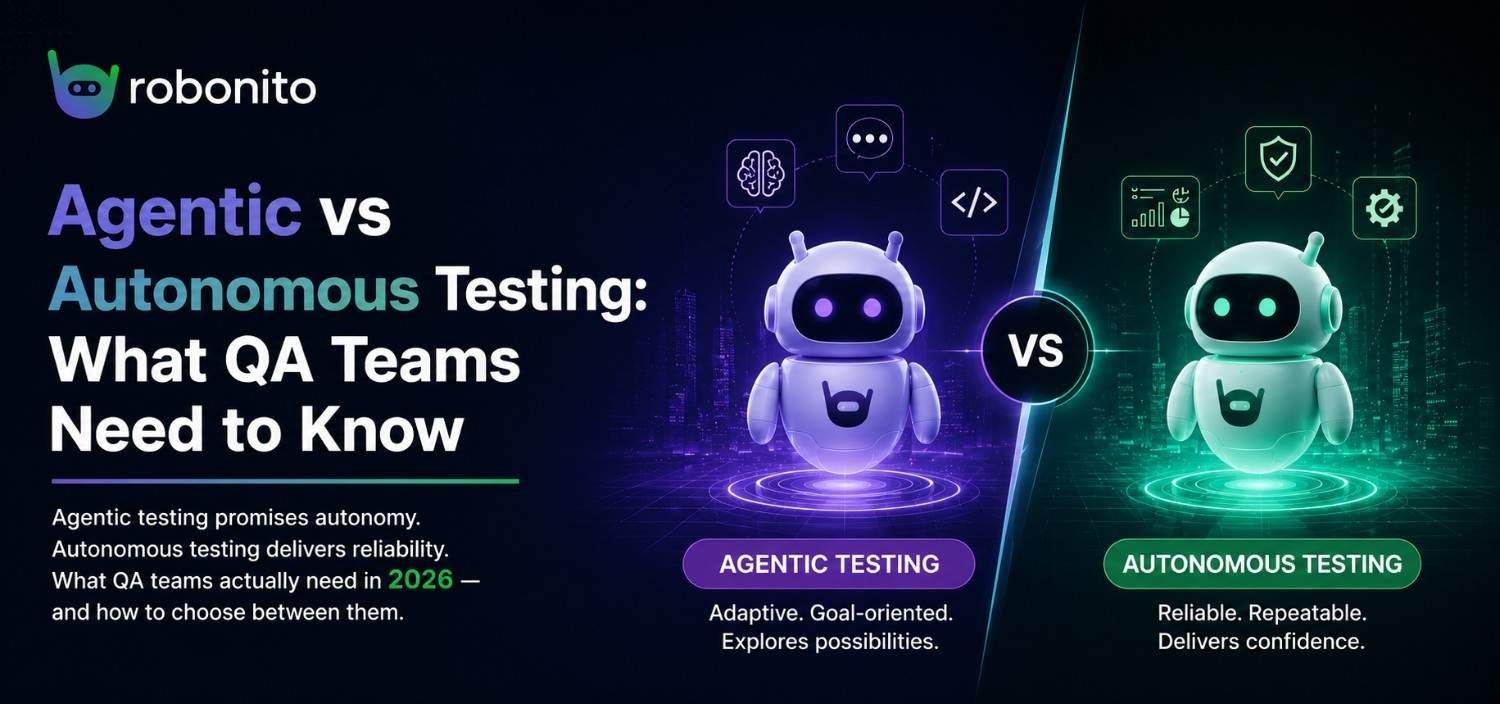
Every quarter, a new AI testing buzzword captures the industry's attention — and "agentic" is doing the heavy lifting heading into 2026. Vendors are racing to attach it to their platforms, and QA leaders are left trying to figure out what's genuinely new versus what's repackaged marketing.
If you've been searching for clarity on agentic testing vs autonomous testing, you're not alone. The distinction matters, but probably not in the way most vendor landing pages suggest. What actually matters is whether your team can ship reliable software faster without adding headcount, complexity, or months of onboarding.
This guide breaks down the real differences, cuts through the positioning, and gives you a practical framework for choosing the right AI testing approach in 2026.
Key Takeaways
- Agentic testing is the most ambitious end of the AI testing spectrum — AI agents that independently plan, execute, and adapt test strategies. Most implementations are still maturing.
- Autonomous testing is the broader, more proven category — self-healing tests, auto-generated coverage, and intelligent maintenance that works reliably today.
- No-code AI testing occupies the practical sweet spot for most teams: autonomous reliability with the accessibility that agentic testing promises, available now.
- Self-healing tests deliver the highest day-to-day ROI of any AI testing capability — more than full agentic autonomy — because they solve the maintenance collapse problem that kills most automation initiatives.
- The right evaluation framework focuses on time to first meaningful test, who can actually use the tool, and maintenance burden after six months — not the marketing category a vendor uses.
What Is Agentic Testing and Why Is Everyone Talking About It?
Agentic testing refers to an approach where AI agents can independently plan, execute, and adapt test strategies with minimal human direction. Think of an agent as a small, goal-oriented AI system: you give it an objective like "verify the checkout flow works for returning customers," and it figures out the steps, navigates the application, handles unexpected states, and reports back.
The concept borrows from the broader agentic AI movement in software engineering, where LLM-powered agents are being applied to code generation, debugging, and now QA. The promise is compelling:
- Reduced test maintenance: Agents could theoretically adapt to UI changes without brittle selectors breaking
- Exploratory coverage: Agents might discover edge cases that scripted tests miss
- Lower reliance on specialized QA engineers: If the AI plans and executes, fewer people need to write and maintain tests
Here's the honest assessment, though. Most agentic testing platforms in 2026 are still maturing. In documented pilots, teams have reported generating large numbers of AI-created test scenarios where a significant portion turned out to be duplicates, irrelevant to business-critical flows, or requiring heavy human review before being usable. The concept is promising; the production-readiness varies significantly by platform.
Agentic doesn't mean accurate, and autonomy without reliability creates more work, not less. That gap is the central tension QA leaders need to navigate right now.
Autonomous Testing Explained: How It Differs from Traditional Automation
Autonomous testing is a broader, more established category. It describes any testing approach where the system can execute, maintain, and sometimes generate tests with reduced human intervention. Where traditional test automation requires engineers to write scripts (in Selenium, Cypress, Playwright, or similar frameworks) and manually update them when the UI changes, autonomous testing platforms aim to handle much of that lifecycle automatically.
The key capabilities that define autonomous testing tools:
- Self-healing locators: When a button's ID or class name changes, the tool automatically finds the right element instead of failing the test
- Auto-generated tests: Some platforms record user flows or analyze the application to suggest or create tests
- Intelligent scheduling and execution: Tests run when triggered by deployments, code changes, or risk signals — not rigid cron schedules
- Result interpretation: Instead of raw pass/fail data, autonomous platforms surface meaningful failures and suppress noise
How is this different from agentic testing? In practice, agentic testing is a subset of autonomous testing — the most ambitious end of the spectrum where the AI actively reasons and makes decisions. Autonomous testing is the umbrella that also includes more proven, more constrained approaches like self-healing tests and smart test maintenance.
Consider a practical scenario: your development team pushes a UI update that renames several CSS classes across the checkout flow. In traditional automation, 15 tests break overnight, and your QA engineer spends the morning fixing selectors. In autonomous testing with self-healing, those tests adapt automatically — zero human intervention, zero false failures in the morning standup. In a fully agentic system, the AI might also notice the UI change, generate new tests for the altered components, and flag potential regression risks it identified independently.
The autonomous approach is battle-tested. The fully agentic approach is aspirational. For most teams, the question isn't which sounds more impressive — it's which actually works reliably today.
Agentic vs. Autonomous vs. No-Code AI Testing: A Comparison Framework
The market is confusing because these categories overlap. Here's a framework to help QA leaders evaluate what they're actually getting when a vendor uses these terms.
| Dimension | Traditional Automation | No-Code AI Testing | Autonomous Testing | Fully Agentic Testing |
|---|---|---|---|---|
| Test creation | Manual scripting | Visual/natural language | AI-assisted or auto-generated | AI-planned and generated |
| Test maintenance | Fully manual | Low-maintenance, self-healing | Self-healing + auto-updating | Agent-managed |
| Skill required | Developers/SDETs | Anyone on the QA team | QA engineers with AI oversight | Minimal (in theory) |
| Reliability today | High (if maintained) | High | High | Variable — still maturing |
| Time to value | Weeks to months | Hours to days | Days to weeks | Weeks to months (pilot + tuning) |
| Best for | Teams with deep engineering resources | Teams needing speed and accessibility | Teams reducing maintenance at scale | Orgs willing to invest in early-stage AI |
What this framework reveals: no-code AI testing with self-healing capabilities occupies the practical sweet spot for most QA teams in 2026. It delivers the reliability and reduced maintenance of autonomous testing, the accessibility that agentic testing promises, and it's proven in production today.
A useful way to think about the evaluation: a team with 3-6 QA engineers, no dedicated SDETs, and a release cadence of weekly or faster is better served by a no-code autonomous tool than by a fully agentic platform that requires configuration, tuning, and supervision. The agentic bet is worthwhile for organizations with dedicated AI tooling teams and appetite for longer deployment timelines.
What QA Leaders Should Prioritize When Evaluating AI Testing Tools
Forget the marketing categories for a moment. When evaluating AI testing platforms, these are the dimensions that predict whether a tool will succeed or become shelfware within six months:
1. Time to First Meaningful Test
How long from signup to a real test running against your actual application? If the answer involves "setting up an agent framework" or "a two-week onboarding engagement," that's a red flag for teams that need results now. Strong tools let your team run a meaningful end-to-end test in the first session.
2. Who Can Actually Use It
If only your senior SDET can operate the tool, you've created a new bottleneck. Ask: can a manual QA tester or a product manager create a test? If yes, you've multiplied your QA capacity without adding headcount.
3. Failure Signal Quality
A tool that produces 200 test results but can't distinguish a real bug from a flaky test is worse than no automation. Prioritize platforms that give clean, actionable failure signals — visual diffs, clear error descriptions, and intelligent noise suppression.
4. Maintenance Burden Over 6 Months
Every tool demos well. Ask vendors directly: "What percentage of tests require manual intervention after a typical UI change?" Ask for a customer reference who can speak to test suite stability over a year of product evolution.
5. CI/CD Integration Depth
Testing that doesn't plug into your deployment pipeline gets ignored. Ensure native integration with your existing tools — GitHub Actions, GitLab CI, Jenkins, CircleCI — without custom glue code.
A useful heuristic for any developer tool evaluation: will your team actually use this three months from now, or will they have reverted to whatever they were doing before? Adoption is the metric that matters, not feature lists.
Why Self-Healing Tests Matter More Than Buzzword Architecture
The feature that delivers the most day-to-day value for QA teams and gets the least marketing attention: self-healing tests.
The number one reason test automation initiatives fail isn't lack of coverage — it's maintenance collapse. A team writes 300 automated tests over six months. The application evolves. Selectors break. Tests start failing for reasons unrelated to actual bugs. The QA team spends more time fixing tests than finding defects. Eventually, the test suite is ignored, runs stay red permanently, and the team reverts to manual testing for critical releases.
Self-healing tests solve this by automatically adapting to UI changes. When a button moves, a class name changes, or a form field gets restructured, the test identifies the element through multiple signals — visual context, surrounding text, element attributes, DOM structure — rather than relying on a single brittle selector.
Consider a typical sprint scenario:
- A frontend developer updates the design system, renaming 40+ CSS classes
- In a traditional automation suite: 25 tests break, the QA engineer spends 4-6 hours fixing selectors
- With self-healing tests: 0 tests break, the system adapts silently, and the QA engineer spends their morning reviewing actual test results and investigating a legitimate bug the tests caught
Over a quarter, this difference compounds. According to research from Capgemini's World Quality Report, test maintenance accounts for a significant share of overall QA effort in organizations with mature automation suites — time that could otherwise be spent on exploratory testing and quality strategy.
This is why, when evaluating autonomous testing platforms or agentic automation tools, the first question should be: "How does your platform handle UI changes across my test suite?" If the answer involves "re-record the test" or "update the agent's configuration," you're looking at a maintenance problem dressed in AI clothing.
Real-World Scenario: When Self-Healing Changes the Math
The setup: A SaaS company has a 4-person QA team and a weekly release cadence. Their Selenium suite covers 150 user journeys across a complex multi-tenant application.
Before autonomous testing: Each sprint, 15-20 tests break due to UI changes —not actual bugs. Diagnosing, fixing, and re-running these tests consumes approximately 8 hours of QA time per sprint. Over a quarter: 96 hours of test maintenance, roughly 12 engineer-days spent not testing new functionality.
After adopting a self-healing no-code platform: That same UI change cadence produces 0-2 manual interventions per sprint (down from 15-20). QA time shifts from maintenance to exploratory testing, edge case investigation, and test strategy.
The business impact: The team reached 200 automated tests covering all critical flows within three weeks. Release confidence improved measurably. The QA lead's timenshifted from managing a fragile test suite to finding real bugs before users did.
This scenario repeats across teams of different sizes. The specific numbers vary, but the pattern is consistent: maintenance collapse is the failure mode, and self-healing is the fix.
Best Practices for Evaluating and Adopting AI Testing Tools
1. Run a structured proof of concept on your real application — not a demo app. Two weeks, 20 real test cases, against your actual production environment. This exposes maintenance behavior, CI integration friction, and team adoption curve in ways that vendor demos never will.
2. Test the self-healing claim specifically. Ask every vendor to demonstrate what happens when an element's ID changes, when a button moves to a different DOM position, or when a page flow gets a new step inserted. Watch what happens — don't take the answer at face value.
3. Measure time to first CI run, not just time to first test. A test that runs in the UI but doesn't trigger in your CI pipeline isn't automated — it's manual testing with extra steps. The proof point is the first green CI run.
4. Evaluate with the people who will own the tool, not just the champions. If the QA manager loves it but the engineers who maintain it hate it, adoption will fail. Include your full team in the POC evaluation.
5. Map pricing to your 12-month test volume, not your current state. Most teams underestimate test growth. A tool that's affordable at 50 tests may become prohibitive at 500. Model the pricing at 5x your current planned coverage before committing.
Common Mistakes When Adopting AI Testing Tools
1. Choosing based on the demo, not the POC. Every AI testing tool looks impressive in a controlled demo on a clean, simple application. The real test is what happens after three months of UI changes on your actual product. Always run a real POC before committing.
2. Confusing "agentic" with "production-ready." Agentic features that generate tests autonomously often require significant post generation review. Teams that adopt agentic tools expecting zero-touch automation frequently discover the AI output needs as much curation as manual test writing.
3. Starting with 100% coverage ambitions. The teams that succeed with autonomous testing start narrow — the top 10-15 critical user journeys — and expand from there. Teams that try to automate everything at once create an unmaintainable backlog before they've proven value.
4. Ignoring the non-SDET team members during evaluation. If your evaluation panel is 100% engineers, you'll likely choose the most technically capable tool rather than the most adopted one. Accessibility for non-developers is a primary predictor of long-term ROI.
5. Treating test automation as a one-time project rather than an ongoing practice. Autonomous testing reduces maintenance burden — it doesn't eliminate it. Teams that "set and forget" their test suite still see drift over time. Build a lightweight review cadence into your process from day one.
How Robonito Fits: The Practical Middle Ground
Most QA teams in 2026 don't need fully agentic AI. They need autonomous reliability — self-healing tests, no-code creation, full CI/CD integration — without months of configuration or unpredictable AI behavior.
Robonito is built for this: no-code test creation, self-healing by default, and native CI/CD integration that plugs into GitHub Actions, GitLab CI, Jenkins, and CircleCI without custom configuration.
The honest position: Robonito isn't trying to replace your QA team with fully autonomous AI agents. It's designed to make your existing team significantly more effective — freeing QA engineers from repetitive regression maintenance so they can focus on the exploratory testing and quality strategy that actually requires human judgment.
If you're evaluating no-code autonomous testing tools, Robonito has a free community tier that lets you create real tests against your actual application before committing to anything.
Checklist: Choosing the Right AI Testing Approach
Use this when evaluating any AI-powered testing platform:
Accessibility
- Can non-developers create tests without training?
- Is the learning curve measured in hours, not weeks?
- Can your entire QA team (not just SDETs) use it?
Reliability
- Does the platform offer self-healing tests as a core feature?
- Can the vendor provide specific data on test stability over 6+ months?
- Are false positives actively suppressed?
Speed to Value
- Can you run a real test against your app on day one?
- Is there a free trial with no professional services required?
- Can you reach meaningful coverage of top user journeys within two weeks?
Integration
- Does it integrate natively with your CI/CD pipeline?
- Can results feed into your existing alerting and communication tools?
Sustainability
- What's the maintenance burden after 3-6 months of UI changes?
- Can you scale from 50 to 500 tests without proportional effort increase?
- Is the pricing model sustainable as your test suite grows?
Team Fit
- Does the tool match your team's current skill set?
- Will your team actually use this three months from now?
Frequently Asked Questions
What is the difference between agentic testing and autonomous testing?
Autonomous testing is the broader category — it covers any approach where the system executes, maintains, and sometimes generates tests with reduced human intervention. Agentic testing is a subset where AI agents independently plan and reason about what to test, not just execute predefined flows. All agentic testing is autonomous, but not all autonomous testing is agentic.
Is agentic testing ready for production use in 2026?
It depends on the platform and use case. The more constrained agentic features — like AI-assisted test generation and intelligent maintenance — are production-ready on mature platforms. Fully autonomous test planning with minimal human oversight is still maturing. For most teams, proven autonomous testing with self-healing capabilities is the better near-term bet.
What is self-healing testing and why does it matter?
Self-healing tests automatically adapt when the UI changes — when element IDs, class names, or DOM structure are updated. Instead of failing and requiring manual selector fixes, the test finds the right element through multiple identification signals. This solves the maintenance collapse problem that kills most automation initiatives: the accumulation of broken tests that costs more to maintain than they save.
Can no-code testing tools handle complex enterprise applications?
Yes, though the quality varies by platform. The best no-code tools handle multi-step flows, conditional logic, authenticated sessions, API interactions, and dynamic content. The key evaluation question is whether the tool has been tested against applications of similar complexity to yours — not just marketing demo apps.
How long does it take to migrate from Selenium to a no-code autonomous tool?
Most teams report faster migration than expected. Recreating a test in a no-code tool typically takes a fraction of the time originally spent writing it in Selenium — particularly for standard UI flows. A realistic estimate for migrating 150 tests is 3-6 weeks with a small team, compared to the months originally spent building them.
What is the ROI case for autonomous testing vs. traditional scripted automation?
The ROI case centers on maintenance cost reduction. Traditional scripted automation requires ongoing engineering time to fix broken selectors, update tests after UI changes, and manage false positives. Autonomous testing with self-healing eliminates most of this maintenance overhead. The freed engineering time either reduces headcount requirements or shifts to higher-value QA work like exploratory testing and test strategy.
How do I evaluate whether an "agentic" platform is genuinely AI-native vs.rebranded automation?
Ask two questions: (1) What happens to your test suite when 30% of your UI element IDs change overnight? (2) Can the platform explain why it identified a specific element in a specific way? Genuine AI-native approaches provide transparent reasoning and adapt gracefully to change. Rebranded automation typically breaks or requires manual reconfiguration.
The Platform You Choose Matters Less Than Whether Your Team Uses It
The debate between agentic testing and autonomous testing will evolve through 2026 as AI capabilities mature. What won't change is the core challenge: test suites that require more maintenance than they save get abandoned, and teams without reliable regression coverage ship bugs that users find.
The most important question isn't whether a platform calls itself agentic, autonomous, or AI-powered. It's whether your team is actually running tests in CI three months after deployment — and whether those tests are telling you something useful.
Start narrow, prove value fast, and expand from there. The architecture question answers itself once you've shipped reliable software with a tool your team actually uses.
Automate your QA — no code required
Stop writing test scripts.
Start shipping with confidence.
Join thousands of QA teams using Robonito to automate testing in minutes — not months.