
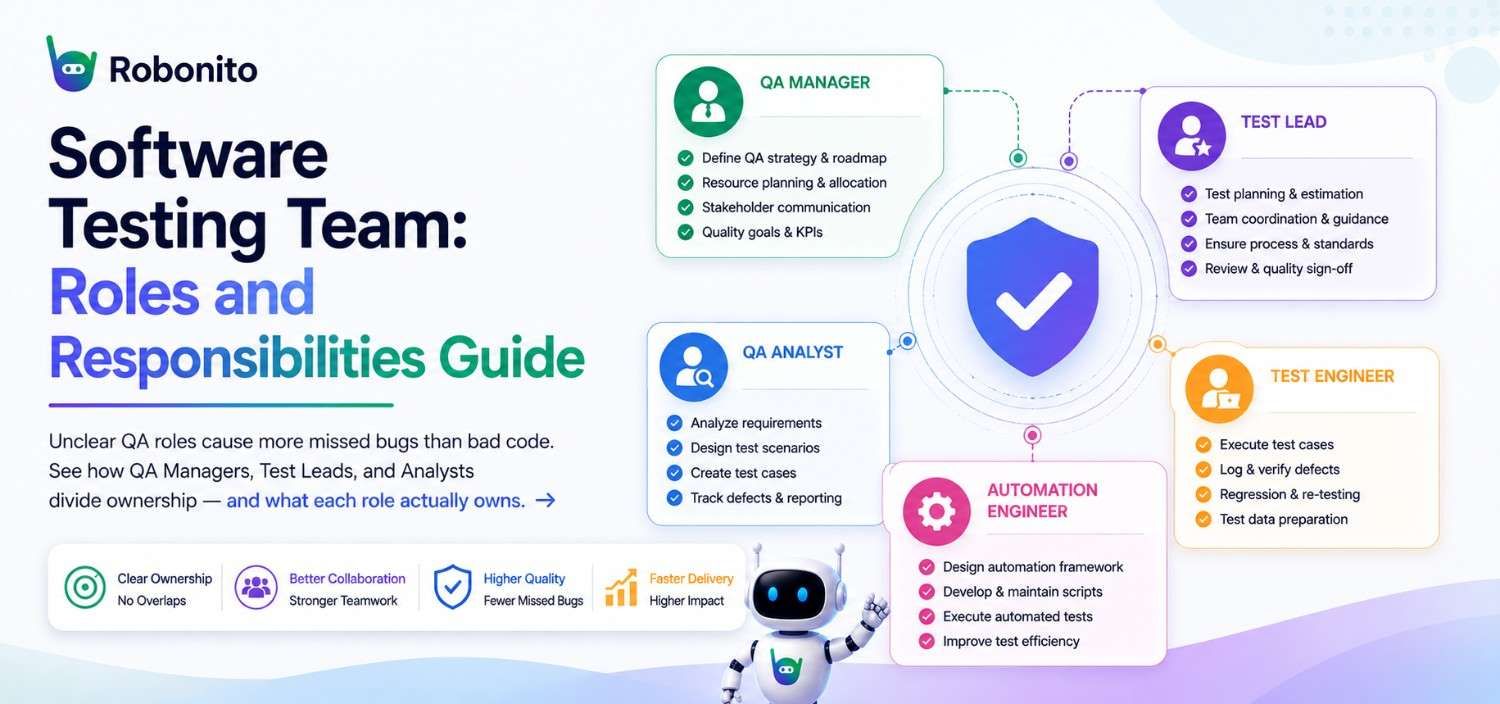
A critical checkout bug reached production at a 40-person B2B SaaS company. Not because they lacked QA engineers — they had five. The bug slipped through because both the Test Lead and the QA Manager assumed the other had verified the payment regression suite before the release. The handoff never happened. The accountability gap was invisible until a customer found it. Role confusion in QA teams doesn't just create inefficiency. It creates production incidents. This breakdown covers what each role in a software testing team actually owns — not just the job description, but the specific handoffs, the decision authority, and the failure modes when those boundaries aren't clear.
Originally published September 2023. Updated May 2026 with current tooling, industry data, and expanded best practices.
Key Takeaways
- The QA Manager and Test Lead serve fundamentally different functions: QA Manager owns strategy and standards across all projects; Test Lead owns execution for a specific project or release cycle — conflating these two roles is the most common structural failure in scaling QA teams
- Automation Test Engineers are not glorified manual testers — their primary output is maintainable test infrastructure, not just test scripts
- The "1 QA per 3–5 developers" ratio breaks down without explicit coverage ownership — gaps compound silently until a production incident forces a retrospective
- Unclear handoffs between Test Lead and Test Analyst are where most bugs that "slipped through QA" actually originate
- No-code automation platforms like Robonito are reshaping the Automation Test Engineer role: non-SDET QA engineers can now own and maintain full automated test suites without scripting expertise
- The most effective QA teams in 2025 use a hybrid model — developers own unit and integration tests in code; QA teams own end-to-end user flow automation through no-code platforms
Why Unclear QA Roles Create Production Bugs
The case for role clarity in QA isn't administrative. It's operational. When responsibilities overlap, two failure modes emerge. The first is duplicated effort: two engineers test the same feature while a different area goes untested. The second— more dangerous — is assumption gaps: each person believes someone else owns a critical scenario. Nobody knows coverage is missing until a user finds it. The World Quality Report 2024 found that over 60% of organizations cite lack of skilled test automation engineers as their biggest barrier to quality. But in conversations with QA leads, the more specific problem is structural: the wrong person owns the wrong work, or nobody clearly owns it at all.
Role clarity answers three questions for every part of the testing process: Who decides? Who executes? Who verifies?
The Four Core Software Testing Team Roles
Most software testing teams are built around four foundational roles. In smaller organizations, one person may fill two roles. In larger organizations, each role may span multiple people. But the functions themselves are consistent — and the distinctions between them are non-negotiable.
Quality Assurance Manager
The QA Manager operates at the organizational level, not the project level. This is the most misunderstood distinction in QA team structure.
What the QA Manager actually owns:
- The testing strategy that applies across all projects and teams — not the test plan for a specific release
- Hiring, onboarding, and professional development for the QA team
- Defining quality standards and acceptance criteria the entire engineering organization works to
- Budget for testing tools, environments, and training
- Reporting quality metrics to engineering leadership and product stakeholders
- Deciding how QA integrates with the development process: shift-left adoption, CI/CD gate definitions, tooling standards
The QA Manager rarely writes test cases or executes tests directly. Their output is the system that makes testing effective at scale.
Reports to: VP of Engineering, CTO, or Director of Product
Primary tools: Jira (portfolio tracking), quality metric dashboards, headcount planning
Test Lead
The Test Lead is the project-level execution owner. This is where the QA Manager / Test Lead confusion most often occurs: both roles sound strategic, but the Test Lead's scope is bounded by a specific project, sprint, or release cycle.
What the Test Lead actually owns:
- The test plan for a specific release — scope, timeline, resource allocation, entry and exit criteria
- Task assignment across the testing team for that release
- Risk assessment: which areas of the application carry the highest risk for this specific change set
- Daily communication with developers on defect prioritization and reproduction
- Sign-off authority for release readiness within their testing scope
- Escalating resource or timeline conflicts to the QA Manager before they become release blockers
The Test Lead knows what was tested, what wasn't, and why — for each specific release. The QA Manager knows whether the team's testing capability overall is adequate.
These are different questions and they need different owners.
Reports to: QA Manager
Primary tools: TestRail, Xray, or qTest; Jira for defect tracking; Confluence for
documentation
Test Analyst
Test Analysts are the execution layer. In well-structured teams, Test Analysts spend 70–80% of their time running test cases and the remaining 20–30% on documentation and defect communication.
What the Test Analyst actually owns:
- Executing test cases against the plan defined by the Test Lead
- Documenting defects with enough detail for developers to reproduce: steps, environment, expected vs. actual behavior, severity, supporting screenshots or logs
- Regression testing on affected areas when developers release fixes
- Maintaining test case documentation so future analysts can inherit coverage without starting from scratch
- Flagging coverage gaps observed during execution back to the Test Lead — not absorbing the risk silently
Test Analysts are in direct contact with the software more than any other role. The instinct for where bugs hide — developed through hundreds of test cycles — is genuinely irreplaceable and can't be fully captured in a test plan.
Reports to: Test Lead
Primary tools: TestRail, Jira, browser DevTools, screen recording tools
Automation Test Engineer
The Automation Test Engineer role is undergoing more disruption than any other QA position, driven directly by AI-powered test automation platforms.
In its traditional form, this role writes and maintains code-based test scripts using Selenium, Cypress, or Playwright. It requires programming proficiency, DOM-level familiarity, and ongoing maintenance as the UI evolves.
What the Automation Test Engineer actually owns (traditional model):
- Building and maintaining the automated test framework and infrastructure
- Writing test scripts for regression suites and high-frequency flows
- Integrating automated tests into the CI/CD pipeline
- Managing test data, environments, and browser/device matrix
- Triaging automated test failures to distinguish real bugs from infrastructure issues
- Collaborating with the Test Lead to identify which tests provide the highest ROI when automated
The 2025 shift: In teams using no-code automation platforms like Robonito, the scripting and maintenance burden is significantly reduced. Non-SDET QA engineers can create and maintain automated tests using natural language instructions. Self-healing AI resolves broken selectors when the UI changes — eliminating the maintenance work that consumed up to 40% of traditional automation engineers' time (Sauce Labs, 2023).
The Automation Test Engineer's role shifts toward CI/CD pipeline architecture, API testing, and performance testing — work that genuinely requires engineering depth — rather than selector management and flaky test debugging.
Reports to: Test Lead (operationally), sometimes Engineering Lead for infrastructure work
Primary tools: Selenium, Cypress, Playwright, Robonito, GitHub Actions / Jenkins,
TestRail
The Three Handoffs That Break Most Often
Understanding each role in isolation is useful. Understanding how they interact is where production incidents actually originate.
Handoff 1 — QA Manager to Test Lead: Strategy to Execution
The QA Manager defines the standards. The Test Lead interprets them for a specific release. This breaks when:
- Standards are set too abstractly ("all critical paths must be tested") without defining what constitutes critical for each product area
- The Test Lead doesn't escalate scope or timeline conflicts early, absorbing pressure until something is silently cut
- Both roles are filled by the same person at a scaling startup, creating a blindspot for systemic quality issues
Fix: Weekly 30-minute sync between QA Manager and all Test Leads. Agenda: risks, coverage gaps, resource conflicts. Decisions documented.
Handoff 2 — Test Lead to Test Analyst: Plan to Execution
The Test Lead writes the plan. The Test Analyst executes it. This breaks when:
- Test cases are written at too high a level of abstraction ("verify checkout works" instead of step-by-step scenarios with specific data states)
- Analysts discover coverage gaps mid-sprint but have no process for surfacing them
- Defect documentation standards aren't enforced, producing bug reports developers can't reproduce
Fix: Test case review sessions before each sprint testing phase. A one-hour investment prevents three days of back-and-forth.
Handoff 3 — Automation Engineer to Test Analyst: Automated to Manual
Automated tests cover what they cover. Manual tests cover what they don't. This breaks when:
- Nobody owns the map of what's automated vs. manual — invisible coverage gaps exist
- Automated test failures aren't triaged quickly, causing analysts to re-test areas already covered by automation (wasted effort)
- The automated suite grows without retiring obsolete tests — maintenance costs compound until the engineer spends more time fixing tests than running them
Fix: Maintain a shared coverage matrix in TestRail or Confluence. Review it quarterly against your highest-risk feature areas.
QA Team Structure at Different Company Stages
| Stage | Eng Team Size | Typical QA Composition | Most Common Gap |
|---|---|---|---|
| Early startup | <20 engineers | 1 QA lead (manages + executes), 1 analyst | No automation; manual testing can't keep up past weekly deploys |
| Growth stage | 20–60 engineers | QA Manager, 1–2 Test Leads, 1–2 Analysts, 1 Automation Engineer | Manager/Lead roles blur; SDET bottleneck on automation |
| Scale-up | 60–150 engineers | Full team + embedded QA per squad | Inconsistent standards across squads; coverage map ownership unclear |
| Enterprise | 150+ engineers | QA Architect, multiple leads, performance/security specialists | Slow cycle times; QA gates block CI/CD velocity |
| Modern no-code team | Any | QA Manager + 2–3 QA Engineers using Robonito | Initial migration effort; coverage map needs rebuilding from scratch |
How No-Code Automation Is Reshaping QA Team Hiring
The traditional QA team pyramid assumed automation requires engineering expertise. That assumption is collapsing.
Platforms like Robonito allow QA engineers without scripting backgrounds to create, run, and maintain automated end-to-end tests using natural language instructions. Self-healing AI resolves broken selectors when the UI changes — eliminating the maintenance work that once defined the Automation Test Engineer role at the UI layer.
The structural implication: teams no longer need a dedicated SDET to own automated UI test coverage. A QA lead with two QA engineers on Robonito can maintain 300+ automated tests without a single line of test code.
This doesn't eliminate the Automation Test Engineer. It changes what they own. Infrastructure, API testing, performance testing, and CI/CD architecture still require engineering depth. What changes is that selector management, DOM-level script maintenance, and basic regression automation are no longer SDET-exclusive work.
The practical question for teams evaluating structure in 2025 isn't "how many automation engineers do we need?" It's: "what proportion of our automation genuinely requires coding expertise — and what can be covered with no-code tooling?"
Best Practices for Software Testing Team Structure That Scale
Define Ownership at the Coverage Level, Not Just the Role Level
Job descriptions tell you who each person is. Coverage ownership tells you what will and won't get tested. Before your next sprint, map every major feature area of your application to a specific person who owns ensuring it's tested. If you can't fill in the map, you have a structural gap — regardless of how many QA engineers are on the team.
Separate Strategy Reviews from Execution Reviews
QA Manager reviews (quality metrics, process improvements, team capacity) and Test Lead reviews (release readiness, defect trends, sprint coverage gaps) serve different purposes and should happen in separate cadences. Combining them results in tactical firefighting crowding out the strategic conversations that prevent the next production incident.
Set Automation Prioritization Criteria in Writing
The highest-ROI tests to automate are those that run most frequently, cover highest-risk flows, and are stable enough that maintenance doesn't consume more time than execution saves. Without written criteria, automation prioritization defaults to "whatever the engineer finds interesting" or "whatever was requested last." Neither optimizes for coverage value.
Review the Coverage Matrix Quarterly — Before Incidents Force It
Most teams audit their test coverage only after a production bug reveals a gap. A quarterly 90-minute coverage review — comparing your test suite against your highest-risk feature areas — prevents this entirely. It's among the highest-leverage QA activities and almost universally skipped.
Common Mistakes in Software Testing Team Structure
Promoting the Best Test Analyst to Test Lead Without Role Preparation
The skills that make a great Test Analyst — attention to detail, edge-case instinct, methodical execution — are different from the skills a Test Lead requires: stakeholder communication, task delegation, timeline management, and escalation judgment. Promoting without explicit role preparation and support typically costs you both a strong analyst and creates a struggling lead.
Letting the QA Manager and Test Lead Roles Blur
When one person or team treats QA Manager and Test Lead responsibilities as interchangeable, strategic quality work — process improvement, tooling decisions, hiring calibration — is permanently deprioritized in favor of urgent execution work. The result: a team that executes competently sprint-to-sprint but never improves its systemic capability. The gap compounds until a major incident forces an expensive post-mortem.
Building Automation Before Building Coverage Visibility
Many teams invest in automation infrastructure before they know what's covered and what isn't. The result: an impressive-looking automated suite that covers 80 flows, while 40 critical flows remain untested. Automation amplifies the coverage you already have. It doesn't tell you what coverage you need — that requires a coverage map built before the first test is automated.
Scaling Headcount Without Scaling Structure
A QA team that works at 3 people often breaks at 7. The informal processes, shared context, and direct communication that made the small team effective don't scale automatically. Add headcount without restructuring ownership and communication, and you get slower decisions, duplicate work, and coverage gaps that are harder to spot precisely because there are more people.
Frequently Asked Questions About Software Testing Team Roles
What is the actual difference between a QA Manager and a Test Lead?
The QA Manager owns quality standards, team strategy, tooling decisions, and cross-project accountability. The Test Lead owns test planning, task allocation, and release readiness for a specific project or sprint. In small teams, one person often does both — but as teams scale past 15–20 engineers, separating these functions becomes critical. When they remain blurred, strategic quality work is consistently deprioritized in favor of urgent sprint execution, and systemic issues compound silently.
How many QA engineers do you need per developer?
A common baseline is 1 QA engineer per 3–5 developers, but this ratio depends heavily on deployment frequency and automation maturity. Teams deploying daily with a strong automated regression suite need fewer QA engineers per developer than teams deploying monthly with primarily manual testing. The more useful question is: what percentage of your critical user flows are covered by automated tests that run on every deploy?
What is the difference between a Test Analyst and an Automation Test Engineer?
Test Analysts execute test cases, document defects, and validate software through direct hands-on interaction with the application. Automation Test Engineers build and maintain automated testing infrastructure — scripts, frameworks, CI/CD integration. In teams using no-code platforms, this distinction is blurring: QA engineers without scripting backgrounds can own automated test suites, while Automation Engineers shift focus to infrastructure-level and API/performance testing work.
At what company size should you hire a dedicated QA Manager?
Most organizations need a dedicated QA Manager when the QA team reaches 4–5 people or the engineering team reaches 30–40 engineers. Before that threshold, a senior Test Lead can handle both strategy and execution. After it, the absence of dedicated strategic ownership shows up as inconsistent standards across projects, adhoc tooling decisions,and QA engineers lacking a clear professional development path.
How does shift-left testing change QA team responsibilities?
Shift-left moves testing earlier in the development cycle — involving QA in requirements review, design discussions, and sprint planning, not only in the testing phase. In practice, Test Analysts and Test Leads spend more pre-sprint time reviewing user stories for testability. It reduces the cost of finding bugs but requires QA engineers to develop stronger product knowledge and communication skills alongside their testing expertise.
What should an Automation Test Engineer automate first?
The highest-ROI automation targets are flows that: (1) run in every regression cycle, (2) are stable enough that routine UI changes won't constantly break the tests, and (3) cover high-risk areas where bugs have real user or revenue impact. Login, checkout,core feature workflows, and onboarding sequences typically meet all three criteria. Low-value targets: features in active development (too unstable to maintain), admin-only flows with no user impact, and cosmetic checks better handled by visual regression tools.
How do no-code testing platforms change QA team hiring decisions?
No-code platforms change the automation ownership equation: you no longer need an SDET to maintain your end-to-end UI test suite. QA hiring can prioritize domain knowledge, communication skills, and product intuition over scripting expertise for most roles. The remaining need for traditional automation engineering shifts toward API testing, performance testing, and CI/CD infrastructure — work that still requires coding depth. For many growth-stage teams, this means one strong automation engineer plus two no-code-capable QA engineers outperforms a team of three SDETs at lower cost and higher coverage.
The QA Team Structure That Actually Holds at Scale
The payment bug at the top of this guide wasn't a testing failure. It was a structural failure — two roles with overlapping accountability and no clear handoff protocol.
Role clarity in QA teams isn't bureaucracy. It's the mechanism that eliminates the assumption gaps where production bugs hide. A QA Manager who owns standards, a Test Lead who owns release execution, Test Analysts who own coverage visibility, and an Automation Engineer who owns infrastructure: when each person knows exactly what they're accountable for, the team stops relying on luck.
The question for 2025 isn't just "what roles do we need?" It's "what does our QA team need to own — and what tools reduce the burden of owning it?"
If your team spends sprint hours maintaining brittle automated test scripts instead of expanding coverage, Robonito's no-code automation platform is worth an afternoon. Up to 200 automated tests, self-healing selectors, CI/CD-ready — free to start.
Automate your first critical test flow without writing a line of code →
Related reading:
Automate your QA — no code required
Stop writing test scripts.
Start shipping with confidence.
Join thousands of QA teams using Robonito to automate testing in minutes — not months.