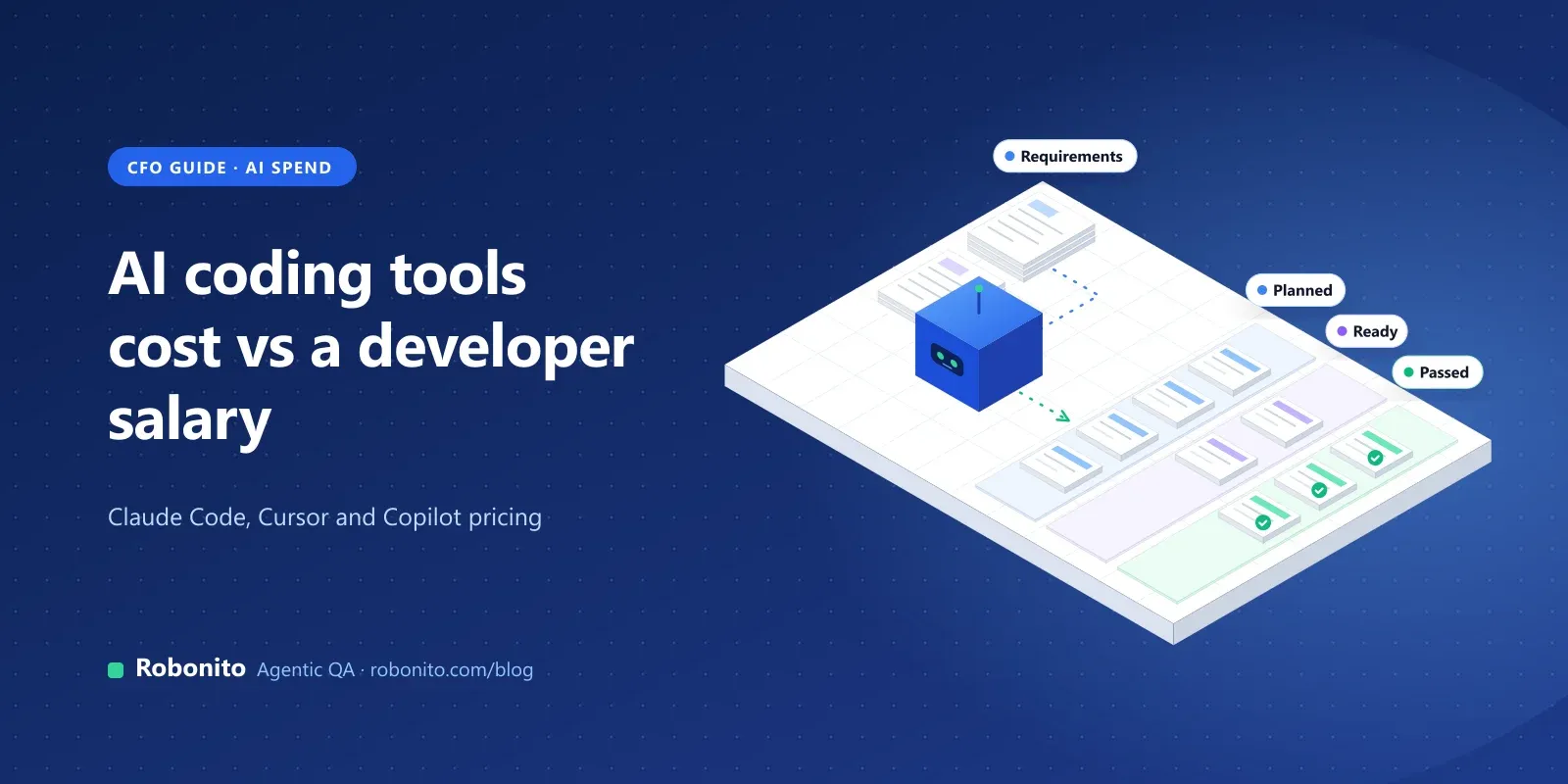
In June 2026, Gartner put a date on a worry many finance teams already had. It predicted that by 2028, AI coding costs will overtake the average developer's salary, driven by rising token consumption and a shift to consumption-based licensing.
The invoices are already changing shape. Claude Code, Cursor and GitHub Copilot now all limit or meter usage on top of the seat, so a seat price no longer tells you what AI coding tools cost per developer. And the biggest costs never appear on a pricing page.
AI coding tools cost $8 to $200 per developer per month in list seat prices as of Nov. 26, 2026, plus usage. Anthropic reports Claude Code averages $150–250 per developer per month across enterprise deployments. The larger costs are human: reviewing AI-generated code, fixing what's almost right, and the incidents that get through.
This guide puts the current Claude Code, Cursor and GitHub Copilot pricing in one table, explains AI token cost in plain terms, compares tool spend with a fully loaded developer salary, and gives you a 2027 budget template that includes the costs vendors leave out.
Key takeaways
- As of Nov. 26, 2026, paid list prices run from $8 (Cursor Plus, Grok models only) to $200 a month (Claude Ultra, Cursor Ultra), and every vendor now limits or meters usage on top of the seat.
- Anthropic says Claude Code averages about $13 per developer per active day and $150–250 per developer per month across enterprise deployments.
- Gartner predicts AI coding costs will overtake the average developer's salary by 2028. Today, a median-paid US software developer costs about $196,500 a year fully loaded, using BLS data.
- One extra hour a week of review per developer costs more than most AI coding seats. Budget for verification, not just licenses.
How much do AI coding tools cost in 2026?
AI coding tools cost a monthly seat fee plus metered usage, and the usage line is the one that varies. The table below lists the plans a US company is most likely to buy, read from each vendor's own page on Nov. 26, 2026.
| Tool and plan | List price (as of Nov. 26, 2026) | Usage model | Source |
|---|---|---|---|
| Claude Pro (includes Claude Code) | $20/month, or $17/month billed annually | Usage limits every 5 hours and every week | Anthropic pricing |
| Claude Max / Ultra | $100 / $200 per month | 5x / 10x Pro usage; $100 / $200 a month in API credits | Anthropic pricing |
| Claude Team, standard seat | $25/seat/month, or $20 billed annually | More usage than Pro; up to $500 a month in pooled API credits | Anthropic pricing |
| Claude Team, premium seat | $125/seat/month, or $100 billed annually | 5x the usage of a standard seat | Anthropic pricing |
| Claude Enterprise (self-serve) | $20/seat/month, billed annually, 20-seat minimum | Plus usage at API rates; admins set spend limits | Anthropic pricing |
| Cursor Premium / Super / Ultra | $30 / $100 / $200 per month ($300 / $1,000 / $2,000 a year) | Weekly pool for Cursor models (4x / 15x / 50x Plus); third-party models at API list price from prepaid credit | Cursor pricing, Cursor docs |
| Cursor Teams | $30, $100 or $200 per seat/month | Same as the matching individual tier; third-party models add a $0.25 per million token "Cursor Token Rate" | Cursor docs |
| GitHub Copilot Pro / Pro+ / Max | $10 / $39 / $100 per month | $15 / $70 / $200 of monthly AI credits | GitHub Copilot plans |
| GitHub Copilot Business / Enterprise | $19 / $39 per granted seat per month | 1,900 / 3,900 AI credits per user, pooled; $0.01 per credit beyond the pool | GitHub Docs |
Cursor lists its prices excluding tax. Cursor Enterprise is quoted by sales, and so is Anthropic's sales-assisted Enterprise tier.
What does Claude Code pricing look like for a team?
Claude Code pricing comes in two forms: a subscription seat (Pro, Max, Ultra, Team or Enterprise) or pay-as-you-go API usage billed per token. For the Enterprise plan, Anthropic's pricing page lists a $20 monthly seat plus usage billed at API rates.
Anthropic publishes its own benchmark. According to the Claude Code cost documentation, "the average cost is around $13 per developer per active day and $150-250 per developer per month," with costs staying below $30 per active day for 90% of users. Anthropic adds that costs vary widely with model choice, codebase size and automation, and recommends a small pilot to set a baseline.
For a CFO, that puts Claude Code on Enterprise at roughly $2,040 to $3,240 per developer per year: $240 in seats plus $1,800 to $3,000 in usage at the average Anthropic reports. Heavy users running several agents at once can sit well above it.
How does Cursor pricing work now?
Cursor pricing changed in October 2026, when xAI launched the X Subscription, which bundles Grok, Grok Bot, Cursor and X Premium in one plan. Cursor's pricing page now says subscriptions are sold through X Subscription Corp.
Three things matter for a budget:
- Plus ($8) is Grok-only and isn't available to teams. Teams buy Premium, Super or Ultra seats at $30, $100 or $200 a month and can mix tiers.
- The included pool covers Cursor's own models and refreshes weekly. The page states pool sizes only as multiples of Plus, not in dollars, so you can't convert them to a fixed spend.
- Third-party models cost extra. Claude, GPT and Gemini models are billed at API list price from prepaid credit. On Teams and Enterprise, Cursor adds a $0.25 per million token rate on eligible third-party models, including when you bring your own key.
Legacy Cursor plans (Pro, Pro+, Ultra and older Teams seats) continue for existing customers with different usage pools, so check which one your company is on.
What is GitHub Copilot pricing for businesses?
GitHub Copilot pricing for businesses is $19 per seat per month for Copilot Business and $39 for Copilot Enterprise, each including that amount in AI credits. One GitHub AI credit equals $0.01, so a Business seat carries $19 of usage.
Credits from every seat go into a shared pool. According to GitHub's usage-based billing docs, usage beyond the pool is billed at $0.01 per credit by default; if an admin turns that policy off, usage is blocked until the next billing cycle. Inline code completions and next edit suggestions don't use credits and remain unlimited. Copilot Chat, Copilot CLI and Copilot cloud agent do consume them.
GitHub's docs describe the older "premium requests" model as legacy billing for annual Pro and Pro+ subscribers who stayed on it after June 1, 2026. Eligible enterprises can also provide "Copilot access" at $0 per user (for users with a GitHub Enterprise Cloud license) or $10 per user standalone, with no included credits.
What is AI token cost, and why does it drive the bill?
A token is a small chunk of text, about a short word, that a model reads or writes; vendors price usage per million tokens (MTok). Coding agents read large amounts of code on every step, so input tokens pile up fast.
Here are Anthropic's API rates, which also set Claude Code's usage cost on Enterprise:
| Model | Input per MTok | Output per MTok | Cache read per MTok | Source |
|---|---|---|---|---|
| Opus 5.5 | $4 | $20 | $0.20 | Anthropic API pricing |
| Sonnet 5.5 | $2 | $10 | $0.10 | Anthropic API pricing |
| Haiku 5.5 (prompts up to 100K tokens) | $0.10 | $0.50 | $0.01 | Anthropic API pricing |
As an illustration, an agent session on Opus 5.5 that reads 2 million fresh input tokens and writes 100,000 tokens costs $8 + $2 = $10. Read the same context from cache and the input part falls to $0.40. Anthropic also lists a 50% discount for batch processing and charges 1.1x for US-only inference.
That's why Gartner's June 24, 2026 press release blames "bloated context windows" and "ungoverned autonomy in agent-driven workflows" for overspending. One of its recommendations is to route simpler, high-frequency tasks to smaller models and save frontier models for complex work.
Will AI coding costs really exceed a developer's salary?
Gartner predicts they will by 2028, but today's averages are far below that line. Gartner's release doesn't give a salary figure, so we use the US median as the line. The gap is worth knowing before you set a 2027 budget.
The US Bureau of Labor Statistics puts the median annual wage for software developers at $135,980 in May 2025, according to the Occupational Outlook Handbook. Wages are only part of the cost. In BLS's Employer Costs for Employee Compensation for June 2026, wages make up 69.2% of compensation for private-industry professional and related occupations, and benefits the other 30.8%.
| Measure (US) | Annual | Monthly | Basis |
|---|---|---|---|
| Median software developer wage | $135,980 | $11,332 | BLS OOH, May 2025 |
| Fully loaded (wage / 0.692) | about $196,500 | about $16,375 | BLS ECEC, June 2026 |
| Claude Code on Enterprise, Anthropic's average | $2,040–$3,240 | $170–$270 | Anthropic docs and pricing |
| Copilot Business seat (credits included) | $228 | $19 | GitHub Docs |
For AI spend to pass the median wage, it would have to reach about $11,300 per developer per month, roughly 45 times the top of Anthropic's average. Gartner Sr. Principal Analyst Nitish Tyagi says costs "will continue to rise" as model pricing goes up and light users become mainstream users. A CFO should read the prediction as a warning about direction, not as today's number.
What do pricing pages leave out of AI coding cost?
Pricing pages leave out review, rework and incidents, and for most teams those cost more than the tools. AI-generated code still has to be read, tested and sometimes fixed by people paid the salaries above.
Review time
In the 2025 Stack Overflow Developer Survey, a global survey, the biggest single frustration with AI tools, cited by 66% of developers, was AI solutions that are "almost right, but not quite", and 45% said debugging AI-generated code is more time-consuming. Using the loaded figure above and 2,080 paid hours a year (an assumption), a developer costs about $94 an hour. One extra hour a week of review costs about $4,900 a year per developer, more than the Claude Code usage average and over 20 times a Copilot Business seat.
Rework and quality
Google Cloud's 2025 DORA report found that AI adoption is now linked to higher software delivery throughput, but "does continue to have a negative relationship with software delivery stability." In a July 2025 Veracode benchmark, which tested more than 100 large language models on 80 coding tasks, AI-generated code introduced security vulnerabilities in 45% of cases. Each of those is rework someone pays for. Our guide to testing AI-generated code covers how to catch it.
Incidents
When a defect reaches production, the bill jumps. New Relic's 2025 Observability Forecast, a vendor survey of more than 1,700 IT and engineering professionals in 23 countries, put the median cost of a high-impact outage at $2 million an hour. That's a global figure covering all causes, not just AI code, but it shows why the cost of software bugs dwarfs a tool budget. The cost of downtime is the line item a CFO should guard.
How should a CFO budget for AI coding tools in 2027?
Budget for AI coding tools as six lines, not one: seats, usage, a usage buffer, review time, verification and an incident reserve. The template below uses formulas you fill in with your own numbers.
| Line item | Formula | Where to get the number |
|---|---|---|
| Seats | developers x seat price x 12 | Vendor pricing page, dated |
| Usage | developers x average monthly usage x 12 | Pilot data; Anthropic's $150–250 average as a starting point |
| Usage buffer | usage x your chosen buffer % | Spread between median and heavy users in the pilot |
| Review time | developers x extra review hours/week x 52 x loaded hourly rate | Pull request data; BLS wage / 0.692 / 2,080 |
| Verification | test automation tools + QA hours for AI-written changes | Current QA spend |
| Incident reserve | expected incidents x hours x cost per hour | Your incident history |
Four controls keep the first three lines honest:
- Set spend limits per user and per team. Anthropic, Cursor and GitHub all offer admin caps.
- Route by task. Use smaller models for routine work, as Gartner recommends.
- Review usage every sprint. Gartner suggests reviewing high-token workflows in sprint retrospectives.
- Automate checks in CI. Claude Code hooks and automated regression testing catch problems before review time is spent on them.
To judge whether the spend pays back, see our companion guide on AI coding ROI, and on tracking verification debt.
How are teams closing the verification gap?
Teams are adding automated end-to-end checks so that faster code output doesn't turn into more review hours and incidents. AI testing agents are one approach among several, alongside unit tests in CI, code review policies and staged rollouts.
Robonito is an agentic QA platform where AI agents create, run and maintain end-to-end tests from a plain-English description, a URL or a Jira issue. Self-healing steps adapt when labels, layouts or locators change, and healed steps are logged for review. Every run keeps video, network traces and an AI root cause for failures, and on Starter and above it runs from GitHub Actions, GitLab CI, Jenkins, Azure DevOps and CircleCI. Club Car cut QA testing time by over 70% with Robonito.
It won't review code line by line, catch a design flaw or replace unit tests. It checks what users see, end to end. There's a free-forever plan for web testing, and paid plans are on the pricing page. If you're comparing it with QA headcount, see QA engineer vs AI testing agent cost.
Frequently asked questions
How much does Claude Code cost per month?
As of Nov. 26, 2026, Claude Code comes with Claude Pro at $20 a month ($17 billed annually), Max at $100 and Ultra at $200. Team seats cost $25 or $125 a month, and Enterprise costs $20 per seat plus usage at API rates. Anthropic says enterprise usage averages $150–250 per developer per month.
What is Cursor pricing for teams?
Cursor Teams costs $30, $100 or $200 per seat per month as of Nov. 26, 2026, matching the Premium, Super and Ultra tiers. Third-party models such as Claude and GPT are billed at API list price, plus a $0.25 per million token Cursor Token Rate on eligible models. Enterprise pricing is custom.
How much is GitHub Copilot for business?
Copilot Business is $19 and Copilot Enterprise is $39 per granted seat per month as of Nov. 26, 2026. Each seat includes the same amount in AI credits, pooled across the organization. Usage beyond the pool costs $0.01 per credit unless admins turn that off.
What is the AI token cost for coding?
It depends on the model. On Anthropic's API, Opus 5.5 costs $4 per million input tokens and $20 per million output tokens, while Haiku 5.5 costs $0.10 and $0.50 for prompts up to 100,000 tokens. Prompt caching and batch processing cut the cost substantially.
Which AI coding tool is cheapest?
Cursor Plus at $8 a month is the lowest paid list price, but it covers Grok models only and isn't sold to teams. GitHub Copilot Pro is $10, and Copilot Business at $19 per seat is the cheapest business seat listed that includes usage. Seat price is a poor guide, though: usage, review time and model choice usually decide the total cost. Run a pilot and measure cost per merged change.
Are AI coding tools worth the cost?
They can be, if the time saved exceeds tool spend plus extra review and rework. A fully loaded US developer costs about $196,500 a year using BLS data, so small gains can justify the tools. The risk is hidden cost: one extra hour of review a week costs about $4,900 per developer a year.
AI writes the code faster. Make sure what ships still works: or .