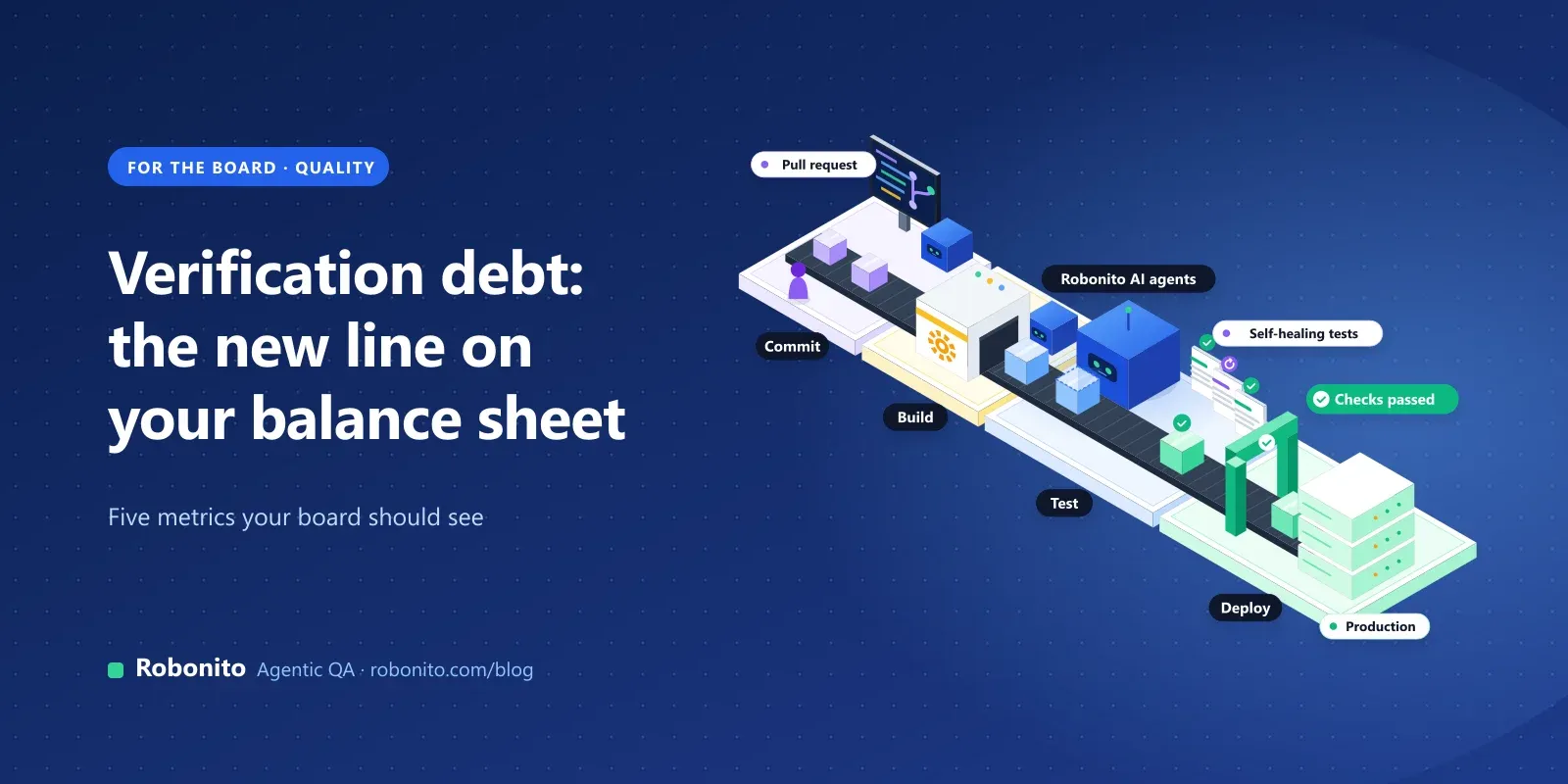
On December 4, 2025, in his , Amazon CTO Werner Vogels brought wide attention to a problem many engineering leaders had felt but not labeled: verification debt. His argument was simple. AI can now generate code faster than people can understand it, and when a machine writes the code, the reviewer has to rebuild the understanding the author would normally have had. Until someone does, software can move toward production without anyone having truly checked what it does.
A month later, code-quality vendor Sonar put numbers on it. In its survey of more than 1,100 developers worldwide, published January 8, 2026, 96% said they don't fully trust that AI-generated code is functionally correct, yet only 48% said they always check AI-assisted code before committing it.
Verification debt is the growing gap between how much code a team ships and how much of it anyone has actually checked. Amazon CTO Werner Vogels popularized the term in December 2025, warning that AI writes code faster than people can understand it. Like technical debt, it is repaid later, with interest, in incidents, rework and slower recovery.
Key takeaways
- Verification debt builds up when code is generated faster than it is understood or tested; Sonar found only 48% of developers always check AI-assisted code.
- It sits on top of technical debt, which CISQ estimated at about $1.52 trillion in the US in 2022.
- DORA's research links AI adoption to more delivery instability: its 2024 report estimated a 7.2% drop in stability for every 25% increase in AI adoption.
- Boards can track it with five metrics: change fail rate, failed deployment recovery time, escaped defects, cost per incident and the share of AI-assisted changes verified. Only the first two have published benchmarks.
What is verification debt?
Verification debt is the accumulated amount of shipped or merged code that no one has independently confirmed does what it should. It grows whenever code is produced faster than a team can review and test it.
Two things make it new. The first is volume: Sundar Pichai wrote in April 2026 that 75% of all new code at Google is AI-generated and approved by engineers, and Sonar's respondents said AI accounts for 42% of their committed code. The second is comprehension: when AI writes the code, understanding has to be rebuilt in review, and 38% of Sonar's respondents said reviewing AI-generated code requires more effort than reviewing code from human colleagues.
Sonar calls the difference between distrust and checking the "verification gap." Verification debt is that gap, added up over every release.
How is verification debt different from technical debt?
Technical debt is the future cost of shortcuts in design or code that a team knows it will have to rework. Verification debt is the future cost of code that may be fine, but that nobody has proven is fine.
| Technical debt | Verification debt | |
|---|---|---|
| What it is | Known shortcuts in design or code | Unchecked behavior in code that looks finished |
| How it builds up | Deadlines, quick fixes, outdated architecture | AI-generated changes merged faster than they are reviewed and tested |
| Who knows it's there | Usually the engineers who took the shortcut | Often no one, until a customer finds the failure |
| Where it shows up | Slower delivery, harder changes | Failed deployments, escaped defects, incidents |
| How to pay it down | Refactoring and rewrites | Independent tests, reviews and evidence of what was checked |
Technical debt is at least visible to the team that owes it. Verification debt hides inside code that passed review and looks correct.
What is the cost of technical debt, and how does AI add to it?
The cost of technical debt in the US was about $1.52 trillion of accumulated principal in 2022, according to the Consortium for Information & Software Quality (CISQ), which derived that figure by adjusting its 2020 estimate for inflation. AI-assisted development adds verification debt on top, through more code, more change and more instability.
CISQ's 2022 report, the latest edition, put the total cost of poor software quality in the US at "at least $2.41 trillion," with technical debt estimated separately. Our guide to why software testing is important breaks that figure down.
The volume of change has since jumped. GitHub's Octoverse 2025 reports that developers on GitHub worldwide merged an average of 43.2 million pull requests a month in the year to August 2025, up 23%, and pushed nearly 1 billion commits, up 25.1%. Every one of those changes needs checking.
The interest payments show up in delivery data:
- Instability. Google Cloud's DORA research found in 2024 that every 25% increase in AI adoption was associated with an estimated 7.2% drop in delivery stability. Its 2025 report found AI now improves throughput but "still increases delivery instability."
- Production failures. In a CloudBees-commissioned vendor survey of 213 enterprise technology leaders, released in May 2026, 81% reported production failures tied to AI-generated code.
- Outage cost. New Relic's 2025 Observability Forecast, a global survey of more than 1,700 IT and engineering professionals, put the median cost of a high-impact outage at $2 million an hour.
Whether AI spending still pays back once these costs are counted is the subject of our analysis of AI coding ROI.
Can AI code review pay down verification debt?
AI code review helps, but it can't pay down verification debt on its own. A review checks that code reads correctly; verification checks that it behaves correctly for the business, which takes tests that run the software.
AI code review is spreading fast. In DORA's 2025 survey, 56% of respondents whose jobs include code review use AI for it. GitHub's Octoverse reports that 72.6% of developers who use Copilot code review said it improved their effectiveness.
The risk is circular checking: an AI reviewer can share the AI author's blind spots, and tests written by the agent that wrote the code can end up confirming what it does, not what was intended. Our playbook on testing AI-generated code covers where review ends and testing begins. In short, use AI review to speed up reading, and independent end-to-end and automated regression tests to prove behavior.
What are DORA metrics?
DORA metrics are five software delivery measures from Google Cloud's DORA research program, grouped into throughput and instability. Here are DORA's definitions, lightly condensed:
Throughput
- Change lead time: the time for a change to go from committed to version control to deployed in production.
- Deployment frequency: the number of deployments over a period, or the time between deployments.
- Failed deployment recovery time: the time to recover from a deployment that fails and requires immediate intervention.
Instability
- Change fail rate: the ratio of deployments that require immediate intervention after deployment.
- Deployment rework rate: the ratio of deployments that are unplanned but happen because of an incident in production.
DORA notes that top performers do well across all five, and its guide warns against setting the metrics as goals.
What are the five metrics your board should see?
A board needs a few metrics chosen so that speed can't hide unverified risk. This scorecard takes two outcome measures from DORA, two that translate quality into money, and one leading indicator of verification debt itself.
| Metric | Definition | Published benchmark | Source |
|---|---|---|---|
| 1. Change fail rate | Share of deployments that need immediate intervention, such as a rollback or hotfix | DORA 2024 elite cluster: 5%. In 2025, 36.2% of respondents reported 8% or less | DORA 2024 and 2025 reports |
| 2. Failed deployment recovery time | Time to recover from a failed deployment | DORA 2024 elite cluster: less than one hour. In 2025, 21.3% of respondents recovered in under an hour | DORA 2024 and 2025 reports |
| 3. Escaped defects | Defects found in production per release, or per 100 deployments | None published; track your own trend | Your defect tracker |
| 4. Cost per incident | Total cost of production incidents (labor, credits, lost revenue) divided by incident count | None for your business; New Relic's survey median is $2 million an hour for high-impact outages | New Relic 2025 (context only) |
| 5. Share of AI-assisted changes verified | AI-assisted changes that passed independent automated tests before merge, divided by all AI-assisted changes | None published; 48% of developers in Sonar's survey say they always check AI-assisted code | Sonar 2026 (context only) |
Why these five:
- Change fail rate and recovery time show whether unverified code reaches customers, and how fast the team recovers.
- Escaped defects and cost per incident turn quality into numbers a finance committee already reads.
- Share of AI-assisted changes verified is the leading indicator: it moves before incidents do. Most teams will need to start tagging AI-assisted changes in version control or CI to measure it.
If the board wants a sixth, add DORA's deployment rework rate. Leave throughput and other engineering metrics to the engineering review; boards rarely lack data on speed.
What do good DORA metrics look like?
The published performance bands for DORA metrics come from DORA's own reports. Its 2024 report grouped respondents into four performance clusters; its 2025 report uses seven team profiles instead and publishes the distribution of answers.
| Performance level (DORA 2024) | Change lead time | Deployment frequency | Change fail rate | Failed deployment recovery time | Share of respondents | Source |
|---|---|---|---|---|---|---|
| Elite | Less than one day | On demand (multiple deploys per day) | 5% | Less than one hour | 19% | DORA 2024, p. 13 |
| High | One day to one week | Once per day to once per week | 20% | Less than one day | 22% | DORA 2024, p. 13 |
| Medium | One week to one month | Once per week to once per month | 10% | Less than one day | 35% | DORA 2024, p. 13 |
| Low | One month to six months | Once per month to once every six months | 40% | One week to one month | 25% | DORA 2024, p. 13 |
The medium cluster had a lower change fail rate than the high cluster; DORA chose to call the faster teams "high."
The 2025 distributions give a current reference point. Of respondents, 8.5% reported a change fail rate of 2% or less, 36.2% reported 8% or less, and 62.2% reported 16% or less. For recovery, 21.3% restored service in under an hour and 56.5% in under a day.
DORA's 2025 report advises comparing each application or service with itself over time, and its 2024 report says "the best teams are those that achieve elite improvement, not necessarily elite performance." For the three metrics without published bands, set targets from your own baseline, and say so when you report them.
How should a board use software quality metrics?
Use software quality metrics as a quarterly trend, reported per critical service, next to the related AI spend. One quarter's number says little; the direction says a lot.
Three questions turn the scorecard into oversight:
- Is change fail rate rising as AI adoption rises? If so, verification debt is being converted into incidents.
- What share of AI-assisted changes to revenue-critical systems was verified before release? Our suggestion, not an industry standard, is that this should approach all of them.
- What did incidents cost this quarter, and how many traced back to changes that skipped independent tests?
Brittle test suites add debt of their own, because failing tests that teams learn to ignore stop catching anything. Our guide to flaky test debt covers how to measure it.
Where do AI testing agents fit?
AI testing agents are one way to raise the share of changes that get independently verified. They don't replace code review, unit tests or security scanning.
Robonito is one example. It's an agentic QA platform: you describe a test in plain English, and its agents create, run and maintain end-to-end tests. It can also generate tests from requirement documents, Jira stories or the live app. Self-healing steps adapt when labels or locators change, and every heal is logged for review. Each run keeps video, network traces and an AI root cause for failures, an audit trail behind a metric like "share of changes verified." On Starter and above, it runs in your CI/CD pipeline, including GitHub Actions, GitLab CI and Jenkins.
FocusSoft, an enterprise ERP vendor, automated 260 complex ERP test cases and runs full end-to-end regression in under 30 minutes, with more than 8,600 executions logged.
It won't fix a release process that ships large, risky batches. Web testing is on the free-forever plan, or you can .
Frequently asked questions
What is verification debt in software?
Verification debt is the backlog of code shipped faster than anyone has checked it. It grows as AI tools generate more code than teams can review and test, and it is repaid later through incidents and rework.
Who came up with the term verification debt?
Amazon CTO Werner Vogels brought the term to wide attention in his closing keynote at AWS re:Invent on December 4, 2025. Sonar's January 2026 developer survey release credits him with the term; no primary source shows who used it first.
What is the cost of technical debt?
CISQ estimated accumulated US technical debt at about $1.52 trillion in 2022, its 2020 estimate adjusted for inflation. Separately, it put the total cost of poor software quality at $2.41 trillion or more. Those are the latest published estimates.
What are the five DORA metrics?
Change lead time, deployment frequency and failed deployment recovery time measure throughput. Change fail rate and deployment rework rate measure instability. DORA warns against setting them as goals and recommends comparing each service with itself over time.
What is a good change failure rate?
In DORA's 2024 report, elite performers had a change fail rate of 5% and low performers 40%. In DORA's 2025 survey, 36.2% of respondents reported 8% or less. Improvement over time matters more than any single band.
Can AI code review replace testing?
No. AI code review checks how code reads, while testing checks how the software behaves. An AI reviewer can share the blind spots of the AI that wrote the code, so independent tests are still needed to verify behavior.
You can't pay down debt you can't see. Start measuring what's verified: or .