
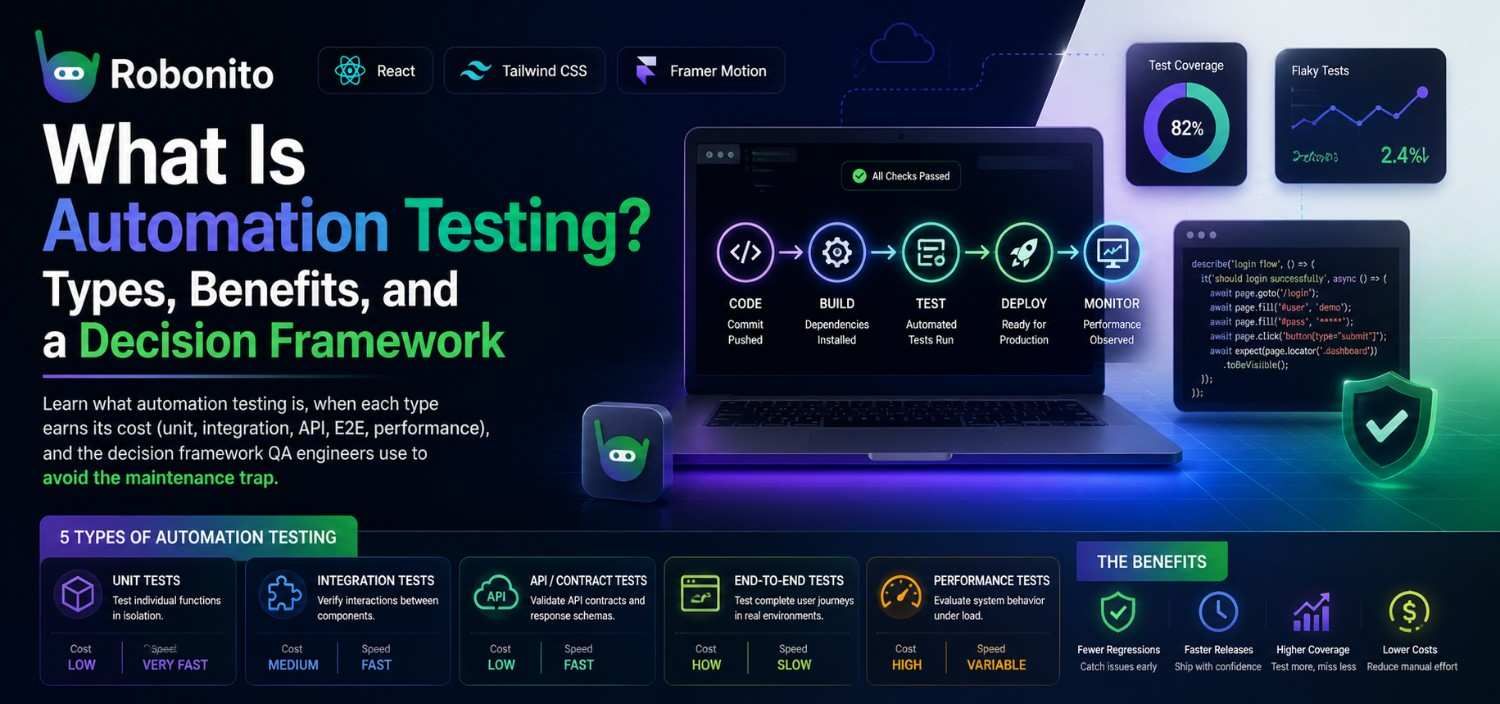
Automation testing has a reputation problem. Teams adopt it expecting to cut their QA cycle in half, then discover six months later that their suite is a maintenance burden that slows deployments rather than enabling them. The culprit is almost never the tooling — it's which tests they chose to automate and why.
This guide focuses on that decision: what automation testing actually is, where it pays off, where it doesn't, and how experienced QA engineers decide which scenarios belong in an automated suite versus a manual exploratory session.
What Automation Testing Actually Means
Automation testing is the practice of executing pre-written scripts against software to verify that it behaves as expected — without a human running each step manually. A script opens a browser, navigates to a login page, types credentials, clicks Submit, and checks whether the dashboard loads. The same script runs identically on every build.
The critical distinction most introductory content glosses over: automation testing is not AI testing, it is not exploratory testing, and it is not a replacement for human judgment on new or poorly-understood features. It is a regression safety net — the fastest way to confirm that things that worked yesterday still work today.
Why Teams Automate: The Real Numbers
The 2023 World Quality Report (Capgemini/Sogeti/Micro Focus, n=1,750 IT leaders across 32 countries) found that organizations with mature automation practices reduce release cycle time by an average of 30–40% and cut regression defect escape rates by roughly 25%. The same report found that teams spending more than 20% of automation effort on UI-layer-only tests saw the opposite outcome — slower releases and higher maintenance cost.
The SmartBear State of Software Quality 2023 survey (n=1,400 QA professionals) reported that 58% of teams cite "hard-to-maintain test scripts" as their top automation challenge — ahead of tool cost, skill gaps, and integration complexity. That number has barely moved in five years. Most automation debt traces back to the same root cause: automating the wrong layer.
The Five Types of Automation Testing (and When Each Earns Its Cost)
Unit Tests
What they cover: Individual functions or methods in isolation, with dependencies mocked.
Where they pay off: Business logic, data transformations, edge-case math (currency rounding, date arithmetic, boundary conditions). A payment service that rounds to two decimal places should have unit tests for every rounding rule. The cost of running them: milliseconds.
Where they don't: UI layout, integration behavior, anything that requires a real database or network call.
Signal it's working: Suite runs in under 2 minutes on every commit. Failures pinpoint a single function, not a system.
Integration Tests
What they cover: Multiple components interacting — a service calling a database, an API calling a third-party endpoint, a queue consumer processing a message.
Where they pay off: Contract verification between services, data persistence correctness, error propagation across component boundaries.
Where they don't: Full user journeys, performance under load, visual rendering.
Signal it's working: A developer can push a change to a service and know within 10 minutes whether it broke its downstream consumers, without reading the consumers' code.
API / Contract Tests
What they cover: HTTP responses — status codes, response body schema, header values, error payloads.
Where they pay off: Any team shipping a public or internal API consumed by multiple clients. Consumer-Driven Contract Testing (Pact is the standard implementation) lets each consumer define what it expects; the provider runs those contracts on every build. This pattern eliminates entire categories of integration failures that only appear in staging.
Where they don't: UI behavior, load characteristics, anything downstream of the API layer.
Benchmark: Pact's own adoption case studies — including implementations at ITV, Atlassian, and DiUS — consistently show staging-environment integration defect reductions in the 40–60% range after contract testing replaces integration environment testing. See docs.pact.io for implementation guides and community case studies.
End-to-End (E2E) Tests
What they cover: Full user journeys through a real browser or native app — login → add to cart → checkout → confirmation email received.
Where they pay off: Three to seven critical paths that must never break: user registration, primary purchase flow, password reset, core report generation.
Where they don't: Every user journey. E2E tests are 10–50× slower and 3–10× more fragile than unit or integration tests. A suite with 400 E2E tests is not mature automation — it is a liability.
Signal it's working: Each E2E test represents a path that would cause immediate business impact if broken. Developers treat a failing E2E as a blocker, not background noise.
Performance / Load Tests
What they cover: System behavior under concurrent users, sustained throughput, or resource constraints.
Where they pay off: Before any significant traffic event (launch, marketing push, seasonal peak), after architectural changes that affect request handling, when SLAs have been defined.
Where they don't: Feature development sprints where no architectural changes occurred.
Tools: k6, Gatling, Apache JMeter, Locust (Python). Each has different strengths; k6 is currently the most developer-ergonomic for CI integration.
No-code option: If your team doesn't have the engineering bandwidth to maintain Selenium or Playwright scripts, Robonito covers UI and regression automation without scripting — useful for teams where QA engineers outnumber developers or where test scripts become a bottleneck on release cadence.
The Automation Pyramid — and Where Teams Corrupt It
Martin Fowler's test pyramid (unit-heavy base, integration middle layer, thin E2E top) reflects economics, not preference. Unit tests are cheap to write, fast to run, and stable. E2E tests are expensive to write, slow to run, and flaky. An investment-rational test suite has more of the cheap thing and less of the expensive thing.
The failure mode Fowler later called the "ice cream cone" — a heavy E2E layer with almost no unit or integration coverage — produces exactly the maintenance burden the SmartBear survey documented. Teams end up with 300 Selenium scripts that take 90 minutes to run, fail intermittently on network timeouts, and require two dedicated QA engineers just to keep green.
The fix is not to delete the E2E tests. It is to stop writing new ones for scenarios that a unit or integration test could cover cheaper and faster.
What Automation Testing Cannot Replace
This distinction matters because teams that misunderstand it build fragile suites and then blame automation itself.
Automation cannot do exploratory testing. Exploratory testing is investigation — a skilled tester using domain knowledge, intuition, and observation to find defects that no one thought to specify. Scripts can only verify what was anticipated. The most expensive production bugs — the ones documented in GitLab's 2017 database deletion incident and Cloudflare's 2019 WAF outage post-mortem — were found only after they hit production, because no automated test was written to anticipate the failure mode.
Automation cannot evaluate UX quality. A test can verify that a button exists and is clickable. It cannot assess whether the confirmation dialog is confusing, whether the error message is helpful, or whether the onboarding flow causes cognitive overload.
Automation cannot reason about new features. For a feature that shipped yesterday, you have no established behavior to verify. Manual testing of new functionality is not a failure to automate — it is the correct choice until the feature is stable enough to warrant automated coverage.
A Decision Framework QA Engineers Actually Use
Before writing an automated test, experienced practitioners answer three questions:
-
Does this scenario have a stable, determinable expected outcome? If the expected output varies by context, time, or user state in ways your test environment can't control, automation will produce false failures.
-
Will this test run at least 20 times before it needs to be rewritten? If the feature is volatile, manual testing is faster and cheaper until it stabilizes.
-
What layer is cheapest to verify this at? If you can verify the business rule with a unit test, don't write an E2E test for it. The unit test runs in milliseconds and can't be broken by a CSS change.
If all three answers are yes, the scenario belongs in the automated suite. If any answer is no, manual or exploratory coverage is the right call.
Where Experienced Teams Cut Flakiness
Flaky tests — tests that fail intermittently without a code change — are the primary reason automation suites lose credibility. Once developers start ignoring failures because "it's probably flaky," the suite stops functioning as a safety net.
The three leading causes, in order of frequency:
Async timing assumptions. A test clicks a button and immediately asserts a result, without waiting for the async operation to complete. Fix: explicit waits on element state (Playwright's waitForSelector, Cypress's cy.get().should()), never hardcoded sleep() calls.
Shared test state. Tests share a database or user account and run in non-deterministic order, producing state interference. Fix: each test creates and destroys its own data. Test isolation is non-negotiable.
Environment dependency. Tests pass locally and fail in CI because of timezone differences, missing environment variables, or third-party API rate limits. Fix: mock external dependencies at the network layer (msw for JavaScript, responses for Python), never rely on live external APIs in automated suites.
Real-World Automation Failure: What the Post-Mortems Show
GitLab's 2017 database incident, Atlassian's 2022 cloud outage, and HashiCorp's own engineering retrospectives all share a pattern: the production failures that automation missed were integration-layer failures — a service returning an unexpected null, a schema migration silently changing a field type, a config change in a downstream service.
The incidents that automation did catch — and prevented from reaching production — were regression failures: a code refactor that broke an existing API contract, a dependency upgrade that changed a sorting behavior, a database query that started returning results in a different order.
This matches the theoretical value proposition of automation: it is excellent at catching "we broke something that used to work" and poor at catching "this new behavior is incorrect in a way we didn't anticipate."
The practical implication: if your CI pipeline has only E2E tests, you are catching the expensive-to-prevent failures (integration regressions) at the most expensive layer, while missing them at the unit and API layers where they would be caught in seconds.
Key Takeaways
- Automation testing is a regression safety net, not a replacement for human judgment on new features or exploratory investigation
- The test pyramid is an economic model: unit tests are 50–100× cheaper per run than E2E tests — invest accordingly
- The leading cause of automation suite failure is E2E-heavy suites with no unit or integration layer underneath
- Flakiness is almost always caused by timing assumptions, shared state, or environment dependency — all fixable with well-known patterns
- A decision framework (stable outcome? runs 20+ times? cheapest layer?) eliminates most test design errors before they become maintenance debt
- Performance testing is not optional for any system with defined SLAs or known traffic spikes
Frequently Asked Questions
Our Selenium suite takes 90 minutes to run and no one trusts it — where do we start the fix?
Triage by failure pattern first. Group your failing tests into: (a) always fails, (b) sometimes fails (flaky), (c) passes but covers logic a unit test could handle. Category (a) means the feature changed — update or delete. Category (b) is your flakiness backlog — address timing, state isolation, and environment dependency in that order. Category (c) is your conversion candidate — rewrite as unit or integration tests and delete the E2E version. Most teams find that 30–40% of their E2E suite falls into category (c).
We're starting fresh. What's the minimum viable automation setup for a five-person team shipping weekly?
Unit tests for all business logic (target 60–70% line coverage on the core domain), one integration test per external integration (database, payment processor, email provider), and three to five E2E tests covering the paths that would produce immediate customer-facing failures if broken. That's it. Add more only when a specific failure type recurs in production that this setup wouldn't have caught.
How do we measure whether our automation is actually reducing defect escape rate?
Track two numbers per sprint: (1) defects found in CI (automation catches), and (2) defects found in production or by QA after merge (escape). Defect escape rate = escapes / (escapes + CI catches). A healthy ratio is under 15% escape. If your automation catches 10 bugs per sprint and 12 make it to production, the suite is not covering the right scenarios — audit which layer those 12 were in and add coverage there.
Further reading: How to build a CI/CD pipeline that doesn't break your QA process · Agentic testing vs no-code QA automation → See how Robonito compares: Robonito vs Selenium
Automate your QA — no code required
Stop writing test scripts.
Start shipping with confidence.
Join thousands of QA teams using Robonito to automate testing in minutes — not months.