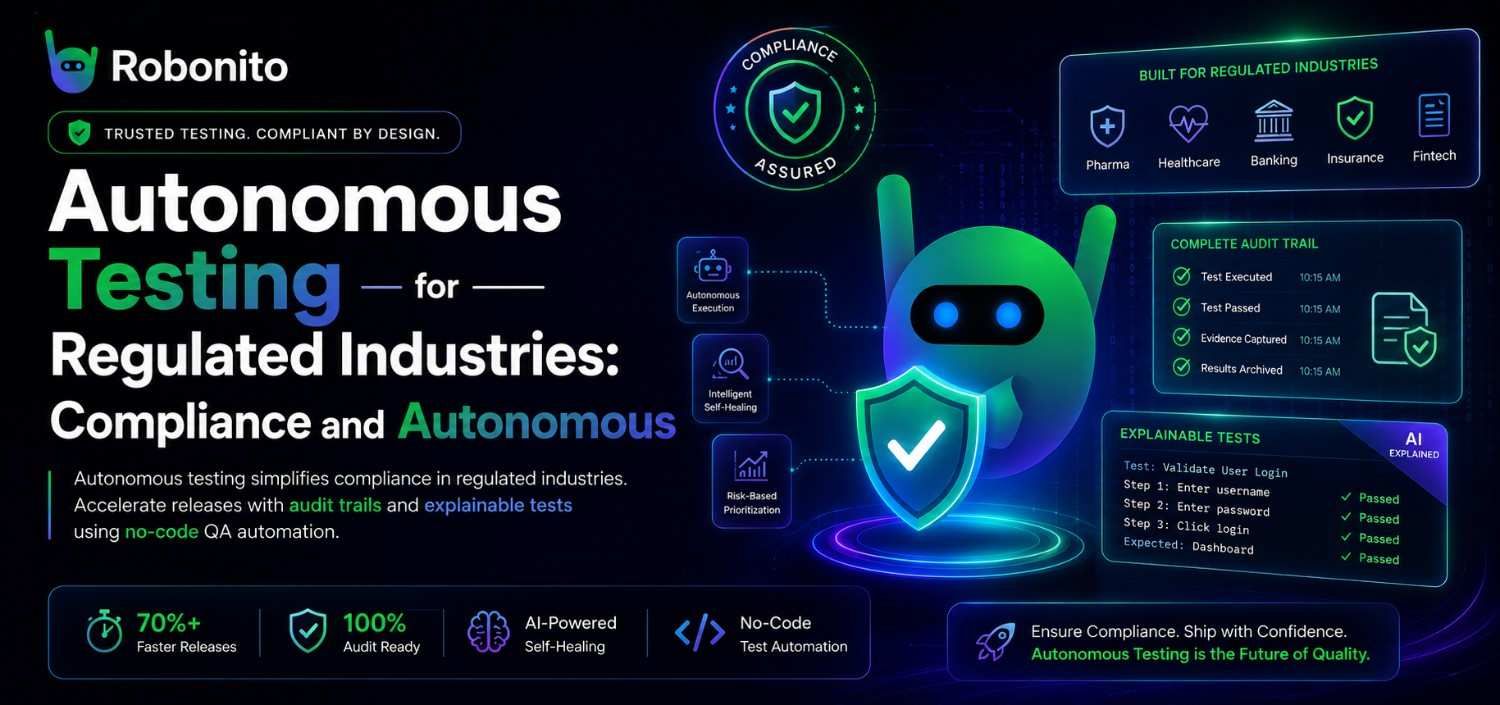
In healthcare, a single unvalidated software release can trigger an FDA warning letter. In fintech, a missed regression test on a payment flow can mean a six-figure fine from the OCC. Across regulated industries, the stakes of software failure extend far beyond broken features — they reach into legal liability, patient safety, and consumer trust. That's exactly why autonomous testing in regulated environments is no longer a nice-to-have. It's becoming the operational backbone of compliant software delivery. But here's the tension most QA teams face: the tools built for speed often lack the governance features regulators demand, and the tools built for compliance are painfully slow. A new generation of no-code, AI-powered testing platforms is resolving that tension — and teams in fintech, healthcare, insurance, and government are paying attention.
Why Regulated Industries Are Turning to Autonomous Testing
Regulated industries have historically been cautious adopters of automation. Manual testing, with its paper trails and human approvals, felt safer — even when it wasn't. But three forces are accelerating the shift toward autonomous testing platforms:
1. Release velocity is increasing, even in regulated orgs. DORA's 2025 State of DevOps research shows that even organizations in regulated sectors like banking and healthcare are accelerating toward weekly or biweekly release cycles. Manual regression testing simply can't keep pace with these cycles without becoming the bottleneck.
2. Regulatory frameworks are evolving to expect automation. The FDA's guidance on Computer Software Assurance (CSA) explicitly encourages risk-based, automated approaches to software validation — a marked shift from the document-heavy IQ/OQ/PQ model of the past. Similarly, PCI DSS 4.0 now requires continuous testing of security controls, which practically mandates automation.
3. Human error is the leading cause of compliance failures. When a QA analyst manually executes 200 test cases before a release, the probability of missed steps, inconsistent execution, and undocumented deviations climbs with every test. Autonomous testing eliminates an entire category of compliance risk by executing tests identically every time and logging every action automatically.
Consider a mid-size health insurance company running a member portal. Before each open enrollment period, they need to validate hundreds of plan selection, eligibility, and payment workflows across multiple states. Doing this manually took six weeks. With autonomous testing, the same coverage runs in days — with a complete, auditable execution log attached to every cycle.
The question is no longer whether regulated teams should automate. It's how to automate without introducing new compliance headaches.
The Compliance Challenge: What Regulators Actually Expect from QA
Before evaluating any QA automation compliance tool, it's critical to understand what regulators actually look for during an audit. The specifics vary by industry, but the core expectations are remarkably consistent:
- Traceability: Every test must be linked to a requirement. Auditors want to see a clear chain from business requirement → test case → test execution → result.
- Reproducibility: If an auditor asks "show me how you tested this," your team needs to replay or demonstrate the exact test that ran, not just show a pass/fail report.
- Change control: When a test is modified, the previous version must be preserved. Who changed it, when, and why — all of this needs to be documented.
- Evidence of execution: Timestamped logs, screenshots, or video recordings that prove a test actually ran against a specific build in a specific environment.
- Separation of duties: In many frameworks (SOX, HIPAA, GxP), the person who writes the test shouldn't be the same person who approves it for production.
Here's where many traditional automation frameworks create problems. A Selenium-based test suite stored in a Git repository technically has version control, but the execution evidence — screenshots, logs, environment details — is scattered across CI/CD logs, third-party reporting tools, and local machines. Piecing together a compliant audit package becomes a manual, error-prone project in itself.
A fintech startup preparing for its SOC 2 Type II audit learned this the hard way. Their engineering team had solid test coverage using Cypress, but when auditors asked for evidence that specific tests ran against specific production-candidate builds during a defined window, the team spent two weeks assembling the documentation retroactively. The tests passed. The audit process nearly didn't.
What regulated teams need is not just test automation — but test automation that generates compliance artifacts as a byproduct of execution, not as an afterthought.
How No-Code Test Automation Simplifies Audit Trails and Traceability
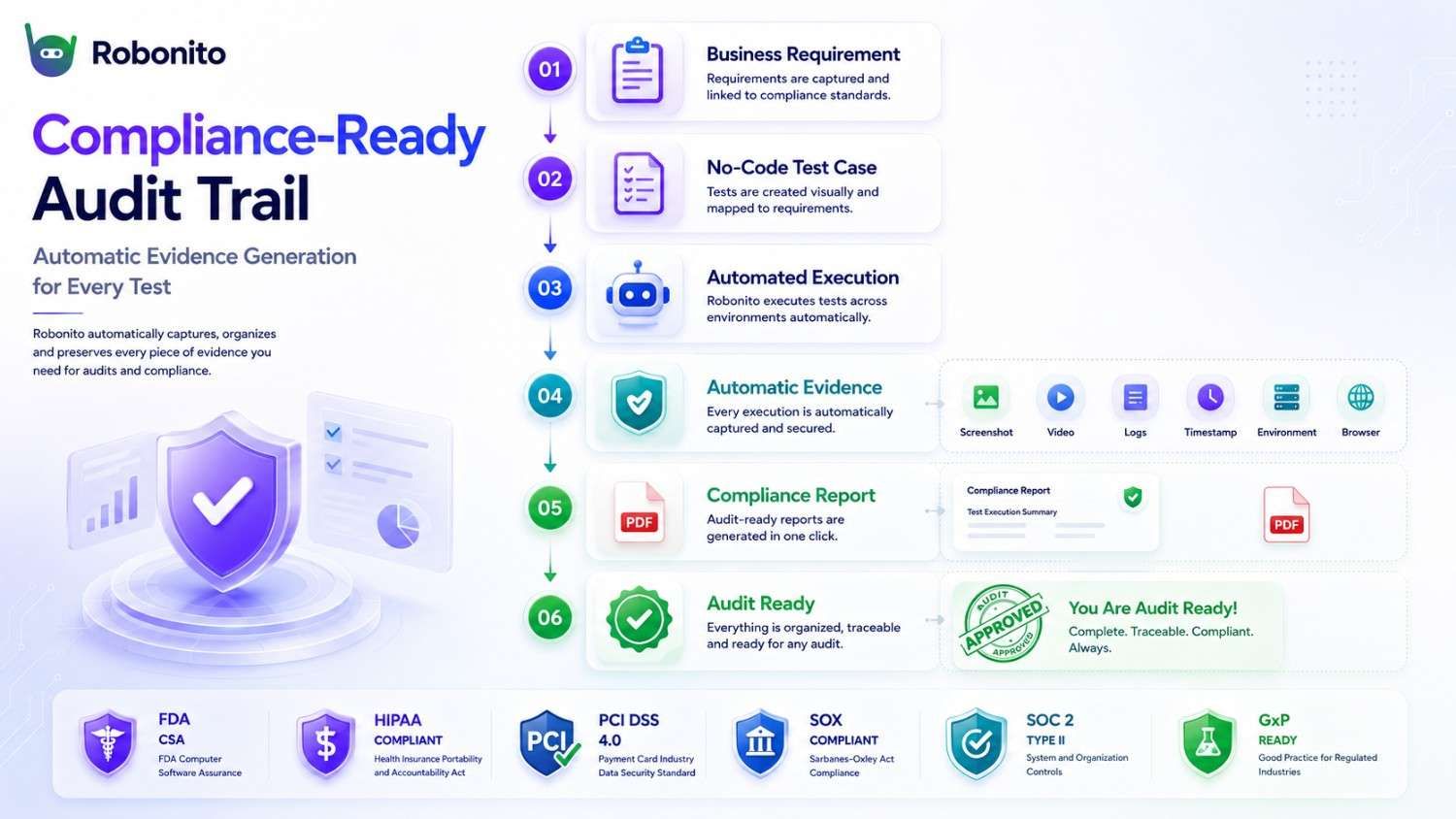
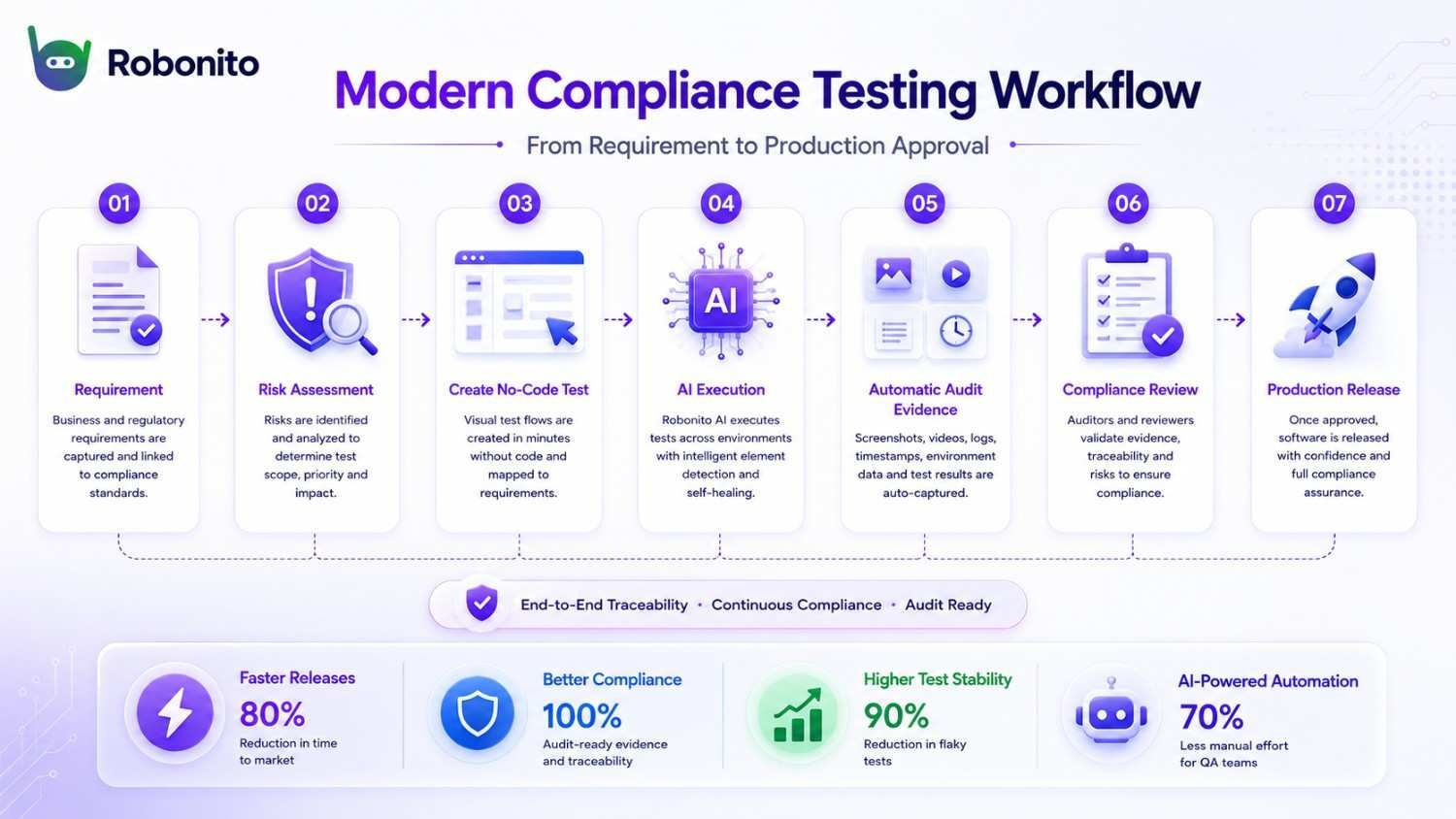
No-code testing platforms like Robonito fundamentally change the relationship between test execution and documentation. Because every test is created through a visual, structured interface rather than handwritten code, the platform can automatically capture and organize the metadata that auditors require.
Here's how no-code testing healthcare fintech teams benefit:
Automatic execution logging. Every test run in Robonito generates a timestamped record that includes the steps executed, the environment and browser configuration, screenshots at each step, and the pass/fail outcome. There's no need to bolt on a separate reporting tool or write custom logging logic. The audit trail is inherent to the platform.
Requirement-to-test mapping. In a no-code environment, test cases are human-readable by default. A test titled "Verify that a user with an expired insurance policy sees a renewal prompt on login" is both the test description and the functional specification. This makes traceability intuitive — QA leads, compliance officers, and auditors can all read and validate the same artifact without needing to interpret code.
Version-controlled test histories. When a Robonito test is modified — say, because the enrollment workflow added a new identity verification step — the platform preserves the previous version. Auditors can see exactly what was tested before the change, what changed, and what was tested after. This satisfies change control requirements without requiring your QA team to manually maintain a change log.
Role-based access. Robonito supports role-based permissions, allowing organizations to enforce separation of duties. A QA analyst creates the test, a QA lead reviews and approves it, and the CI/CD pipeline executes it automatically. Every action is attributed to a specific user with a timestamp.
Consider a digital banking platform that needs to validate its loan origination workflow before each release. With traditional coded tests, the compliance team has to trust that the engineering team's tests are correct — they can't independently verify because they can't read Python or JavaScript. With Robonito, the compliance officer can open the test, read each step in plain language, confirm it maps to the regulatory requirement, and sign off. That's not just convenience — it's a structural improvement to the compliance process.
Self-Healing Tests Reduce Flakiness — and Compliance Risk
Test flakiness is annoying in any context. In regulated environments, it's a compliance hazard.
Here's why: when a test fails intermittently, teams learn to distrust the results. They start re-running suites and ignoring transient failures. Eventually, someone marks a flaky test as "known issue" and stops investigating. In a regulated context, that ignored failure could mask a genuine defect in a critical workflow — a payment calculation error, a dosage display bug, or a privacy control bypass.
Flakiness also corrupts your audit trail. If a test suite shows three failures on Monday, zero on Tuesday (same code, same environment), an auditor will rightly question the reliability of your entire testing process. You'll spend audit time defending your tooling rather than demonstrating your coverage.
Self-healing tests address this at the root cause. Most flakiness in UI testing stems from brittle element selectors. A developer renames a CSS class, reorganizes a div structure, or updates a component library — and suddenly, dozens of tests break. Not because the application is broken, but because the test is broken.
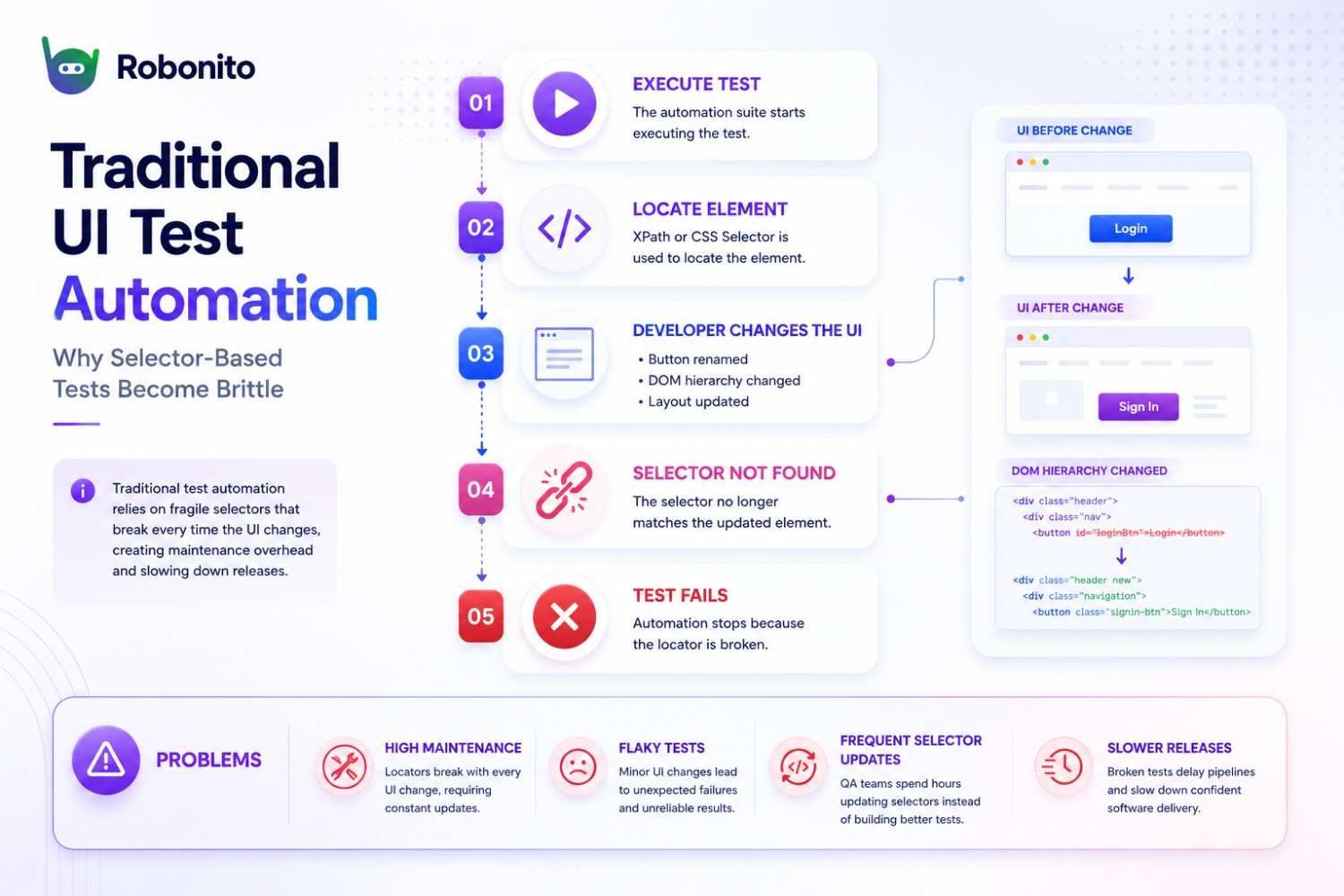
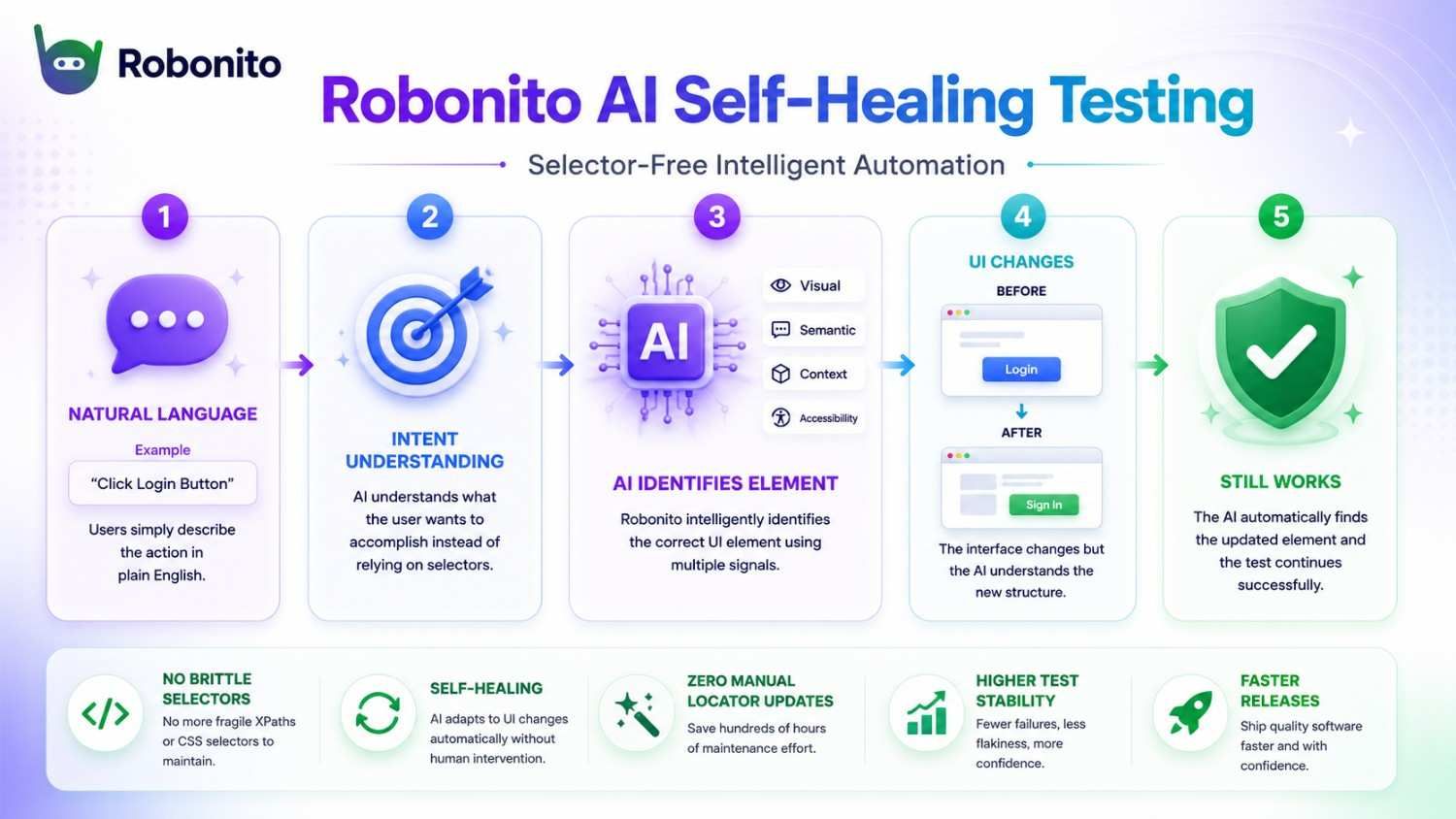
Robonito's AI-powered self-healing engine adapts to these UI changes automatically. When an element's selector changes but its visual context and function remain the same, Robonito identifies the element using multiple signals — position, text, surrounding elements, visual appearance — and continues the test without interruption. The healed selector is logged, so you have full visibility into what changed and how the platform adapted.
For a healthcare SaaS company maintaining a patient scheduling module, this capability was transformative. A healthcare SaaS team shared this with our onboarding team their Angular-based frontend generated dynamic class names on every build, which caused 15-20% of their Selenium tests to fail on each run. After migrating to Robonito, that flakiness dropped to near zero. More importantly, their compliance team could finally trust that a "pass" meant the feature works, not just the selectors held up.
Self-healing isn't just a developer convenience feature. In regulated environments, it's a reliability guarantee that directly supports audit readiness.
Buyer's Checklist: Evaluating Autonomous QA Tools for Regulated Environments
If you're evaluating autonomous testing platforms for a regulated organization, don't just compare feature lists. Evaluate through the lens of what your auditors, compliance officers, and regulators will actually ask for.
Here's a practical checklist:
Audit Trail and Documentation
- Does the platform automatically generate timestamped execution logs with screenshots or video?
- Can you export test evidence in a format your auditors accept (PDF, CSV, or integrated with your GRC tool)?
- Are test results tied to specific build numbers and environment configurations?
Traceability
- Can test cases be linked to requirements, user stories, or regulatory controls?
- Are test cases readable by non-technical stakeholders (compliance, legal, QA management)?
- Does the platform support tagging or categorizing tests by regulation (HIPAA, SOX, PCI DSS, FDA)?
Change Control and Versioning
- Does the platform version-control test definitions automatically?
- Can you view a diff between test versions?
- Is every modification attributed to a specific user with a timestamp?
Access Control and Governance
- Does the platform support role-based access control (RBAC)?
- Can you enforce approval workflows before tests are promoted to production pipelines?
- Is there an SSO integration for centralized identity management?
Reliability and Stability
- Does the platform offer self-healing capabilities to minimize false failures?
- What is the platform's reported flakiness rate?
- Can you distinguish between test failures (broken test) and application failures (real bug)?
Integration and Deployment
- Does the platform integrate with your CI/CD pipeline (Jenkins, GitHub Actions, GitLab CI, Azure DevOps)?
- Can tests be triggered automatically on specific branches or deployment events?
- Does the platform support environment-specific configurations for staging, UAT, and production validation?
Use this checklist not just for vendor evaluation, but as a conversation starter with your compliance team. Getting their buy-in early dramatically smooths adoption.
Robonito in Practice: Fast Onboarding Without Sacrificing Governance
One of the most common objections to adopting new QA tooling in regulated environments is the onboarding cost. Compliance teams worry about validation of the tool itself. Engineering managers worry about weeks of training. QA leads worry about re-creating hundreds of existing test cases.
Robonito is designed to dismantle each of these objections.
Productive in hours, not weeks. Because Robonito requires no code — no CSS selectors, no XPath expressions, no scripting — QA analysts can start building meaningful tests on their first day. In a recent onboarding with a fintech payments company, the teams typically create and execute 30-50 end-to-end tests within the first week, covering their core payment processing, KYC verification, and transaction reporting workflows.
Natural language test creation. Tests in Robonito are described in plain English. "Navigate to the patient dashboard, verify that the medication list shows the three prescribed medications, click on the refill button for the first medication, and confirm the refill request confirmation message appears." This isn't pseudocode — it's how you actually build the test. The result is a test artifact that serves double duty: it's both the executable test and the human-readable test case document your compliance team needs.
Works on any web app out of the box. Robonito doesn't require agents, browser extensions, or custom integrations to start testing. Point it at your application URL, and it can interact with your UI immediately. This eliminates the multi-week "setup and configuration" phase that plagues enterprise testing tools.
CI/CD integration from day one. Robonito plugs into Jenkins, GitHub Actions, GitLab CI, Azure DevOps, and other major pipelines. Regulated teams can embed automated testing into their deployment gates immediately — ensuring that no release proceeds without validated test execution.
For an insurance company migrating off a legacy manual testing process, this combination was critical. Their compliance officer needed to see that the new platform produced better audit evidence than the old spreadsheet-and-screenshot approach. Within two weeks, the team demonstrated a complete traceability matrix — requirement to test case to execution evidence — that was more thorough and more reliable than anything they'd produced manually in five years.
Getting started with Robonito — quick start guide
Code-Heavy vs. No-Code Autonomous Testing: Which Meets Compliance Faster?
Let's be direct about the trade-offs.
Code-heavy frameworks (Selenium, Cypress, Playwright) offer maximum flexibility. You can test anything, customize everything, and integrate with any system. For engineering teams with deep automation expertise, they're powerful tools.
But in regulated environments, that flexibility comes with hidden compliance costs:
| Dimension | Code-Heavy Frameworks | No-Code (Robonito) |
|---|---|---|
| Test readability | Requires code literacy to review | Plain language, auditor-readable |
| Audit trail | Assembled from CI logs, screenshots, custom reporters | Generated automatically per run |
| Maintenance burden | High — selector changes break tests | Low — self-healing adapts automatically |
| Onboarding time | Weeks to months | Hours to days |
| Change control | Git-based (technical reviewers only) | Platform-native with user attribution |
| Compliance team involvement | Indirect — rely on engineering interpretation | Direct — compliance can read and approve tests |
| Flakiness | Moderate to high | Near zero with self-healing |
The critical question isn't "which framework is more powerful?" It's "which approach produces audit-ready evidence faster and with fewer human touchpoints?"
For a GxP-regulated medical device software company, the answer was unambiguous. Their previous Selenium suite required a dedicated automation engineer to maintain, a separate reporting tool to generate evidence, and a manual process to map tests to regulatory requirements. Total time from code change to audit-ready evidence: 3-4 days. With Robonito, the same cycle completes in hours — with richer evidence and zero manual assembly.
Code-heavy approaches aren't wrong. But in environments where compliance speed and reliability are as important as test coverage, no-code platforms deliver a structural advantage that's hard to replicate with scripts alone.
Frequently Asked Questions
Does autonomous testing satisfy FDA Computer Software Assurance requirements?
Yes — when implemented correctly. The FDA's Computer Software Assurance guidance, updated in 2023, explicitly encourages risk-based, automated approaches to software validation and moves away from the document-heavy IQ/OQ/PQ model. Autonomous no-code testing platforms satisfy CSA requirements when they produce automatic execution logs with timestamps, screenshots at each test step, traceability from test to requirement, and version-controlled test histories that show what changed and when. The critical requirement is that execution evidence is generated automatically as a byproduct of the test run — not assembled retroactively by hand. Platforms where QA teams must manually collect screenshots from CI logs and map them to requirements create both compliance risk and audit preparation burden.
Why do compliance auditors have a problem with Selenium and Cypress test suites, even when the tests pass?
The problem is not the tests — it is the evidence. When auditors ask "show me how you tested this payment flow against build 2.3.1 in your staging environment on the fourteenth of March," Selenium and Cypress teams typically have to assemble the answer from CI/CD logs, a third-party reporting tool, screenshots saved to a local machine, and a Git commit history. Piecing this together is manual, time-consuming, and error-prone. The tests may have been rigorous. The evidence package often is not. Regulators require that execution evidence is timestamped, tied to a specific build and environment, and attributable to an identified executor. No-code platforms that generate this evidence automatically as part of every test run eliminate the retroactive documentation problem entirely.
What is separation of duties in QA testing and which regulations require it? Separation of duties in QA testing means the person who creates a test should not be the same person who approves it for production execution. This control prevents a single individual from both introducing and validating a change without independent review — a risk in any process where human error or intentional misconduct could affect regulated outcomes. SOX, HIPAA, and GxP frameworks all include separation of duties requirements. In practice, this means your testing platform must support role-based permissions where QA analysts create tests, QA leads or compliance officers approve them, and the CI/CD pipeline executes them — with every action attributed to a specific named user with a timestamp. Systems where a single user can create, approve, and execute a test without oversight do not satisfy this requirement.
How does test flakiness create compliance risk in regulated environments?
In regulated environments, a flaky test does not just waste engineering time — it corrupts the audit trail. When a test fails on Monday and passes on Tuesday against identical code and environment, an auditor reviewing the execution logs has legitimate grounds to question whether the entire testing process is reliable. Teams that learn to tolerate flakiness — re-running suites, ignoring transient failures, marking tests as "known intermittent" — progressively erode the evidential value of their test results. In the worst case, a genuine defect in a critical workflow is masked by a pattern of intermittent failures that the team has stopped investigating. Self-healing automation addresses flakiness at its root cause: brittle element selectors that break when developers rename classes or update component libraries, producing test failures that have nothing to do with application behaviour.
What should a compliance officer look for when reviewing an automated testing platform?
A compliance officer evaluating an automated testing platform should ask six specific questions: Does the platform generate timestamped execution logs with screenshots automatically, or does the QA team assemble them manually? Can test cases be read and validated by non-technical compliance staff without interpretation from engineering? Does the platform version-control test definitions and attribute every change to a named user? Does it support role-based access control and approval workflows that enforce separation of duties? Can it export execution evidence in a format acceptable to your auditors — PDF, CSV, or integrated with your GRC tool? And critically: when a test is modified, is the previous version preserved so auditors can see what was tested before and after the change? A platform that satisfies all six produces compliance artifacts as a byproduct of normal test execution. One that cannot satisfy these questions creates documentation debt that accumulates with every release.
Start Testing Smarter in Your Regulated Environment
If you're a QA lead or engineering manager in fintech, healthcare, insurance, or any regulated industry, you already know the pain: every release feels like it's one missed test away from an audit finding.
Robonito gives you a faster path to compliant, reliable test automation — without asking your team to learn a new programming language or your compliance officers to trust a black-box process.
Schedule a compliance readiness demo Create your first end-to-end test in minutes, see the automatic audit trail it generates, and judge for yourself whether no-code autonomous testing belongs in your compliance toolkit.
Automate your QA — no code required
Stop writing test scripts.
Start shipping with confidence.
Join thousands of QA teams using Robonito to automate testing in minutes — not months.