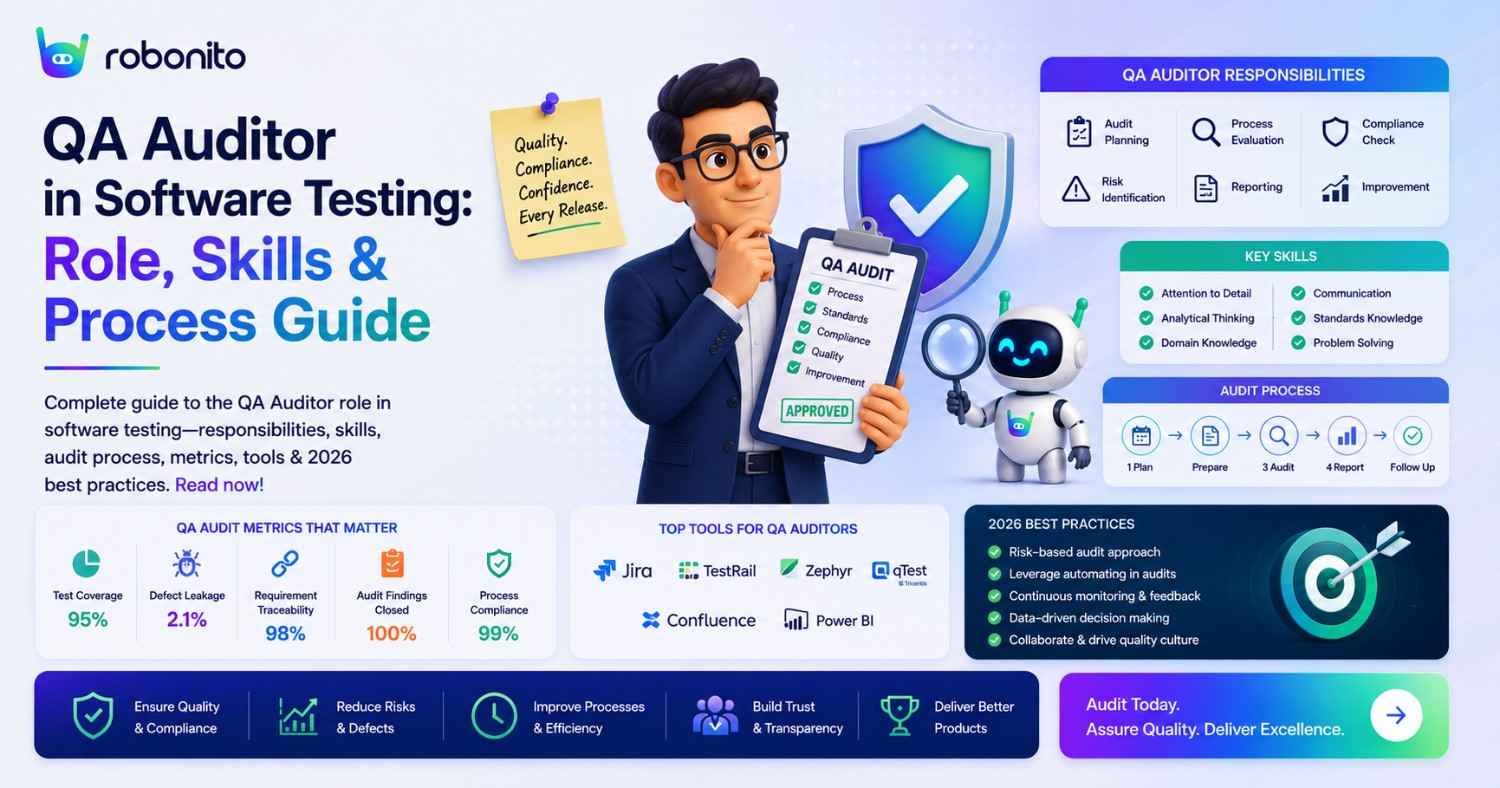
When a product ships with bugs that testing should have caught, the question is not "why did testing miss this?" — it is "why did the testing process allow this to happen?" That is the question a QA auditor answers. A QA audit evaluates not the software but the testing of the software: the coverage, the process, the tools, the metrics, and the gaps that let defects through. This guide covers the full QA auditor role in software testing — from responsibilities and required skills to the complete audit process with real templates.
By Robonito Engineering Team · Updated June 2026 · 19 min read
Quick stats
| Fact | Source |
|---|---|
| 46% of production incidents are regressions that testing should have caught | Tricentis State of Testing 2025 |
| Only 34% of organisations regularly audit their QA processes | World Quality Report 2025 |
| Organisations with formal QA auditing ship 2× fewer production defects | Capgemini World Quality Report 2025 |
| 74% of QA teams report their test coverage is insufficient | World Quality Report 2025 |
| A production defect costs 10× more to fix than one caught in testing | IBM Systems Sciences Institute |
Table of Contents
- What is a QA auditor in software testing?
- QA auditor vs QA engineer — the clear distinction
- QA auditor responsibilities — the complete list
- QA auditor skills and qualifications
- How to conduct a software QA audit — step by step
- QA audit metrics — what to measure
- QA audit report — structure and real template
- Automation tools in QA auditing
- Common QA audit findings and how to address them
- QA audit in Agile environments
- Pre-audit preparation checklist
- Frequently Asked Questions
Make your next QA audit easier — automate the evidence collection
Robonito generates detailed test execution reports, coverage metrics, and defect evidence automatically in CI — giving QA auditors the data they need without manual collection effort. Try Robonito free →
1. What is a QA auditor in software testing?
One-sentence definition for featured snippets: A QA auditor in software testing evaluates an organisation's testing processes, coverage, tools, and practices against defined quality standards — identifying gaps, inefficiencies, and compliance issues that allow software defects to reach production.
The distinction that makes the QA auditor role unique: QA engineers test the software. QA auditors test the testing. Where a QA engineer asks "does this feature work correctly?", a QA auditor asks "is our process for determining whether features work correctly actually effective?"
This meta-level quality function is essential because testing processes can fail silently. A QA team can execute 200 test cases, achieve 95% pass rate, and still have a flawed process — if those 200 tests cover the wrong scenarios, if the test environment does not reflect production, if defect severity ratings are inconsistent, or if automation maintenance has eroded suite reliability. A QA audit surfaces these process failures before they manifest as production incidents.
When QA audits are triggered:
Reactive triggers (audit prompted by an event):
├── Significant production incident — "how did this get through testing?"
├── Release failure — testing signed off but deployment rolled back
├── Audit requirement from regulator or customer (FDA, ISO, SOC 2)
└── Merger/acquisition — assessing acquired team's QA maturity

Proactive triggers (planned quality improvement):
├── Quarterly or annual QA process review
├── New team onboarding — establishing baseline quality standards
├── Tool or process migration — validating new automation framework
└── Pre-certification preparation (ISO 9001, CMMI, SOC 2 Type II)
2. QA auditor vs QA engineer — the clear distinction
Confusion between these roles leads to misaligned expectations and underutilised auditing capability. The table below clarifies the difference precisely:
| Dimension | QA Engineer | QA Auditor |
|---|---|---|
| Primary question | Does the software work correctly? | Does our testing process work correctly? |
| Subject of evaluation | The software application | The testing process and practices |
| Activities | Writing tests, executing tests, reporting bugs | Reviewing processes, assessing coverage, evaluating tools |
| Output | Bug reports, test execution results | Audit findings, compliance assessments, recommendations |
| When engaged | Throughout every sprint | Quarterly, annually, or event-triggered |
| Independence | Works within the development team | Should have independence from the team being audited |
| Focus | Finding defects in the product | Finding defects in the QA process |
| Stakeholder | Product team, developers | QA leadership, management, compliance |
The relationship in practice:
A QA engineer who discovers during a sprint that 40% of test cases do not have defined expected outcomes is doing good work — but fixing it within the sprint. A QA auditor who discovers that test cases systematically lack expected outcomes across 12 sprints is identifying a process failure that requires a structural fix, not a sprint-level correction.
Both roles are essential. The QA engineer provides continuous quality coverage. The QA auditor provides periodic systemic assessment that prevents quality debt from accumulating undetected.
3. QA auditor responsibilities — the complete list
Core audit responsibilities
1. Planning and scoping audits
Defining what will be audited, what criteria will be applied, who will be interviewed, what documentation will be reviewed, and what the expected outputs are. Poorly scoped audits produce findings that are too vague to act on. Well-scoped audits produce specific, actionable results within a defined area.
2. Reviewing testing documentation
Evaluating the quality and completeness of:
- Test strategy documents
- Test plans per release
- Test case repositories (completeness, preconditions, expected outcomes)
- Defect logs and severity classifications
- Test execution reports
3. Assessing actual practices against documented processes
Documentation and reality frequently diverge. A QA auditor interviews team members, observes testing activities, and reviews CI/CD pipeline logs to verify that documented processes reflect actual practice. Finding where the gap is — and why — is one of the highest-value audit activities.
4. Evaluating test coverage quality and gaps
Coverage percentage alone is insufficient. A suite with 100% requirement coverage can still have poor coverage if:
- Test cases only cover happy paths (no error paths tested)
- Boundary values are untested
- Integration between components is uncovered
- Specific user types or permission levels are untested
The QA auditor assesses coverage depth, not just coverage breadth.
5. Analysing quality metrics
Reviewing trends and patterns in:
- Defect removal efficiency (DRE)
- Production incident rates
- Test pass/fail rates
- Automation maintenance overhead
- Mean time to detect regression
6. Evaluating tools and infrastructure
Assessing whether the team's tool choices are appropriate for their needs, correctly configured, and being used effectively. This includes CI/CD pipeline design, automation framework selection, test environment management, and reporting systems.
7. Producing audit reports with actionable recommendations
Every finding must be documented with:
- Clear description of the finding
- Evidence supporting the finding
- Root cause (not just symptom)
- Severity rating
- Specific recommendation
- Owner and target resolution date
8. Monitoring corrective action implementation
Following up to verify that recommended improvements are implemented and effective. An audit finding that is acknowledged but not acted upon is an audit that delivered no value.
4. QA auditor skills and qualifications
Technical skills required
Software testing expertise — non-negotiable
A QA auditor who has not personally performed software testing at a competent level cannot meaningfully evaluate a software testing process. The auditor must understand what good test case design looks like, what a stable automated test suite requires, what makes a CI/CD pipeline reliable, and what constitutes meaningful test coverage. This typically requires 3–5 years of hands-on QA experience before moving into auditing.
Testing standards and methodologies
Working knowledge of:
- IEEE 829 (test documentation standards)
- ISTQB testing terminology and concepts
- Agile and shift-left testing practices
- Risk-based testing approaches
- Test process improvement models (TPI Next, TMMi)
Automation frameworks and CI/CD
The QA auditor must be able to evaluate whether a team's automation suite is well-architected — even if they are not writing tests themselves. This requires familiarity with:
Framework knowledge (audit-level understanding required):
├── Web: Playwright, Selenium, Cypress
├── API: pytest, Postman, REST Assured
├── Mobile: Detox, Appium, XCUITest, Espresso
├── Performance: k6, JMeter
└── CI/CD: GitHub Actions, GitLab CI, Jenkins

Red flags a QA auditor should recognise:
├── CSS class selectors used throughout (fragile, high maintenance)
├── No test data isolation strategy (tests share state)
├── sleep() calls instead of proper waits (flakiness indicator)
├── Inverted pyramid (mostly E2E, few unit tests)
└── No deployment gate (tests run but never block releases)
Metrics and data analysis
The ability to calculate DRE, interpret trend data in test pass rates, identify anomalies in defect distributions, and distinguish between flaky tests and genuine failures.
Soft skills equally important
Independence and objectivity — the ability to report findings accurately even when they reflect poorly on the team being audited. Audit findings must be evidence-based, not subjective, and must be communicated in a way that is constructive rather than critical.
Structured communication — audit findings must be documented clearly enough for someone who was not in the audit to understand the finding, the evidence, and the required action.
Stakeholder management — QA auditors interact with everyone from individual testers to CTOs. The same finding is communicated differently depending on the audience.
Qualifications and certifications
| Qualification | Relevance | Required? |
|---|---|---|
| ISTQB Foundation Level | Core testing terminology and concepts | Strongly recommended |
| ISTQB Test Manager | Test process, metrics, organisational testing | For senior QA auditor roles |
| ISTQB TMMi Professional | Test maturity model assessment | For TMMi-specific audit work |
| ISO 9001 Lead Auditor | Process auditing methodology | Useful for regulated industries |
| CSTE / CSQA (QAI) | Certified Software Test Engineer | US market recognition |
| 3-5 years QA experience | Hands-on testing foundation | Non-negotiable prerequisite |
5. How to conduct a software QA audit — step by step
Stage 1: Planning and scoping
Define before starting: what is being audited, against what criteria, with what resources, and with what expected outputs.
## QA Audit Plan — Sprint 15 Regression Process

**Audit type:** Process audit — regression testing effectiveness
**Scope:** Automated regression suite and CI/CD integration
**Out of scope:** Manual exploratory testing, UAT process
**Audit period:** Covering sprints 10-15 (12 weeks)

**Criteria:**
  - Test cases have explicit preconditions, steps, expected outcomes
  - Regression suite runs on every merge to main
  - All P0/P1 test cases have automated equivalents
  - CI fails (non-zero exit) when tests fail
  - DRE > 85% for the audit period

**Evidence to collect:**
  - Test case repository (TestRail export)
  - CI/CD pipeline logs (GitHub Actions, last 12 sprints)
  - Production incident log (last 12 sprints)
  - Defect log with severity/priority classifications

**Stakeholders:**
  - QA Lead (auditee)
  - Engineering Manager (sponsor)
  - 2 QA Engineers (interviewees)

**Timeline:**
  - Planning and documentation review: 2 days
  - Interviews and process observation: 1 day
  - Analysis and report writing: 2 days
  - Finding review with team: 1 day
Stage 2: Documentation review
Collect and systematically review:
Documentation review checklist:

Test Strategy Document:
□ Exists and is current (updated within last 6 months)?
□ Defines test types used (unit, integration, E2E, performance)?
□ Specifies coverage targets with measurable criteria?
□ Defines entry and exit criteria for each test phase?
□ Assigns ownership of each testing activity?

Test Cases:
□ Sample: Review 20 test cases across 3 different features
□ Each has explicit preconditions?
□ Each has step-by-step actions?
□ Each has specific expected outcomes (not "works correctly")?
□ Each maps to a requirement in the RTM?
□ Error paths and boundary values covered alongside happy paths?

Defect Records:
□ Severity classifications consistent and correct?
□ Root cause documented for all P0/P1 defects?
□ Defects linked to requirements they violated?
□ Resolution time tracked?

CI/CD Pipeline:
□ Tests run automatically on every merge to main?
□ Tests block deployment when failing (non-zero exit code)?
□ Test results visible to development team?
□ Failure notifications configured?
Stage 3: Process assessment — interviews and observation
Structured interviews surface the gap between documented and actual processes:
Interview questions — QA Engineer:

"Walk me through what happens when a developer pushes a PR.
 What tests run, who reviews them, what needs to pass before merge?"
→ Looking for: automated gate, clear ownership, pass criteria

"What happens when an automated test fails in CI?
 Who investigates? How long does it typically take?"
→ Looking for: accountability, response time, flaky test management

"When did you last have a test that broke because of a UI change?
 How long did it take to fix?"
→ Looking for: self-healing capability, maintenance overhead

"Are there tests you do not trust — tests that you expect to be flaky
 or tests you skip because they are unreliable?"
→ Looking for: hidden technical debt, false confidence in results

"If I asked you right now what percentage of P0 features have
 automated regression tests, what would you say?"
→ Looking for: coverage awareness, honest self-assessment
Stage 4: Metrics analysis
## QA Audit — Metrics Analysis Template
## Calculate these from actual data during the audit

audit_period_sprints = 12
total_user_stories = 87
stories_with_test_cases = 82
p0_features = 15
p0_features_automated = 12

production_defects = 8        ## Defects found after release
testing_defects = 48          ## Defects found during testing
automated_tests = 156
total_test_executions = 156 * 26  # 26 runs over audit period
failed_executions = 312           ## Tests that failed in CI
false_positive_failures = 187     ## Failures due to flakiness, not bugs

maintenance_hours_per_sprint = [8.5, 7, 9, 11, 6, 5.5, 8, 7.5, 6, 5, 4.5, 4]

## Calculate key metrics
requirement_coverage = stories_with_test_cases / total_user_stories * 100
p0_automation_rate = p0_features_automated / p0_features * 100
dre = testing_defects / (testing_defects + production_defects) * 100
true_failure_rate = (failed_executions - false_positive_failures) / failed_executions * 100
avg_maintenance = sum(maintenance_hours_per_sprint) / len(maintenance_hours_per_sprint)

print(f"Requirement coverage:    {requirement_coverage:.1f}%  (target: 95%+)")
print(f"P0 automation coverage:  {p0_automation_rate:.1f}%  (target: 100%)")
print(f"Defect Removal Efficiency: {dre:.1f}%  (target: 85%+)")
print(f"True failure rate:       {true_failure_rate:.1f}%  (false+ rate: {100 - true_failure_rate:.1f}%)")
print(f"Avg maintenance hours:   {avg_maintenance:.1f}h/sprint  (target: decreasing)")

## Output:
## Requirement coverage:    94.3%  (target: 95%+)
## P0 automation coverage:  80.0%  (target: 100%)  ← FINDING
## Defect Removal Efficiency: 85.7%  (target: 85%+)  ← Pass, but marginal
## True failure rate:       40.1%  (false+ rate: 59.9%)  ← CRITICAL FINDING
## Avg maintenance hours:   7.0h/sprint  (target: decreasing)  ← FINDING
Stage 5: Tools and infrastructure evaluation
CI/CD Pipeline audit checklist:

□ Pipeline triggers on: every PR, every merge to main?
□ Unit tests complete in < 5 minutes?
□ Integration tests complete in < 20 minutes?
□ E2E regression complete in < 60 minutes?
□ Failing tests produce non-zero exit code (deployment blocked)?
□ Test artifacts (screenshots, videos) attached to failure reports?
□ Test results visible in PR comments?
□ Failure notifications sent to Slack/Teams?
□ Historical test results retained for trend analysis?

Automation framework health:
□ Selectors: ARIA-first (getByRole, getByLabel) vs CSS classes?
□ Waits: Explicit element waits vs sleep() calls?
□ Test data: Isolated per test vs shared state?
□ Structure: Test pyramid respected (unit 70%, integration 20%, E2E 10%)?
□ Self-healing: Platform with AI healing vs manual selector updates?
□ Coverage: Cross-browser including Safari/WebKit?
6. QA audit metrics — what to measure
The seven metrics a QA audit must assess
1. Defect Removal Efficiency (DRE)
The single most important QA quality metric. DRE measures what percentage of all defects were found before production.
DRE = Testing defects / (Testing defects + Production defects) × 100

Benchmarks:
  < 70%: QA process is failing — significant gaps
  70-80%: Below average — improvement needed
  80-90%: Industry average
  > 90%: Strong QA process
  > 95%: Excellent — rarely achieved without mature automation

Audit finding trigger: DRE below 80% requires root cause investigation
2. Requirement coverage
Coverage = Requirements with ≥1 test case / Total requirements × 100

Audit assessment:
  Report coverage percentage overall AND by priority level:
  - P0 requirements: must be 100%
  - P1 requirements: target 95%+
  - P2 requirements: target 85%+
  - P3 requirements: target 70%+

Common finding: 95% total coverage with P0 gaps because
  engineers avoid the most complex scenarios
3. Test execution reliability (false positive rate)
False positive rate = Flaky failures / Total failures × 100

Benchmarks:
  < 5% false positives: Healthy suite
  5-15%: Needs attention — flakiness eroding confidence
  > 15%: Critical — team learns to ignore failures

Impact: A test suite with 30%+ false positives trains the team
to ignore CI failures — eliminating the pipeline's entire value
4. Automation coverage percentage
Automation % = Automated test cases / Total test cases × 100

Minimum targets:
  P0 test cases: 100% automated
  P1 test cases: 90% automated
  Regression suite: 80% automated
  New features: Tests written in same sprint as development

Audit finding trigger: Any P0 test case without automated equivalent
5. Test maintenance overhead
Maintenance hours per sprint — measured from team time logs or estimates

Trend is more important than absolute value:
  Increasing trend: Automation suite health declining
  Flat trend: No improvement despite growing suite
  Decreasing trend: Self-healing or better practices working

Above 8 hours/sprint for a 200-test suite: consider AI self-healing platform
6. Defect density by feature area
Defect density = Defects per feature area / Test cases for that area

High density in one area signals:
  - Insufficient test coverage of that area
  - Complex code with inadequate unit test foundation
  - Recently changed code without corresponding test updates
  - Testing methodology mismatched to the feature type
7. Release defect escape rate
Escape rate = Production defects per release / Total defects (testing + production)

Audit trigger: Any release with > 3 production defects that
  were catchable by testing requires root cause analysis
7. QA audit report — structure and real template
The four-part audit report structure
Every audit finding must be documented with sufficient detail for someone who was not present to understand and act on it.
## QA Process Audit Report — Sprint 10-15

**Audit type:** Regression testing effectiveness
**Audit period:** 2026-02-15 to 2026-05-10
**Auditor:** [Name], QA Manager
**Auditee:** QA Team (3 engineers)
**Report date:** 2026-05-14
**Classification:** Internal

---

## Executive Summary

The regression testing process for sprints 10-15 demonstrates adequate
coverage (94.3%) and acceptable DRE (85.7%), but two critical issues
require immediate attention: a 59.9% false positive rate (CI failures
not caused by genuine bugs) and 20% of P0 features lacking automated
test coverage. These issues are eroding team confidence in CI results
and creating production risk on the platform's highest-impact features.

Overall audit verdict: CONDITIONAL PASS
Required before next release: Findings 1 and 2 (Critical)

---

## Findings

### Finding 1: Critical — High false positive rate (59.9%)

**Severity:** Critical
**Evidence:** CI pipeline logs for 26 runs across sprints 10-15
  show 312 total test failures, of which 187 (59.9%) were caused
  by test flakiness or environment issues, not genuine defects.
  Three specific tests (TC-089, TC-142, TC-198) account for 67%
  of all false positive failures.

**Root cause:** TC-089 uses sleep(2000) to wait for an async operation
  that sometimes takes 3-4 seconds. TC-142 and TC-198 share test user
  data that accumulates state across runs, causing assertion failures
  when run in sequence.

**Impact:** Development team reports skipping CI review "because it's
  always failing." Three production incidents in sprints 12-14 occurred
  on features covered by tests that were ignored due to alert fatigue.

**Recommendation:**
  1. Replace sleep(2000) in TC-089 with explicit element wait
  2. Add test data isolation (unique user per test run) to TC-142, TC-198
  3. Introduce flakiness tracking: flag any test failing > 3 times
     without code change for immediate investigation

**Owner:** QA Lead (TC fixes), Engineering Manager (process policy)
**Target date:** Sprint 16 (by 2026-06-01)
**Acceptance criteria:** False positive rate < 5% measured over sprint 16

---

### Finding 2: Critical — P0 automation coverage at 80% (target: 100%)

**Severity:** Critical
**Evidence:** RTM analysis shows 3 of 15 P0 features have no
  automated test equivalent. All three are payment-related:
  - TC-gap-01: 3D Secure authentication flow
  - TC-gap-02: Refund to original payment method
  - TC-gap-03: Subscription renewal with expired card

**Root cause:** All three involve complex payment provider interactions
  that the team considered "too hard to automate" — no investigation
  of mocking strategies was undertaken.

**Impact:** Payment flows are the highest-risk area of the application.
  Production incident INC-2847 (sprint 13) involved a refund processing
  failure that manual testing signed off on — automated regression would
  have caught the regression at the PR stage.

**Recommendation:**
  1. Use payment provider sandbox (Stripe test mode) for TC-gap-01 and TC-02
  2. Mock payment provider responses for TC-gap-03 edge cases
  3. Assign automation engineer to 3D Secure flow in sprint 16

**Owner:** Automation Engineer
**Target date:** Sprint 17 (by 2026-06-15)

---

### Finding 3: Medium — Maintenance overhead not decreasing (7.0h/sprint average)

**Severity:** Medium
**Evidence:** Time tracking data shows average maintenance of 7.0 hours/sprint
  across the 12-sprint audit period, with no significant downward trend
  despite suite maturation. Manual selector updates account for 73% of
  maintenance work.

**Root cause:** 68% of automated tests use CSS class selectors rather than
  ARIA-first selectors. Every design system update breaks a cohort of tests.

**Recommendation:**
  1. Migrate to ARIA-first selectors (getByRole, getByLabel) for all new tests
  2. Evaluate self-healing automation platform (Robonito) for existing suite
  3. Add selector review to test PR review checklist

**Owner:** QA Lead
**Target date:** Sprint 18 (for process change), ongoing for migration

---

## Metrics Summary

| Metric | Actual | Target | Status |
|--------|--------|--------|--------|
| Requirement coverage | 94.3% | 95%+ | ⚠️ Near miss |
| P0 automation coverage | 80.0% | 100% | ❌ Critical |
| DRE | 85.7% | 85%+ | ✅ Pass (marginal) |
| False positive rate | 59.9% | < 5% | ❌ Critical |
| P0 test pass rate | 96.2% | > 95% | ✅ Pass |
| Avg maintenance/sprint | 7.0h | Decreasing | ⚠️ Flat trend |

## Required Actions Before Next Release
- [ ] Fix TC-089 wait implementation (Owner: QA Eng, Due: 2026-05-20)
- [ ] Add data isolation to TC-142, TC-198 (Owner: QA Eng, Due: 2026-05-20)
- [ ] Begin 3D Secure automation investigation (Owner: Automation Eng, Due: 2026-05-27)
8. Automation tools in QA auditing
Modern QA auditors use automation tools both to gather audit evidence and to improve the testing processes they audit.
Tools for gathering audit evidence
| Tool | Purpose | What a QA auditor uses it for |
|---|---|---|
| TestRail / Zephyr | Test management | Export test case completeness metrics, coverage reports |
| Jira | Defect tracking | Analyse defect distribution, severity classification accuracy |
| GitHub Actions / GitLab CI | CI/CD pipelines | Review pipeline logs, pass rates, execution time trends |
| Allure / Playwright Report | Test reporting | Review historical test results, flakiness identification |
| Lighthouse CI | Performance | Audit Core Web Vitals trend over releases |
| SonarQube | Code quality | Audit unit test coverage, technical debt metrics |
Robonito as a QA audit tool
Robonito serves a dual role in QA auditing: it generates the evidence QA auditors need, and it addresses the process gaps they most commonly find.
Evidence generation for audits:
## Robonito CI integration generates audit-ready evidence automatically:
## - Test execution reports with pass/fail per test case
## - Screenshot and video evidence for every test run
## - Coverage metrics across browsers and platforms
## - Self-healing activity log (which tests were healed, confidence scores)
## - Historical trend data for DRE and pass rate analysis

- name: Robonito regression (audit-ready evidence generated)
  uses: robonito/run-tests-action@v2
  with:
    api-key: ${{ secrets.ROBONITO_API_KEY }}
    suite: regression
    environment: staging
    browsers: chrome,safari,firefox,edge
    generate_audit_report: true  # Detailed audit evidence package
    fail-on: critical
Addressing common audit findings:
The two most common QA audit findings in software testing are: insufficient test coverage and high test maintenance overhead. Robonito addresses both — AI-generated test cases from user flows expand coverage rapidly, and intent-based self-healing reduces maintenance overhead by up to 80% by automatically updating tests when UIs change.
When a QA auditor recommends "reduce test maintenance overhead" and "expand P0 coverage by end of quarter," Robonito is frequently the implementation path for both recommendations simultaneously.
9. Common QA audit findings and how to address them
Finding 1: Test cases lack expected outcomes
Symptom: Test cases describe steps but not expected results — "navigate to checkout, fill form, click submit" with no specification of what should happen.
Why it matters: Testers cannot determine pass/fail without an expected outcome. Tests become subjective. Regression is undetectable.
Fix: Mandate expected outcome field in test case template. Review 10% of test cases per sprint for compliance.
Finding 2: No deployment gate in CI
Symptom: Automated tests run in CI but the pipeline continues to deployment even when tests fail.
Why it matters: Tests that do not block deployment are decorative. They provide no protection against regression reaching production.
Fix:
## Before (broken — tests run but never block):
- run: npx playwright test
  continue-on-error: true  ## ← This negates all value

## After (correct — tests gate deployment):
- run: npx playwright test
  ## Exit code 1 on failure automatically fails the pipeline
  ## Downstream deployment steps do not execute
Finding 3: Fragile CSS class selectors throughout automation suite
Symptom: Test failure spikes after every design sprint. Engineers spend 6+ hours per sprint updating selectors.
Why it matters: Maintenance overhead consumes ROI and creates alert fatigue when tests fail for non-bug reasons.
Fix: Migrate to ARIA-first selectors and evaluate self-healing platforms. See Section 8 for Robonito's self-healing approach.
Finding 4: No test data isolation
Symptom: Tests pass individually but fail in sequence. Results vary by test execution order.
Why it matters: Tests that interfere with each other produce unreliable results. High false positive rate undermines confidence.
Fix: Each test creates its own data, cleans up after itself, and shares no state with other tests.
Finding 5: Test pyramid inverted
Symptom: Suite has 400 E2E tests, 50 integration tests, and 30 unit tests. Full suite takes 3+ hours.
Why it matters: Inverted pyramid produces slow, brittle suites. Teams run them less frequently, degrading the feedback loop.
Fix: Refactor to pyramid ratio: 70% unit, 20% integration, 10% E2E. Move logic assertions to unit tests.
10. QA audit in Agile environments
Traditional QA audits are periodic, formal events. Agile teams benefit from a hybrid approach: lightweight continuous quality checks embedded in sprints, with formal audits quarterly.
Sprint-level quality checks (not a full audit)
End-of-sprint quality review (1 hour, QA Lead):
□ DRE for this sprint calculated and trending correctly?
□ New tests written for all new features?
□ No new flaky tests added to suite?
□ P0 automation coverage maintained at 100%?
□ Test maintenance hours within target?
□ Any production defects this sprint → root cause documented?
Quarterly formal audit
Full audit as described in Section 5, covering the preceding 3 months (6 sprints). Produces formal audit report with findings and corrective action plan.
Continuous evidence collection — automation makes this possible
The manual effort of gathering audit evidence has historically made frequent auditing impractical. Modern CI/CD platforms generate audit evidence automatically:
Automatically generated per sprint with Robonito + CI:
  ✅ Test execution reports (pass/fail per test case)
  ✅ Coverage metrics (requirements vs test cases)
  ✅ Browser coverage evidence (tests ran on Chrome, Safari, Firefox, Edge)
  ✅ Self-healing log (what changed, what was healed, confidence scores)
  ✅ Performance trend (execution time per sprint)
  ✅ Failure evidence (screenshots and videos for every failure)

A QA auditor reviewing 3 months of Robonito evidence has access
to more data in less collection time than 3 months of manual testing
would ever produce.
11. Pre-audit preparation checklist
For QA teams preparing for an audit
2 weeks before audit:
□ Test case repository reviewed and updated
□ All defect records complete with severity and root cause
□ CI/CD pipeline logs from audit period exported and organised
□ Test execution reports from audit period compiled
□ DRE, coverage, and pass rate metrics pre-calculated
□ Known gaps in coverage documented proactively

1 week before audit:
□ Audit plan reviewed and scope confirmed
□ Interview participants identified and scheduled
□ All documentation compiled in accessible location
□ Any in-progress corrective actions from previous audit documented

During audit:
□ Answer questions factually and specifically
□ Provide evidence when requested (don't paraphrase — show the data)
□ Flag known issues proactively — auditors respect honesty
□ Ask clarifying questions if a finding seems based on misunderstanding
For QA auditors preparing to conduct an audit
Preparation:
□ Audit plan documented and shared with auditees
□ Evidence request list sent 1 week in advance
□ Criteria and standards clearly defined before starting
□ Interview questions prepared

During audit:
□ Maintain independence — findings based on evidence, not opinions
□ Document evidence source for every finding
□ Distinguish observed fact from inference
□ Confirm understanding with interviewees before recording

Reporting:
□ Every finding has: description, evidence, root cause, severity, recommendation
□ Positive findings documented alongside negative (balanced audit)
□ Recommendations are specific and actionable, not generic
□ Owner and target date assigned to every corrective action
Frequently Asked Questions
What is a QA auditor in software testing?
A QA auditor in software testing evaluates the testing process itself — assessing test coverage, process compliance, tool effectiveness, and quality metrics — rather than testing the software directly. They identify gaps, inefficiencies, and compliance issues in the QA function and produce recommendations that improve software quality systematically.
What is the difference between a QA auditor and a QA engineer?
QA engineers test the software — writing tests, finding bugs, maintaining automation. QA auditors evaluate the testing process — assessing whether QA activities are effective, whether coverage meets standards, and whether tools and practices are appropriate. Engineers test the product; auditors test the testing.
What does a software QA audit involve?
Six stages: planning (scope and criteria definition), documentation review (test plans, test cases, defect logs), process assessment (interviews and observation to verify actual vs documented practices), metrics analysis (DRE, coverage, false positive rate), tools evaluation (CI/CD pipeline, automation framework), and reporting (findings with severity ratings and actionable recommendations).
What metrics does a QA audit evaluate?
The seven key metrics: defect removal efficiency (DRE), requirement coverage, P0 automation coverage percentage, test false positive rate (flakiness), release defect escape rate, test maintenance overhead per sprint, and mean time to detect regression. DRE is the single most important indicator of testing process effectiveness.
What qualifications does a QA auditor need?
3–5 years of hands-on software testing experience (non-negotiable), ISTQB Foundation or Test Manager certification, familiarity with automation frameworks and CI/CD, knowledge of testing standards (IEEE 829), and strong analytical and communication skills. For regulated industries, domain-specific compliance knowledge (FDA, ISO 9001) is also required.
External references
- ISTQB Syllabi and Certifications — QA auditor certification reference
- IEEE 829 Test Documentation Standard — Test documentation standards
- TMMi Foundation — Test Maturity Model integration
- Capgemini World Quality Report 2025 — Industry benchmarks
- Tricentis State of Testing 2025 — Regression incident data
- Playwright Documentation — Automation framework reference
- DORA State of DevOps 2025 — Testing performance data
Give your QA auditor the evidence they need — automatically
Robonito generates comprehensive test execution reports, coverage metrics, cross-browser evidence, and self-healing activity logs automatically in CI — turning every sprint into an audit-ready quality record. Start free at Robonito.com →
Automate your QA — no code required
Stop writing test scripts.
Start shipping with confidence.
Join thousands of QA teams using Robonito to automate testing in minutes — not months.