
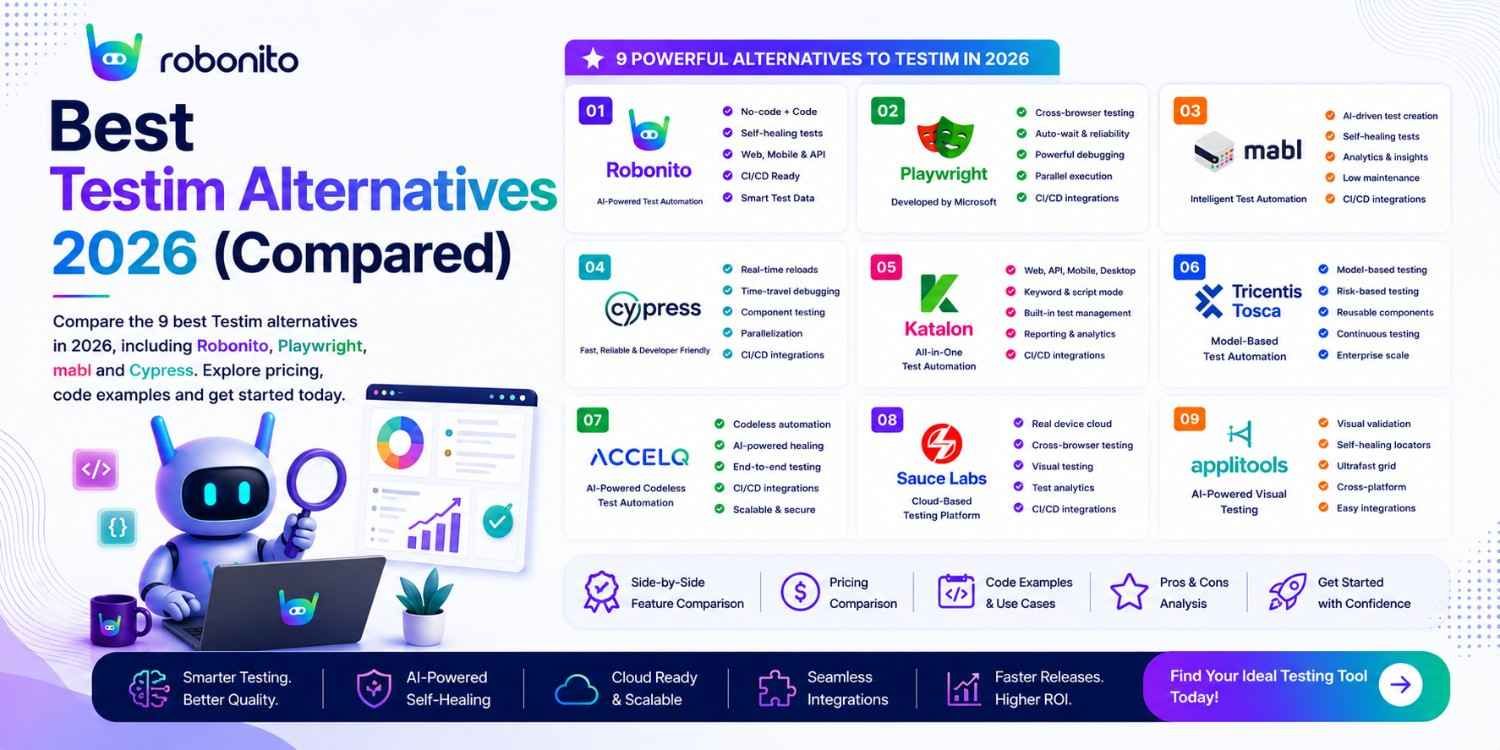
Testim was one of the first platforms to make "AI-powered test automation" mean something real — ML-based element stability that genuinely reduced test breakage. Then Tricentis acquired it in 2022. Since then, teams report pricing increases, roadmap shifts toward enterprise, and a product that is evolving away from its agile roots toward the broader Tricentis ecosystem. This guide covers the 9 strongest alternatives, with real code, honest pricing, and a direct Testim vs Robonito breakdown.
By Robonito Engineering Team · Updated June 2026 · 19 min read
Quick stats
| Fact | Source |
|---|---|
| Testim was acquired by Tricentis in 2022 — roadmap now integrated into Tricentis ecosystem | Tricentis press release |
| AI self-healing automation reduces test maintenance time by up to 80% | DORA State of DevOps 2025 |
| 74% of QA teams report test maintenance is their biggest challenge | Capgemini World Quality Report 2025 |
| No-code test automation adoption grew 340% from 2023 to 2026 | Gartner |
| Teams using AI-powered QA platforms deploy 2.4× more frequently | DORA State of DevOps 2025 |
| The AI testing market reaches $12.8 billion by 2028 | Grand View Research 2025 |
Why teams look for Testim alternatives in 2026
Testim earned its reputation. Its ML-based element identification — using multiple DOM properties to identify elements rather than a single fragile selector — was a genuine technical advance when it launched. Teams that adopted Testim in 2019–2021 got meaningfully more stable test suites with less maintenance overhead.
The landscape shifted in 2022 and has continued shifting since.
The Tricentis acquisition and its consequences:
When Tricentis acquired Testim, it gained a modern AI testing capability to complement its flagship Tosca platform. For Tricentis, this was a strategic portfolio addition. For Testim customers, it meant their standalone agile-focused tool became part of a large enterprise software portfolio, with all the strategic implications that brings: pricing reviewed against enterprise contracts, roadmap decisions made in the context of Tosca and NeoLoad integration priorities, and support resources distributed across a larger product surface.
Teams that chose Testim for its agile-friendly positioning — fast setup, transparent pricing, independent roadmap — find the post-acquisition product less aligned with those values.
The four specific reasons teams evaluate alternatives:
Pricing changes — Multiple community reports indicate pricing increases and model changes post-acquisition. Teams that budgeted for Testim's original pricing discover renewal conversations that look different from the original purchase.
Roadmap uncertainty — The standalone Testim roadmap is now subordinate to Tricentis's broader platform strategy. Features that would benefit independent Testim users may be deprioritised in favour of Tosca integration.
Platform coverage ceiling — Testim remains primarily a web UI testing platform. API testing, desktop testing, and native mobile testing are limited compared to platforms built with broader coverage from the start.
Self-healing scope — Testim's ML element identification handles moderate UI changes well. Large-scale redesigns — new component libraries, full layout restructures, design system migrations — can still break suites and require manual intervention.
The Testim alternative built for agile teams — stronger AI, free tier, no acquisition baggage
Robonito covers web, mobile web, API, and desktop in one AI-powered platform — with intent-based self-healing that survives full UI redesigns, transparent pricing, and a generous free tier to start. Try Robonito free →
Quick comparison table
| Platform | Coding | Self-healing | Platform coverage | Free tier | Pricing from | Best for |
|---|---|---|---|---|---|---|
| Robonito | None | ✅ Intent-based AI | Web + Mobile + API + Desktop | ✅ Generous | Free | Broadest no-code, post-Testim |
| Testim | Low (JS) | ✅ ML element ID | Web + Mobile web | ❌ | ~$450+/mo | ML stability, Tricentis ecosystem |
| Playwright | Yes (multi-lang) | ❌ Manual | Web + Mobile web | ✅ OSS | Free | Engineering teams, cross-browser |
| Cypress | JS/TS only | ❌ | Web | ✅ OSS | Free | JS frontend, developer experience |
| mabl | None | ✅ Advanced visual | Web | ❌ | Enterprise | Visual regression AI |
| ACCELQ | None (visual) | ✅ | Web + Mobile + API + Desktop | ❌ | Custom | Enterprise DevOps |
| Katalon Studio | Low (Groovy) | ⚠️ | Web + Mobile + API + Desktop | ⚠️ | Custom | Scripting flexibility |
| WebdriverIO | JS/TS | ❌ | Web + Mobile | ✅ OSS | Free | Unified web + mobile JS |
| Testsigma | None (NL) | ✅ Selector fallback | Web + Mobile | ❌ | ~$499/mo | Natural language authoring |
| Applitools | Via integration | ❌ | Visual layer only | ✅ | Custom | Visual regression depth |
The 9 best Testim alternatives in 2026
1. Robonito — Best AI-powered platform for post-Testim teams
robonito.com · Free tier · No coding · AI intent-based · Self-healing
Robonito is the strongest overall Testim alternative for agile teams who chose Testim for its AI stability capabilities and need a platform that delivers those capabilities more completely — without the pricing uncertainty that comes with enterprise acquisition.
Understanding the architectural difference between Testim's ML and Robonito's intent-based AI:
Testim's ML element identification works by training a model on the properties of each element — tag name, class list, ID, position, text, surrounding HTML — and using that model to re-identify elements when they change. This is genuinely better than single-selector testing and handles a wide range of UI changes reliably.
The limitation: when the training data itself changes dramatically — a full component rewrite, a new design system, a layout restructure — the model's reference point is no longer valid and re-identification fails.
Robonito's intent-based approach does not train on specific element properties. It captures what the element does — "this is the primary action to complete the current user goal in context" — using five simultaneous signals. When the element changes, the intent remains: there is still a primary checkout action, it still follows the payment form, it still has the accessible name associated with completing a purchase.
Testim self-healing scenario — full design system migration:

Original training data:
  element.className = "btn btn-primary checkout-cta"
  element.id = "checkout-submit"
  element.tagName = "BUTTON"
  element.textContent = "Place Order"

After design system migration:
  element.className = "ds-button ds-button--action"  (new DS class)
  element.id = null  (IDs removed from DS components)
  element.tagName = "BUTTON"  (unchanged)
  element.textContent = "Complete Purchase"  (UX copy change)

Testim result: Model confidence drops below threshold
              Manual re-identification required

Robonito intent evaluation:
  Signal 1: ARIA role = "button" (still matches) ✅ confidence 1.0
  Signal 2: Accessible name = "Complete Purchase" (different, but semantic match) ✅ 0.87
  Signal 3: Visual position = bottom of checkout form (unchanged) ✅ 0.92
  Signal 4: Surrounding context = follows payment method section ✅ 0.89
  Signal 5: Visual prominence = primary action styling ✅ 0.88

Combined confidence: 0.912 → Auto-healed. Test continues.
Platform coverage Robonito provides that Testim lacks:
## Robonito covers all four testing surfaces in one platform
## Testim is primarily web UI — these require separate tools

robonito_coverage:
  web:
    browsers: [chrome, safari, firefox, edge]
    viewports: [desktop, tablet, mobile]
    ci_integration: [github_actions, gitlab_ci, jenkins, circleci]

  mobile_web:
    viewports: [iPhone SE 375px, iPhone 14 393px, Pixel 7 412px, iPad 768px]
    browsers: [safari_ios, chrome_android]
    touch_interactions: true

  api:
    protocols: [REST, GraphQL]
    assertions: [status_code, response_schema, response_time, auth_flows]
    data_driven: true  ## Run same API test with multiple data sets

  desktop:
    apps: [electron, web_based_desktop, progressive_web_apps]
    platforms: [windows, macos]
CI/CD integration that replaces Testim's pipeline setup:
## .github/workflows/robonito-testim-replacement.yml
name: Robonito QA — Testim Alternative

on:
  push:
    branches: [main, develop]
  pull_request:

jobs:
  full-platform-regression:
    runs-on: ubuntu-latest
    steps:
      - uses: actions/checkout@v4

      - name: Web regression (replaces Testim web tests)
        uses: robonito/run-tests-action@v2
        with:
          api-key: ${{ secrets.ROBONITO_API_KEY }}
          suite: web-regression
          environment: staging
          browsers: chrome,safari,firefox,edge
          fail-on: critical
          healing_mode: intent  ## Intent-based, not selector fallback

      - name: API regression (new coverage Testim didn't provide)
        uses: robonito/run-tests-action@v2
        with:
          api-key: ${{ secrets.ROBONITO_API_KEY }}
          suite: api-regression
          environment: staging
          fail-on: any

      - name: Mobile web regression (new coverage)
        uses: robonito/run-tests-action@v2
        with:
          api-key: ${{ secrets.ROBONITO_API_KEY }}
          suite: mobile-regression
          environment: staging
          platform: mobile-web
          fail-on: critical
Migrating from Testim to Robonito:
Testim test cases cannot be exported as code (they are stored in Testim's proprietary format). The practical migration approach is to re-record the top 20 critical user flows in Robonito — which takes approximately 2–4 hours depending on complexity — and let the coverage grow organically from there.
Robonito's recording captures the same flows faster than re-scripting them, and the resulting tests are immediately more durable because they use intent-based rather than property-based element recognition.
Honest limitations: Robonito's native mobile app testing (React Native, Swift, Kotlin) is less deep than dedicated mobile platforms. Testim also has a slight edge in complex JavaScript-heavy SPAs where its ML model has been trained on complex dynamic DOM patterns. For teams whose primary surface is web applications, Robonito is the stronger long-term choice.
Best for: Agile teams previously on Testim seeking transparent pricing and a stronger AI foundation; teams wanting to extend coverage beyond web UI to API and desktop; non-technical QA teams who need self-healing without scripting.
Pricing: Generous free tier. Competitive paid plans — robonito.com/pricing.
2. Playwright — Best for engineering teams wanting full code control
playwright.dev · Open source · Free · TypeScript/JS/Python/Java/C#
Playwright is the right Testim alternative for engineering teams who chose Testim for its stability features but increasingly feel constrained by the abstraction layer. Playwright gives you everything Testim's test recorder captures — cross-browser execution, ARIA-first element selection, network interception — with the full expressiveness of code.
The Testim recorder vs Playwright ARIA — a direct comparison:
// What Testim's recorder generates (approximate):
{
  "step": "click",
  "element": {
    "id": "checkout-submit",
    "className": "btn btn-primary",
    "xpath": "//button[@id='checkout-submit']",
    "text": "Place Order",
    "ml_stable": true
  }
}
// Testim's ML then uses these properties to re-identify on execution

// What Playwright generates with ARIA-first (manual but stable):
await page.getByRole('button', { name: 'Place order' }).click();
// ARIA role + accessible name: survives CSS changes, class renames, ID removal
// Human-readable, version-controlled, reviewable in pull requests
Playwright handles what Testim cannot — multi-tab OAuth flows:
// Playwright — testing OAuth login that opens a new browser tab
// Testim cannot test across browser tabs/windows

test('Google OAuth login completes successfully', async ({ page, context }) => {
  await page.goto('/login');

  // Click Google sign-in — opens new tab
  const [authTab] = await Promise.all([
    context.waitForEvent('page'),  // Wait for new tab to open
    page.getByRole('button', { name: 'Continue with Google' }).click()
  ]);

  await authTab.waitForLoadState('networkidle');

  // Verify Google auth page loaded
  await expect(authTab).toHaveURL(/accounts\.google\.com/);

  // Fill Google credentials in the auth tab
  await authTab.getByLabel('Email').fill(process.env.TEST_GOOGLE_EMAIL!);
  await authTab.getByRole('button', { name: 'Next' }).click();

  await authTab.getByLabel('Password').fill(process.env.TEST_GOOGLE_PASSWORD!);
  await authTab.getByRole('button', { name: 'Sign in' }).click();

  // Tab closes, original page should show authenticated state
  await authTab.waitForEvent('close');
  await expect(page).toHaveURL(/\/dashboard/);
  await expect(page.getByRole('heading', { name: 'Welcome back' })).toBeVisible();
});
Cross-browser with real WebKit — Testim requires BrowserStack for Safari:
// playwright.config.ts
// Testim needs BrowserStack or similar for Safari — adds cost and latency
// Playwright includes WebKit natively — free, runs in your CI

export default defineConfig({
  projects: [
    { name: 'chromium', use: { ...devices['Desktop Chrome'] } },
    { name: 'webkit',   use: { ...devices['Desktop Safari'] } }, // Free, native
    { name: 'firefox',  use: { ...devices['Desktop Firefox'] } },
    { name: 'mobile',   use: { ...devices['iPhone 14'] } },
  ],
  // All browsers run on ubuntu-latest in GitHub Actions — no cloud dependency
});
API testing alongside UI — one framework:
// Playwright — API + UI in the same test file
// Testim requires separate tools for API testing

test('order placed via UI exists in API', async ({ page, request }) => {
  // UI interaction
  await page.goto('/products/widget-pro');
  await page.getByRole('button', { name: 'Add to cart' }).click();
  await page.goto('/checkout');
  await page.getByLabel('Email').fill('test@example.com');
  await page.getByRole('button', { name: 'Place order' }).click();

  // Extract order ID from UI confirmation
  const orderNumber = await page.getByTestId('order-number').textContent();
  const orderId = orderNumber!.replace('ORD-', '');

  // Verify the same order exists in the API — cross-layer assertion
  const response = await request.get(`/api/v1/orders/${orderId}`, {
    headers: { Authorization: `Bearer ${process.env.TEST_API_TOKEN}` }
  });
  expect(response.status()).toBe(200);

  const orderData = await response.json();
  expect(orderData.status).toBe('pending');
  expect(orderData.customer_email).toBe('test@example.com');
  // Verify no duplicate order was created
  expect(orderData.id).toBe(orderId);
});
Honest limitations: Requires coding — not accessible to non-technical QA. No built-in self-healing — broken selectors require manual updates. No visual dashboard or test management UI.
Best for: Engineering teams frustrated with Testim's abstraction constraints, Python/Java/C# teams who need proper language support, teams needing multi-tab, cross-domain, or API + UI testing in one framework.
Pricing: Free and open source.
3. Cypress — Best for JavaScript teams with developer-led testing
cypress.io · Open source core · JavaScript/TypeScript
Cypress is the Testim alternative built for JavaScript teams where developers and QA collaborate on the same test codebase. Testim's recorder abstracts test creation; Cypress makes test creation transparent, debuggable, and fully owned by the team.
The developer experience Cypress offers that Testim cannot:
// Cypress — real-time debugging that Testim's abstraction hides

describe('Checkout flow', () => {
  it('handles payment decline gracefully', () => {
    // Intercept and mock the payment API — Testim has limited network control
    cy.intercept('POST', '/api/v1/payments', {
      statusCode: 402,
      body: { error: 'card_declined', message: 'Your card was declined' }
    }).as('paymentAttempt');

    cy.visit('/checkout');
    cy.get('[data-testid="card-number"]').type('4000000000000002'); // Decline test card
    cy.get('[data-testid="card-expiry"]').type('1228');
    cy.get('[data-testid="card-cvv"]').type('123');
    cy.get('[data-testid="place-order"]').click();

    // Verify API was called with correct payload
    cy.wait('@paymentAttempt').its('request.body').should('deep.include', {
      currency: 'USD',
      capture_method: 'automatic'
    });

    // Verify UI shows correct error — cart preserved, form not cleared
    cy.get('[role="alert"]')
      .should('be.visible')
      .and('contain', 'Your card was declined');

    cy.get('[data-testid="card-number"]')
      .should('have.value', '4000000000000002'); // Form preserved

    cy.url().should('include', '/checkout'); // Still on checkout, not redirected
  });
});
Cypress time-travel debugging — Testim has no equivalent:
// Every Cypress test step is captured with a DOM snapshot
// Click "Step 3" in the Cypress UI: the DOM rewinds to exactly that state
// Debug exactly what the page looked like when a step failed
// Testim shows you that it failed — Cypress shows you why

// This debugging capability reduces investigation time from hours to minutes
// for complex failures in multi-step flows
Honest limitations: JavaScript/TypeScript only. Limited Safari support (experimental in 2026). No multi-tab testing. Cypress Cloud adds cost for parallelisation and advanced reporting.
Best for: JavaScript/TypeScript-first teams, React/Vue/Angular SPAs, teams where developers and QA share ownership of the test suite, teams prioritising debugging experience over coverage breadth.
Pricing: Free OSS core. Cypress Cloud from ~$75/month.
4. mabl — Best AI visual regression and test stability platform
mabl.com · No-code · Enterprise
mabl is the closest no-code competitor to Testim — both position as AI-powered web test automation requiring no code. The meaningful differences in 2026: mabl's visual AI is significantly more sophisticated, and mabl has not been absorbed into an enterprise platform that changes its pricing and roadmap.
Where mabl's AI exceeds Testim's:
Testim's AI: ML element identification
→ Trains a model on element properties
→ Handles: attribute changes, minor restructuring
→ Fails on: component rewrites, design system changes
→ Visual testing: basic screenshot comparison with threshold

mabl's AI: Visual AI + element AI + stability scoring
→ Visual AI: understands layout context, not pixel comparison
→ Handles: attribute changes, restructuring, minor redesigns
→ Stability analysis: proactively identifies and reports flaky tests
→ Visual testing: AI distinguishes real regressions from rendering noise
  "Button moved 40px" = real regression ← mabl catches this
  "Safari sub-pixel font rendering" = noise ← mabl ignores this
  "Testim: would flag both as failures or miss both (threshold-dependent)"
Honest limitations: No free tier — enterprise pricing commitment before evaluation. Web-only platform — no API, no desktop, no native mobile. The premium over Testim may not be justified for teams whose budget was already strained by Testim pricing.
Best for: Teams specifically seeking stronger visual regression quality over Testim, design-critical applications, enterprises where Testim's visual testing has missed production visual regressions.
Pricing: No free tier. Enterprise pricing — contact mabl.
5. ACCELQ — Best for enterprise DevOps with deepest CI/CD integration
accelq.com · No-code (visual flow) · Enterprise
ACCELQ is the Testim alternative for enterprise teams whose primary frustration is not the AI quality but the integration depth. Testim integrates with popular CI/CD tools and project management platforms. ACCELQ integrates with 25+ enterprise tools natively — including ServiceNow, Jira Service Management, Azure DevOps release gates, and UrbanCode.
The integration gap between Testim and ACCELQ:
Testim native integrations:
  CI/CD: GitHub Actions, Jenkins, GitLab CI, CircleCI
  Test management: Jira (basic), Zephyr
  Reporting: Built-in dashboard

ACCELQ native integrations:
  CI/CD: GitHub Actions, Jenkins, GitLab CI, Azure DevOps, CircleCI, TeamCity, Bamboo
  Test management: Jira, Azure DevOps, ALM, TestRail, qTest, Zephyr Scale
  Service management: ServiceNow, Jira Service Management
  Release management: UrbanCode, Octopus Deploy, XebiaLabs
  Monitoring: Datadog, Splunk (test failures as deployment quality signals)
  Reporting: Enterprise dashboards with cross-project metrics
ACCELQ test flow (visual canvas, no code required):
## ACCELQ test flow — YAML representation of visual drag-and-drop canvas
test_flow: checkout_complete
version: 1.0

steps:
  - action: navigate
    url: "${env.BASE_URL}/products/widget-pro"
    wait_for: page_ready

  - action: click
    label: "Add to Cart"
    element_type: button
    ai_fallback: true

  - action: verify
    label: "Cart count"
    expected: "1"
    comparison: equals

  - action: navigate
    url: "${env.BASE_URL}/checkout"

  - action: input
    field_label: "Full name"
    value: "${data.customer_name}"  ## From connected test data set

  - action: input
    field_label: "Email address"
    value: "${data.customer_email}"

  - action: click
    label: "Place order"
    element_type: button

  - action: verify
    heading: "Order confirmed"
    wait_timeout: 15
    on_fail: screenshot + block_deployment
Honest limitations: Custom enterprise pricing — no self-serve evaluation. Visual flow design requires more initial setup than Testim's recorder. Better suited to large QA organisations than individual contributors or small teams.
Best for: Enterprise teams needing Testim-level AI stability with enterprise-grade DevOps integration depth across 25+ tools, regulated industries requiring formal quality gates in release pipelines.
Pricing: Custom pricing — contact ACCELQ.
6. Katalon Studio — Best when scripting flexibility is required
katalon.com · Low-code (Groovy) · Commercial
Katalon is the Testim alternative for teams who liked Testim's visual approach but need a scripting escape hatch for complex scenarios. Testim's automation is fully AI-managed — there is no way to write custom code when the AI abstraction is insufficient. Katalon provides Groovy scripting when the visual recorder cannot handle the test scenario.
Real code — Katalon's Groovy scripting for complex assertions:
// Katalon Studio — when visual no-code is insufficient
// This complexity is impossible in Testim's visual recorder

import com.kms.katalon.core.webui.keyword.WebUiBuiltInKeywords as WebUI
import com.kms.katalon.core.model.FailureHandling

// Standard keyword approach (accessible to non-technical testers)
WebUI.openBrowser('https://yourapp.com/checkout')
WebUI.click(findTestObject('checkout/btn_place_order'))

// Extract dynamic order ID from confirmation page
String rawConfirmation = WebUI.getText(findTestObject('checkout/text_order_number'))
String orderId = rawConfirmation.replaceAll('[^0-9]', '')

// Call REST API to verify order created correctly — impossible in Testim
import groovy.json.JsonSlurper
def apiResponse = new URL("${API_BASE}/orders/${orderId}")
    .openConnection().with {
        setRequestProperty('Authorization', "Bearer ${API_TOKEN}")
        new JsonSlurper().parse(inputStream)
    }

// Complex assertion that UI alone cannot verify
assert apiResponse.status == 'pending' :
    "Order status should be 'pending', got: ${apiResponse.status}"
assert apiResponse.payment_captured == false :
    "Payment capture should be deferred, got: ${apiResponse.payment_captured}"
assert apiResponse.inventory_reserved == true :
    "Inventory should be reserved immediately"

WebUI.closeBrowser()
Honest limitations: Groovy scripting is a barrier for non-technical testers despite low-code positioning. Significant pricing increase post-Perforce acquisition. Self-healing less mature than Testim or Robonito.
Best for: Teams wanting a recorder like Testim's with the option to drop into code when the recorder is insufficient, teams that have outgrown Testim's AI abstraction but do not want to move to a fully code-first framework.
Pricing: Free tier with limitations. Paid plans — verify current pricing at katalon.com post-acquisition.
7. WebdriverIO — Best Node.js alternative with unified web + mobile
webdriver.io · Open source · Free · JavaScript/TypeScript
WebdriverIO is the Testim alternative for Node.js teams who specifically need unified web and native mobile testing from one framework. Testim is web-only. WebdriverIO runs the same test infrastructure against web applications (via WebDriver) and native mobile apps (via Appium), with consistent syntax across both.
Real code — WebdriverIO unified web + mobile:
// webdriverio/test/checkout.e2e.js
// Same framework runs web and native mobile tests

describe('Checkout — web', () => {
  it('completes purchase with valid details', async () => {
    await browser.url('/checkout');

    await $('[data-testid="name-input"]').setValue('Jane Smith');
    await $('[data-testid="email-input"]').setValue('jane@example.com');
    await $('[data-testid="place-order"]').click();

    await expect($('[data-testid="confirmation"]')).toBeDisplayed();
    const confirmText = await $('[data-testid="confirmation"]').getText();
    expect(confirmText).toContain('Order confirmed');
  });
});

// Switch capabilities to Appium for native mobile:
// capabilities: { platformName: 'Android', 'appium:automationName': 'UiAutomator2' }
// Test structure and assertions are identical
// This unified approach is not available in Testim
WebdriverIO's WDIO testrunner — stronger CI integration than Testim:
// wdio.conf.js — WebdriverIO configuration
// More control than Testim's CI connector

export const config = {
  specs: ['./test/**/*.e2e.js'],
  maxInstances: 10,  // Parallel execution, free — no Testim Cloud subscription
  capabilities: [
    { browserName: 'chrome', acceptInsecureCerts: true },
    { browserName: 'firefox' },
    { browserName: 'safari' }
  ],
  services: [
    ['selenium-standalone'],
    ['browserstack', {  // Real devices when needed
      browserstackLocal: true,
      capabilities: [{ 'bstack:options': { deviceName: 'iPhone 15' } }]
    }]
  ],
  reporters: ['spec', ['allure', { outputDir: 'allure-results' }]],
  // Custom logic impossible in Testim's abstraction:
  beforeTest: async function(test) {
    // Seed test data, reset state, set up authentication
    await seedTestDatabase(test.ctx.testData);
  },
  afterTest: async function(test, context, { error }) {
    if (error) {
      // Custom failure handling — notify Slack, create Jira ticket
      await notifyTeamOnFailure(test, error);
    }
  }
};
Honest limitations: Requires JavaScript/TypeScript proficiency. More setup overhead than Testim for basic web testing. No built-in AI or self-healing.
Best for: Node.js teams needing unified web and native mobile testing, teams with existing Appium investment wanting a more structured JavaScript framework.
Pricing: Free and open source.
8. Testsigma — Closest functional equivalent to Testim's no-code approach
testsigma.com · No-code (natural language) · Commercial
Testsigma is the most direct functional equivalent to Testim in the no-code AI testing market — both platforms require no code, both have AI stability features, and both target non-technical QA teams. Teams evaluating Testim in 2026 should always run Testsigma in parallel.
Testim vs Testsigma — the honest comparison:
| Dimension | Testim (post-Tricentis) | Testsigma |
|---|---|---|
| AI element stability | ML-based property matching | NL + selector fallback |
| Test authoring | Visual recorder | Natural language sentences |
| Mobile app testing | Mobile web primarily | Native iOS + Android stronger |
| API testing | Limited | More developed |
| Platform independence | Tricentis ecosystem | Independent platform |
| Roadmap transparency | Integrated into Tricentis roadmap | Independent roadmap |
| Pricing model | Enterprise-shifted | Team-based |
| Free tier | ❌ | ❌ |
| Community | Established | Growing |
When to choose Testsigma over Testim: Independent roadmap, stronger native mobile, clearer team pricing, more developed API testing.
When to choose Testim over Testsigma: If already embedded in Tricentis ecosystem (Tosca, NeoLoad), or specifically need Testim's ML recorder quality.
When to choose Robonito over both: Free tier, intent-based self-healing that survives larger changes, broader platform coverage (API and desktop), faster setup.
Pricing: ~$499/month for team plans.
9. Applitools — Best when visual regression is the specific Testim gap
applitools.com · Free tier · Integrates with any framework
Applitools is not a direct Testim replacement — it is a visual testing intelligence layer that sits on top of any framework. If the specific reason your team is moving from Testim is that visual regressions are slipping through — Testim's visual testing flagging too many false positives or missing real visual bugs — Applitools solves that specific problem more completely than any full-platform replacement.
Adding Applitools visual AI on top of your Testim migration framework:
// Playwright (replacing Testim) + Applitools Eyes (replacing Testim's visual layer)
// Best of both: Playwright's control + Applitools' AI visual quality

import { test } from '@playwright/test';
import { Eyes, Target, BatchInfo, Configuration, BrowserType } from '@applitools/eyes-playwright';

const batch = new BatchInfo({ name: 'Sprint 16 Visual — Post-Testim Migration' });

test.describe('Visual regression suite (Applitools replacing Testim visual)', () => {
  let eyes: Eyes;

  test.beforeEach(async ({ page }) => {
    eyes = new Eyes();
    const config = new Configuration();
    config.setBatch(batch);
    // Run across browsers simultaneously — Testim needs separate runs
    config.addBrowser(1280, 800, BrowserType.CHROME);
    config.addBrowser(1280, 800, BrowserType.FIREFOX);
    config.addBrowser(1280, 800, BrowserType.SAFARI);
    config.addDeviceEmulation('iPhone 14');
    eyes.setConfiguration(config);
    await eyes.open(page, 'YourApp', test.info().title);
  });

  test.afterEach(async () => {
    const results = await eyes.close(false);
    if (results.getStatus() === 'Failed') {
      throw new Error(`Visual regression: ${results.getUrl()}`);
    }
  });

  test('checkout renders consistently post-migration', async ({ page }) => {
    await page.goto('/checkout');
    await page.waitForLoadState('networkidle');

    await eyes.check('Checkout page', Target.window().fully()
      .ignoreRegion(page.getByTestId('countdown-timer'))
      .layout(page.getByTestId('promo-banner'))
      // Applitools AI: layout comparison ignores text changes in banners
      // Strict check on trust signals — must be pixel-perfect
      .strict(page.getByTestId('payment-icons'))
    );
  });
});
Honest limitations: Does not replace a full test platform — adds visual intelligence to tests you run elsewhere. Requires an existing framework alongside it. Pricing scales with screenshot volume.
Best for: Teams migrating from Testim to Playwright or Robonito who specifically need to preserve or improve visual regression quality during the migration.
Pricing: Free tier available. Enterprise custom pricing based on screenshot volume.
Testim vs Robonito — the direct comparison
The comparison most readers of this article are working through. Here it is in full, with honest assessments of both platforms.
| Dimension | Testim (2026) | Robonito |
|---|---|---|
| AI mechanism | ML property-based element identification | Multi-signal intent recognition |
| Self-healing scope | Handles attribute/selector changes | Handles attribute changes + component rewrites + design system migrations |
| Test authoring | Visual recorder (no code) | AI generation from recorded flows (no code) |
| Platform coverage | Web UI primarily | Web + Mobile web + API + Desktop |
| API testing | Limited, secondary | Native, comprehensive |
| Desktop testing | ❌ | ✅ Electron + web-based |
| Native mobile | Limited | Mobile web focus |
| Free tier | ❌ | ✅ Generous |
| Setup time | 2–4 hours | Under 1 hour |
| Enterprise ownership | Tricentis (acquired 2022) | Independent |
| Pricing transparency | Enterprise-shifted | Transparent, free tier entry |
| CI/CD integration | GitHub Actions, Jenkins, GitLab | GitHub Actions, GitLab, Jenkins, CircleCI (native) |
| Cross-browser | ✅ (needs cloud for Safari) | ✅ Chrome, Safari, Firefox, Edge |
| Safari testing | Requires external cloud (cost) | Included in platform |
| Data-driven testing | ✅ | ✅ Excel, CSV, API, JSON |
| Best for | Teams in Tricentis ecosystem | Agile teams, post-Testim migration |
The honest verdict:
For teams evaluating Testim fresh in 2026, Robonito has the stronger value proposition in nearly every dimension: broader platform coverage, intent-based self-healing that outlasts ML property matching on large changes, a free tier for real evaluation, faster setup, and transparent pricing without enterprise acquisition dynamics.
For teams already running Testim with a working, stable suite, the migration calculus depends on how frequently tests are breaking (if rarely, the status quo is fine) and what your next renewal conversation with Tricentis looks like. If pricing has increased significantly, the migration ROI is clear.
Migrating from Testim to Robonito
Most teams migrate in three phases:
- Identify critical business workflows
- Re-record core flows in Robonito
- Run both platforms in parallel for 2–4 weeks
Start with login, checkout, onboarding, and revenue-generating workflows before migrating secondary test suites.
Common Migration Timeline
| Team Size | Typical Migration Time |
|---|---|
| Small Team | 1–2 weeks |
| Mid-Size Team | 2–4 weeks |
| Enterprise | 4–8 weeks |
Choosing the right Testim alternative
| Your situation | Best choice | Key reason |
|---|---|---|
| Post-Testim, need stronger AI + free start | Robonito | Intent-based healing, API + desktop, free tier |
| Engineering team wanting full code control | Playwright | Free, multi-language, best cross-browser |
| JavaScript frontend team, developer-owned testing | Cypress | Interactive debugger, network interception |
| Visual regression was Testim's specific weakness | mabl or Applitools | Most sophisticated visual AI available |
| Enterprise with 25+ tool integrations required | ACCELQ | Deepest enterprise DevOps integration |
| Need scripting flexibility alongside no-code | Katalon Studio | Groovy escape hatch when recorder insufficient |
| Node.js, need unified web + native mobile | WebdriverIO | Same framework for both platforms |
| Closest Testim functional equivalent, independent | Testsigma | Similar no-code approach, independent roadmap |
| Keep some Testim, add better visual layer | Applitools | Integrates with Testim directly |
Pre-evaluation checklist before migrating from Testim
- Specific reason for migrating documented — pricing, platform gaps, or AI quality?
- Current Testim suite health assessed — what % of tests break per sprint?
- Platform coverage gap identified — is API, desktop, or mobile web needed?
- Self-healing failure patterns documented — where is Testim's ML failing?
- Free trial completed against your real application (not a vendor demo)
- Non-technical testers evaluated the alternative independently
- CI/CD integration tested with your actual pipeline
- Pricing modelled at your team size over 12 months
- Testim test inventory assessed — how many tests to migrate, what complexity?
- Migration approach agreed — gradual (new tests in new platform) vs batch migration
Frequently Asked Questions
What is the best Testim alternative in 2026?
Robonito for teams wanting stronger intent-based self-healing, broader platform coverage (web + mobile + API + desktop), a free tier, and independence from enterprise acquisition dynamics. Playwright for engineering teams wanting code-first control. Cypress for JavaScript-first developer teams. mabl for visual regression depth. The best choice depends on your specific Testim pain point.
What is Testim?
Testim is an AI-assisted test automation platform (acquired by Tricentis in 2022) that uses machine learning to create and stabilise web UI tests without code. Its ML-based element identification was an advance over single-selector testing. Post-acquisition, it has evolved toward integration with the Tricentis enterprise platform (Tosca, NeoLoad).
Why do teams look for Testim alternatives in 2026?
Post-Tricentis acquisition pricing changes, roadmap shifts toward enterprise that affect agile teams, limited platform coverage (primarily web UI), self-healing that breaks on large UI redesigns, and the push toward Tricentis enterprise tooling that smaller teams do not need.
How does Robonito compare to Testim?
Both are no-code AI platforms with self-healing. Robonito's intent-based multi-signal healing is more durable than Testim's ML property matching for large UI changes. Robonito covers web, mobile web, API, and desktop in one platform (Testim is primarily web). Robonito has a generous free tier; Testim does not. Robonito is independent; Testim is integrated into Tricentis.
Is Testim still a good choice in 2026?
For teams already running Testim with a stable, reliable suite: yes, continue unless renewal pricing is untenable. For teams evaluating fresh: compare Testim's current post-acquisition pricing and roadmap against Robonito, mabl, and Playwright before committing. The 2026 alternatives are stronger relative to Testim than they were when Testim launched.
External references
- Playwright Documentation — Official docs
- Cypress Documentation — Official docs
- WebdriverIO Documentation — Official docs
- mabl Documentation — Official docs
- Applitools Documentation — Visual AI testing
- DORA State of DevOps 2025 — AI testing performance data
- Capgemini World Quality Report 2025 — Maintenance statistics
Everything Testim promised — stronger AI, broader coverage, free to start
Robonito delivers intent-based self-healing that outlasts Testim's ML element matching, covers web + mobile web + API + desktop in one platform, and starts completely free — no enterprise acquisition dynamics, no pricing surprises. Teams migrating from Testim are live in Robonito within the same sprint. Start free at Robonito.com →
Automate your QA — no code required
Stop writing test scripts.
Start shipping with confidence.
Join thousands of QA teams using Robonito to automate testing in minutes — not months.