01 / 03
Hallucinations look like answers
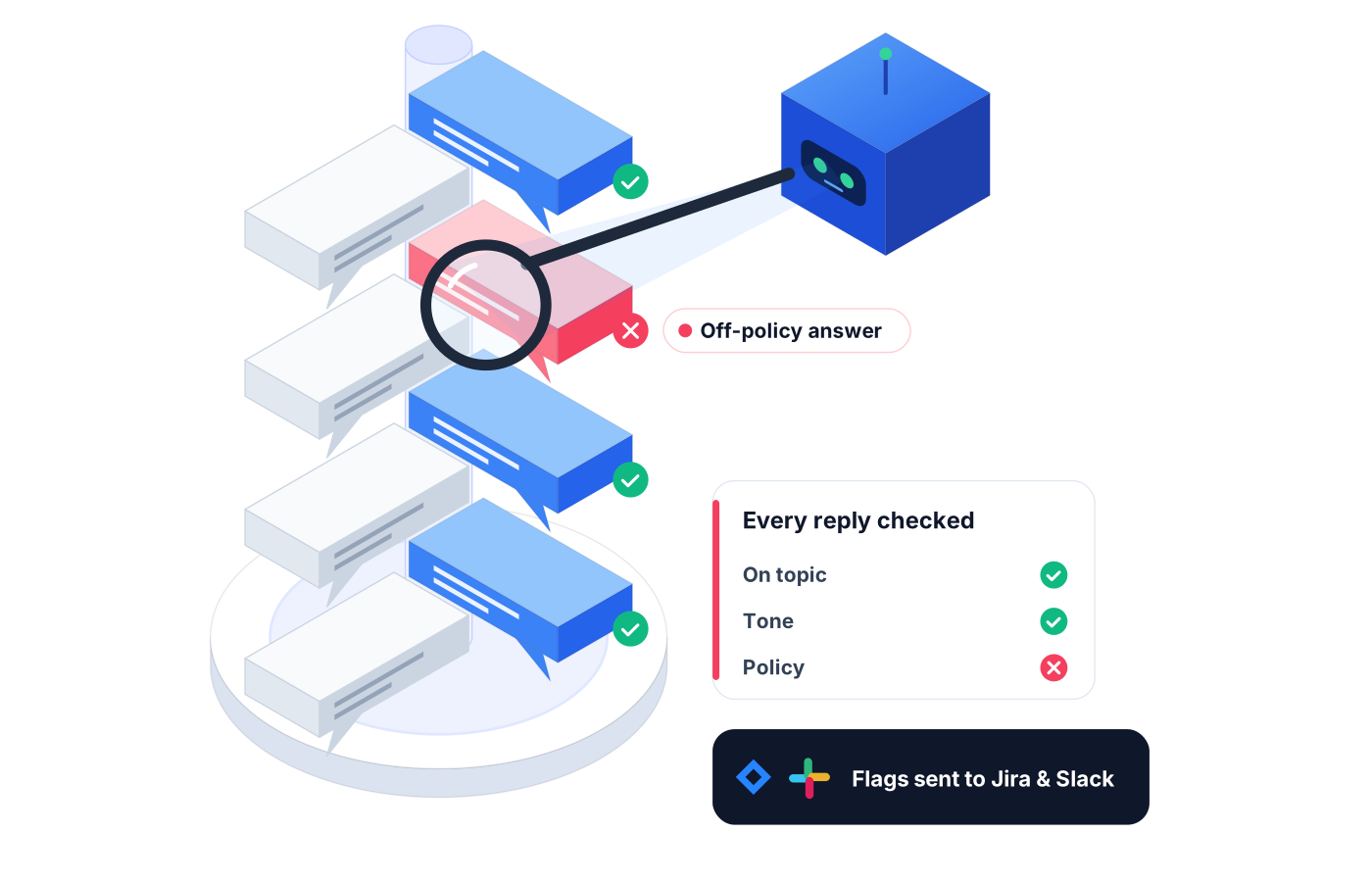
The bot invents a return policy or a product feature, and nothing in your monitoring flags it.
Conversational AI Testing
Chatbot testing used to mean checking a decision tree, but your AI assistant now writes its own answers. Robonito's agents hold real multi-turn conversations with your bot and review every reply for accuracy, intent, and policy.
Free forever plan · No code required
Teams that refuse to trade speed for quality ship with Robonito






01The problem
A wrong answer from an AI assistant doesn't look like an error. It looks helpful, polished, and sure of itself, which is exactly why customers believe it.
01 / 03
The bot invents a return policy or a product feature, and nothing in your monitoring flags it.
02 / 03
It handles the first question well, then forgets what the customer said a few messages ago.
03 / 03
A small change to the system prompt or knowledge base fixes one answer and quietly breaks others.
02Capabilities
Robonito tests the conversation, not just the endpoint, and judges answers the way a careful reviewer would.
01
Test complete journeys like order tracking, account changes, and troubleshooting, from the first message to resolution.
02
Check that the bot understands what users mean and gives correct, complete answers, even when they phrase things oddly.
03
Flag answers that state things your business never said, like made-up policies, prices, or features.
04
Confirm the bot stays on topic, declines what it should, and follows your rules for tone and disclosures.
05
Test long conversations where users refer back, change their minds, or add details, so context holds across turns.
06
Verify the bot escalates when it should and passes the conversation along, so the customer doesn't have to repeat themselves.
03How it works
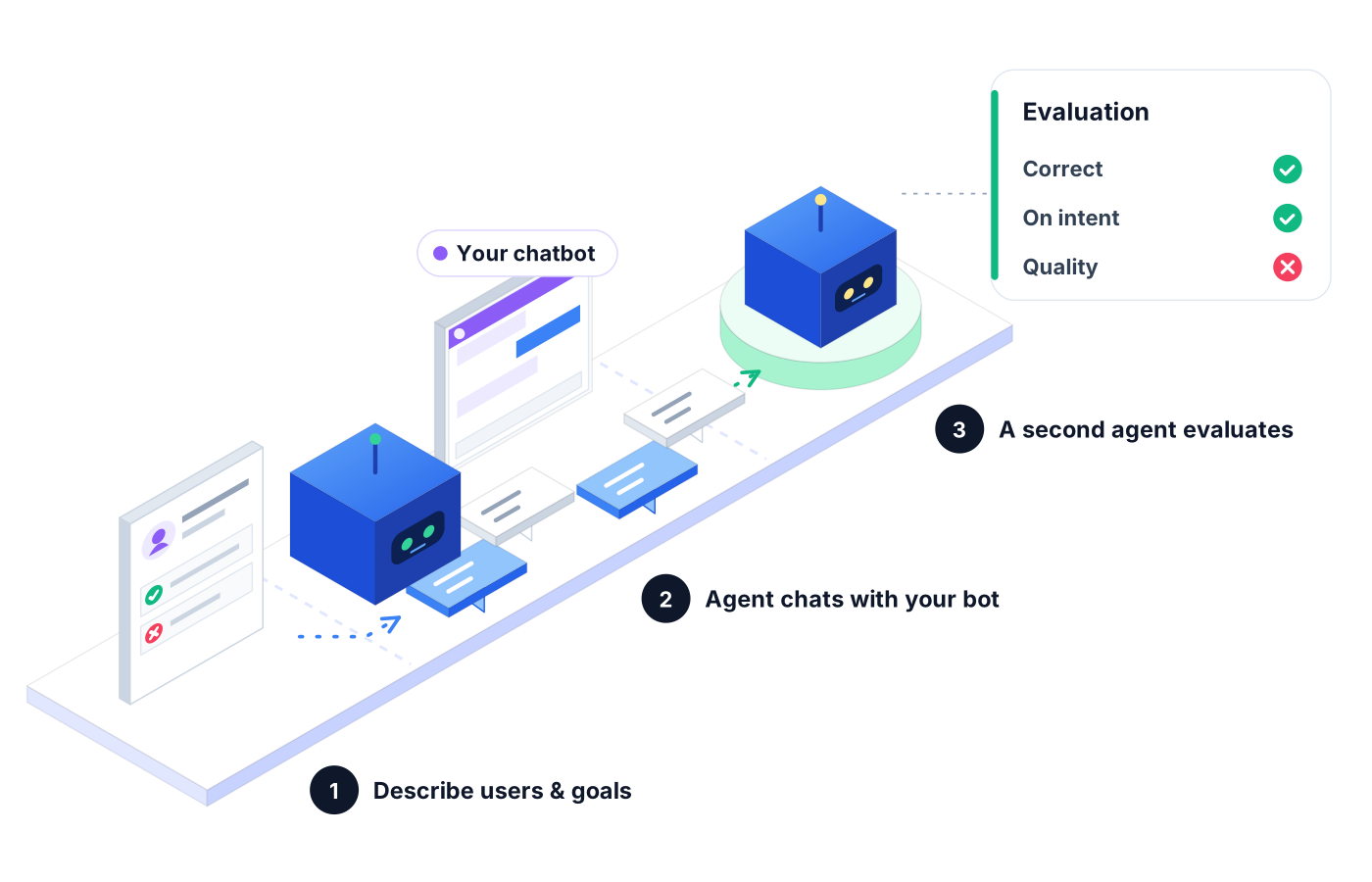
Write the scenarios you care about in plain language: who the user is, what they want, and what a good answer must include or avoid.
One agent plays the user and holds a real multi-turn conversation, logging every message along the way.
An evaluating agent reviews the conversation for correctness, intent, and quality, and explains each failure.
04Real examples
A customer asks for a refund on an item bought outside the return window. The test checks that the bot quotes your actual policy instead of inventing a friendlier one.
A user asks about shipping, then mid-thread asks to change their delivery address. The test confirms the bot keeps track of the order they were discussing.
After two unhelpful replies, the user types "let me talk to a person." The test confirms the bot hands off and the conversation history goes with it.
05Evidence
Before you change a prompt, a model, or a knowledge source, you can see how the answers hold up.
Every test conversation is logged turn by turn, so you can read exactly where it went wrong.
Proof you get: Turn-by-turn conversation log
Each reply is judged for correctness, intent, and quality, with an explanation you can share with the team that owns the bot.
Proof you get: Agent-to-agent evaluation for each conversation
Rerun the same suite after a change and check pass rate and failure clusters in Reporting.
Proof you get: Execution overview with pass rate and failure clusters
06Ways to start
01
Try Robonito on your own web app with the free-forever plan. No code required, and no time limit.
02
Run a no-obligation proof of concept on your real system. You get clear results and a clear recommendation before you commit.
03
Robonito Professional Services helps with test strategy, migration from existing suites, and rollout across your teams.
Explore Professional Services07FAQ
Chatbot testing checks that a chatbot understands users, gives accurate and safe answers, keeps context across a conversation, and hands off to a human when it should. For AI chatbots built on large language models, it also means catching hallucinations and policy violations, since the bot writes a new answer every time instead of following a fixed script.
You test an AI chatbot by running realistic multi-turn conversations against it and evaluating each reply. With Robonito, one AI agent plays the user and chats with your bot, and a second agent evaluates the conversation for correctness, intent, and quality. You review the flagged failures, fix the prompt or knowledge source, and rerun the same suite.
You detect hallucinations by checking the bot's answers against what your business actually says, such as your policies, prices, and product details. Robonito's evaluating agent reviews each reply for correctness and flags answers that contradict what your scenarios define as true. Running these checks after every update helps catch new hallucinations before customers see them.
Yes. Automated chatbot testing swaps hours of manual chatting for test conversations an AI agent runs for you. Robonito's agents can run the same set of scenarios after every prompt, model, or knowledge base change, and Reporting shows pass rate and failure clusters, so your team compares runs instead of reading transcripts one by one.
Chatbot testing checks the whole product experience, while LLM evaluation focuses on the model's raw outputs. A chatbot test cares whether the bot resolved the customer's issue, kept context, followed policy, and handed off correctly. Robonito's agent-to-agent testing covers both: it holds the conversation like a user and evaluates each response for correctness, intent, and quality.
Book a demo and bring a few real customer questions your bot struggles with. We'll set up scenarios, run a Robonito agent against your chatbot, and walk through the evaluation together. In the meantime, you can start free to try Robonito's web test automation on the rest of your product.
Conversational AI Testing
Test AI phone agents on inbound and outbound calls
Learn moreConversational AI Testing
Menus, DTMF, speech input, and call routing
Learn moreAI QA Agents
Agents that write, run, and heal your tests
Learn moreAI QA Agents
Full user journeys across web, mobile, API, desktop
Learn moreBook a demo to see a Robonito agent chat with your bot, test it against your policies, and show you which answers need work.