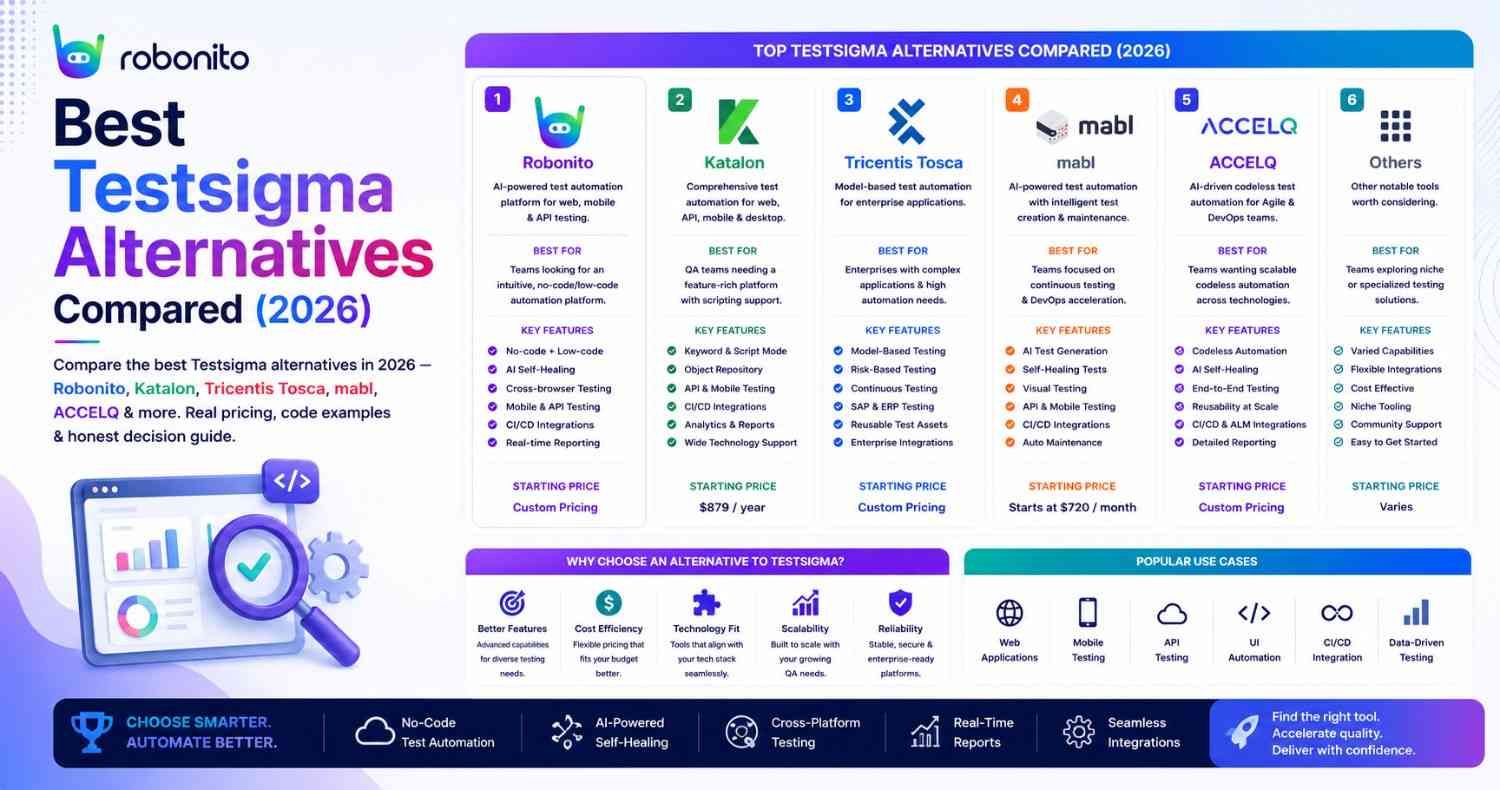
Testsigma promised to make test automation accessible to everyone. For many teams it delivers on that promise — but it does not deliver it for every team. Pricing at scale, self-healing maturity gaps, limited API testing depth, and natural language authoring that is less intuitive than marketed are the four reasons teams explore alternatives. This guide covers the 9 best — with real pricing, working code, and a direct Testsigma vs Robonito comparison so you can make an informed decision today.
By Robonito Engineering Team · Updated May 2026 · 19 min read
Quick stats
| Fact | Source |
|---|---|
| No-code test automation adoption grew 340% from 2023 to 2026 | Gartner |
| Teams with self-healing automation spend 5–10% on maintenance vs 40–60% with scripted tools | Capgemini World Quality Report 2025 |
| 67% of software projects fail to meet quality expectations at first release | Standish Group CHAOS Report 2025 |
| AI-powered test platforms reduce QA cycle time by up to 80% | DORA State of DevOps 2025 |
| The no-code/low-code testing market reaches $8.4 billion by 2027 | Forrester |
Why teams look beyond Testsigma
Testsigma is a capable platform. The teams that look for alternatives are not dissatisfied with it categorically — they have hit specific constraints that a different tool handles better.
Pricing at scale — Testsigma's per-user licensing model becomes expensive for larger QA organisations. Teams with 10+ testers all needing platform access find the total cost of ownership significantly higher than alternatives with team-based or usage-based pricing.
Self-healing maturity gap — Testsigma has self-healing capabilities, but they rely primarily on fallback selector strategies. AI-native platforms like Robonito use intent-based multi-signal recognition that survives more dramatic UI changes than selector fallbacks handle.
Natural language authoring ceiling — Testsigma's "write tests in plain English" works well for simple linear flows. For complex conditional logic, multi-step data-driven scenarios, or tests requiring API setup, it requires technical knowledge that contradicts the no-code promise.
Limited API testing depth — Testsigma is UI-first. Its API testing capabilities are functional but secondary. Teams with significant API testing requirements find dedicated frameworks or broader platforms more capable.
Mobile native depth — Testsigma handles mobile web well. For deep native iOS and Android testing (complex gesture sequences, hardware integrations, offline mode), purpose-built mobile tools offer more control.
The Testsigma alternative with stronger AI, broader coverage, and a free tier
Robonito covers web, mobile web, API, and desktop in one AI-powered platform — with self-healing that actually works when your UI redesigns, not just when element IDs change. Try Robonito free →
Quick comparison table
| Platform | Coding | Self-healing | Coverage | Free tier | CI/CD | Pricing from |
|---|---|---|---|---|---|---|
| Robonito | None | ✅ AI intent | Web + Mobile + API + Desktop | ✅ | ✅ Native | Free |
| Testsigma | None (NL) | ✅ Selector fallback | Web + Mobile + API | ❌ | ✅ | ~$499/mo |
| Katalon Studio | Low (Groovy) | ⚠️ | Web + Mobile + API + Desktop | ⚠️ Limited | ✅ | Custom |
| Tricentis Tosca | Low (model) | ✅ | Web + Mobile + API + SAP + Desktop | ❌ | ✅ | Enterprise |
| TestComplete | Low (GUI) | ⚠️ | Web + Mobile + Desktop | ❌ | ✅ | Enterprise |
| ACCELQ | None | ✅ | Web + Mobile + API + Desktop | ❌ | ✅ | Custom |
| mabl | None | ✅ Advanced visual | Web | ❌ | ✅ | Enterprise |
| Playwright | Yes (multi-lang) | ❌ Manual | Web + Mobile web | ✅ OSS | ✅ | Free |
| Leapwork | None (visual flow) | ✅ | Web + Desktop + SAP | ❌ | ✅ | Enterprise |
| Applitools | Via integration | ❌ | Visual only | ✅ | ✅ | Custom |
Best No-Code Alternatives to Testsigma
Not every team evaluating Testsigma wants a code-first framework such as Playwright or Selenium. Many organizations are specifically looking for no-code or low-code platforms that reduce maintenance effort, accelerate automation adoption, and allow both technical and non-technical team members to contribute.
The following platforms are among the strongest no-code alternatives to Testsigma in 2026.
| Platform | Best For | Web | Mobile | API | Desktop | AI Features |
|---|---|---|---|---|---|---|
| Robonito | End-to-end AI-powered automation | ✅ | ✅ Mobile Web | ✅ | ✅ | ✅ Advanced |
| ACCELQ | Enterprise continuous testing | ✅ | ✅ | ✅ | ✅ | ✅ |
| mabl | AI-powered web testing | ✅ | Limited | Limited | ❌ | ✅ Advanced |
| Leapwork | Visual flow automation | ✅ | Limited | Limited | ✅ | ✅ |
| Testsigma | Natural-language test creation | ✅ | ✅ Native Apps | ✅ | Limited | ✅ |
Robonito
Robonito is ideal for teams seeking a single platform for web, mobile web, API, and desktop automation. Its AI-powered self-healing, visual workflows, and no-code approach help reduce maintenance while enabling broader automation coverage.
Best for:
- Teams replacing manual testing
- Organizations adopting AI-powered automation
- Cross-platform testing requirements
- Fast-growing QA teams
ACCELQ
ACCELQ provides enterprise-grade codeless automation with strong DevOps integrations and support for web, mobile, API, and desktop testing.
Best for:
- Enterprise environments
- CI/CD-focused teams
- Organizations with complex business workflows
mabl
mabl specializes in AI-powered browser testing and visual regression detection. Its intelligent maintenance capabilities help reduce flaky tests and visual defects.
Best for:
- SaaS companies
- Agile development teams
- Visual testing requirements
Leapwork
Leapwork uses a visual flowchart approach to automation that appeals to non-technical users while still supporting enterprise-scale testing initiatives.
Best for:
- Business-user-driven automation
- SAP and enterprise software testing
- Teams preferring visual workflow design
Which No-Code Alternative Is Best?
- Choose Robonito if you need AI-powered automation across web, mobile web, API, and desktop applications.
- Choose ACCELQ if enterprise governance and continuous testing are priorities.
- Choose mabl if browser testing and visual regression are your primary concerns.
- Choose Leapwork if your team prefers visual workflow automation and enterprise application testing.
- Choose Testsigma if native mobile testing and natural-language authoring are your main requirements.
For most teams evaluating Testsigma alternatives in 2026, the decision comes down to whether they prioritize native mobile testing (Testsigma), enterprise governance (ACCELQ), visual testing (mabl), or broader AI-powered automation coverage (Robonito).
1. Robonito — Best AI-powered alternative across web, mobile, API, and desktop
robonito.com · Free tier · No coding required · AI intent-based
Robonito is the strongest overall Testsigma alternative in 2026. Where Testsigma uses natural language as its interface, Robonito uses intent-based AI — observing actual user interactions and generating test cases from that observed behaviour rather than from text descriptions.
This architectural difference produces a meaningfully better self-healing outcome. Testsigma's self-healing falls back to alternative selectors when the primary one fails. Robonito's multi-signal recognition captures the intent of each interaction (what the user is trying to accomplish) rather than the implementation (which HTML element to click). When the implementation changes, the intent-based test continues to work.
Platform coverage comparison with Testsigma:
Testsigma covers:          Robonito covers:
├── Web (UI-first)         ├── Web (AI intent-based)
├── Mobile (native + web)  ├── Mobile Web
├── API (secondary)        ├── API (native, comprehensive)
└── Desktop (limited)      └── Desktop (Electron + web-based)
Real CI/CD integration:
## .github/workflows/robonito-suite.yml
name: Robonito Full QA Suite

on:
  push:
    branches: [main]
  pull_request:

jobs:
  web-regression:
    runs-on: ubuntu-latest
    steps:
      - uses: actions/checkout@v4
      - name: Run Robonito regression
        uses: robonito/run-tests-action@v2
        with:
          api-key: ${{ secrets.ROBONITO_API_KEY }}
          suite: regression
          environment: staging
          platforms: web,mobile-web,api
          browsers: chrome,safari,firefox,edge
          fail-on: critical
          notify-slack: ${{ secrets.SLACK_QA_WEBHOOK }}
How Robonito's self-healing differs from Testsigma's:
Testsigma self-healing:
Element ID changes → try CSS class → try XPath → fail if all selectors fail
(Works for: renaming, minor restructuring)
(Fails for: full component rewrites, design system changes)

Robonito self-healing:
"Click the primary checkout button" →
  Signal 1: Visual position (top-right of form)
  Signal 2: ARIA role (button) + accessible name
  Signal 3: Text content ("Place Order" / "Checkout" / "Buy Now")
  Signal 4: Surrounding context (after payment form, before confirmation)
(Works for: renaming, restructuring, design system changes, content changes)
(Fails for: removed features — which should fail)
Data-driven testing without code:
// What Robonito generates from a recorded data-driven flow
// Teams record once with one data set
// Robonito applies it to all rows in the connected spreadsheet or API response

// Checkout flow applied to test data matrix:
// customer_type | product_id | quantity | expected_total | expected_status
// "premium"     | "P001"     | 3        | "$44.97"       | "success"
// "standard"    | "P001"     | 1        | "$19.99"       | "success"
// "standard"    | "P001"     | 1000     | N/A            | "error: max 100"

// Each row becomes an independent test case
// All run in parallel across Chrome, Safari, Firefox
// Results aggregated in CI report
Honest limitations: Robonito's native mobile app testing (Swift, Kotlin, React Native E2E) is less deep than Testsigma's dedicated mobile layer. For teams whose primary testing surface is native iOS or Android apps, Testsigma or dedicated mobile tools provide more capability. Robonito's strength is web, mobile web, API, and desktop.
Best for: Agile teams with mixed technical/non-technical QA, high UI change frequency causing test maintenance overhead, teams wanting one platform across web + mobile web + API + desktop.
Pricing: Free tier with generous limits. Paid plans competitive — robonito.com/pricing.
2. Katalon Studio — Best all-in-one platform with scripting flexibility
katalon.com · Low-code (Groovy) · Commercial
Katalon Studio is the closest all-in-one competitor to Testsigma in terms of breadth — covering web, mobile, API, and desktop testing from one platform. Its distinguishing characteristic versus Testsigma is the scripting layer: Katalon exposes Groovy (a Java-based scripting language) for scenarios where the visual interface is insufficient.
This makes Katalon better-suited for teams with at least some technical QA engineers who need an escape hatch to code when the no-code abstraction is not enough.
Real code — Katalon's Groovy scripting layer:
// Katalon Studio — test case with Groovy scripting
import com.kms.katalon.core.webui.keyword.WebUiBuiltInKeywords as WebUI
import com.kms.katalon.core.model.FailureHandling

// Keyword-driven approach (accessible to non-technical QA)
WebUI.openBrowser('https://yourapp.com/checkout')
WebUI.setText(findTestObject('checkout/input_name'), 'Jane Smith')
WebUI.setText(findTestObject('checkout/input_email'), 'jane@example.com')

// Groovy scripting layer (for complex logic keyword UI cannot handle)
def orderTotal = WebUI.getText(findTestObject('checkout/text_order_total'))
def totalValue = Double.parseDouble(orderTotal.replace('$', ''))

if (totalValue > 500.0) {
    // Apply enterprise discount validation
    WebUI.click(findTestObject('checkout/btn_enterprise_discount'))
    def discountedTotal = WebUI.getText(findTestObject('checkout/text_discounted_total'))
    WebUI.verifyElementText(
        findTestObject('checkout/text_discount_badge'),
        'Enterprise discount applied',
        FailureHandling.STOP_ON_FAILURE
    )
}

WebUI.click(findTestObject('checkout/btn_place_order'))
WebUI.verifyElementPresent(findTestObject('checkout/heading_confirmation'), 15)
WebUI.closeBrowser()
Honest limitations: Significant pricing increase post-Perforce acquisition — verify current pricing directly. Groovy scripting is a barrier for genuinely non-technical testers. Maintenance overhead grows with suite complexity. Self-healing less mature than AI-native platforms. Heavy resource usage on local machines.
Best for: Teams wanting an all-in-one platform with the flexibility to drop into scripting when needed; Katalon users migrating from pre-acquisition pricing who want to evaluate whether staying is worth the new cost.
Pricing: Free tier with limitations. Paid plans — pricing changed post-Perforce acquisition, verify at katalon.com.
3. Tricentis Tosca — Best for large enterprise continuous testing
tricentis.com · Model-based · Enterprise
Tricentis Tosca is the most comprehensive test automation platform in this comparison — and by a significant margin, the most expensive and complex. It uses a model-based test automation (MBTA) approach: test cases are derived from abstract models of application behaviour rather than recorded interactions or written scripts.
This approach provides extraordinary test coverage breadth for complex enterprise systems — SAP, Salesforce, web, mobile, API, packaged enterprise software — from one platform. It is the right tool when your application portfolio is complex enough that the investment justifies the setup and licensing cost.
Real Tosca test module structure:
Tosca Test Configuration (TCC)
├── Module: Customer Login
│   ├── Action: Navigate to Login Page
│   ├── Action: Enter Username {data.username}
│   ├── Action: Enter Password {data.password}
│   └── Verification: Dashboard heading visible
│
├── Module: Add Product to Cart
│   ├── Action: Search for {data.product_name}
│   ├── Action: Select first result
│   ├── Action: Click Add to Cart
│   └── Verification: Cart count = {data.expected_count}
│
└── Module: Complete Checkout
    ├── Action: Navigate to Cart
    ├── Action: Click Proceed to Checkout
    ├── Action: Enter shipping details from {data.shipping}
    └── Verification: Order confirmation contains {data.order_id_pattern}

## Test cases assembled from modules:
## Full checkout = Login + Add Product + Complete Checkout
## Risk-based: run only modules affected by recent change
What separates Tosca from Testsigma in enterprise contexts:
Tosca's model-based approach enables risk-based test selection — the platform analyses which parts of the model are affected by a code change and runs only the tests relevant to that change. For enterprise regression suites with thousands of tests, this selective execution is the difference between a 4-hour regression run and a 20-minute targeted run.
Honest limitations: The most expensive option in this comparison by a wide margin — enterprise licensing typically runs five to six figures annually. Requires significant training investment (Tosca certification programmes, professional services). Overkill for any team that is not testing enterprise-scale application portfolios with complex regulatory compliance requirements.
Best for: Large enterprises with complex heterogeneous application portfolios (SAP, Salesforce, web, mobile, desktop), regulated industries (banking, insurance, pharma) requiring comprehensive audit trails and risk-based test selection.
Pricing: Enterprise licensing — contact Tricentis. Typically five to six figures annually.
4. TestComplete — Best for enterprise desktop + web + mobile in one
smartbear.com/testcomplete · Low-code GUI · Enterprise
TestComplete from SmartBear is the most practical Testsigma alternative for teams whose testing scope extends to desktop applications. Testsigma is web and mobile native — desktop testing is limited. TestComplete covers web, mobile, and desktop from one platform with a comprehensive object recognition engine.
Real code — TestComplete script for web application:
// TestComplete JavaScript test — web application
function testCheckoutFlow() {
  // Open browser and navigate
  Browsers.Item("Chrome").Run("https://yourapp.com");
  var page = Sys.Browser("Chrome").Page("https://yourapp.com/products/widget-pro");

  // Interact with elements using object recognition
  var addToCartBtn = page.FindElement(".product-detail__add-to-cart");
  addToCartBtn.Click();

  // Wait for cart update
  var cartCount = page.FindElement("[data-testid='cart-count']");
  aqUtils.Delay(1000);

  // Verify cart updated
  if (cartCount.contentText !== "1") {
    Log.Error("Cart count should be 1, got: " + cartCount.contentText);
    return;
  }

  // Navigate to checkout
  page.FindElement("[data-testid='checkout-link']").Click();

  // Fill form
  var nameField = page.FindElement("#name");
  nameField.Keys("Jane Smith");

  var emailField = page.FindElement("#email");
  emailField.Keys("jane@example.com");

  // Submit order
  page.FindElement("[data-testid='place-order']").Click();

  // Verify confirmation
  var confirmation = page.FindElement("[data-testid='confirmation']");
  if (confirmation.Exists) {
    Log.Message("✅ Checkout completed successfully");
  } else {
    Log.Error("❌ Confirmation not found after checkout");
  }
}
Honest limitations: Expensive enterprise licensing. Heavier setup than modern alternatives. Groovy/JavaScript scripting layer has a learning curve for non-technical testers. Self-healing less mature than AI-native platforms. Best results typically require SmartBear professional services for large implementations.
Best for: Enterprises testing desktop applications alongside web and mobile, teams already using SmartBear products (Jira integration, Zephyr test management).
Pricing: Enterprise licensing — contact SmartBear.
5. ACCELQ — Best codeless AI automation with deep DevOps integration
accelq.com · No-code (visual) · Commercial
ACCELQ is the least well-known platform in this comparison but deserves serious evaluation as a Testsigma alternative. It provides genuinely codeless automation for web, mobile, API, and desktop — and its DevOps integration is the most comprehensive of any no-code platform, with native integrations for Jira, Azure DevOps, ServiceNow, and all major CI/CD platforms.
What makes ACCELQ different from Testsigma:
Testsigma's test authoring uses natural language (write "click the Add to Cart button"). ACCELQ uses visual flow design — you assemble test flows by dragging actions, conditions, and assertions onto a canvas. This visual approach can be more intuitive for testers who find natural language ambiguous but visual step-sequencing clear.
ACCELQ also has stronger continuous testing integration — its platform is designed to be the intelligence layer in a CI/CD pipeline, not just a test execution tool that hooks into one.
Real ACCELQ test flow (YAML representation of visual design):
## ACCELQ test flow (exported YAML — actual authoring is visual drag-and-drop)
test_flow: checkout_regression
version: 2.1.0
environment: staging

steps:
  - action: navigate
    url: "${env.base_url}/products/widget-pro"
    wait_for: page_load

  - action: click
    element: "Add to Cart"
    element_type: button
    ai_fallback: true  ## ACCELQ AI finds element if primary locator fails

  - action: verify
    element: "Cart count"
    expected_value: "1"
    comparison: equals

  - action: click
    element: "Checkout"
    element_type: link

  - action: input
    field: "Full name"
    value: "${data.customer_name}"  ## Data-driven from connected dataset

  - action: input
    field: "Email address"
    value: "${data.customer_email}"

  - action: click
    element: "Place order"
    element_type: button

  - action: verify
    element: "Order confirmed"
    element_type: heading
    timeout: 15s
    on_fail: screenshot + log + block_deployment
Honest limitations: Less brand recognition than Testsigma or Katalon — smaller community and fewer resources. Pricing is not publicly listed, requiring a sales conversation before evaluation. Visual flow approach, while powerful, requires more setup time than natural language test authoring for simple scenarios.
Best for: DevOps-mature teams wanting codeless automation deeply integrated into their CI/CD and service management platforms, enterprise teams with Jira/Azure DevOps/ServiceNow workflows.
Pricing: Custom pricing — contact ACCELQ. No free tier.
6. mabl — Best AI-powered visual regression and browser testing
mabl.com · No-code · Enterprise
mabl is the most direct no-code competitor to Testsigma focused specifically on web application testing and visual regression. Its AI-powered visual testing engine is the most sophisticated visual regression capability available in any no-code platform — detecting meaningful visual changes while ignoring irrelevant rendering noise.
Where mabl exceeds Testsigma:
- Visual regression depth — mabl's visual AI understands layout context, not just pixel differences. It correctly classifies a broken button layout as a regression and a sub-pixel Safari font rendering difference as noise.
- Browser coverage — mabl's Ultrafast Grid runs tests across multiple browsers simultaneously in a single execution, reducing cross-browser test suite time significantly.
- Stability analysis — mabl tracks which tests are flaky over time and provides AI-powered analysis of flakiness root causes.
Honest limitations: Web-only — no native mobile app testing, no API testing, no desktop testing. No free tier — requires budget commitment before evaluation. Per-seat pricing becomes expensive for large teams. Learning curve for configuring visual baseline management.
Best for: Teams whose primary quality concern is visual consistency across browsers, design-driven product organisations where pixel-perfect rendering is a quality metric.
Pricing: No free tier. Enterprise pricing — contact mabl.
7. Playwright — Best scripted alternative for engineering teams
playwright.dev · Code-first · Free OSS
Playwright is the right Testsigma alternative for engineering teams whose frustration with Testsigma is not the scripting — it is specifically that they want more control than a no-code platform provides while still having a modern, reliable framework.
// Playwright — full TypeScript control vs Testsigma's NL abstraction
import { test, expect } from '@playwright/test';
import { CheckoutPage } from '../pages/CheckoutPage';
import { testUsers, testProducts } from '../fixtures/test-data';

// Data-driven checkout test — explicit, readable, controllable
test.describe('Checkout — data driven', () => {
  for (const { user, product, expectedTotal, scenario } of checkoutMatrix) {
    test(`${scenario}: ${user.tier} user buys ${product.name}`, async ({ page }) => {
      const checkout = new CheckoutPage(page);

      await checkout.login(user.email, user.password);
      await checkout.addToCart(product.id);
      await checkout.proceedToCheckout();

      await expect(checkout.orderTotal).toHaveText(expectedTotal);

      await checkout.fillShipping(user.address);
      await checkout.placeOrder();

      await expect(checkout.confirmationHeading).toBeVisible();
      await expect(checkout.orderNumber).toMatch(/^ORD-\d{8}$/);

      // Verify database record — not possible with Testsigma UI-only approach
      const dbOrder = await getOrderByEmail(user.email);
      expect(dbOrder.status).toBe('pending');
      expect(dbOrder.total).toBe(product.price);
    });
  }
});
What Playwright does that Testsigma cannot:
- Database state assertions alongside UI assertions in the same test
- API call verification and response validation inline
- Custom retry logic and error recovery
- Full TypeScript type safety across the test suite
- Component testing for React/Vue/Angular
Honest limitations: Requires coding — not accessible to non-technical QA. No self-healing — broken selectors must be updated manually. No built-in test management or reporting dashboards.
Best for: Engineering teams wanting maximum control and flexibility, teams whose frustration with Testsigma is the abstraction limit rather than the coding requirement.
Pricing: Free and open source.
8. Leapwork — Best visual flow automation for non-technical teams
leapwork.com · Visual flow (no-code) · Enterprise
Leapwork uses a visual flowchart interface for building test automation — genuinely no-code, genuinely visual, and particularly strong for SAP and enterprise software testing alongside web. It is particularly well-suited for QA teams in industries that use complex packaged enterprise software.
Where Leapwork differs from Testsigma:
Testsigma uses natural language ("click the Submit button"). Leapwork uses visual drag-and-drop flow diagrams where each action is a distinct block connected by flow arrows. For testers who think visually and find natural language descriptions ambiguous, Leapwork's flow approach is more intuitive.
Honest limitations: Primarily enterprise-focused — pricing and complexity are appropriate for large teams, not startups. Web testing is its strength but modern web app testing is less powerful than Playwright. Less flexible than scripted frameworks for complex custom scenarios.
Best for: Enterprise teams with SAP or complex packaged software testing requirements alongside web, organisations where visual flow design is more intuitive than natural language for QA teams.
Pricing: Enterprise pricing — contact Leapwork.
9. Applitools — Best when visual regression is the only gap
applitools.com · Integrates with any framework · Free tier
Applitools is the right Testsigma alternative when the specific gap is visual regression quality — not a full platform replacement. It integrates with your existing framework (Playwright, Selenium, Cypress, Testsigma itself) and adds AI-powered visual comparison on top.
// Playwright + Applitools — adding visual intelligence to existing tests
import { Eyes, Target, BatchInfo } from '@applitools/eyes-playwright';

test('checkout renders consistently across browsers', async ({ page }) => {
  const eyes = new Eyes();
  await eyes.open(page, 'YourApp', 'Checkout Visual', { width: 1280, height: 800 });

  await page.goto('/checkout');
  await page.waitForLoadState('networkidle');

  // Applitools AI analyses visual state — not pixel comparison
  await eyes.check('Checkout full page', Target.window().fully()
    .ignoreRegion(page.getByTestId('live-price'))    // Ignore dynamic pricing
    .layout(page.getByTestId('promo-banner'))        // Layout-only check for banners
  );

  const results = await eyes.close(false);
  // results.url — link to visual diff review in Applitools dashboard
});
Honest limitations: Does not replace a full test platform — adds visual intelligence to tests you already run. Pricing scales with screenshot volume. Requires an existing test framework alongside it.
Best for: Teams already on Testsigma (or any platform) who specifically need better visual regression — Applitools integrates directly with Testsigma to enhance its visual capabilities rather than replacing the platform.
Pricing: Free tier available. Enterprise pricing scales with screenshot volume.
Testsigma vs Robonito — the direct comparison
This is the comparison most readers of this article actually want. Here it is with full honesty on both sides.
| Dimension | Testsigma | Robonito |
|---|---|---|
| Test authoring | Natural language ("click Submit") | Intent-based AI from recorded flows |
| Self-healing mechanism | Selector fallback strategies | Multi-signal intent recognition |
| Self-healing scope | Selector changes | Selector changes + component rewrites + design system updates |
| Platform coverage | Web + Mobile (native + web) + API | Web + Mobile web + API + Desktop |
| Native mobile app testing | ✅ Strong | ⚠️ Mobile web focus |
| API testing depth | Secondary capability | Native, comprehensive |
| Desktop testing | Limited | ✅ Electron + web-based |
| Free tier | ❌ No free tier | ✅ Generous free tier |
| Setup time | Several hours | Under 1 hour |
| Non-technical accessibility | ✅ Natural language | ✅ Visual recording |
| CI/CD integration | ✅ | ✅ Native GitHub Actions |
| Cross-browser | ✅ | ✅ Chrome, Safari, Firefox, Edge |
| Pricing | ~$499/mo+ per team | Free tier + competitive paid |
| Best for | Natural language authoring, native mobile | Broad platform, self-healing, free start |
The honest verdict: Robonito's advantages are clearer self-healing (intent-based vs selector fallback), broader platform coverage (adds desktop, stronger API), a meaningful free tier, and faster onboarding. Testsigma's advantages are stronger native mobile app testing and natural language authoring that specific business analyst personas prefer. For teams whose mobile testing is mobile web rather than native app, Robonito is the stronger overall platform.
Choosing the right Testsigma alternative
| Your situation | Best choice | Key reason |
|---|---|---|
| Want stronger self-healing + free tier | Robonito | Intent-based AI, broader coverage |
| Need natural language for business analysts | Testsigma or ACCELQ | Designed for this authoring style |
| Want scripting flexibility in all-in-one | Katalon Studio | Groovy scripting escape hatch |
| Large enterprise, SAP, complex compliance | Tricentis Tosca | Model-based, enterprise-grade |
| Desktop + web + mobile in enterprise | TestComplete or Leapwork | Multi-surface enterprise coverage |
| Visual regression is primary concern | mabl or Applitools | AI visual testing depth |
| Engineering team wanting full control | Playwright | Free, code-first, maximum flexibility |
| Deep DevOps/CI integration, no-code | ACCELQ | Best CI/CD integration in no-code |
| Visual-flow no-code + SAP | Leapwork | Flowchart interface + enterprise software |
Pre-evaluation checklist before switching from Testsigma
- Primary reason for switching documented — which Testsigma limitation is the actual problem?
- Platform coverage verified — does the alternative cover all surfaces you test (web, mobile, API, desktop)?
- Self-healing evaluated against your actual UI change frequency — not just in demos
- Free trial completed against your real application, not the vendor's demo app
- Non-technical tester evaluation — can your least technical QA team member use it independently?
- Pricing modelled at your team size and test volume over 12 months
- CI/CD integration tested with your actual pipeline before committing
- Migration path confirmed — how do existing Testsigma test cases transfer?
Frequently Asked Questions
What is the best Testsigma alternative in 2026?
Robonito for teams wanting stronger self-healing, broader platform coverage (web + mobile web + API + desktop), and a free tier to start. mabl for visual regression depth. Katalon for scripting flexibility. Tricentis Tosca for large enterprise scale. The best choice depends on your team size, technical level, and primary testing surface.
Why do teams look for Testsigma alternatives?
Pricing at scale (per-user model), self-healing maturity gap versus AI-native platforms, natural language authoring reaching its ceiling for complex test logic, limited API testing depth, and the need for broader platform coverage including desktop.
How does Robonito compare to Testsigma?
Both are no-code AI automation platforms. Robonito's intent-based self-healing is more durable than Testsigma's selector fallback approach. Robonito covers web, mobile web, API, and desktop in one platform. Robonito has a free tier; Testsigma does not. Testsigma's native mobile app testing is deeper than Robonito's mobile web focus.
What is the difference between Testsigma and Tricentis Tosca?
Testsigma is a cloud-native no-code platform for teams wanting rapid adoption. Tricentis Tosca is a mature enterprise platform using model-based test automation for comprehensive coverage of complex heterogeneous enterprise systems. Tosca is far more powerful and far more expensive; Testsigma is faster to adopt and more accessible.
Is Testsigma still worth using in 2026?
Yes, for teams that specifically value natural language test authoring for business analysts and need native mobile app testing alongside web. The platform's primary limitations are pricing at scale and self-healing maturity relative to newer AI-native alternatives.
External references
- Tricentis Tosca Documentation — Official Tosca docs
- TestComplete Documentation — Official TestComplete docs
- ACCELQ Documentation — Official ACCELQ docs
- mabl Documentation — Official mabl docs
- Playwright Documentation — Official Playwright docs
- Applitools Documentation — Official Applitools docs
- Gartner No-Code Testing Market — Market data
Start where Testsigma left off — stronger AI, broader coverage, free
Robonito covers everything Testsigma covers plus desktop applications and deeper API testing — with intent-based self-healing that survives full UI redesigns, not just element renames. Free tier, live in under an hour. Start free at Robonito.com →
Automate your QA — no code required
Stop writing test scripts.
Start shipping with confidence.
Join thousands of QA teams using Robonito to automate testing in minutes — not months.