On Oct. 20, 2025, a fault in Amazon Web Services' us-east-1 region was likely to have affected nearly 70,000 organizations, by CyberCube's estimate. Parametrix, which sells cloud-outage insurance, estimated financial losses for US companies at $500 million to $650 million. CyberCube, a cyber risk modeler, put insured cyber losses at $38 million to $581 million and expected most outcomes near the low end.
The gap between those numbers is the story of AI insurance in 2026. Outage losses already fall mostly on the companies themselves, and insurers are now writing AI out of some standard policies. If AI writes more of your code and runs more of your customer conversations, it's worth knowing what your policies still cover.
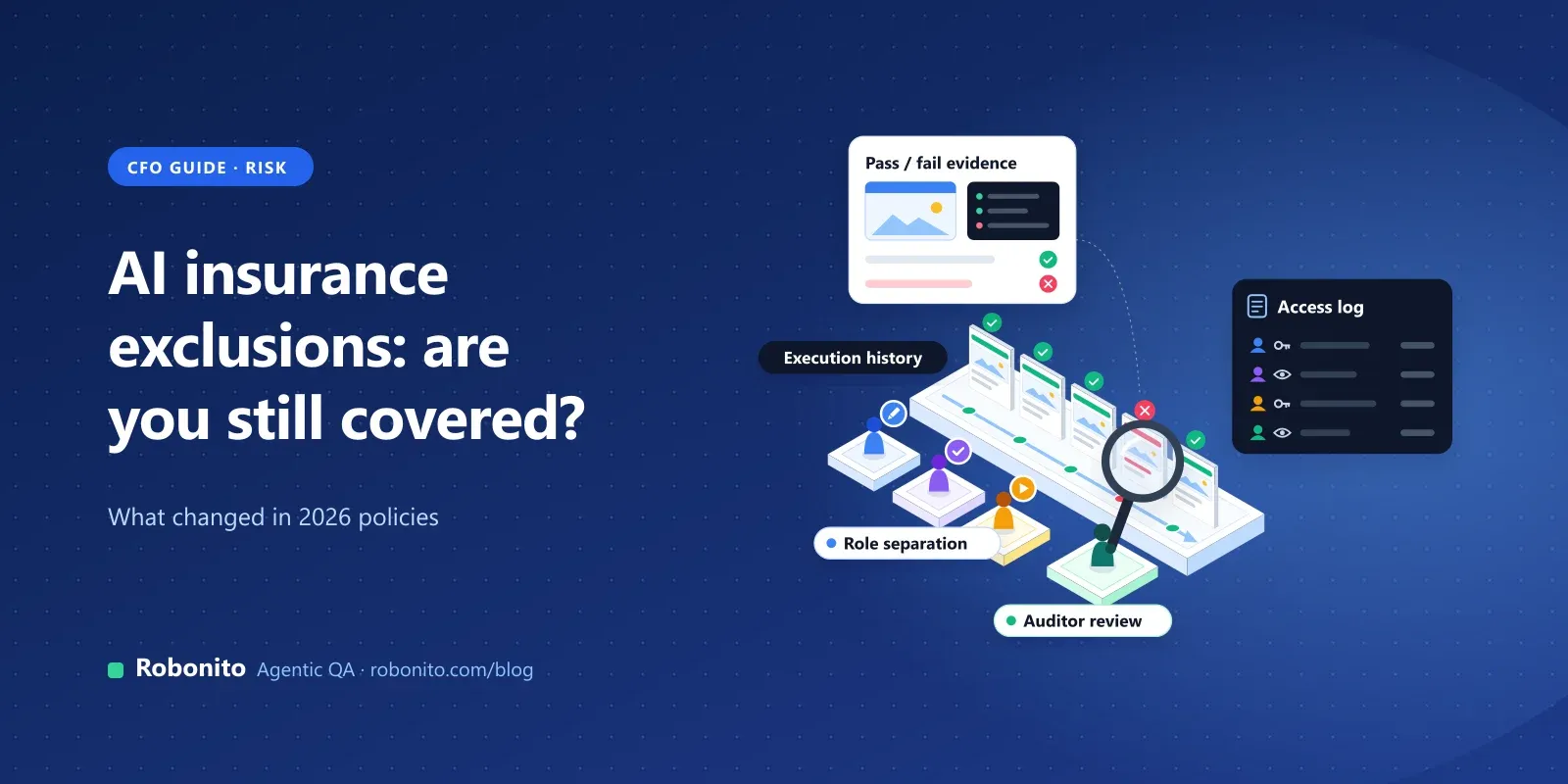
AI insurance is cover that names AI failures, such as model errors, hallucinations and agent mistakes, instead of relying on older policies' silence. It matters now because Verisk has filed optional generative AI exclusions for general liability, Berkley's absolute AI exclusion can remove AI claims from D&O cover, and cyber waiting periods leave many outage losses uninsured.
This article is general information, not insurance or legal advice. Policy wording decides coverage; review yours with a licensed broker or coverage counsel.
Key takeaways
- Verisk's ISO filed optional generative AI endorsements for general liability on July 17, 2025, with a proposed effective date of Jan. 1, 2026. Whether your policy has one depends on your insurer and state.
- Berkley's "Artificial Intelligence Exclusion (Absolute)" for D&O, employment practices and fiduciary liability excludes claims arising from AI use "by any person or entity."
- Outage losses are mostly uninsured: Parametrix says most cyber policies have 8- to 12-hour waiting periods, so most companies hit by the AWS outage will receive no compensation.
- Affirmative AI liability cover exists, with published limits of up to $25 million per insured (Armilla) or $25 million or more (Chaucer's Vanguard AI), priced from technical reviews and model performance data.
What is AI insurance, and why are insurers adding AI exclusions?
AI insurance is a policy, or part of one, that expressly covers losses caused by AI systems. Many policies in force today don't mention AI at all, and insurers are starting to say where they stand.
Three terms explain the market:
- Silent AI is AI risk that a policy neither covers nor excludes in so many words. In an April 2025 release, the CEO of Armilla, an AI insurance provider, described it as uncertainty over whether existing policies will respond to AI failures.
- An AI exclusion is an endorsement that removes coverage for claims arising from AI.
- Affirmative AI insurance names AI failures as a covered risk, usually in a standalone policy.
Verisk tied its filing to litigation: as early generative AI product liability lawsuits move through the courts, it said the new optional endorsements give insurers "additional underwriting flexibility."
What do the new AI insurance exclusions say?
Two kinds of exclusion now matter to US buyers: Verisk's optional ISO endorsements for commercial general liability, and insurer-written forms such as Berkley's absolute AI exclusion for management liability.
| Exclusion | Line of coverage | What it removes | Status as of Nov. 26, 2026 | Primary source |
|---|---|---|---|---|
| ISO generative AI exclusion endorsements | Commercial general liability | Liability arising from generative AI (wording varies by endorsement) | Filed July 17, 2025; proposed effective date Jan. 1, 2026; optional, so each insurer chooses, subject to state filing rules | Verisk, July 2025; Verisk GL hub |
| Berkley PC 51380 00 (06-24), "Artificial Intelligence Exclusion (Absolute)" | D&O, employment practices, fiduciary liability | Claims arising from any use, deployment or development of AI by anyone, AI-related statements, AI law violations, and demands or legal requirements to assess or respond to AI risks | Form edition June 2024; how widely it's attached isn't public | Form specimen |
The Berkley form is the broadest we've read. It excludes claims arising from AI used "by any person or entity," including:
- content generated with AI, and failure to detect third parties' AI content;
- inadequate AI policies, procedures or training;
- promises or representations made by a chatbot or virtual customer service agent;
- statements about the company's AI plans or AI risks.
For a board, the last point matters: a securities claim alleging that AI capabilities were overstated could fall outside D&O cover if this exclusion is attached.
The ISO endorsements are optional, which is the important nuance. Verisk filed them; it doesn't attach them. An ISO generative AI exclusion is on your general liability policy only if your insurer chose to use it where it's available and it appears on your endorsement schedule. Insurers can also write their own AI exclusions. Ask your broker to search the policy for "artificial intelligence."
Does cyber insurance cover AI failures and cloud outages?
Sometimes, and usually for less than the loss. Cyber policies are built around security events. A non-malicious failure, like a bad update or an AI model error, is generally covered only if the policy includes system-failure cover, and business interruption claims must usually outlast a waiting period first.
Three recent outages show the gap:
| Event | Estimated economic loss | Estimated insured loss | Sources |
|---|---|---|---|
| CrowdStrike update, July 19, 2024 | $5.4 billion in direct losses for US Fortune 500 companies, excluding Microsoft | No more than 10–20% of that likely insured (Parametrix); $400 million to $1.5 billion for the global standalone cyber market (CyberCube) | Parametrix, CyberCube |
| AWS us-east-1, Oct. 20, 2025 | $500 million to $650 million for US companies | $38 million to $581 million for cyber insurers (geography not stated), clustered toward the low end | Parametrix, CyberCube |
| Microsoft 365, Nov. 12–14, 2026 | Not estimated | Most likely under $100 million globally; upper bound $350 million | CyberCube |
These are modeled estimates from firms that sell outage insurance (Parametrix) or cyber risk analytics (CyberCube), not paid-claims data, and they don't always cover the same geography. The reasons they give for the gap are consistent:
- Waiting periods. After the AWS outage, Parametrix wrote that most cyber policies have 8- to 12-hour waiting periods, so most affected companies will receive no compensation. The outage's most severe phase lasted about 2 hours and 36 minutes.
- Retentions and limits. Parametrix attributed the CrowdStrike gap to large risk retentions and low limits relative to the loss.
- Narrow triggers. CyberCube said Microsoft 365 losses would fall only on policies that cover non-malicious system failure at an outside provider.
The cyber insurance market is not small: US cyber direct written premium was about $9.46 billion in 2025, including about $2 billion from non-US surplus lines insurers, according to the NAIC. But as the estimates above show, it pays far less when software fails on its own. For the costs behind those outages, see why software testing is important and our cost of downtime tracker.
Who pays when AI code fails? AI liability in 2026
AI liability is the legal responsibility for harm caused by an AI system, and in 2026 it's spreading across developers, deployers and their vendors. Without insurance, it lands on the balance sheet.
Three developments shift that liability toward the companies that ship software:
- EU product liability. For products placed on the EU market after Dec. 9, 2026, Directive (EU) 2024/2853 treats software as a product, through each member state's national law. Defectiveness is presumed if a defendant fails to disclose relevant evidence.
- Colorado. SB 26-189, with duties starting Jan. 1, 2027, sets how fault is allocated between AI developers and deployers in discrimination claims under existing law.
- Vendor claims. After the CrowdStrike outage, Delta Air Lines said in an Aug. 8, 2024 Form 8-K that it was pursuing legal claims against CrowdStrike and Microsoft for damages totaling at least $500 million.
The dates, and the court order that limits Colorado's enforcement, are in our AI regulation tracker.
Where can companies buy AI liability insurance?
Several specialist providers sell affirmative AI cover, including Lloyd's-backed programs and a reinsurer. Published limits are modest next to the outage losses above.
- Armilla AI, a Lloyd's coverholder, lists limits of up to $25 million aggregate per insured and $5 million per model, backed by Chaucer, AXIS Capital and Convex. Its site lists cover for AI model errors and hallucinations, AI agent mistakes, and AI regulatory investigations.
- Chaucer and Armilla's "Vanguard AI" (Feb. 10, 2026) pairs cyber and tech E&O with a standalone AI policy, offering dedicated AI aggregate limits of $25 million or more per organization alongside $10 million of cyber limits.
- Munich Re's aiSure insures AI performance, including guarantees vendors give customers. Munich Re says it issued its first AI policy, for an anti-fraud model, in 2018.
What evidence do AI insurance underwriters ask for?
Underwriters who publish their method ask for technical evidence about the model: how it was built, how it performs and how it's monitored. They don't publish a standard checklist, so ask your broker for the actual submission requirements.
What the insurers say:
- Munich Re says it first evaluates the model development pipeline and risk scenarios such as unrepresentative training data, data drift, and how the model is updated and monitored. It then uses historical performance data to estimate how likely the model is to underperform.
- Armilla says its underwriters price each system from a technical review, plus data from its own risk platform.
- Chaucer says Vanguard AI is supported by AI model certification and risk and compliance reporting.
Translated into documents a CFO can request from engineering (our suggestion, not an insurer's list):
- An inventory of AI systems and AI-written components in production.
- Pre-set performance thresholds and dated test results against them, including adversarial tests for chatbots and agents. See testing non-deterministic AI agents.
- Regression results for every release, especially AI-generated code. See testing AI-generated code.
- Monitoring and drift logs, plus incident and rollback records.
- A map of critical cloud and software vendors, with contract liability caps.
What should CFOs ask at the next renewal?
Ask these five questions before you sign:
- Does any policy carry a generative AI or absolute AI exclusion, and on which lines?
- Does our cyber policy cover non-malicious system failure, ours and our providers', and what's the waiting period?
- If AI-generated code causes an outage or a wrong output reaches a customer, which policy responds?
- Would statements in our filings about AI fall under a D&O exclusion?
- Is standalone AI cover worth pricing, and what evidence would the underwriter want?
How teams are closing the gap
Underwriters price what they can see, so evidence of testing and monitoring is part of the conversation. One way to produce it is automated regression testing that records every run.
Robonito is one tool for that. Its AI agents create, run and self-heal end-to-end tests for web apps, plus mobile, API and desktop apps on Pro and Enterprise, and can test chatbots, voice agents and IVR flows, grading them for accuracy, policy and safety. Every run keeps video, network traces and an AI root cause for failures, and healed steps are logged for review. It plugs into GitHub Actions, GitLab CI, Jenkins, Azure DevOps and CircleCI on Starter and above. Club Car cut QA testing time by over 70% with Robonito.
It won't get you insured, and it doesn't replace cloud-provider resilience, monitoring or a broker's review. It gives you a dated record of what was tested. Details on SOC 2 Type II and audit logs are on our security and compliance page.
Frequently asked questions
Does cyber insurance cover AI failures?
Only partly, and it depends on the wording. Cyber policies are built around security events. A non-malicious AI or software failure is covered only if the policy includes system-failure cover, and outage claims usually face 8- to 12-hour waiting periods, according to Parametrix.
Does general liability insurance cover generative AI?
Possibly, unless an exclusion is attached. Verisk filed optional generative AI exclusion endorsements for the ISO general liability program in July 2025, with a proposed effective date of Jan. 1, 2026. Check your policy's endorsement schedule.
What is an absolute AI exclusion?
It removes coverage for any claim arising from AI, not just specific uses. Berkley's form PC 51380, when attached, applies to D&O, employment practices and fiduciary liability, and reaches AI used by anyone, AI-related statements and AI law violations.
How much AI liability insurance can a company buy?
The published limits we found are about $25 million per organization, as of Nov. 26, 2026. Armilla lists up to $25 million aggregate per insured and $5 million per model. Chaucer's Vanguard AI offers AI limits of $25 million or more per organization alongside $10 million of cyber cover.
Did insurance cover the AWS outage?
Mostly not. Parametrix estimated US companies lost $500 million to $650 million in the Oct. 20, 2025 outage, and said most would receive no compensation because of waiting periods. CyberCube estimated insured losses of $38 million to $581 million, clustered toward the low end.
What do underwriters want to see before covering AI?
Insurers that publish their approach ask for technical evidence. Munich Re reviews model development pipelines and historical performance data, and Armilla prices from a technical review of each system. Dated test results and monitoring logs help answer both.
Insurers price what you can prove. Keep a tested record of every release: or .