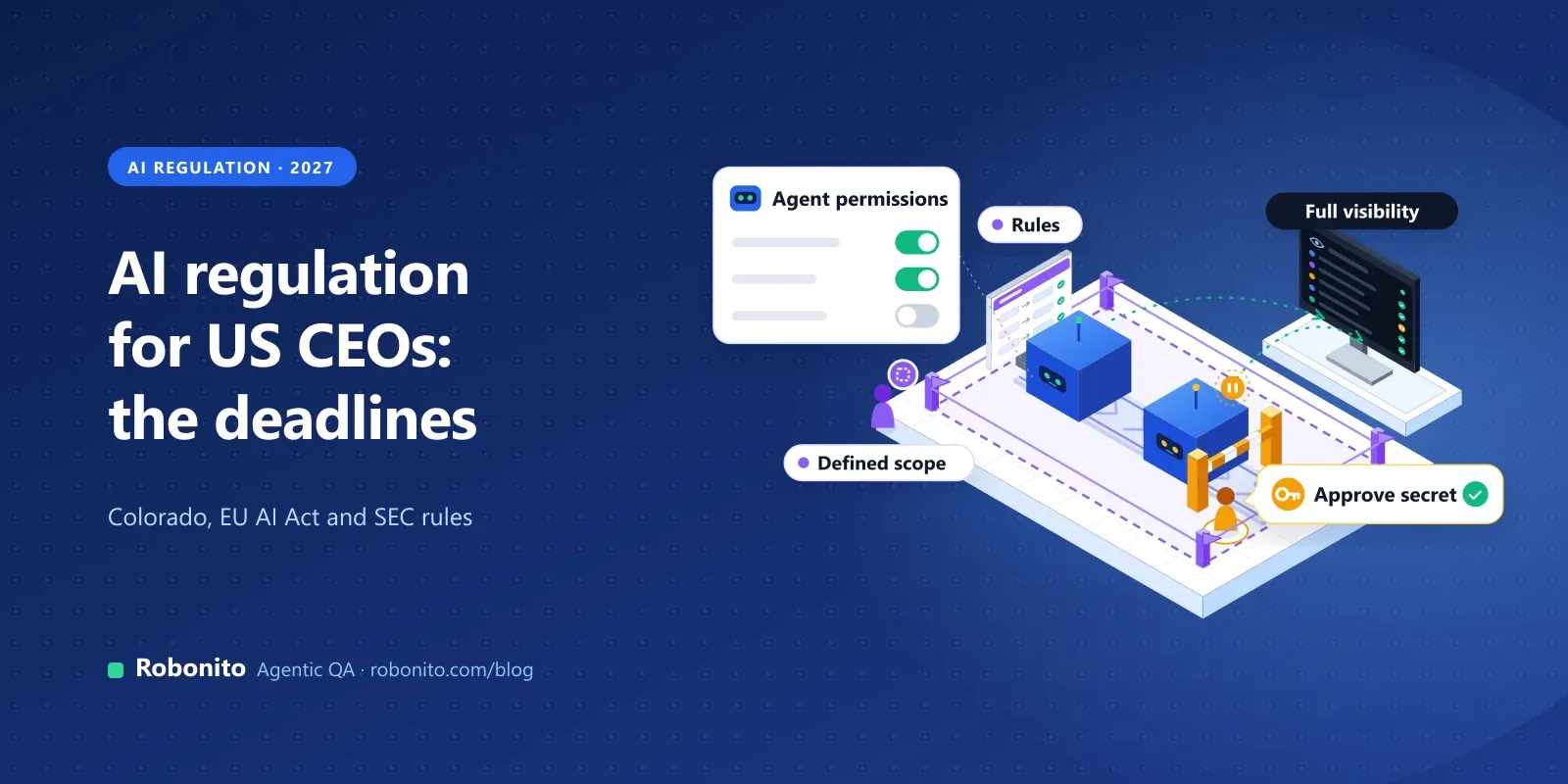
On Jan. 1, 2027, Colorado's rewritten AI law takes effect, but a federal court order limits when the attorney general can enforce it. Three weeks earlier, software placed on the EU market after Dec. 9, 2026 falls under a new EU product liability law.
That is AI regulation for a US company in late 2026: firm deadlines, moving dates and open lawsuits. This tracker puts the dates in one table, with sources and the testing evidence each law names.
AI regulation in the US is a patchwork, not one law. Colorado's SB 26-189 starts Jan. 1, 2027, but a court order limits enforcement. EU AI Act high-risk duties now begin Dec. 2, 2027 and Aug. 2, 2028. The SEC's cybersecurity disclosure rules already apply. Texas and California AI laws took effect in 2026.
This article is general information, not legal advice. Dates were checked against statutes, regulators and court records as of Nov. 26, 2026. Confirm them with counsel before you act.
Key takeaways
- Colorado SB 26-189 replaced the 2024 Colorado AI Act; its duties start Jan. 1, 2027. A federal court order of April 27, 2026 limits when the attorney general can start enforcing it.
- The EU's Digital Omnibus moved EU AI Act high-risk obligations to Dec. 2, 2027 (Annex III uses) and Aug. 2, 2028 (AI in regulated products).
- For products placed on the EU market after Dec. 9, 2026, EU product liability law covers software, and a court can presume a product defective if the defendant fails to disclose relevant evidence.
- Few laws name testing outright. The EU AI Act does for high-risk systems, and Texas's TRAIGA protects companies that find violations through adversarial or red-team testing.
What AI regulation applies to US companies in 2027?
Four sets of rules matter most: state AI laws (Colorado, Texas, California), the EU AI Act and Product Liability Directive for anything sold or used in the EU, and the SEC's cybersecurity disclosure rules for public companies. As of Nov. 26, 2026, there is no comprehensive federal AI statute.
Two terms help when reading them:
- AI governance is the set of policies, roles and records a company uses to decide how AI is built, bought, checked and retired.
- AI risk management is the part of governance that finds, measures and reduces the ways an AI system can cause harm, and keeps proof that it did.
AI regulation tracker: dates and deadlines for US companies
This table lists, in date order, the obligations most likely to reach a US company. The testing column reports only what the text itself says.
| Date | Rule | What starts | Testing evidence named in the text | Primary source |
|---|---|---|---|---|
| Dec. 18, 2023 | SEC cybersecurity disclosure rules | Public companies report material cyber incidents on Form 8-K, Item 1.05 (smaller companies 180 days later) | None. The 10-K must describe cyber risk processes (Item 106) | SEC release 2023-139 |
| Jan. 1, 2026 | Texas TRAIGA (HB 149) | Attorney general enforcement, 60-day cure period, penalties up to $200,000 per uncurable violation | No liability if a violation is found through testing, "including adversarial testing or red-team testing" | Texas HB 149 |
| Jan. 1, 2026 | California SB 53 | Developers with frontier models and over $500 million in revenue publish a frontier AI framework | Framework must explain how catastrophic-risk thresholds are defined and assessed | California SB 53 |
| Apr. 27, 2026 | xAI v. Weiser order (D. Colo.) | No enforcement over violations occurring up to 14 days after a ruling on xAI's injunction motion | n/a | Minute order, ECF No. 24 |
| Aug. 2, 2026 | EU AI Act, general application | Most remaining provisions, including Article 50 transparency duties | None for Article 50 | Reg. (EU) 2024/1689 |
| Dec. 2, 2026 | EU AI Act, as amended | Generative AI already on the market must mark synthetic content; new bans on non-consensual intimate deepfakes and AI-generated child sexual abuse material | None | Reg. (EU) 2026/1744 |
| Dec. 9, 2026 | EU Product Liability Directive | Covers software placed on the EU market after this date | None; defect presumed if relevant evidence isn't disclosed | Directive (EU) 2024/2853 |
| Jan. 1, 2027 | Colorado SB 26-189 | Duties for developers and deployers of AI used in consequential decisions | None; records to demonstrate compliance, kept 3 years | Colorado SB26-189 |
| Jan. 1, 2027 | Colorado HB 26-1263 (Chatbot Safety Act) | Chatbot operators: AI disclosure, age estimation, annual report | Report on the "efficacy and reliability" of safeguards | Colorado Department of Law |
| Dec. 2, 2027 | EU AI Act, Annex III high-risk | Employment, education, credit scoring and other listed uses | Testing "against prior defined metrics and probabilistic thresholds" before release; logs | Reg. (EU) 2026/1744 |
| Aug. 2, 2028 | EU AI Act, Annex I high-risk | AI in products under EU safety law, such as machinery | Same as above | Reg. (EU) 2026/1744 |
| Jan. 1, 2030 | Colorado SB 26-189 | 60-day notice-and-cure requirement ends for actions started from this date | n/a | Colorado SB26-189 |
What does the Colorado AI Act (SB 26-189) require?
SB 26-189 regulates "automated decision-making technology" (ADMT) that materially influences consequential decisions about people, from Jan. 1, 2027. Colorado signed it on May 14, 2026, replacing its 2024 AI Act (SB 24-205) before that law took effect.
According to the legislature's summary of the act as enacted:
- Scope: decisions about access to, eligibility for or compensation related to education, employment, housing, financial or lending services, insurance, health care, or essential government services and public benefits.
- Developers give deployers documentation of intended uses, training-data categories, known limitations and instructions for appropriate use and human review.
- Deployers give notice at the point of interaction and, within 30 days of an adverse decision, a plain-language description of the ADMT's role. Consumers can correct their data and request human review.
- Records needed to demonstrate compliance must be kept for at least 3 years.
- Enforcement is by the attorney general only, as a deceptive trade practice. There's no new private right of action.
The law doesn't mention testing, but documented "known limitations" are hard to produce without test results.
Is the Colorado AI Act enforceable on Jan. 1, 2027?
The law takes effect, but as of Nov. 26, 2026 a court order limits enforcement. xAI sued Colorado Attorney General Philip Weiser on April 9, 2026; the United States intervened on April 24. In a joint stipulation filed that day, the attorney general said he doesn't intend to enforce the law, or any replacement, until after rulemaking has concluded.
The court's April 27 minute order granted it. The attorney general "shall not initiate enforcement," including investigations, for alleged violations that occur on or before 14 days after the court rules on xAI's preliminary-injunction motion. xAI must file that motion within 28 days after "final adoption" of the implementing rules.
Those rules are close. The Colorado Department of Law adopted them on Nov. 19, 2026 and has asked for the attorney general's formal opinion; they become final 20 days after publication. When the 28-day clock starts is a question for counsel. Plan for Jan. 1, 2027 anyway: the order limits enforcement, not the date the duties begin, and the court can change it.
When do EU AI Act obligations apply to US companies?
The EU AI Act reaches US companies that place AI systems on the EU market, and those whose AI output is used in the EU (Article 2). The Digital Omnibus, Regulation (EU) 2026/1744, published July 24, 2026, delayed the heaviest obligations:
- Annex III high-risk systems (employment, education, credit and other listed uses): Dec. 2, 2027, instead of Aug. 2, 2026.
- High-risk AI in regulated products (Annex I): Aug. 2, 2028, instead of Aug. 2, 2027.
- Unchanged: bans on prohibited practices have applied since Feb. 2, 2025, and general-purpose AI model rules since Aug. 2, 2025.
The duties themselves didn't get lighter. Article 9 says high-risk systems must be tested before release, "against prior defined metrics and probabilistic thresholds," so that they "perform consistently for their intended purpose." Providers need documented test and validation procedures (Article 17), and deployers must keep the logs under their control for at least six months (Article 26).
Fines reach €35 million or 7% of worldwide annual turnover for prohibited practices, and €15 million or 3% for most other breaches, including deployer and transparency duties, with lower caps for smaller firms (Article 99).
What changes on Dec. 9, 2026 under the EU Product Liability Directive?
Directive (EU) 2024/2853 defines "product" to include software and applies to products placed on the EU market after Dec. 9, 2026, the deadline for member states to write it into national law. Only individuals (natural persons) can claim under it. Three provisions matter to software teams:
- In judging defects, courts consider the effect of a product's "ability to continue to learn" after release (Article 7).
- At a claimant's request, a court can order the defendant to disclose relevant evidence (Article 9).
- Defectiveness is presumed if the defendant fails to disclose it, or if an "obvious malfunction" caused the damage (Article 10).
In practice, your release records, test results and incident logs become evidence a court may order you to produce.
What do the SEC cybersecurity disclosure rules require?
The SEC cybersecurity disclosure rules require US public companies to report a material cybersecurity incident on Form 8-K within four business days of deciding it's material, and to describe cyber risk management and governance in each 10-K. The SEC adopted them on July 26, 2023 (press release 2023-139).
They don't mention AI; a material AI-related incident is disclosed like any other. Financial industry groups have petitioned the SEC to rescind Item 1.05; as of Nov. 26, 2026 the rules remain in force, and we found no SEC proposal to change them.
Will federal law preempt state AI regulation?
Not by statute yet. Executive Order 14365, signed Dec. 11, 2025, directed the attorney general to set up an AI Litigation Task Force to challenge state AI laws, and cites Colorado's "algorithmic discrimination" law as an example. In April 2026 the United States intervened in the xAI case.
On July 1, 2026, the FTC proposed a policy statement saying state laws that push companies to alter AI outputs may be preempted, naming Colorado's AI Act. The FTC still lists it as proposed.
Two of those state laws are already in force. Texas TRAIGA (since Jan. 1, 2026) gives companies 60 days to cure, and a defense if they found a violation through testing or through internal review under NIST's generative AI risk profile. California SB 53 (signed Sept. 29, 2025) requires frontier developers to report critical safety incidents to the state's Office of Emergency Services within 15 days, with civil penalties up to $1 million per violation, enforced by the attorney general.
What testing evidence do AI regulators expect?
Only the EU AI Act (for high-risk systems) and Texas's TRAIGA spell out testing. The others ask for records that are easiest to produce if you test and keep the results. A practical evidence file (our suggestion, not a legal checklist) holds:
- An inventory of AI systems, flagging consequential-decision uses (Colorado) and high-risk uses (EU).
- Metrics and thresholds written before testing (EU AI Act, Article 9).
- Dated test results, including adversarial cases for chatbots and agents (Texas). See testing non-deterministic AI agents.
- Logs kept six months (EU deployers) to three years (Colorado records).
- Known limitations you can hand to deployers (Colorado).
- Incident records that support a timely 8-K decision (SEC).
The same trail applies to testing AI-generated code. For what failures cost, see why software testing is important; for coverage, see AI insurance exclusions.
How teams are closing the gap
The laws above ask for records more often than for specific tests, so the practical gap is usually proof. One approach, common in regulated environments, is automated runs that save evidence by default.
Robonito is one example. Its AI agents create, run and self-heal end-to-end tests for web apps, plus mobile, API and desktop apps on Pro and Enterprise, and can test chatbots, voice agents and IVR flows, grading them for accuracy, policy and safety. Every run keeps video, network traces and an AI root cause for failures, and healed steps are logged for review. Enterprise plans add role-based access and audit logs; see security and compliance. FocusSoft runs full end-to-end ERP regression in under 30 minutes.
It won't make you compliant. It doesn't do bias audits, impact assessments or legal classification of AI systems. It gives you dated evidence of how your applications behaved. .
Frequently asked questions
What is the Colorado AI Act?
The original Colorado AI Act, SB 24-205, passed in 2024 and was replaced before it took effect. Its successor, SB 26-189, regulates automated decision-making technology used in consequential decisions such as hiring, lending and housing. Duties start Jan. 1, 2027, and only the attorney general enforces it.
Can Colorado enforce SB 26-189 on Jan. 1, 2027?
Not right away, as of Nov. 26, 2026. A federal court order bars enforcement over violations that occur up to 14 days after the court rules on xAI's preliminary-injunction motion, which xAI files after the rules are final.
Does the EU AI Act apply to US companies?
Yes, if they place AI systems on the EU market or their AI output is used in the EU. High-risk obligations now start Dec. 2, 2027 for Annex III uses and Aug. 2, 2028 for AI in regulated products.
What are the SEC cybersecurity disclosure rules?
They require US public companies to disclose a material cybersecurity incident on Form 8-K within four business days of determining it's material, and to describe cyber risk management in the 10-K. They remain in force as of Nov. 26, 2026.
What is an AI risk management framework?
It's a structured method for identifying, measuring and reducing AI risks. In the US, the best-known is NIST's AI Risk Management Framework, and Texas's TRAIGA refers to NIST's generative AI profile by name.
Is there a federal AI law that preempts state laws?
No. As of Nov. 26, 2026, Congress hasn't passed one, and the federal push rests on Executive Order 14365, a Justice Department task force and a proposed FTC policy statement. Until Congress or a court acts, state AI laws stand.
Regulators want proof, not promises. Build the evidence trail as you test: or .