
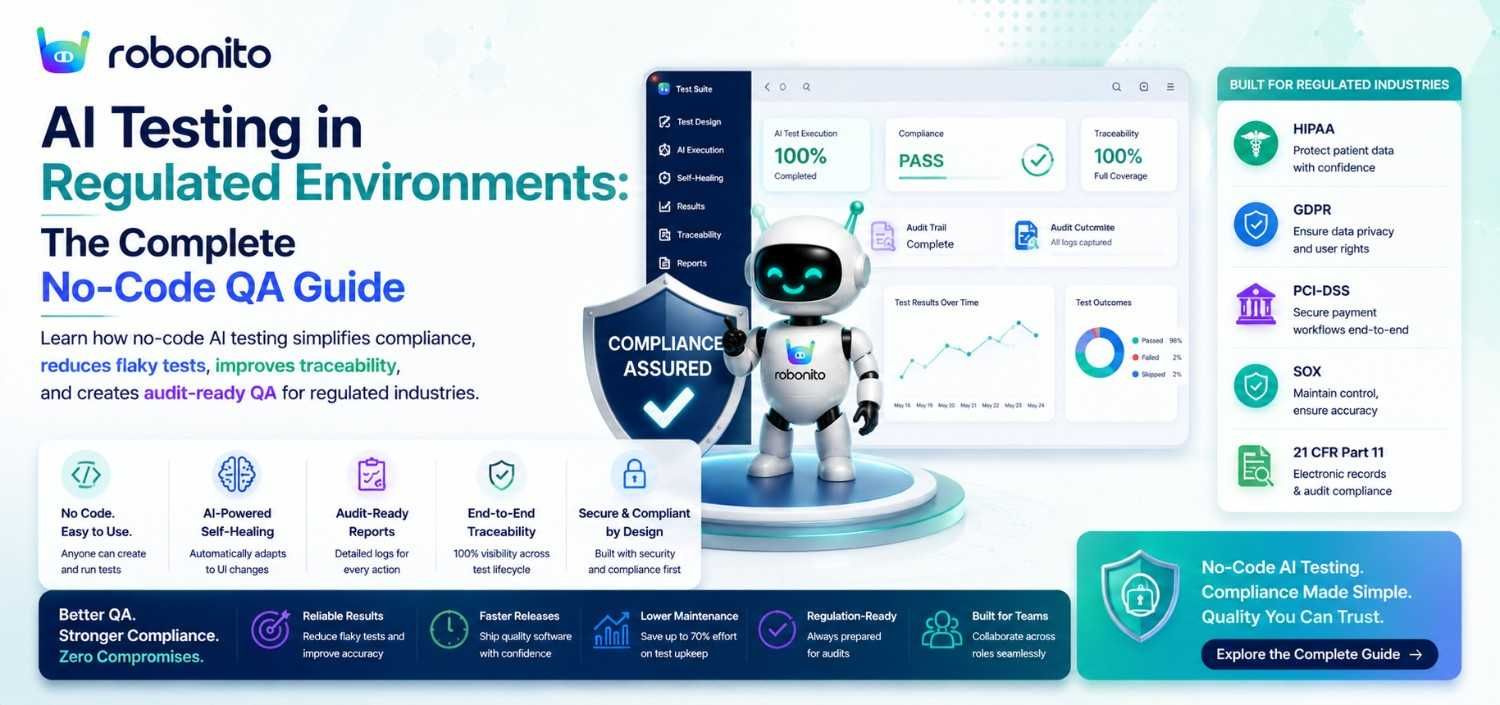
When a fintech company's quarterly release gets held up for three weeks because auditors can't trace a test failure back to a specific requirement—or a healthcare platform's deployment stalls because flaky tests generate hundreds of false negatives that each need manual review—the cost isn't just engineering time. It's delayed compliance sign-off, missed market windows, and eroded trust with regulators. AI testing in regulated environments presents a unique set of challenges that traditional automation frameworks were never designed to solve. The stakes are higher, the documentation requirements are stricter, and the tolerance for ambiguity is essentially zero. Yet most QA teams in healthcare, fintech, and government are still wrestling with the same brittle, code-heavy test suites that plague every other industry—except the consequences of failure are orders of magnitude worse.
This post lays out why regulated industries need a fundamentally different approach to test automation, and how a no-code, self-healing strategy can turn compliance from a bottleneck into a competitive advantage.
Gartner has identified AI-assisted software engineering as a strategic investment area, with governance, explainability, and operational efficiency becoming increasingly important as organizations adopt AI across the software delivery lifecycle.
DORA research consistently shows that reliable automated testing supports faster software delivery while maintaining stability, making trustworthy test execution an important capability for regulated organizations.
Why Regulated Industries Struggle with Traditional Test Automation
Regulated industries don't just need software that works. They need software they can prove works—repeatedly, traceably, and to the satisfaction of auditors who may have no technical background.
Traditional test automation was built for speed, not accountability. Selenium scripts, Cypress suites, and Playwright frameworks are powerful tools, but they produce artifacts that are opaque to anyone outside the engineering team. When an FDA auditor asks "How do you verify that patient data is correctly masked on the discharge summary screen?", pointing to a 200-line JavaScript file with CSS selectors and async/await patterns doesn't inspire confidence.
Consider a real-world scenario: A mid-sized healthtech company building an EHR (Electronic Health Record) system needs to validate 21 CFR Part 11 compliance—the FDA regulation governing electronic records and signatures. Every test must map to a specific requirement. Every test result must be stored, timestamped, and retrievable. Every change to a test must be documented with a reason.
Traditional frameworks typically require additional tooling, custom reporting, and manual documentation to satisfy these compliance requirements. Teams end up building custom reporting layers, manually mapping tests to requirements in spreadsheets, and spending as much time maintaining compliance documentation as they do writing actual tests.
The result is predictable:
- Slow release cycles because compliance review takes longer than development
- High maintenance burden as UI changes break brittle selectors, requiring re-validation
- Knowledge silos where only the engineer who wrote the test can explain what it does — are dissolved entirely when tests are written in plain English that every stakeholder can read.
- Audit anxiety because the team isn't fully confident their documentation is complete
Testing in regulated industries demands a paradigm shift—not just better tools, but a fundamentally different relationship between tests and the humans who need to understand them.
The Compliance Problem with Code-Heavy Testing Frameworks
Code-heavy testing frameworks create a specific, measurable compliance liability: they introduce a translation layer between what is being tested and how it is described to auditors.
When a test is written in Python, Java, or JavaScript, someone has to translate that code into plain-language documentation that regulators can review. This translation is manual, error-prone, and almost always out of date. The moment a developer refactors a test—renames a variable, restructures a helper function, updates a locator strategy—the documentation diverges from reality.
In fintech, this problem is acute. Consider a payment processing company subject to PCI DSS (Payment Card Industry Data Security Standard). They need to demonstrate that cardholder data is never displayed in plain text after tokenization. Their QA team has an automated test that validates this, but it's buried inside a 500-line test suite with shared fixtures, parameterized inputs, and custom assertions.
During an audit, the assessor asks: "Show me the test that validates requirement 3.4—render PAN unreadable anywhere it is stored." The QA lead has to:
- Find the relevant test file (or files—it might be split across multiple)
- Explain what the code does in plain language
- Demonstrate that the test hasn't been modified since the last validation
- Prove that the test actually ran against the current production build
Each of these steps introduces risk. Each is a potential audit finding.
QA automation compliance requires that the connection between a requirement and its test be direct, readable, and version-controlled—not mediated by code that only developers can interpret. This is where code-heavy frameworks fundamentally fall short: they optimize for execution, not for explanation.
The most dangerous failures in regulated environments aren't the ones that crash the build. They're the ones that silently pass while the underlying validation logic has drifted from the actual requirement.
How No-Code Testing Simplifies Audit Trails and Traceability
The single most powerful advantage of no-code testing in regulated environments is legibility. When a test is described in natural language—"Verify that the patient's Social Security number is masked on the billing summary page"—every stakeholder in the compliance chain can read it, understand it, and validate that it maps to the correct requirement.
This isn't a minor convenience. It's a structural advantage that transforms how organizations handle traceability.
Traceability matrices—the documents that map every regulatory requirement to its corresponding test—are the backbone of compliance in healthcare, fintech, and government. With code-heavy frameworks, building and maintaining these matrices is a manual, ongoing project. With no-code tests written in natural language, the matrix practically writes itself. The test description is the documentation.
Here's what this looks like in practice for a government agency deploying a citizen-facing benefits portal subject to Section 508 accessibility requirements and FedRAMP security controls:
- Traditional approach: QA engineers write Selenium tests that check ARIA labels and form validation. A separate team maintains a spreadsheet linking each test to NIST 800-53 controls. When tests change, the spreadsheet must be updated manually. Drift is inevitable.
- No-code approach: Tests are created in plain English: "Verify that the 'Submit Application' button has an accessible label" and "Verify that session timeout redirects to the login page after 15 minutes of inactivity." Each test is tagged with its corresponding control ID. Auditors can review the tests directly—no translation needed.
The audit trail benefits compound when you factor in version history. No-code platforms can track every change to a test as a human-readable diff: "Step 3 changed from 'Click Submit' to 'Click Submit Application.'" Compare that to a Git diff showing driver.findElement(By.cssSelector(".btn-primary.submit-v2")).click() replacing driver.findElement(By.cssSelector(".btn-primary.submit")).click(). One tells a story. The other requires an interpreter.
For organizations pursuing stable test automation in regulated settings, this legibility isn't optional—it's the foundation everything else is built on.
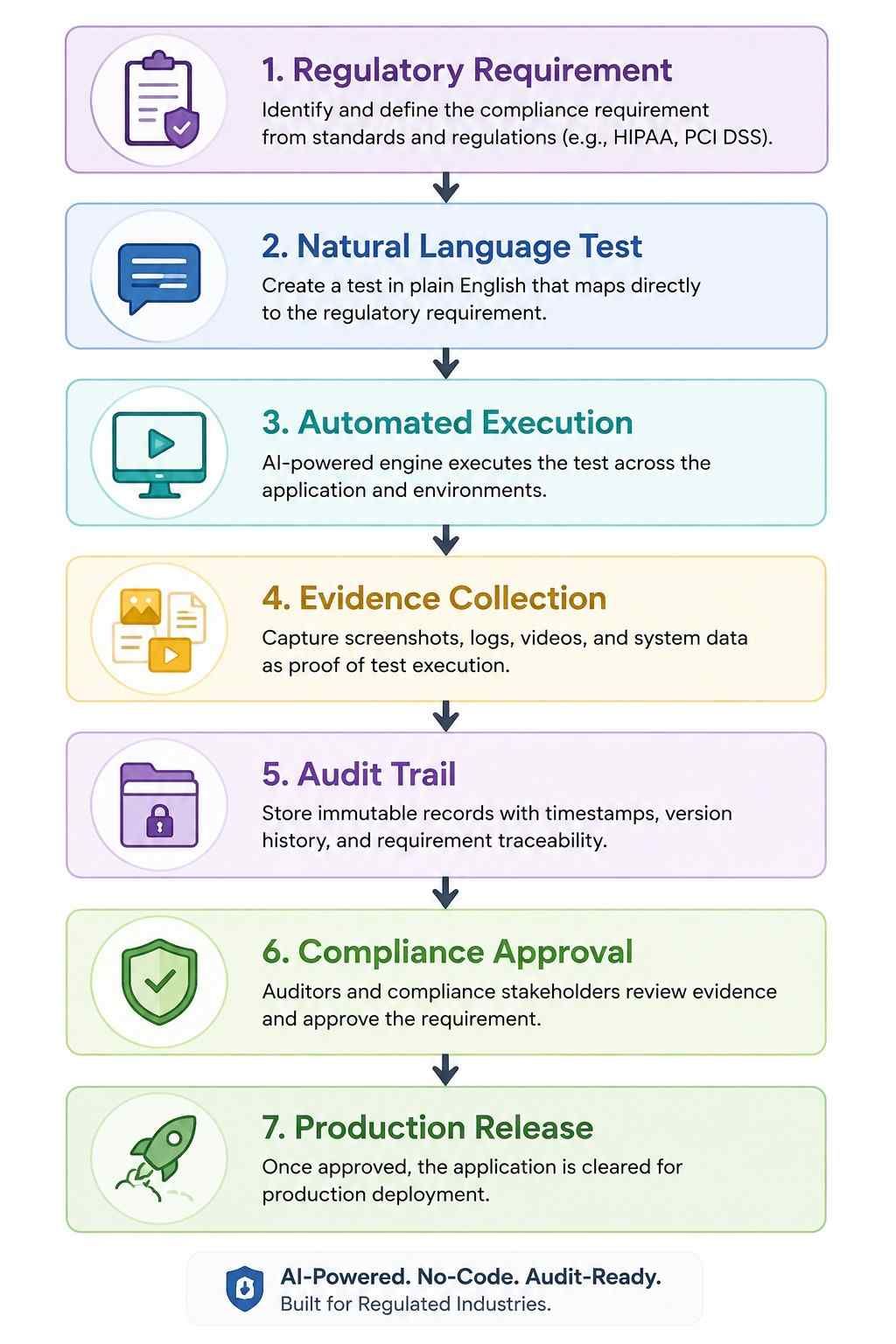
Self-Healing Tests: Reducing False Failures That Derail Release Cycles
Flaky tests are annoying in any context. In regulated environments, they're genuinely dangerous.
Here's why: most compliance frameworks require that every test failure be investigated, documented, and resolved before a release can proceed. When a test fails because a developer changed a button's class name from btn-submit to btn-submit-primary—not because anything is actually broken—someone still has to investigate it. In a regulated environment, that investigation needs to be documented. The resolution needs to be documented. And if the test was linked to a compliance requirement, the entire re-validation workflow may need to be triggered.
A real-world example: A digital banking platform running nightly regression suites against 2,000 tests experiences a 5% flake rate. That's 100 false failures every night. Each one requires a team member to investigate, confirm it's a false positive, and document the finding. At a conservative 15 minutes per investigation, that's 25 hours of wasted work—every single night. Over a quarter, the cumulative cost in engineering hours, delayed releases, and audit preparation time can easily reach six figures.
Self-healing tests can significantly reduce this category of waste by automatically adapting to routine UI changes while preserving transparent audit records. When a UI element changes—a renamed button, a restructured form, a redesigned navigation menu—self-healing AI identifies the element by its intent and context rather than its specific technical identifier. The test adapts automatically, and the change is logged.
This logging is critical for compliance. Instead of a mysterious test failure that requires investigation, teams get a clear record: "Element 'Submit Payment' was located using updated identifier. Previous: #submit-btn. Current: button[aria-label='Submit Payment']. Test continued successfully."
Regulators don't want to see that tests never change. They want to see that changes are controlled, documented, and traceable. Self-healing with transparent logging delivers exactly that—turning what would be a release-blocking event into a routine, auditable adaptation.
For QA teams in healthcare and fintech, this autonomous testing compliance capability means fewer false alarms, faster release cycles, and dramatically less time spent on failure triage.
Key Requirements for QA Tools in Healthcare, Fintech, and Government
Not every QA automation tool is suited for regulated environments. Before evaluating specific vendors, teams need to understand the non-negotiable requirements that regulators and auditors expect.
Auditability and Traceability
Every test must be traceable to a specific requirement (regulatory, business, or technical). Every execution must produce a timestamped, immutable record. Every change to a test must be tracked with metadata: who changed it, when, and why.
For healthcare (HIPAA, FDA 21 CFR Part 11): Test records may need to satisfy electronic signature and audit trail requirements. Results must be stored in a way that prevents backdating or tampering.
For fintech (PCI DSS, SOX, SOC 2): Testing must demonstrate that security controls are validated regularly. Evidence of continuous testing is often required during annual audits.
For government (FedRAMP, FISMA, Section 508): Tests must be mappable to NIST control families. Accessibility testing must cover specific WCAG criteria with documented evidence.
Role-Based Access Control
Regulated environments require strict separation of duties. The person who creates a test should not necessarily be the person who approves it for compliance mapping. QA tools need role-based permissions that support maker-checker workflows.
Environment Isolation and Data Handling
Tests in healthcare and fintech often interact with sensitive data. Tools must support environment isolation (no test data leaking to production), synthetic data generation, and—where required—data masking or anonymization.
Reproducibility
If an auditor asks "Run test #4721 against build 3.2.1 from March 15th," the team needs to be able to do exactly that and produce identical results. This requires version-controlled tests, environment snapshots, and deterministic execution.
Integration Without Lock-In
Regulated organizations typically have complex, approved technology stacks. QA tools must integrate with existing CI/CD pipelines (Jenkins, GitLab CI, Azure DevOps), test management platforms (Jira, Azure Boards), and reporting systems without requiring architectural changes that would need their own compliance review.
Buyer's Checklist: Evaluating AI QA Tools for Regulated Environments
Use this autonomous testing compliance checklist when evaluating any AI-powered QA tool for a regulated context. Not every item will apply to every industry, but any tool that fails on multiple criteria should be flagged.
Traceability and Documentation
- Tests can be linked to specific regulatory requirements or control IDs
- Test descriptions are human-readable without code interpretation
- Full version history is maintained for every test with change metadata
- Test execution produces immutable, timestamped results
Auditability
- The platform provides a complete audit log of all user actions
- Role-based access control supports maker-checker workflows
- Test results can be exported in formats suitable for auditor review (PDF, CSV, structured reports)
- Historical test runs can be reproduced on demand
Reliability and Stability
- Self-healing capabilities reduce false failures without hiding real defects
- Healing events are logged transparently with before/after details
- Flake rate metrics are tracked and reportable
- Tests produce consistent results across consecutive runs (deterministic execution)
Security and Data Handling
- The platform supports SSO and MFA
- Test data can be masked, anonymized, or generated synthetically
- The tool meets the data residency requirements for your jurisdiction
- SOC 2 Type II certification (or equivalent) is available for the platform itself
Integration and Workflow
- Native integration with your CI/CD pipeline
- Webhooks or APIs for custom reporting workflows
- Compatible with your existing test management and defect tracking tools
- No vendor lock-in—tests can be exported or migrated
Organizational Fit
- Non-engineers (manual QA, business analysts, compliance officers) can create and review tests
- Onboarding time is measured in hours or days, not weeks
- Vendor provides compliance-specific documentation or templates
- Dedicated support for regulated industry customers
Print this list. Bring it to vendor demos. The tools that check the most boxes with genuine capability—not roadmap promises—are the ones worth shortlisting.
How Robonito Meets Compliance Needs Without Adding Engineering Overhead
Robonito was built on a principle that aligns naturally with what regulated environments demand: tests should be understandable by everyone who has a stake in quality, not just the people who can read code.
Here's how that principle translates into concrete compliance advantages:
Natural language tests are audit-ready by default. When you create a test in Robonito, you describe what should happen in plain English. "Navigate to the patient dashboard. Verify that the SSN field displays only the last four digits. Click 'Download Report' and verify the PDF does not contain the full SSN." An auditor can read this. A compliance officer can validate it against HIPAA requirements. No translation layer. No documentation drift.
Self-healing with full transparency. Robonito's self-healing AI adapts to UI changes automatically, but it never hides what it did. Every healing event is logged with a clear explanation of what changed and how the test adapted. This gives regulated teams the stability they need for continuous testing without sacrificing the traceability auditors require.
No-code significantly reduces the technical debt associated with maintaining scripted automation. There are no fragile CSS selectors to maintain, no custom frameworks to version, and no engineering bottlenecks when tests need to be updated. When a regulation changes or a new requirement is added, a QA analyst can create or modify a test in minutes—not days—without waiting for a developer sprint.
Fast onboarding protects your timeline. Regulated industries often face hard deadlines—annual audits, certification renewals, go-live dates tied to regulatory windows. Robonito's no-code approach means QA teams are productive in hours, not weeks. You don't need to hire automation engineers or retrain your existing team on a new programming language.
CI/CD integration without architectural risk. Robonito plugs into your existing pipeline—Jenkins, GitLab CI, GitHub Actions, Azure DevOps—without requiring changes to your approved architecture. Tests run as part of your standard build process, producing results that feed directly into your compliance reporting workflow.
No-code testing in healthcare, fintech, and government isn't just about making QA easier. It's about making QA auditable, traceable, and trustworthy—without doubling your headcount or your timeline.
Frequently Asked Questions
Why do traditional automated testing frameworks create compliance problems in regulated industries?
Traditional testing frameworks (Selenium, Cypress, Playwright) produce test artifacts that are opaque to everyone outside the engineering team. When an FDA auditor asks how a specific requirement is validated, pointing to a 200-line JavaScript file with CSS selectors and async/await patterns does not satisfy the requirement for readable, traceable, explainable evidence. The deeper problem is the translation layer: someone must convert code into plain-language documentation that regulators can review, and that documentation diverges from the actual tests the moment any developer makes a change. Regulated environments require that the connection between a requirement and its test be direct, human-readable, and version-controlled — not mediated by code that only developers can interpret.
What is the difference between test flakiness and a real test failure in regulated environments — and why does it matter?
A real test failure means the application does not behave correctly. A flaky test failure means the test's element selector broke because a developer renamed a CSS class — even though the application works perfectly. In unregulated environments, the cost of a flaky test is investigation time. In regulated environments, the cost is dramatically higher: most compliance frameworks require that every test failure be investigated, documented, and resolved before a release proceeds. A 5% flake rate on a 2,000-test suite produces 100 false failures every night, each requiring documentation. Self-healing tests eliminate this category of waste by adapting to routine UI changes automatically — and logging every adaptation transparently, so the audit trail is enriched rather than interrupted.
What does traceability mean in QA testing for healthcare and fintech compliance?
Traceability in QA compliance means every automated test links explicitly to the specific regulatory requirement it validates. A test for a healthcare application must map to a particular HIPAA control, a 21 CFR Part 11 requirement, or an internal policy. A test for a payment platform must map to a specific PCI DSS requirement — such as requirement 3.4 (render PAN unreadable anywhere it is stored). Traceability matrices — documents that show every requirement and its corresponding test — are a standard auditor deliverable. With code-based tests, these matrices must be maintained manually and diverge from the actual tests over time. With natural language tests, the test description itself is the traceability documentation, reducing drift and maintenance overhead to near zero.
What non-negotiable requirements should QA tools meet for regulated-industry compliance?
Five requirements are non-negotiable for regulated environments. Auditability: every test execution produces an immutable, timestamped record that cannot be backdated or altered. Traceability: tests link explicitly to requirement IDs, making traceability matrices maintainable without manual effort. Role-based access control: maker-checker workflows ensure the person who creates a test is not the same person who approves it for compliance mapping. Reproducibility: historical test runs can be re-executed against specific builds on demand for audit purposes. Legibility: test descriptions are readable by auditors and compliance officers without code interpretation. Any QA tool that fails on auditability or legibility creates a compliance liability regardless of how powerful its automation capabilities appear in a demo.
How does self-healing test automation support rather than undermine compliance audit trails?
Self-healing automation is sometimes viewed with suspicion in compliance contexts because "the test changed itself" sounds like it could mask defects. Well-implemented self-healing resolves this concern by logging every adaptation transparently: what element changed, from what identifier to what new identifier, with what confidence score, and with what action taken. Regulators do not require that tests never change — they require that changes are controlled, documented, and traceable. A self-healing event that logs "Element 'Submit Payment' located using updated identifier. Previous: #submit-btn. Current: button[aria-label='Submit Payment']. Test continued successfully" is more auditable than a manual selector update committed to Git without documentation of why the change was made. Self-healing with transparent logging turns a potential compliance risk into a compliance advantage.
Ready to see how no-code testing works in your regulated environment?
Start a free trial of Robonito and build your first audit-ready test in under 10 minutes. No code. No selectors. No engineering overhead. Just tests that humans and auditors can actually understand.
Automate your QA — no code required
Stop writing test scripts.
Start shipping with confidence.
Join thousands of QA teams using Robonito to automate testing in minutes — not months.