
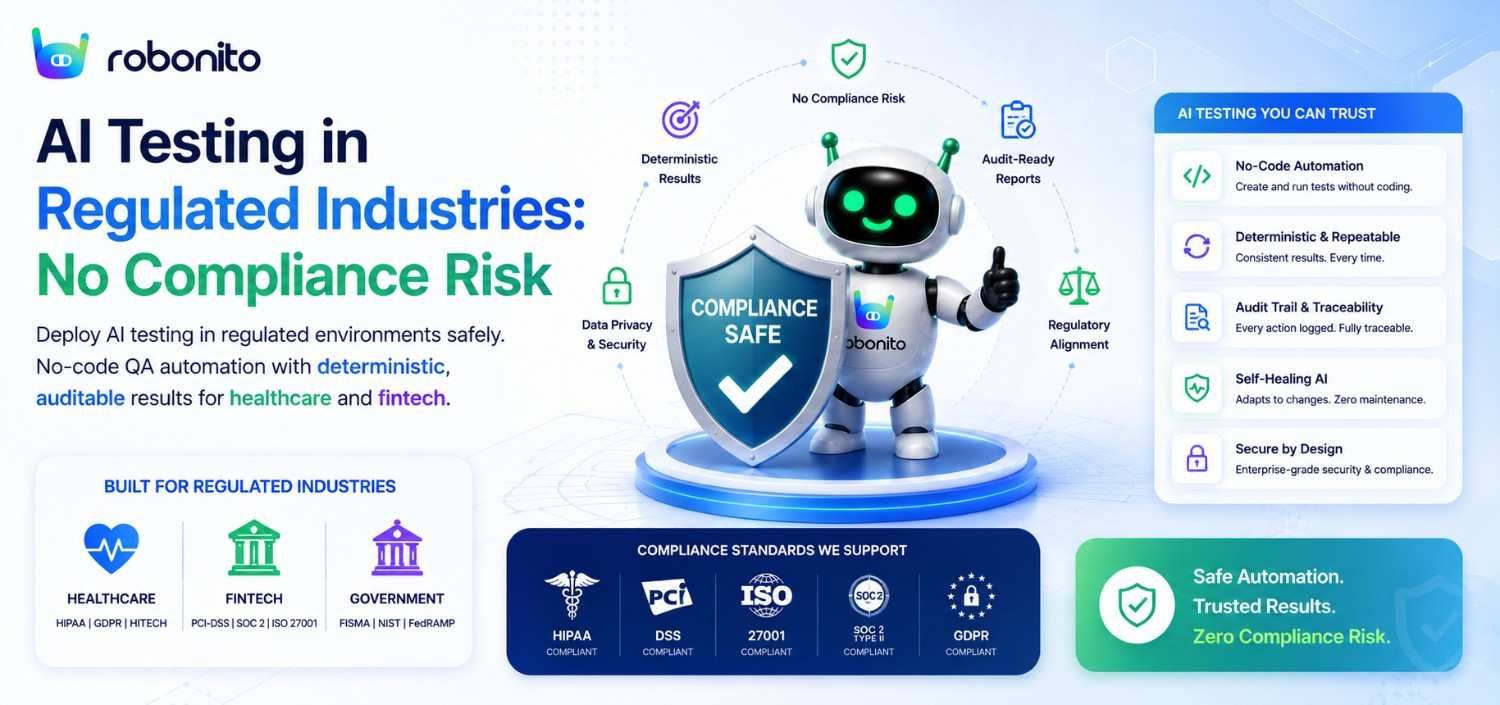
If your organisation operates in healthcare, fintech, insurance, or government, you already know that every tool you adopt has to survive a compliance review before it ever reaches production. That reality is now colliding with one of the fastest-moving categories in software: AI-powered test automation. The result? A growing number of QA and engineering leaders are actively searching for guidance on AI testing in regulated environments — trying to figure out which tools accelerate quality without introducing audit risk. The stakes are real. Choose the wrong platform and you face rejected audits, regulatory findings, or worse, undetected defects in systems that handle protected health information, financial transactions, or citizen data. Choose the right one and you unlock speed, coverage, and a documentation trail that actually makes compliance easier. This post breaks down exactly what to look for — and what to avoid.
Why Regulated Industries Are the Fastest-Growing Segment in Test Automation
Regulated industries have historically been slow adopters of test automation. Manual testing, while expensive and error-prone, provided predictable documentation and traceability. Every step was documented, every result was reviewable, every tester could explain what they did and why.
That's changing fast, for three reasons:
-
Digital transformation is non-negotiable. Banks are shipping customer-facing features weekly. Telehealth platforms are iterating on appointment flows constantly. Government portals are under pressure to modernise. Manual QA simply cannot keep pace with these release cycles.
-
Industry analysts are also seeing this shift. Gartner has identified AI-augmented software engineering as a major trend across the software development lifecycle, with testing becoming one of the fastest-growing areas for practical AI adoption. For regulated organizations, the challenge is no longer whether to adopt AI—but how to do so while maintaining governance, traceability, and auditability.
-
Regulatory bodies are raising the bar on software quality. The FDA's guidance on software as a medical device (SaMD), the OCC's expectations around fintech vendor management, and FedRAMP's continuous monitoring requirements all demand more rigorous, more frequent, and better-documented testing.
-
The cost of quality failures is asymmetric. A broken checkout page on an e-commerce site is a revenue problem. A broken medication dosage calculator in a healthcare app is a patient safety crisis. Regulated organisations cannot afford gaps in test coverage, which makes automation not just attractive but essential.
Consider a mid-size digital bank rolling out a new loan origination workflow. They're releasing bi-weekly. Their compliance team requires documented evidence that every critical user path — application submission, identity verification, disclosure acceptance — has been tested before each release. Without automation, that testing cycle alone consumes three to four days of a two-week sprint.
The market has noticed. Applitools recently published multiple pieces of content and a buyer's checklist focused specifically on QA automation in regulated environments — a clear signal that vendor interest (and buyer demand) in this niche is surging. But not all automation approaches are equally suited to the constraints these industries face.
The Compliance Problem with Black-Box AI Testing Tools
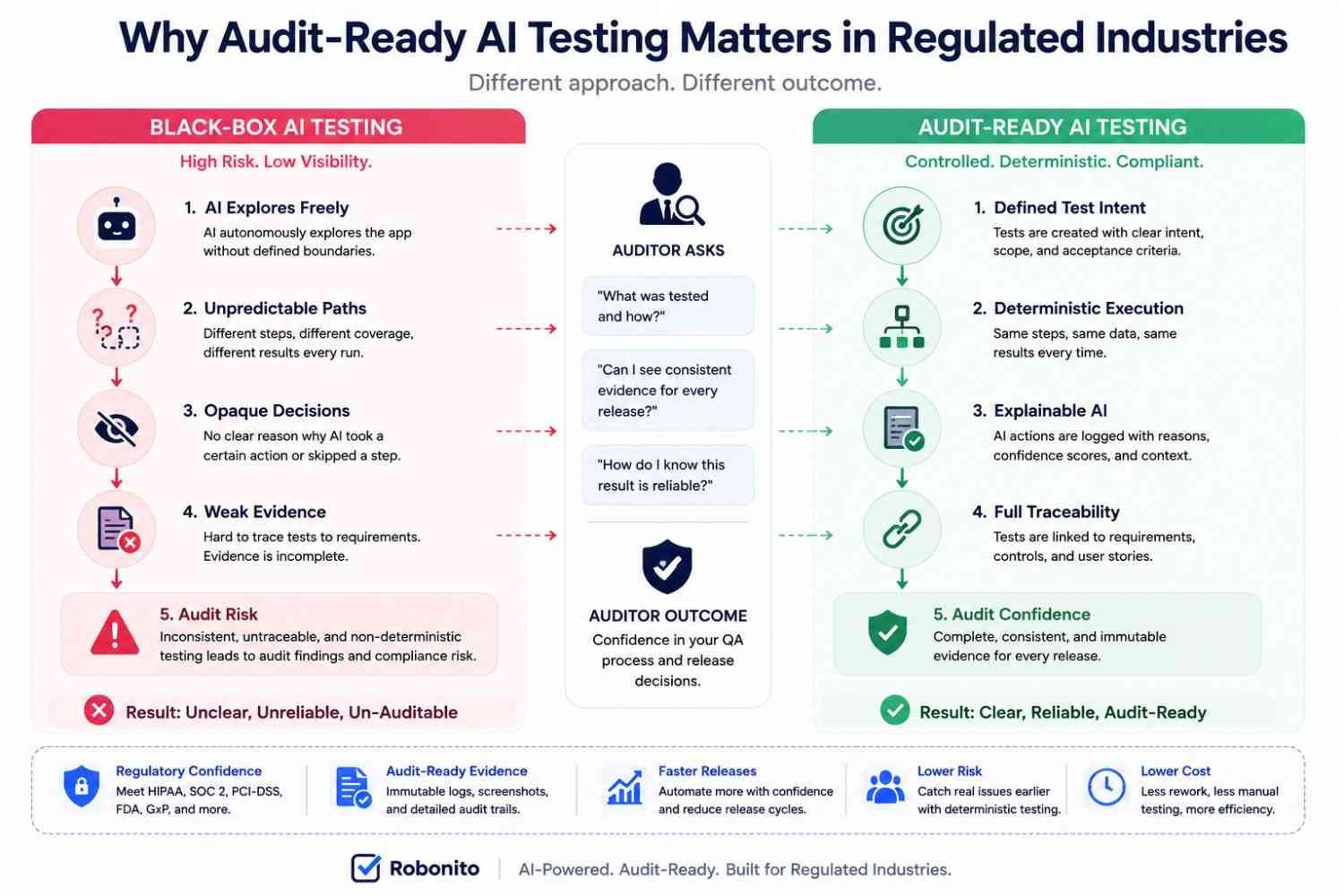
The latest generation of AI-powered testing tools promises something remarkable: point the AI at your application and it will autonomously explore, generate tests, and find bugs — all without human intervention. For many teams, that sounds like a dream. For compliance officers, it sounds like a nightmare.
Here's why. Most regulatory frameworks — HIPAA, SOC 2, PCI-DSS, FDA 21 CFR Part 11, GxP — share a common requirement: you must be able to explain what was tested, how it was tested, and why a specific test result should be trusted. Black-box autonomous testing fundamentally conflicts with this requirement.
The specific problems:
-
Non-deterministic behaviour. If an AI agent explores your application differently each run, you cannot guarantee consistent coverage of critical paths. An auditor asking "Was the patient consent flow tested in every release?" needs a definitive yes — not "probably, based on the AI's exploration patterns."
-
Opaque decision-making. When an autonomous agent decides to skip a particular flow or interprets a UI element in an unexpected way, there's often no clear log explaining why. That opacity is a compliance gap.
-
Untraceable test logic. If you can't map a test directly back to a requirement or user story, you can't demonstrate traceability — a core expectation in frameworks like ISO 13485 (medical devices) and SOX (financial controls).
Imagine a fintech company using an autonomous testing tool during a SOC 2 Type II audit. The auditor asks for evidence that the funds transfer authorisation flow was validated in each of the last twelve monthly releases. The team can show that the AI "explored" the application, but they cannot produce a deterministic test that maps to that specific flow. That's a finding — and a potentially expensive one.
The enthusiasm for AI in testing is justified. But in regulated environments, the type of AI matters enormously. How Robonito's self-healing tests work
Black-Box AI vs Audit-Ready AI Testing
| Capability | Black-Box AI | Audit-Ready AI |
|---|---|---|
| Deterministic execution | ❌ | ✅ |
| Requirement traceability | Limited | ✅ |
| Explainable decisions | Limited | ✅ |
| Audit trail | Partial | ✅ |
| Human review | Limited | ✅ |
| Best for | Exploration | Regulated industries |
What Auditors and Regulators Actually Want to See in Your QA Process
Having worked through SOC 2 audits, FDA pre-market reviews, or PCI assessments, QA leaders in regulated environments quickly learn that auditors are not anti-automation. They are anti-ambiguity. Here's what they consistently look for:
1. Traceability from requirement to test to result. Every test should map back to a documented requirement, user story, or regulatory control. Auditors want to follow the chain: "This regulation requires X → this test validates X → here's the pass/fail result from the last release."
2. Deterministic, repeatable execution. A test must produce the same result given the same conditions. If your testing approach introduces randomness — whether through AI exploration or flaky selectors — you undermine the reliability of your evidence.
3. Immutable, timestamped records. Test results need to be stored in a way that proves they weren't altered after the fact. This includes execution logs, screenshots or recordings, pass/fail status, and timestamps.
4. Clear ownership and approval workflows. Who created the test? Who approved it? Who reviewed the results? Regulated environments need role-based access and audit trails for test management, not just test execution.
5. Evidence of coverage for critical paths. Auditors will identify your highest-risk workflows — financial transactions, PHI access, identity verification — and ask for specific evidence that those paths are covered.
A practical example: a healthcare SaaS company preparing for a HITRUST assessment needs to demonstrate that their patient portal login, data export, and consent management flows are tested continuously. The assessor doesn't care whether the tests are manual or automated. They care that the evidence is clear, complete, and trustworthy.
The takeaway? Your QA automation tool isn't just a productivity investment. In regulated environments, it's a compliance asset — but only if it produces the right kind of evidence. Getting started with Robonito for QA teams
No-Code + Deterministic: Why Transparent Test Automation Wins in Regulated Environments
The sweet spot for QA automation in regulated industries sits at the intersection of two properties: no-code accessibility and deterministic execution. Let's unpack why.
No-code lowers the barrier to adoption without sacrificing control.
In regulated organisations, QA teams are often stretched thin. The people who understand compliance requirements best — QA analysts, business analysts, domain experts — are rarely the ones who can write Selenium scripts or maintain Cypress test suites. No-code platforms let these domain experts create and maintain tests directly, which means:
- Tests are written by people who understand the regulatory context
- Test intent is expressed in natural language, making review and audit easier
- There's no translation layer between "what we need to test" and "what the script actually does"
Consider a compliance analyst at an insurance company who knows exactly which claim adjudication steps must be validated before each release. With a code-based tool, they'd file a ticket, wait for a developer to write the test, and hope the implementation matches their intent. With a no-code tool, they build the test themselves — and the test reads like a plain-English description of the workflow.
Deterministic execution provides the auditability regulators demand.
Unlike autonomous AI that explores unpredictably, deterministic test automation follows a defined sequence of steps every time. This means:
- You can guarantee that critical paths are covered in every run
- Test results are reproducible and explainable
- Traceability from requirement to test to result is straightforward
When you combine no-code creation with deterministic execution, you get tests that are easy to create, easy to understand, and easy to audit — the trifecta for regulated environments.
Add self-healing capabilities — where the tool adapts to minor UI changes without breaking or altering test logic — and you eliminate the most common source of false failures (flaky tests due to selector changes) without introducing the opacity of black-box AI.
This isn't a theoretical argument. It's the architecture that compliance-conscious buyers are actively seeking.
A Practical Compliance Checklist for Evaluating QA Automation Tools
Before you demo a single vendor, align your QA and compliance teams on evaluation criteria. Here's a checklist built from real audit expectations:
Traceability & Documentation
- Can each test be linked to a specific requirement, user story, or regulatory control?
- Does the tool produce human-readable test descriptions (not just code)?
- Are test results exportable in formats your auditors accept (PDF, CSV, structured logs)?
Determinism & Repeatability
- Does the same test produce the same steps and assertions on every run?
- Can you guarantee coverage of specific critical paths in every test suite execution?
- Are there clear logs showing exactly which steps were executed and in what order?
Audit Trail & Access Control
- Does the tool maintain an immutable log of test creation, modification, and execution?
- Is there role-based access control (RBAC) for creating, approving, and running tests?
- Are execution results timestamped and tamper-evident?
Adaptability Without Opacity
- If the tool uses AI (e.g., self-healing), is the AI's behaviour explainable and logged?
- Do self-healing actions get recorded so reviewers can see what changed and why?
- Is there a clear distinction between AI-assisted maintenance and AI-driven autonomous exploration?
Integration & Governance
- Does the tool integrate with your CI/CD pipeline for automated execution on every build?
- Can test execution be gated (e.g., blocking deployment if critical tests fail)?
- Does the vendor provide SOC 2, HIPAA BAA, or other relevant compliance documentation for their own platform?
Vendor Transparency
- Is the vendor clear about how your test data is stored and processed?
- Can the tool run against staging environments without exposing production data?
- Does the vendor support on-premises or private cloud deployment if required?
Print this list. Bring it to your next vendor evaluation. It will save you from choosing a tool that looks impressive in a demo but fails in an audit.
How Robonito Delivers Audit-Ready Test Documentation Without Extra Work
Robonito was built to make test automation accessible to everyone on a QA team — and that design philosophy turns out to be exactly what regulated environments need.
Natural language test creation = built-in documentation.
Every Robonito test is expressed in plain, readable steps. There's no gap between what a test does and what a reviewer sees. When an auditor reviews your test suite, they're reading something like:
Sample audit-ready test record — what your auditor actually receives:
┌─────────────────────────────────────────────────────────────────┐ │ TEST EXECUTION RECORD │ │ Test name: Loan Application — End-to-End Critical Path │ │ Compliance mapping: SOC 2 Control CC7.1 / REQ-LOAN-FLOW-003 │ │ Executed: 2026-06-20 09:14:22 UTC (automated — CI/CD trigger) │ │ Environment: staging.lendingplatform.com (build #2291) │ │ Overall result: PASS │ ├─────────────────────────────────────────────────────────────────┤ │ Step 1: Log in as test applicant [screenshot] ✅ PASS │ │ Step 2: Navigate to "Apply for Loan" [screenshot] ✅ PASS │ │ Step 3: Enter loan amount: $15,000 [screenshot] ✅ PASS │ │ Step 4: Upload proof of income document [screenshot] ✅ PASS │ │ Step 5: Accept terms and disclosures [screenshot] ✅ PASS │ │ Step 6: Submit application [screenshot] ✅ PASS │ │ Step 7: Verify "Application Received" [screenshot] ✅ PASS │ │ Step 8: Verify admin dashboard status [screenshot] ✅ PASS │ │ = "Pending Review" │ ├─────────────────────────────────────────────────────────────────┤ │ Self-healing event (Step 6): │ │ "Submit application" button moved from sidebar to page footer │ │ Re-identified via: label text "Submit" + ARIA role "button" │ │ Confidence score: 0.94 | Action: auto-healed, logged │ │ Human review: not required (above 0.85 threshold) │ ├─────────────────────────────────────────────────────────────────┤ │ Run ID: RB-2026-0620-7731 (immutable) │ │ Exportable as: PDF report | CSV | API-accessible log │ │ Created by: QA Analyst (no coding required) │ │ Approved by: QA Lead (role-based access log available) │ └─────────────────────────────────────────────────────────────────┘
This record is generated automatically on every CI/CD run. No manual documentation. No post-processing. Audit-ready by default.
Navigate to the loan application page → Enter applicant details → Upload identity document → Submit application → Verify confirmation message appears
That's not a translated summary of code. That is the test. It's inherently auditable.
Deterministic execution with self-healing transparency.
Robonito runs the same steps in the same order every time. When its self-healing engine adapts to a UI change — say, a button that moved from the sidebar to the header — that adaptation is logged. You can see exactly what changed, when, and how Robonito resolved it. No black boxes. No unexplainable behaviour.
Structured, exportable results.
Every test run produces timestamped results with step-by-step execution details, screenshots, and pass/fail status. These are exportable and ready to attach to your audit evidence packages — no manual compilation required.
No selectors, no scripts, no hidden complexity.
Because Robonito doesn't rely on CSS selectors or XPath, there's no technical layer obscuring test intent. What your compliance team reviews is what your QA team built. This eliminates the "lost in translation" problem that plagues code-based tools in regulated settings.
CI/CD integration for continuous compliance.
Robonito plugs into your existing CI/CD pipeline, running your critical-path tests on every build. That means your audit evidence isn't a periodic snapshot — it's a continuous, automated record of quality validation. Robonito CI/CD integration guide
Case Framework: Setting Up Compliant End-to-End Testing for a Fintech Web App
Let's walk through a realistic scenario: a Series B fintech company that offers a web-based lending platform. They're preparing for SOC 2 Type II certification and need to demonstrate continuous testing of critical workflows. DORA's continuous delivery research
Step 1: Identify Critical Compliance Paths
Working with their compliance officer, the QA team maps out the workflows that auditors will scrutinise:
- User registration and KYC verification (identity checks, document upload)
- Loan application and approval flow (data entry, credit check integration, disclosure acceptance)
- Funds disbursement authorisation (multi-step approval, transaction logging)
- User data export and deletion (CCPA/GDPR compliance)
Step 2: Create Deterministic Tests in Robonito
For each critical path, the QA team (which includes two manual testers with no coding background) builds end-to-end tests in Robonito using natural language steps. For example, the loan application test:
- Log in as test applicant
- Navigate to "Apply for Loan"
- Enter loan amount, term, and purpose
- Upload proof of income document
- Accept terms and disclosures
- Submit application
- Verify "Application Received" confirmation appears
- Verify application appears in admin dashboard with status "Pending Review"
Each test is tagged with the relevant SOC 2 control (e.g., CC7.1 — system monitoring) for traceability.
Step 3: Integrate with CI/CD for Continuous Execution
The team connects Robonito to their GitHub Actions pipeline. Every pull request to main triggers the critical-path test suite. Deployments are blocked if any critical test fails.
Step 4: Generate Audit Evidence Automatically
Before each monthly audit evidence collection, the compliance team exports Robonito's test execution history — timestamped results, step-by-step logs, screenshots — and adds them directly to their SOC 2 evidence repository. No manual test documentation needed.
Step 5: Maintain Tests Effortlessly as the UI Evolves
When the front-end team redesigns the loan application form (new layout, updated field labels), Robonito's self-healing engine adapts automatically. The self-healing actions are logged, the compliance team reviews the adaptation log, and the tests continue running without interruption.
The result: Twelve months of continuous, documented, deterministic testing across all critical paths — exactly what the SOC 2 Type II auditor needs to see. No custom scripts. No dedicated automation engineers. No audit findings related to QA.
Frequently Asked Questions
What do regulators and auditors actually require from QA automation tools?
Regulators and auditors in healthcare, fintech, insurance, and government share five consistent requirements regardless of the specific framework (HIPAA, SOC 2, FDA 21 CFR Part 11, PCI-DSS, or FedRAMP): traceability from each test back to a specific requirement or regulatory control, deterministic and repeatable test execution that produces the same result under the same conditions, immutable and timestamped test execution records, clear ownership and approval trails showing who created and approved each test, and documented coverage of critical paths. Auditors are not anti-automation — they are anti-ambiguity. Any QA tool that cannot produce this evidence is a compliance liability, not a compliance asset.
Why is black-box AI testing a risk in regulated environments?
Most regulatory frameworks — HIPAA, SOC 2, FDA 21 CFR Part 11, GxP, and ISO 13485 — require organisations to demonstrate exactly what was tested, how it was tested, and why a result should be trusted. Black-box autonomous AI testing introduces three specific compliance risks: non-deterministic behaviour (the AI may explore different paths each run, so critical path coverage cannot be guaranteed), opaque decision-making (when an AI agent skips a flow or misinterprets an element, there is often no log explaining why), and untraceable test logic (autonomous tests are difficult to map to specific requirements or controls). The issue is not AI itself — it is the type of AI. Tools that use AI to create and maintain deterministic tests avoid these risks; tools where AI makes unsupervised runtime decisions introduce them.
What is the difference between no-code testing and black-box AI testing in regulated environments?
No-code testing lets human QA professionals define exactly what gets tested through natural language steps, with the AI handling element identification and maintenance rather than autonomous exploration. The test sequence is human-defined and deterministic; the AI assists with resilience and accessibility. Black-box AI testing hands the exploration decision to an AI agent, which independently decides what to test and how to navigate the application. In regulated environments, no-code deterministic testing is audit-ready because every step is documented and reproducible. Black-box AI testing creates compliance gaps because coverage cannot be guaranteed and agent decisions cannot always be explained to an auditor.
How does self-healing test automation support compliance without introducing opacity?
Compliant self-healing automation logs every adaptation transparently — showing exactly which element changed, how the AI re-identified it, and what confidence score the identification produced. This means self-healing provides the maintenance benefits (tests that survive UI changes without manual patching) while preserving the audit requirements (a clear, reviewable log of what happened and why). The compliance risk would arise if self-healing operated silently without logging, or if it could make substantive changes to test logic rather than simply updating element references. Well-designed self-healing addresses the element layer only and flags low-confidence adaptations for human review.
Can a QA team without coding skills build audit-ready automated tests for SOC 2, HIPAA, or FDA compliance?
Yes — provided the testing platform is specifically designed for non-technical users with regulatory accountability in mind. The people best positioned to build compliant tests are often domain experts — compliance analysts, QA specialists, business analysts — who understand the regulatory context deeply but do not write code. No-code platforms that express tests in natural language, produce plain-English audit documentation, and generate structured execution reports allow these domain experts to create, review, and maintain tests independently. The compliance value is that test intent is never lost in translation between requirements and code — what the test says it does and what it actually does are the same thing.
Ready to Make Your QA Process Audit-Ready?
Regulated environments don't need less automation — they need the right kind of automation. Robonito gives your QA team the speed of no-code test creation, the reliability of deterministic execution, and the transparency that auditors and compliance officers demand.
No selectors. No scripts. No black boxes. Just clear, auditable tests that your entire team can build, understand, and trust.
Start your free trial of Robonito → and see how fast you can build audit-ready end-to-end tests for your most critical workflows. Your QA team can release faster. Your auditors can review with confidence.
Automate your QA — no code required
Stop writing test scripts.
Start shipping with confidence.
Join thousands of QA teams using Robonito to automate testing in minutes — not months.