When your software serves patients, processes financial transactions, or handles sensitive government data, a failed test isn't just a bug — it's a regulatory incident. Yet the teams responsible for QA in healthcare, fintech, insurance, and government are often the most under-resourced, the least technical, and the most constrained by compliance overhead. That's exactly why AI testing in regulated environments is accelerating — not despite the rules, but because the right tools make compliance easier, not harder.
The catch? Most AI-powered testing platforms still assume your QA team can write code, wrangle selectors, and debug flaky scripts. In regulated industries, that assumption is not just wrong — it's a risk multiplier. What these teams actually need is a way to build deterministic, auditable, reproducible tests without writing a single line of code.
This post breaks down why no-code AI testing is uniquely suited to regulated environments, what compliance officers actually care about (it's not what most vendors think), and how to evaluate tools that won't create more regulatory headaches than they solve.
Why Regulated Industries Are Adopting AI-Powered QA Faster Than You Think
There's a persistent myth that regulated industries move slowly on new technology. In reality, healthcare, fintech, and government organisations are under immense pressure to ship faster — while maintaining airtight compliance. The result is a growing gap between release velocity and QA capacity.
Consider a mid-size health-tech company maintaining an EHR (Electronic Health Record) portal. They push updates biweekly to meet HIPAA requirements, patch security vulnerabilities, and respond to provider feedback. Their QA team? Three manual testers, none of whom write code. Every release cycle means days of repetitive regression testing, handwritten test logs, and a constant fear that something will slip through.
This scenario is playing out across regulated sectors:
- Fintech firms under PCI-DSS and SOX obligations need to prove that every release was tested against specific controls — and that proof must survive an audit.
- Insurance platforms governed by state-level regulations must validate rate calculations, disclosure language, and data handling with every deployment.
- Government contractors bound by FedRAMP or NIST frameworks face strict requirements around change management and test documentation.
These organisations aren't avoiding AI-powered QA. They're desperate for it. But they need solutions that fit their actual teams — people who understand the domain deeply but aren't software engineers. Traditional test automation frameworks like Selenium or Playwright fail here not because they lack power, but because they demand technical skills that regulated QA teams rarely have and can't easily hire for.
Adoption of AI-assisted QA is accelerating as regulated organizations look for ways to increase release frequency without increasing compliance risk. The biggest barrier has historically been accessibility rather than willingness to automate.
The Real Compliance Challenge: Auditability, Not AI Complexity
When vendors pitch AI testing to regulated companies, they tend to lead with technical sophistication: visual AI, machine learning models, intelligent assertions. But when you sit down with a compliance officer or a quality manager at a pharmaceutical company, their first question is almost never "How smart is your AI?"
It's: "Can you show me exactly what was tested, when, and what the result was?"
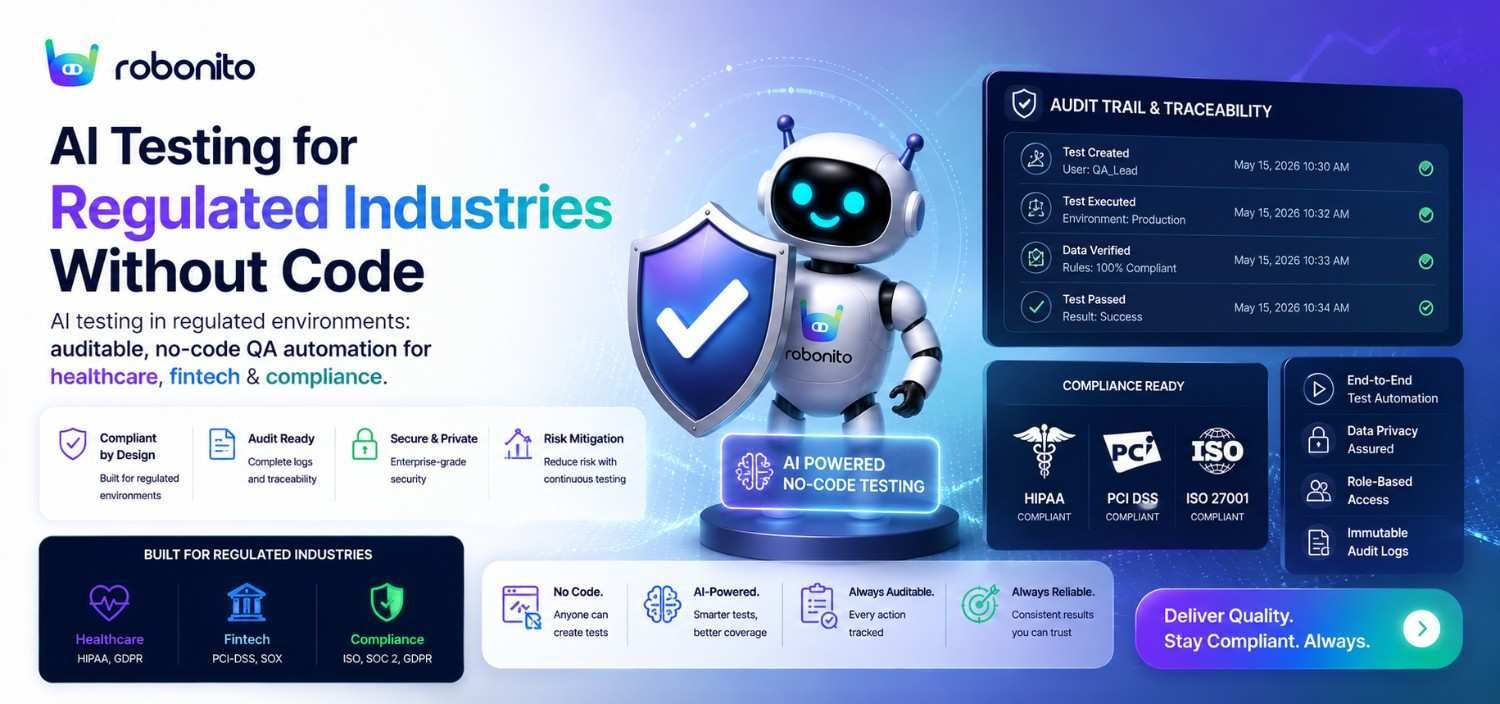
Auditability is the foundation of compliance in every regulated framework. FDA 21 CFR Part 11 requires electronic records with full traceability. SOX demands evidence that financial software controls were validated before release. HIPAA's Security Rule expects documented testing of safeguards.
The real challenge in adopting any AI QA tool isn't the AI itself — it's ensuring the test automation audit trail meets regulatory standards. That means:
- Immutable test records: Every test run must produce a tamper-evident log showing what steps were executed, what data was used, and what passed or failed.
- Reproducibility: An auditor should be able to look at a test from six months ago and understand — without running it — exactly what it validated.
- Traceability to requirements: Each test must map back to a specific requirement, user story, or regulatory control.
Here's where many AI-powered tools introduce risk. If a tool uses non-deterministic AI to decide what to test or how to interact with the UI, the audit trail becomes murky. An auditor asks, "Why did the test click here instead of there?" and the answer is "the model decided" — that's a compliance red flag.
Regulated teams need AI that enhances efficiency without sacrificing determinism. The intelligence should help create and maintain tests, not make opaque runtime decisions that can't be explained.
Why No-Code Testing Reduces Risk in Regulated Environments
In regulated environments, risk comes from two directions: the software itself and the testing process. Most conversations focus on the first. The second deserves far more attention.
Every time a QA engineer writes a custom script to automate a test, they introduce code that must itself be validated, maintained, and documented. In FDA-regulated software development, test scripts are often treated as part of the validation deliverable — meaning they're subject to the same change control as production code. A one-line fix to a broken CSS selector in a test script can trigger a full review cycle.
No-code testing eliminates this entire category of risk for regulated industries. When tests are defined through natural language steps and visual workflows rather than code, several things happen:
- Domain experts own the tests directly. A compliance analyst who understands HIPAA requirements can build and review tests without depending on a developer to translate requirements into code. This removes a translation layer where errors and miscommunications thrive.
- Test maintenance doesn't require engineering cycles. When the UI changes — a button moves, a label updates — non-technical testers can update workflows without submitting a pull request.
- Review and approval become straightforward. A quality manager can read a test that says "Navigate to patient records → Verify access denied for unauthenticated user" and approve it. They cannot meaningfully review 200 lines of Playwright assertions.
Consider a fintech startup preparing for its first SOX audit. The auditor asks to see evidence that user-facing financial calculations are regression-tested before every release. With a coded framework, the QA lead must explain the test architecture, the assertion logic, and the CI integration. With a no-code platform, they open the test, and the auditor reads each step in plain English alongside timestamped results and screenshots.
The risk reduction isn't theoretical. It's the difference between a two-hour audit walkthrough and a two-week scramble to produce documentation. getting started with no-code test creation
Traditional Automation vs No-Code AI Testing for Regulated Industries
| Requirement | Traditional Automation | No-Code AI Testing |
|---|---|---|
| Audit Trail | Manual | Automatic |
| Test Review | Requires reading code | Plain-language steps |
| Test Maintenance | High | Lower |
| Domain Expert Participation | Limited | High |
| Change Control Overhead | High | Lower |
| Regulatory Evidence | Requires additional documentation | Built into execution reports |
Where No-Code AI Testing Still Requires Human Oversight
No-code AI testing simplifies test creation and maintenance, but regulated organizations still need:
- security testing
- penetration testing
- manual exploratory testing
- validation of business rules
- human approval for regulated releases
AI reduces repetitive testing work—it does not replace engineering judgment, regulatory governance, or human approval.
Self-Healing Tests and Stability: What Compliance Officers Want to Hear
Test flakiness is annoying in any context. In regulated environments, it's genuinely dangerous.
When a test fails intermittently, teams face a choice: investigate every failure thoroughly (consuming scarce QA time) or start ignoring failures that "probably" aren't real (creating blind spots). Neither option is acceptable when you're shipping software that processes insurance claims or manages patient medications.
This is where self-healing tests become a compliance feature, not just a convenience. Deterministic, self-healing automation in healthcare, fintech, and other regulated sectors requires a level of stability that manual selector-based scripting simply can't deliver.
Here's what self-healing means in practice. Suppose a development team updates their React component library, and a button's underlying identifier changes from btn-submit-claim to submit-claim-button. In a traditional automation framework, every test referencing that button breaks. The QA team spends hours updating selectors, re-running tests, and re-documenting results. If this happens mid-release on a compliance deadline, the pressure to skip tests or rubber-stamp results is enormous.
A self-healing platform like Robonito recognises the button by its visual context, label text, and position — not by a brittle selector. The test adapts automatically, logs that an element reference was updated, and completes successfully. The compliance officer gets what they actually want:
- Consistent test execution across releases without gaps
- A clear log showing that the test adapted (and what changed)
- No human intervention that could introduce error or require its own change control documentation
Stability also matters for a subtler reason: regulatory confidence DORA's research on test suite trust. When a QA team can demonstrate to an auditor that their test suite runs reliably across hundreds of releases without manual patching, it builds trust in the overall quality process. Flaky tests erode that trust, even when the underlying software is sound.
A Practical Checklist for Evaluating AI QA Tools in Regulated Sectors
Not every AI testing tool is built for regulated environments. Before your team invests in a platform, run it through this checklist — informed by what auditors, compliance officers, and quality managers actually ask for:
Auditability and Documentation
- Does the tool produce immutable, timestamped records of every test run?
- Are test results exportable in formats your compliance framework requires (PDF reports, CSV data, API-accessible logs)?
- Can you trace each test back to a specific requirement or regulatory control?
Determinism and Explainability
- Can you explain exactly what every test step does — without referencing an AI model's internal logic?
- Are test flows defined in human-readable language that non-technical reviewers can audit?
- Does the tool avoid non-deterministic runtime decisions that could produce inconsistent results?
Accessibility for Non-Technical Teams
- Can domain experts (compliance analysts, QA specialists without coding backgrounds) create and maintain tests independently?
- Does the platform require knowledge of CSS selectors, XPath, or scripting languages?
- How long does onboarding take — hours, days, or weeks?
Stability and Maintenance
- Does the tool offer self-healing capabilities that log adaptations transparently?
- What happens when the UI changes — does the entire test suite break, or does it adapt?
- Can you demonstrate test stability across multiple releases to an auditor?
Integration and Workflow Fit
- Does the tool integrate with your existing CI/CD pipeline (Jenkins, GitHub Actions, GitLab CI, etc.)?
- Can test runs be triggered automatically on every deployment?
- Does it support role-based access so that test creation, review, and approval can follow your change control process?
Use this as a scoring rubric. Any tool that fails on auditability or determinism is a non-starter in regulated environments, regardless of how impressive its AI capabilities appear in a demo.
How Robonito Handles Traceability and Reproducibility Out of the Box
Robonito was designed from the ground up for teams where simplicity and accountability aren't nice-to-haves — they're requirements.
Natural language test definitions. Every test in Robonito is expressed as a series of human-readable steps. There's no underlying code to validate or maintain. When an auditor reviews a test, they read exactly what a user would do: "Log in as admin → Navigate to Claims Dashboard → Verify total matches expected value." This eliminates the gap between what a test says it does and what it actually does.
Timestamped, screenshot-backed run reports. Every test execution generates a complete report with step-by-step screenshots, timing data, and pass/fail status. These reports are designed to serve as audit evidence without additional formatting or post-processing. You don't need to build a documentation layer on top of your testing tool — Robonito is the documentation layer.
Example audit record — what an auditor actually sees:
┌─────────────────────────────────────────────────────────────┐ │ TEST RUN REPORT │ │ Test: "Verify claim total calculation — Submit Claim flow" │ │ Mapped requirement: REQ-CLAIMS-014 (SOX Control 4.2) │ │ Executed: 2026-06-20 14:32:07 UTC │ │ Environment: staging.yourapp.com (build #1847) │ │ Result: PASS │ ├─────────────────────────────────────────────────────────────┤ │ Step 1: Log in as test-claims-admin [screenshot] PASS │ │ Step 2: Navigate to Claims Dashboard [screenshot] PASS │ │ Step 3: Enter claim amount: $4,250.00 [screenshot] PASS │ │ Step 4: Click "Submit Claim" [screenshot] PASS │ │ Step 5: Verify total = $4,250.00 [screenshot] PASS │ │ ⚠ Self-healing event: "Submit Claim" button relocated │ │ from header to footer position. Re-identified via │ │ label text + ARIA role. Confidence: 0.94. Logged. │ ├─────────────────────────────────────────────────────────────┤ │ Executed by: Robonito (automated, scheduled via CI/CD) │ │ Run ID: RB-2026-0620-4471 (immutable, exportable as PDF/CSV) │ └─────────────────────────────────────────────────────────────┘
This is what "audit-ready" means in practice — not a promise, but a specific, exportable artifact an auditor can review without asking the QA team a single follow-up question.
Self-healing with transparent logging. When Robonito's self-healing engine adapts to a UI change, it logs exactly what changed and how it responded. This means your test stability doesn't come at the cost of explainability. A compliance reviewer can see: "Element 'Submit' relocated from position A to position B; test adapted using label matching."
CI/CD integration for continuous compliance. Robonito plugs into all major CI/CD pipelines, so tests run automatically with every deployment. For regulated teams, this means compliance validation isn't a manual gate that slows releases — it's a continuous, automated process that produces evidence as a byproduct of normal development workflow.
Zero-code ownership. Because there's no test code, there's no test code to govern under change control. This is a meaningful reduction in compliance overhead for teams operating under FDA, SOX, or ISO 27001 frameworks where all software artifacts — including test scripts — fall under documentation requirements. Robonito CI/CD integration guide
Getting Buy-In From Legal and Compliance for AI Test Automation
The biggest barrier to adopting AI QA tools in regulated organisations isn't technical — it's organisational. Legal teams are cautious about AI. Compliance officers worry about auditability. Quality managers fear losing control over validated processes. These concerns are legitimate, and dismissing them guarantees failure.
Here's how to build a persuasive case:
Lead with risk reduction, not efficiency. Compliance stakeholders don't care that tests run 10x faster. They care that the new tool reduces the chance of shipping untested code, missing a regression, or failing an audit. Frame the conversation around the risks of the current process: manual test coverage gaps, undocumented test results, inability to scale regression testing with release frequency.
Show, don't tell. Run a pilot on a low-risk application and produce a sample audit package. When a compliance officer sees a timestamped, screenshot-backed test report generated automatically from a CI/CD pipeline, the abstract concern about "AI testing" gives way to concrete confidence in the output.
Address the "AI black box" concern directly. Many legal teams conflate all AI tools with generative AI, imagining unpredictable model outputs and hallucinated results. Explain that Robonito uses AI to create and maintain test flows, but the test execution is deterministic. Every step is defined, every action is logged, every result is reproducible. This is a critical distinction.
Map to existing frameworks. Don't ask compliance to create a new policy for AI testing tools. Instead, show how Robonito's outputs map to existing documentation requirements in your framework — whether that's IQ/OQ/PQ deliverables for FDA validation, control testing evidence for SOX, or security testing records for FedRAMP.
Start with a champion. Find one QA lead or quality manager who feels the pain of manual testing most acutely. Give them Robonito for a sprint. Their firsthand experience — "I built 30 regression tests in an afternoon, and here's the audit report they generated" — is more persuasive than any vendor deck.
Frequently Asked Questions
What do compliance officers actually look for in AI testing tools?
Compliance officers in regulated industries prioritise auditability over AI sophistication. The central question is not "how advanced is the AI" but "can you show exactly what was tested, when, and what the result was." This means immutable, timestamped test records, reproducibility (an auditor can understand what a test validated without re running it), and traceability mapping each test to a specific requirement or regulatory control. A tool that cannot produce this evidence is a non-starter in FDA, SOX, HIPAA, or FedRAMP environments — regardless of how capable its AI appears in a demo.
Is AI test automation compatible with FDA, SOX, or HIPAA compliance requirements?
Yes, provided the AI is used for test creation and maintenance rather than runtime decision-making. The compliance risk in AI testing comes from non-deterministic systems where an AI model decides what to test or how to interact with the UI at runtime — producing audit trails that cannot be fully explained. Deterministic AI testing platforms use AI to help build and adapt tests (such as self-healing element identification) while keeping the actual test execution fully defined, logged, and reproducible. This distinction — AI assists creation, but execution remains deterministic — is what allows AI testing tools to satisfy FDA 21 CFR Part 11, SOX control testing, and HIPAA Security Rule documentation requirements.
Why is no-code testing better suited to regulated industries than coded test automation?
In regulated environments, test scripts are often treated as validation deliverables subject to the same change control as production code — a one-line selector fix can trigger a full review cycle. No-code testing eliminates this category of risk because tests are defined in natural language rather than code, meaning there is no script to govern under change control. It also allows domain experts — compliance analysts and QA specialists without programming backgrounds — to create, review, and approve tests directly, removing the translation layer between requirements and code where errors typically occur.
How does self-healing test automation function as a compliance feature, not just a convenience?
Test flakiness in regulated environments creates a dangerous choice: investigate every failure (consuming scarce QA time) or start ignoring failures that are "probably" not real (creating blind spots in safety- or finance-critical software). Self-healing automation resolves this by automatically adapting to routine UI changes — recognising an element by label, position, and context rather than a brittle selector — and logging exactly what changed. This produces consistent test execution across releases without manual patching, which builds the kind of regulatory confidence that flaky, manually-maintained test suites erode over time.
What should a regulated QA team check before adopting an AI testing tool?
Five categories matter most: auditability (does it produce immutable, exportable, timestamped records mapped to requirements?), determinism (can every test step be explained without referencing an opaque AI decision?), accessibility (can non-technical domain experts create and maintain tests independently?), stability (does the tool self-heal transparently, or does the suite break with every UI change?), and CI/CD integration (does it produce compliance evidence automatically as a byproduct of the existing deployment pipeline?). A tool that fails on auditability or determinism should be eliminated regardless of how sophisticated its AI capabilities appear.
Ready to See How No-Code AI Testing Works in Your Regulated Environment?
Regulated teams can't afford tools that create more compliance work than they eliminate. Robonito gives you deterministic, auditable, self-healing test automation that your QA team can use from day one — no code, no selectors, no flaky scripts.
Start your free trial today and build your first end-to-end test in minutes. See exactly what your audit reports will look like, connect to your CI/CD pipeline, and discover why regulated teams are making the switch to no-code QA.
Automate your QA — no code required
Stop writing test scripts.
Start shipping with confidence.
Join thousands of QA teams using Robonito to automate testing in minutes — not months.