
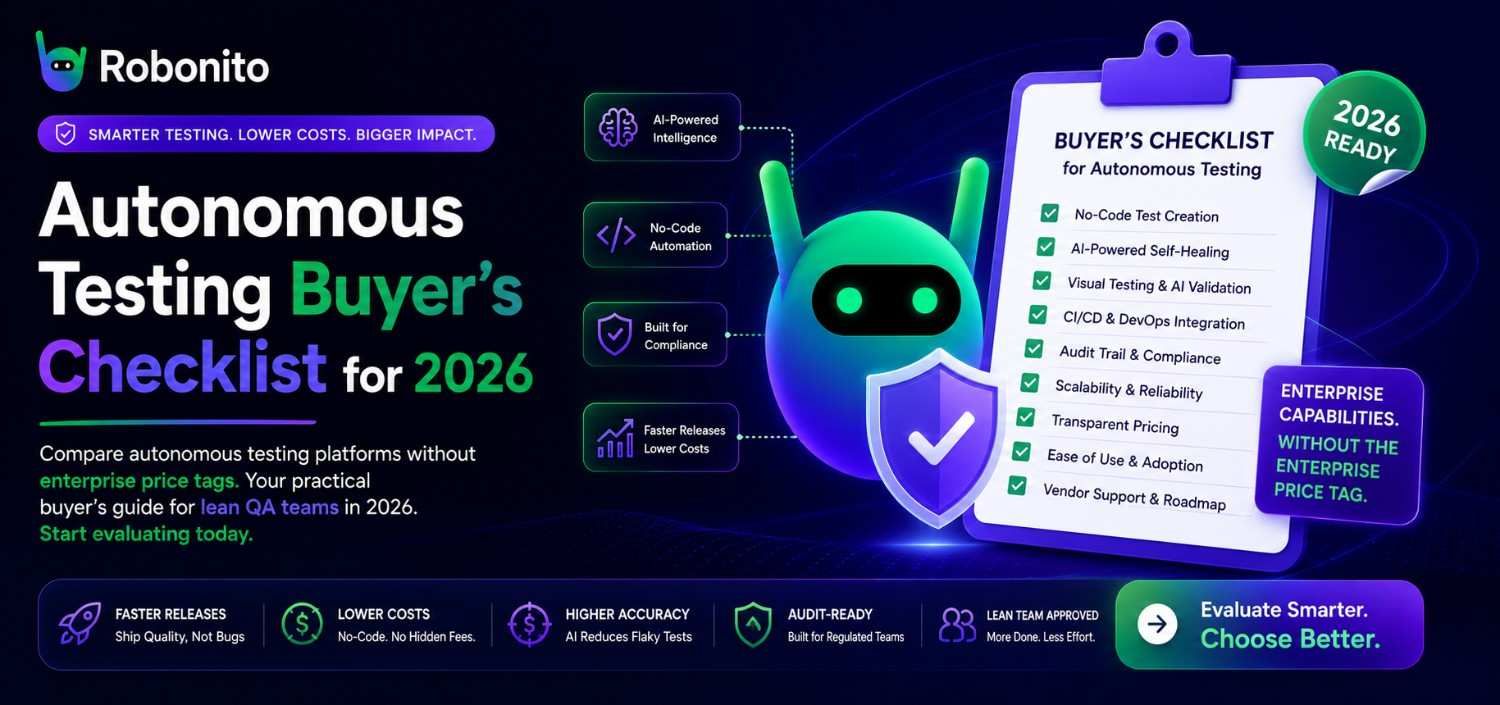
Every software team wants faster releases with fewer bugs. But when you search for an autonomous testing platform in 2026, you're met with a wall of enterprise-grade sales decks, six-figure contracts, and buyer's guides written for companies with 50-person QA departments. What about the rest of us?
Startups shipping weekly. Mid-market SaaS teams with two QA engineers and a backlog that never shrinks. Engineering managers who know manual testing doesn't scale but can't justify a $120K annual tool contract that requires dedicated SDETs just to maintain.
Autonomous testing — the real kind, not the marketing kind — should be accessible to these teams too. This post is your practical buyer's checklist for 2026: no compliance jargon, no enterprise gatekeeping, just a clear framework for choosing an autonomous testing tool that fits your team, your budget, and your actual workflow.
What "Autonomous Testing" Actually Means in 2026 (Beyond the Buzzword)
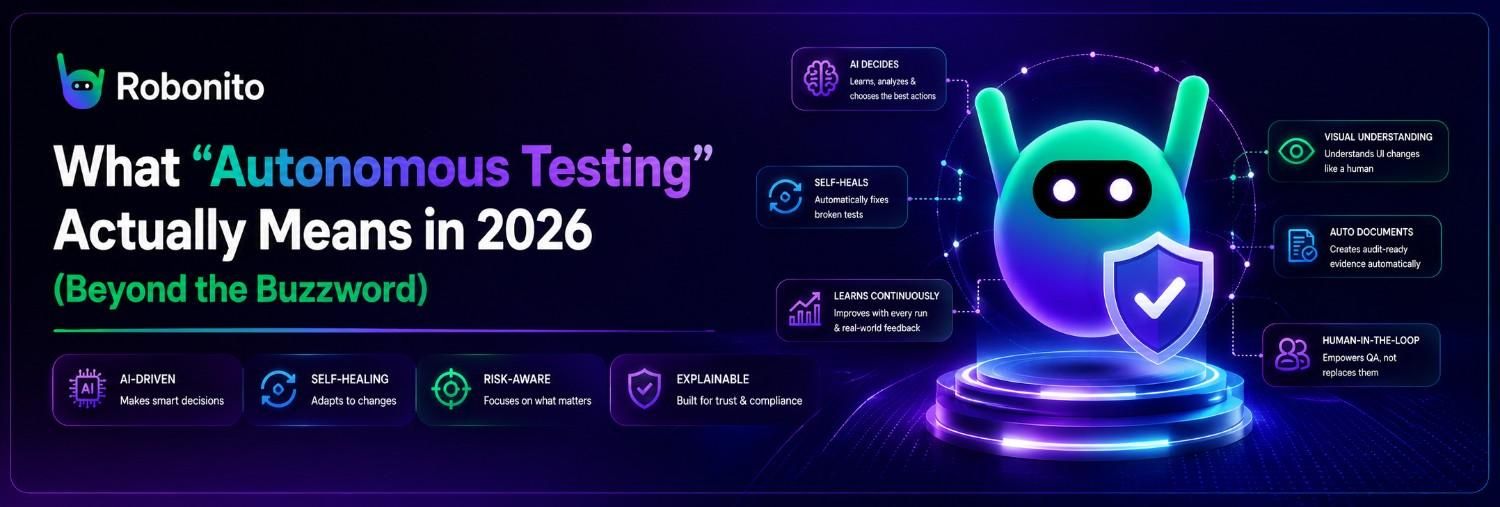
The term "autonomous testing" has been stretched thin by marketing teams. So let's ground it in what actually matters to you — a person who needs tests to work reliably without babysitting them.
At its core, an autonomous testing platform should do three things:
-
Generate tests with minimal human input. You describe what should happen — "a user signs up, gets a confirmation email, and lands on the dashboard" — and the system creates the test. Not a recording that breaks the moment a button moves. An actual resilient test.
-
Heal itself when the UI changes. If your dev team renames a CSS class, swaps a dropdown for a combobox, or restructures a page layout, autonomous tests should adapt without someone manually updating selectors.
-
Decide what to test and when. Advanced autonomous platforms can analyse code changes and determine which test suites are most relevant to run, reducing wasted CI minutes and surfacing failures faster.
Where the buzzword falls apart is when vendors slap "autonomous" on tools that still require you to write JavaScript hooks, maintain element locators, or configure complex visual baselines before anything works. That's assisted automation — and it's fine — but it's not autonomous.
Real-world example: A 15-person SaaS startup pushes updates to their billing dashboard three times a week. They don't have time to update brittle Selenium tests after every change. For them, autonomous testing means writing a test once in plain English, and trusting it to run correctly even after the front-end framework gets refactored. Anything less, and they're back to manual spot-checking before every deploy.
When you evaluate tools, ask this question: "If my UI changes tomorrow and nobody touches the test suite, what happens?" The answer tells you whether the platform is truly autonomous or just well-marketed.
The Forrester Wave and Why Enterprise Rankings Don't Tell the Whole Story
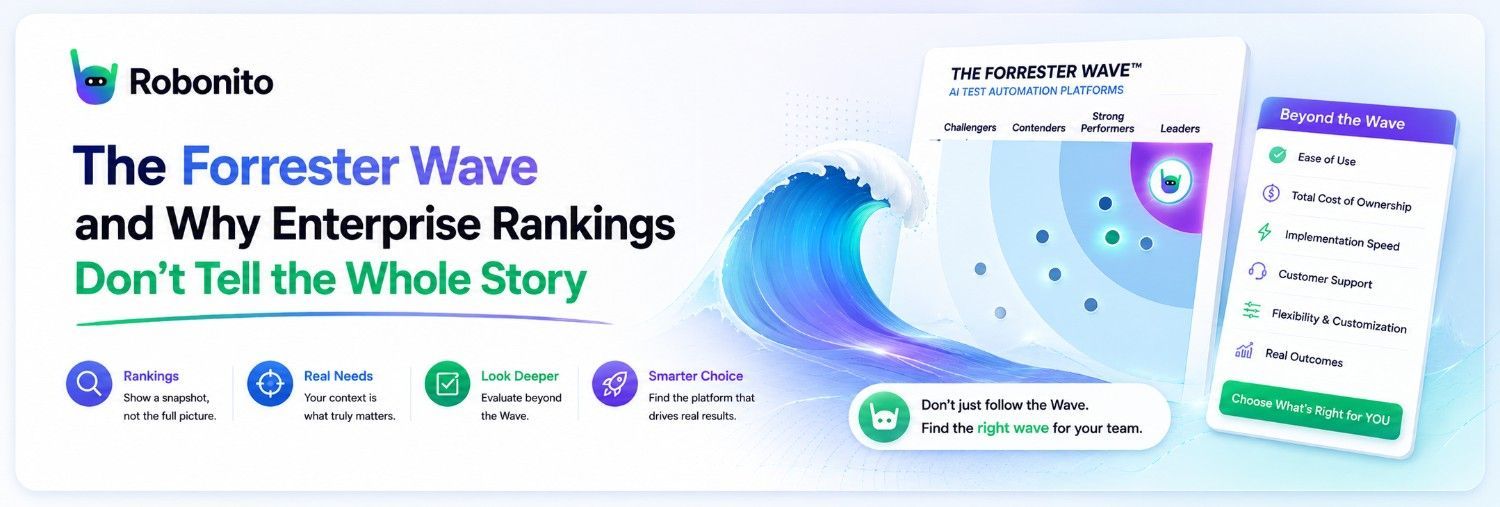
In late 2024, Forrester published its Wave for continuous testing platforms, and several vendors — Applitools prominently among them — used the rankings in their go-to-market messaging. Applitools subsequently published a buyer's checklist oriented toward regulated enterprise environments: healthcare, finance, government.
There's nothing wrong with that. If you're building software for a hospital network and need FDA-compliant test documentation, enterprise evaluation frameworks are exactly what you need.
But here's what those rankings don't capture:
- Time to value for small teams. Forrester evaluates platform capabilities at scale. They don't penalise a tool for requiring a three-week onboarding with a solutions engineer — because enterprise buyers expect that. A 10-person engineering team cannot afford that ramp-up.
- True cost of ownership. A tool might score highly on feature breadth while costing $80K+ per year with seat-based licensing. The Wave doesn't weigh affordability against team size.
- Maintenance burden. Some "autonomous" tools require dedicated SDETs to author and tune tests. For teams without that role, the tool's theoretical capability is irrelevant.
Scenario: An engineering manager at a B2B SaaS company reads the Forrester report, gets excited, and enters a sales conversation with a top-ranked vendor. Three weeks later, she has a quote for $95K/year with a six-month implementation timeline. Her team ships a major feature next month. That timeline doesn't work.
The takeaway isn't that Forrester is wrong — it's that their evaluation criteria are designed for a buyer persona that might not be you. If your team is under 30 engineers, doesn't have regulatory compliance requirements, and needs to see ROI within weeks rather than quarters, you need a different checklist.
10-Point Buyer's Checklist for Teams Without Dedicated SDETs
This is the checklist Forrester won't give you. It's designed for QA engineers, engineering managers, and product teams who need autonomous testing without the enterprise overhead.
1. Can a non-developer create a test in under 10 minutes? Time the first test. If it takes longer than a coffee break, adoption will stall.
2. Does the tool require CSS selectors, XPath, or any code to identify elements? If yes, you're one refactor away from a broken test suite.
3. How does the platform handle UI changes without human intervention? Ask for specifics on self-healing: what types of changes does it survive? A renamed button? A restructured form? A completely new page layout?
4. What does the pricing model look like at your actual team size? Enterprise tools often price per seat or per test run minute. Get a quote for your real numbers — 3 users, 500 test runs/month — not their showcase tier.
5. Can you integrate with your existing CI/CD pipeline in under a day? If integration requires custom scripting or professional services, factor that into your timeline and cost.
6. What happens when a test fails — do you get actionable debugging info or just a red X? Autonomous testing without clear failure reporting just means you've automated confusion.
7. Is there a free tier or trial that lets you test with your actual application? Demos with sandbox apps prove nothing. You need to run tests against your product.
8. Does the vendor lock you into annual contracts, or can you pay monthly? Flexibility matters when you're still evaluating fit.
9. How frequently is the platform updated, and do updates break existing tests? Check their changelog. If updates are infrequent or undocumented, expect stagnation.
10. Can the tool scale with you from 50 tests to 5,000 without an architecture overhaul? You need something that works today and still works when you're 3x your current size.
Print this list. Bring it to every vendor call. The vendors who can answer every question clearly — without redirecting you to a "solutions architect" — are the ones worth your time.
No-Code vs. Low-Code vs. Code-Based: Which Autonomy Level Fits Your Team?
The autonomous testing market splits into three tiers of abstraction. Understanding where each fits saves you months of misaligned tool selection.
Code-Based (Selenium, Playwright, Cypress)
You write and maintain everything. Full control, full responsibility. Tests are as good as the engineer writing them — and as fragile as the selectors they depend on.
Best for: Teams with dedicated SDETs who want granular control and are comfortable maintaining test infrastructure.
Watch out for: Maintenance costs scale linearly with your test suite. A 2,000-test Selenium suite can consume 20+ hours/week in upkeep.
Low-Code (Katalon, Testim, Mabl)
A visual interface with code escape hatches. You can build simple tests quickly, but complex scenarios often push you into scripting. Self-healing exists in some of these tools but varies widely in reliability.
Best for: Teams with at least one technical QA who can handle the code portions when the visual builder falls short.
Watch out for: The "low-code" label can be misleading. If 40% of your tests require custom scripts, you've got a code-based tool with a visual wrapper.
No-Code (platforms like Robonito, and to varying degrees mabl for visual testing)
Tests are created in natural language or through guided flows — no selectors, no scripts, no technical prerequisites. Self-healing is built into the core architecture, not bolted on.
Best for: Lean QA teams, manual testers transitioning to automation, startups without SDET headcount, and any team that needs tests created and maintained by the same people who understand the product — not just the codebase.
Real-world scenario: A product manager at a fintech startup creates regression tests for the onboarding flow using natural language descriptions. When engineering refactors the form fields the following sprint, the tests continue passing without anyone touching them. The PM never wrote a line of code.
The autonomy level you need isn't about ambition — it's about the skillsets you actually have on your team today.
Hidden Costs to Watch: Seat Licenses, Cloud Minutes, and Maintenance Overhead
The sticker price of an autonomous testing platform is never the real price. Here's where budgets quietly explode:
Seat-Based Licensing
Many vendors charge commonly ranging from hundreds to over a thousand dollars per seat per month depending on tier. For a team of five, that's $12,000–$36,000/year before you've run a single test. Ask whether pricing is per-seat or usage-based, and whether "read-only" users (like developers reviewing results) count as seats.
Cloud Execution Minutes
Running tests in the vendor's cloud often costs extra. Some platforms offer 1,000 minutes/month on their base plan — which sounds generous until your 300-test regression suite takes 4 minutes per run and you execute it twice daily. That's 72,000 minutes/month. The overage charges are where vendors make their margin.
300 tests × 4 minutes per test × 2 daily runs × 30 days = 72,000 minutes/month.
Maintenance Labour
This is the hidden cost that doesn't appear on any invoice. If a tool claims to be autonomous but requires 15 hours/week of test maintenance, multiply your QA engineer's hourly cost by that number. A $30K/year tool with $50K/year in maintenance labour is an $80K/year tool.
Integration and Onboarding
Some enterprise platforms require professional services for CI/CD integration — at $200–$400/hour. A "quick" 20-hour engagement adds $4,000–$8,000 to your first-year cost.
Cost comparison scenario: A mid-market SaaS company evaluates two platforms. Platform A costs $48K/year but requires an SDET to maintain tests (a conservative estimate for a mid-level SDET in the US market, fully loaded). Platform B costs $12K/year with truly self-healing tests that a manual QA tester maintains in 3 hours/week. The total cost of ownership difference is over $150K annually.
Always calculate total cost of ownership, not subscription cost. Ask vendors: "What does a team of our size and test volume actually pay, all-in, after 12 months?"
Engineering Lessons from Building Robonito
As we built Robonito, we discovered that the hardest problem in automation wasn't generating tests—it was helping them remain reliable as applications evolved.
One insight became clear early on: most broken tests weren't caused by broken software. They were caused by UI evolution. Teams continuously rename components, refactor layouts, migrate design systems, and restructure the DOM. From a user's perspective nothing is broken, but selector-based automation often interprets these harmless changes as failures.
This led us to rethink how an autonomous testing platform should identify interface elements. Rather than depending solely on fixed locators, we found that combining multiple signals—such as visible text, page context, accessibility attributes, visual relationships, and surrounding elements—provides a far more resilient way to recognise the intended target after UI changes.
We also observed that many so-called flaky tests were not application defects at all. They resulted from assumptions about timing, rendering order, asynchronous requests, animations, and dynamically generated components. Eliminating those assumptions proved just as important as improving element detection.
Another unexpected lesson was organisational rather than technical. Natural-language testing significantly broadened participation in quality assurance. Product managers, manual testers, developers, and QA engineers could discuss the same workflow without translating requirements into complex automation code first.
Perhaps the most difficult engineering trade-off has been deciding when automation should adapt and when it should fail. An autonomous platform must be intelligent enough to recognise harmless interface changes while remaining strict enough to expose genuine product regressions. Finding that balance is an ongoing engineering challenge—and one that continues to guide every new capability we build into Robonito.
How Robonito Delivers Autonomous Test Creation and Healing at a Fraction of the Cost
Robonito was built specifically for the teams this post is written for — the ones who need real autonomous testing without the enterprise baggage.
Here's how it maps against the buyer's checklist above:
Natural language test creation. You describe test steps in plain English. No CSS selectors. No XPath. No scripting. A QA engineer, a product manager, or a developer can create a comprehensive end-to-end test in minutes. Robonito interprets your intent and interacts with your application the way a real user would.
Self-healing that actually works. Robonito doesn't rely on brittle element locators. When your UI changes — a button gets renamed, a form gets restructured, a navigation menu shifts — Robonito's AI identifies the element by context, not by a hard-coded selector. This means test suites don't break every time engineering ships a front-end update.
Works on any web app, immediately. There's no SDK to install, no tag to inject, no configuration file to set up. Point Robonito at your application URL, and start creating tests. Teams are typically productive within hours of signing up — not weeks.
CI/CD integration without professional services. Robonito connects to all major pipelines — GitHub Actions, GitLab CI, Jenkins, CircleCI, and more — through straightforward integrations that take minutes, not days.
Pricing that respects small teams. No punitive seat-based licensing. No surprise overage charges for cloud minutes. Robonito's pricing model is designed so that a three-person QA team and a thirty-person QA team both get value without budget anxiety.
Example in action: A 20-person SaaS startup replaced a Cypress test suite that took one engineer two days per sprint to maintain. With Robonito, their QA lead created equivalent coverage in a single afternoon. Over the following three months, the self-healing capability absorbed dozens of UI changes without a single test requiring manual updates. That engineer now spends those two days per sprint on exploratory testing and feature work.
Robonito isn't trying to be an enterprise compliance platform. It's trying to be the autonomous testing tool your team will actually use — every day, without friction.
Decision Framework: When You Need Enterprise Tools vs. When You Don't
Not every team should use Robonito. And not every team needs Applitools, Sauce Labs, or a Forrester-ranked platform. Here's a practical framework for deciding.
You likely need an enterprise autonomous testing platform if:
- You operate in a regulated industry (healthcare, finance, government) and need audit-trail documentation for every test execution
- Your QA team exceeds 20 people and you need role-based access controls, advanced governance, and multi-team orchestration
- You have dedicated SDETs who can fully leverage code-based extensibility and custom integrations
- Your procurement process already accommodates six-figure annual contracts with 3–6 month evaluation cycles
You likely need a lean, no-code autonomous testing platform like Robonito if:
- Your QA team is 1–10 people, or QA responsibilities are shared across developers and product managers
- You don't have SDETs and don't plan to hire them
- You need to see measurable value within the first week, not the first quarter
- Your budget for testing tools is under $30K/year
- You're scaling fast and can't afford to spend engineering time maintaining test infrastructure
- You want autonomous testing capabilities — self-healing, AI-driven test creation, intelligent execution — without the enterprise price tag or complexity
The honest middle ground: Some teams start with a no-code platform like Robonito to get immediate coverage and ROI, then evaluate whether they need enterprise features as they grow. This is almost always more cost-effective than starting with an enterprise tool and paying for capabilities you won't use for years.
The goal isn't to have the most powerful testing platform on paper. It's to have the one that makes your team ship better software, faster, starting now.
Frequently Asked Questions
What should small teams look for in an autonomous testing platform that enterprise buyer's guides miss?
Enterprise buyer's guides evaluate platforms at scale — they do not penalise a tool for requiring a three-week onboarding with a solutions engineer, because enterprise buyers expect that. For teams under 30 engineers, four criteria matter that do not appear in Forrester or Gartner evaluations: time to first passing test (should be under 10 minutes with your actual application, not a sandbox demo), whether non-developers can create and maintain tests independently, whether the pricing model works at 3-5 users rather than 50, and whether the self-healing capability is architectural or bolted on. A tool that scores highly at enterprise scale can be completely impractical for a lean team that needs ROI within weeks, not quarters.
What is the real total cost of ownership for an autonomous testing platform?
The subscription price is only one of four cost components. Seat-based licensing adds up quickly — at $200-$600 per seat per month, a five-person team pays $12,000-$36,000 annually before running a single test. Cloud execution minutes create variable costs that scale unexpectedly — a 300-test suite running twice daily consumes 72,000 minutes per month (300 tests × 4 minutes × 2 runs × 30 days), which can trigger significant overage charges on base plans. Maintenance labour is the hidden cost that never appears on an invoice: a tool that requires 15 hours per week of test upkeep from a QA engineer has a real annual cost far above its subscription price. Integration and onboarding professional services — common in enterprise platforms — add $4,000-$8,000 to first year costs at $200-$400 per hour. Always ask vendors for an all-in cost estimate for your actual team size and test volume after 12 months.
What is the difference between no-code, low-code, and code-based autonomous testing?
Code-based platforms (Selenium, Playwright, Cypress) give you full control but full responsibility — tests are as reliable as the engineers who write them and as fragile as the selectors they use. Low-code platforms provide a visual interface with code escape hatches; they work well for simple scenarios but complex tests often push teams into scripting, making the "low-code" label misleading when 40% of tests require custom code. No-code platforms allow tests to be created in natural language or guided flows with no selectors, no scripts, and no technical prerequisites. The autonomy level that fits your team depends on who will create and maintain tests daily — if it requires a dedicated SDET to function, a no-code label does not make it accessible to a team without one.
When does a team actually need an enterprise autonomous testing platform versus a lean no-code tool?
Enterprise platforms are the right choice when: the organisation operates in a regulated industry requiring audit trail documentation for every test execution, the QA team exceeds 20 people and needs advanced governance and multi-team orchestration, dedicated SDETs are available to leverage code-based extensibility, and the procurement process already accommodates six-figure contracts with multi-month evaluation cycles. Lean no-code platforms are the right choice when: the QA team is 1-10 people or QA is shared across roles, no SDETs exist or are planned, measurable value is needed within the first week, the annual tool budget is under $30,000, and the team needs autonomous capabilities without enterprise price or complexity. The honest middle ground is to start with a no-code platform for immediate coverage and ROI, then evaluate whether enterprise features are genuinely needed as the organisation scales.
How do you evaluate whether an autonomous testing tool's self-healing is genuine or marketing language?
Ask one question and time the answer: if our UI changes tomorrow and nobody touches the test suite, what exactly happens? Then request a live demonstration — not a recorded demo, not a sandbox — against your actual application. Make a specific UI change: rename a CSS class, move a button to a different position, swap a dropdown for a combobox. Watch whether the test continues passing without human intervention. If the vendor redirects you to documentation, a technical account manager, or a scripted demo environment, the self-healing is not production-grade. Genuine self-healing should survive a class rename, a structural reorganisation, and a component library update without requiring selector updates, configuration changes, or any human input. Anything that requires manual intervention after a UI change is selector fallback with a self-healing label, not true autonomous adaptation.
Start Testing Autonomously — Without the Enterprise Overhead
If this checklist resonated, you're probably the exact team Robonito was built for. You don't need a 90-day proof of concept. You don't need a solutions engineer to hold your hand through integration. You don't need to learn a scripting language.
You need to create your first test, watch it run, change something in your UI, and see the test heal itself. That's what autonomous testing should feel like.
Try Robonito free today — create your first self-healing test in under 10 minutes, no credit card required. Bring your own app, run it against your real product, and see the results for yourself.
Your backlog isn't getting shorter. But your testing can get smarter — starting this afternoon.
Automate your QA — no code required
Stop writing test scripts.
Start shipping with confidence.
Join thousands of QA teams using Robonito to automate testing in minutes — not months.