What QA engineers are asking in 2026, and why the future of test automation is humans orchestrating AI.
In the second week of September, one of the busiest threads in r/QualityAssurance had a blunt title: "QA career probably over." It pulled 85 upvotes and nearly 50 comments in a few days.
The interesting part wasn't the title. It was the reply that got the most upvotes:
"The important QA skills are all about attention to detail, asking the right questions, deep domain understanding. AI is making the coding part easier." u/shark-with-a-horn, 84 upvotes
That exchange sums up where test automation is right now. AI can write test scripts. It cannot decide what's worth testing, tell a real bug from a flaky one, or own a release decision. The job isn't going away. It's moving up a level.
We spent the last 30 days reading what testers are posting and asking on Reddit, YouTube, TikTok, Instagram and Hacker News. Here's what's on their minds, what it means for people doing QA, and what it means for the people leading QA teams.
What QA people are asking right now
Across hundreds of posts and comments, five questions keep coming up.
1. "Is QA automation still a real career?" Besides "QA career probably over," there's a manual tester with 2 years of experience who is "terrified of AI automating testing" and wondering whether to jump to data engineering. There's also a 50-year-old tester noticing recruiter calls drying up. The fear is real. So is the pushback: one r/QualityAssurance commenter reported "400 recruiter actions and 50+ interview calls in the past 6 months."
2. "How are you actually using AI, MCP and agents in QA?" This is the top practical question. A QA lead starting automation from zero asked r/softwaretesting exactly this and got 47 replies. In r/Playwright, testers compare notes: Cursor for adding UI tests, Claude Code for framework-level work like CI/CD and reporting.
3. "Should I learn Playwright or Selenium?" The community has mostly settled this one. Playwright is now used by about 45% of QA professionals, versus 22% for Selenium (State of Test Automation 2026). Most learning-path advice now says Playwright first, go deep on one language, and skip months of BDD ceremony.
4. "How do I explain my framework in an interview?" Interview prep is the most concrete demand in the data. The top QA reel on Instagram this month was a walkthrough on explaining a test automation framework from scratch. It's aimed at people who freeze when an interviewer says "tell me about your framework." Scenario-based questions come next. AI coding agents are now a standard SDET interview topic too.
5. "Why does no one see the work QA does?" Underneath the career questions is a morale problem. As one tester put it in a thread about hard-won lessons: "When QA does a good job, everything is running smoothly, so they're invisible."
The shift: from executor to orchestrator
QA has been through this before. Manual testing moved knowledge from people's heads into test cases. Automation moved it from test cases into code. Each era automated the previous era's manual work, and each time QA moved up a level instead of disappearing.
The current era moves knowledge into rules, intent and review that AI agents follow. The engineer's job shifts from typing every step to directing the agents, setting the guardrails and judging the results.
There's a trap on the way, and testers are already running into it. QA educator Ivan Davidov calls it "completion theater": an agent is optimized to finish the task, not to test your product. Left without rules, it produces green suites that check nothing:
"You can have 12 different steps and zero assertions."
That's the core argument. AI without a human orchestrator doesn't give you quality. It gives you faster-looking quality. The teams getting real value from AI in testing aren't the ones that removed the human. They're the ones that put the human in the right seat.
Built for exactly this: Robonito
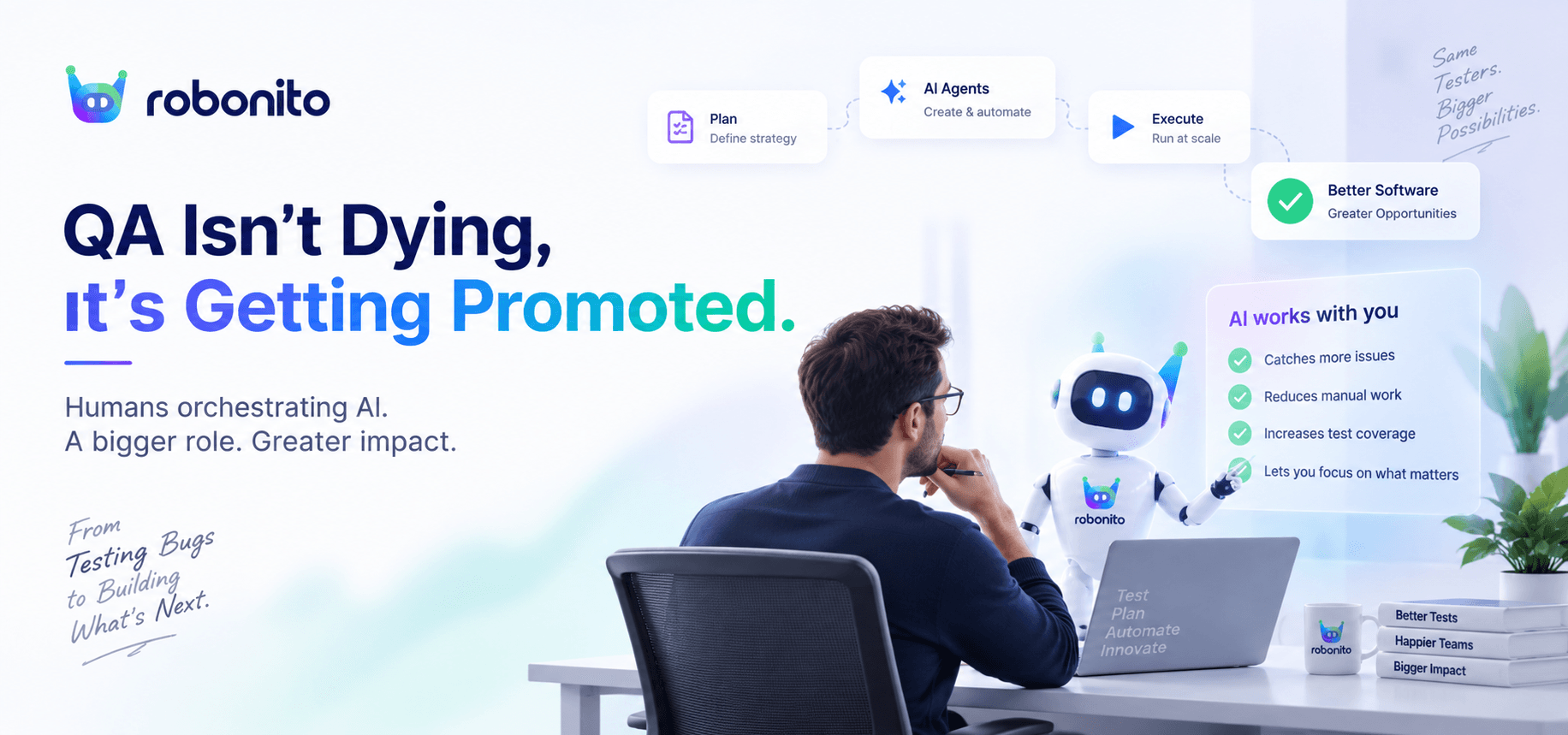
Robonito is an AI QA automation platform built for humans to orchestrate AI. It works as a three-layer system you direct:
- Planner reads your requirements and outlines the test scenarios worth running.
- Generator turns those scenarios into executable tests. You can describe them in plain English, no code required.
- Healer adapts tests when your UI or DOM changes, so you're not rewriting selectors every sprint.
You set the intent and review the output. The agents do the tedious parts. Try it free: 100 test cases/month, no credit card →
For QA engineers: the skills that matter now
If you're doing QA today, here's what the research says is worth investing in.
Test design over test typing. Anyone (and anything) can write a login test. The valuable skill is designing a suite that gives fast feedback, catches real regressions and doesn't collapse every time the app changes. AI makes scripts cheap. That makes judgment about what to script expensive.
Reviewing AI output like a senior engineer. If an agent writes your tests, your job is catching the hollow ones: steps without assertions, assertions that can't fail, "passes" that verified nothing. This is the new code review, and most teams don't have anyone who's good at it yet.
One framework, deeply. Pick Playwright (the market is moving there) and one language, TypeScript or Python, and go deep. Depth beats a résumé listing five tools.
Domain knowledge. Understanding what the business actually cares about is the part AI can't fake. It doesn't know which breaking change matters to your customers. You do.
Positioning yourself as the orchestrator. One of the most upvoted comments in a thread about experienced testers' job hunts made this point directly:
"At that level, 'I know Selenium/Playwright/API automation' shouldn't be the headline anymore." u/DependentHuge8944, 68 upvotes
The headline now is: I design quality strategy, I direct automation (human and AI), and I own the release decision.
The agent asks. You decide.
The most dangerous failure in autonomous testing isn't a crash. It's an agent confidently acting on the wrong interpretation of your app.
Robonito is designed around that risk. When its agent hits something ambiguous, like a login wall it didn't expect, an option that isn't there, or a value that doesn't match what you asked for, it pauses and asks you, with concrete options to choose from. It doesn't guess. Nothing about your test changes without your decision.
As we wrote in Teaching a Machine to Browse: "The goal is not to remove the human from the loop. The goal is to make the human's time in the loop as efficient and well-informed as possible."
For QA and engineering leaders: what's actually changing
If you run a QA team or own the testing budget, the career anxiety on Reddit is a signal about your hiring and tooling, not just morale.
Headcount is being redistributed, not eliminated. Manual-only QA postings are 25-40% below their 2021 peak in mature SaaS markets. Roles requiring automation or quality-engineering skills are flat to 15% higher (SQAExperts). A team that once hired six manual testers now hires two quality engineers, an exploratory testing specialist, and expects developers to own more checks.
The winning model is hybrid. Across industry analysis this year, the pattern is consistent. AI agents handle broad coverage and the maintenance-heavy regression work that drains teams. Humans handle strategy, exploratory testing, edge cases and anything compliance-critical.
Your developers' coding agents are outrunning QA. This came up again and again on Hacker News this month: engineering teams now ship with AI coding assistants, and QA capacity hasn't kept up. You don't close that gap by adding headcount at the same rate. You close it by giving each QA engineer a set of agents to direct.
What to look for in an AI testing platform:
- Clear human control points. Where does a person approve, redirect or reject? If the answer is "nowhere," you're buying completion theater.
- Escalation, not guessing. Does the agent stop and ask when it's unsure, or push ahead and report green?
- Self-healing you can see. Adaptive tests are great, as long as you can see what changed and why.
- No-code for the common path, low-code for the edge cases. Your manual testers can contribute on day one, and your SDETs aren't boxed in.
- Fits your pipeline. CI/CD, parallel runs, and the tools your team already lives in, without a forced migration.
- Coverage for AI features, too. If you ship chatbots or agents, you need a way to test non-deterministic output.
Robonito for teams
Robonito gives QA leaders AI speed without giving up human judgment:
- Faster QA cycles. Teams typically see a 60-80% reduction in QA time within the first month. Club Car cut its QA time by 70%.
- One platform, every surface: web, API, mobile and desktop applications.
- Agent-to-agent testing: use one AI agent to evaluate another's outputs, for teams shipping AI features.
- Works with your stack: Jira, GitHub, Azure DevOps, Jenkins, TestRail, Zephyr, Slack and your CI/CD pipeline.
- Deploy your way: cloud, private cloud or on-prem.
Schedule a demo → or run a proof-based PoC on your own application.
The bottom line
The question on every QA forum this month is "Will AI replace me?" It's the wrong question.
The better one is: who's directing the AI? Agents can crawl, generate, heal and repeat faster than any team. Deciding what matters, spotting the test that passes but proves nothing, and owning the call to ship is still human work. It's worth more now, not less.
Or, as one tester in r/QualityAssurance put it: "All the doom and gloom of AI taking QA jobs and the irony is that manual qa is more important than ever."
QA isn't dying. It's getting promoted, from the person who runs the tests to the person who orchestrates the system that runs them.
Frequently Asked Questions
Will AI replace QA engineers in 2026?
AI is changing QA engineering rather than simply replacing it. AI agents can generate tests, execute repetitive checks, assist with failure analysis, and maintain parts of automated test suites. Human QA engineers are still responsible for test strategy, risk assessment, exploratory testing, reviewing AI-generated results, and making context-dependent quality decisions. The role is increasingly shifting from executing every test manually to directing and validating AI-assisted testing workflows.
What skills should QA engineers learn for AI-driven testing?
QA engineers should strengthen test design, risk-based testing, exploratory testing, domain knowledge, automation fundamentals, and the ability to review AI-generated tests critically. Learning one modern automation framework deeply, such as Playwright, can also provide a strong technical foundation. As AI handles more test generation and maintenance work, knowing what to test, how to evaluate results, and when to intervene becomes increasingly important.
How is AI being used in software testing?
AI is being used to generate test scenarios, create automated tests from natural-language requirements, identify and adapt to UI changes, analyze failures, prioritize test execution, and assist with maintaining regression suites. Agentic testing systems can perform multi-step testing tasks, but human oversight remains important when requirements are ambiguous, business risk is high, or an AI-generated result needs validation.
What is human-in-the-loop AI testing?
Human-in-the-loop AI testing is an approach where AI agents automate repetitive testing work while QA professionals retain control over important decisions. The AI may generate, execute, analyze, or adapt tests, while humans define intent, review uncertain situations, validate assertions, investigate unexpected behavior, and decide whether results provide enough confidence to release software.
Is Playwright or Selenium better to learn for QA automation in 2026?
Playwright is a strong choice for QA engineers starting with modern web automation because it provides built-in auto-waiting, browser automation capabilities, and support for resilient locator strategies. Selenium remains widely used across established enterprise automation environments and continues to be a valuable skill. Rather than learning many frameworks superficially, QA engineers can benefit more from mastering one framework deeply while developing broader skills in test architecture, debugging, CI/CD, and AI-assisted testing.
Ready to orchestrate instead of execute?
Robonito is the AI QA automation platform built for humans to orchestrate AI. Turn requirements into tests, let agents handle the grind, and stay in control of every decision that matters.
- ✅ Free forever plan: 100 test cases/month, 2 parallel runs, self-healing tests, live reporting
- ✅ No credit card required
- ✅ Join 1,000+ testers in the Robonito Slack community
Automate your QA — no code required
Stop writing test scripts.
Start shipping with confidence.
Join thousands of QA teams using Robonito to automate testing in minutes — not months.