Research from Xray indicates that a significant portion of software failures stem from undetected errors during testing, underscoring the critical need for robust quality assurance (QA) processes. While traditional test automation has long been the standard, it often presents challenges such as high implementation costs, complex setups, and the misconception that only code-heavy solutions can deliver reliable results. No-code platforms are emerging as a transformative force in scripless test automation, offering a simplified approach without sacrificing precision. However, misconceptions about their reliability and suitability for enterprise-level testing persist, hindering widespread adoption.
This blog will explore how no-code platforms are redefining QA automation, dispel the top 5 myths surrounding their capabilities, and examine their suitability for enterprise-grade testing. We will also present a real-world case study of Club Car's successful QA automation journey with Robonito, demonstrating the tangible benefits of a best-in-class no-code platform in achieving both trust and efficiency.
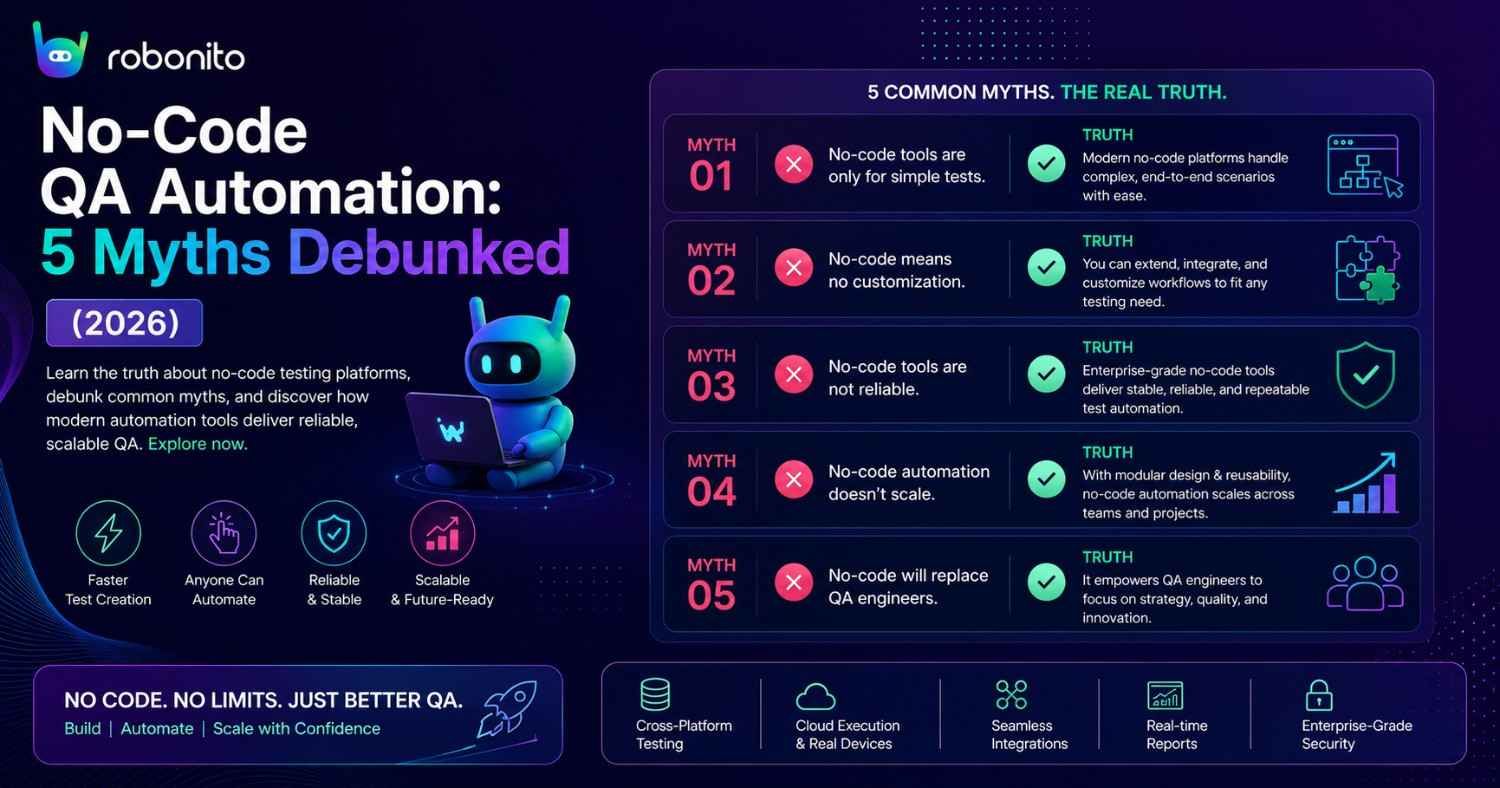
Debunking 5 Myths on Why No-Code Platforms Are Trustworthy for QA Automation
No-code platforms are gaining significant traction in the QA automation landscape, offering a more efficient and streamlined approach to testing.
However, several misconceptions persist, hindering their wider adoption.
Let's dispel 5 common myths and demonstrate why no-code platforms are not only reliable but crucial for modern software testing strategies.
Myth 1: No-Code Platforms Are Only for Simple Applications
Reality: Modern no-code platforms have evolved significantly, offering robust capabilities for complex testing scenarios.
Key Features:
- Scalability: Handle large volumes of tests across diverse environments.
- Flexibility: Support integrations with existing tools and accommodate intricate workflows.
- Modular Frameworks: Allow for the creation, execution, and management of tests for both small and large-scale applications.
Example: Platforms like Robonito are designed to accommodate a wide range of testing needs, from basic functional tests to intricate regression testing across diverse enterprise environments.
Myth 2: No-Code Platforms Are Not Reliable for Large-Scale Testing
Debunking the Myth: Some believe that no-code platforms lack the robustness required for large-scale testing, particularly when dealing with high volumes of test cases and complex systems.
Reality:
- Scalability and Performance: Leading no-code platforms are engineered for scalability and can handle thousands of tests concurrently across various configurations and environments.
- CI/CD Integration: Seamless integration with CI/CD pipelines enables efficient and reliable execution of extensive test suites.
No-code platforms are capable of effectively managing large-scale testing requirements across diverse domains, including APIs, web applications, and mobile interfaces.
Myth 3: No-Code Means No Customization
Debunking the Myth: A common misconception is that no-code platforms are inflexible and lack the customization options needed to address specific testing requirements.
Reality:
Customization Capabilities:
- Drag-and-Drop Interface: Enables the creation of tailored workflows and test scenarios.
- Conditional Logic: Facilitates the definition of specific conditions and the configuration of actions to align with unique testing needs.
- Integrations: Allow for the incorporation of various tools and technologies to enhance testing capabilities.
No-code platforms provide a balance of simplicity and flexibility, empowering QA teams to create customized testing solutions without the need for extensive coding.
Myth 4: No-Code Platforms Are Less Secure
Debunking the Myth: Some believe that no-code platforms are inherently less secure than traditional, code-based solutions, potentially exposing applications to vulnerabilities.
Reality:
Security Measures: Leading no-code platforms prioritize security with features such as:
- Encryption: Protects sensitive data.
- Access Controls: Restricts access to authorized personnel.
- Audit Logs: Tracks all activities within the platform.
Regular Updates: Continuous updates address emerging security threats and maintain compliance with industry standards.
No-code platforms often enhance security by reducing human error, which can be a significant source of vulnerabilities in manually written scripts.
Myth 5: No-Code Testing Platforms Are Expensive in the Long Run
Debunking the Myth: While initial subscription fees may be associated with no-code platforms, they offer significant long-term cost savings compared to traditional approaches. Cost Savings:
- Reduced Development Costs: Eliminates the need for extensive coding resources and the associated personnel costs.
- Faster Time to Market: Accelerates testing cycles, leading to faster product releases and reduced time-to-market costs.
- Lower Maintenance Costs: Minimizes ongoing maintenance efforts and reduces the need for specialized developer support.
Scalable Pricing Models: Most no-code platforms offer scalable pricing models, allowing organizations to pay only for the resources they utilize.
Are No Code Platforms Good?
The myths surrounding no-code platforms often stem from outdated perceptions and a lack of understanding of their evolving capabilities. Modern no-code platforms are robust, flexible, and secure, offering a strategic advantage for organizations seeking to streamline their QA processes, improve efficiency, and reduce costs.
Yes, no code platforms are not only good, but they have become essential tools for many businesses and software development teams.
The growing adoption of no code platforms is a testament to their effectiveness.
No code platforms are powerful, scalable, and user-friendly tools that can help organizations:
- Build applications
- Streamline operations.
- Automate testing
They provide practical solutions to real-world problems by offering businesses a way to implement automation and development with reduced complexity, cost, and time.
Whether you're in QA automation, business process automation, or software development, no code platforms are indeed a great option.
How Modern No-Code Platforms Actually Work
One of the biggest misconceptions about no-code testing platforms is that they simply replace code with drag-and-drop interfaces. In reality, modern no-code platforms use sophisticated automation engines, AI-powered capabilities, and enterprise-grade integrations to deliver reliable and scalable testing.
Instead of requiring users to write thousands of lines of test scripts, no-code platforms abstract technical complexity while still executing the same underlying automation processes needed for comprehensive software testing.
Visual Test Creation
Modern no-code platforms allow testers to create automated tests using visual workflows, record-and-playback functionality, and reusable test components.
Benefits include:
- Faster test creation
- Reduced dependency on coding skills
- Easier collaboration between QA, product, and business teams
- Improved test readability and maintainability
AI-Assisted Automation
Many modern no-code platforms leverage artificial intelligence to improve automation efficiency and reliability.
Common AI-powered capabilities include:
- Self-healing test execution when UI elements change
- Intelligent test maintenance
- Automated test generation recommendations
- Smart failure analysis and defect identification
- Risk-based test prioritization
These capabilities help teams spend less time fixing broken tests and more time improving product quality.
Enterprise Integrations
No-code platforms are designed to fit into existing software delivery pipelines rather than replace them.
Most enterprise-grade platforms support integrations with:
- CI/CD tools
- Test management systems
- Defect tracking platforms
- Version control systems
- Collaboration tools
This enables organizations to automate testing while maintaining existing development workflows.
Cross-Platform Testing
Modern no-code solutions are capable of testing across multiple environments, including:
- Web applications
- Mobile applications
- APIs
- Desktop applications
This unified approach reduces tool sprawl and simplifies test management across complex technology stacks.
How Robonito Applies Modern No-Code Automation
Robonito combines no-code automation with AI-powered capabilities to help organizations accelerate software delivery while reducing maintenance overhead. Features such as visual test creation, self-healing automation, reusable workflows, and multi-platform testing allow teams to automate web, mobile, desktop, and API testing without maintaining large volumes of automation code.
By eliminating repetitive scripting tasks and simplifying automation management, Robonito enables QA teams to focus on quality, innovation, and faster release cycles rather than maintaining fragile test scripts.
The Bottom Line
Modern no-code platforms are not simplified testing tools with limited functionality. They are enterprise-grade automation platforms that combine visual workflows, AI-powered capabilities, and scalable infrastructure to help organizations achieve faster, more reliable software testing with significantly less maintenance effort.
No-Code vs Traditional Automation
Traditional automation has helped organizations scale software testing for years. However, it often requires significant coding expertise, ongoing maintenance, and dedicated automation engineers to keep test suites running efficiently.
Modern no-code automation platforms take a different approach by enabling teams to create, execute, and maintain automated tests through visual workflows and AI-assisted capabilities rather than extensive scripting.
Comparison Overview
| Area | Traditional Automation | No-Code Automation |
|---|---|---|
| Test Creation | Manual scripting | Visual workflows |
| Maintenance | High | Lower |
| Learning Curve | Steep | Faster adoption |
| Test Updates | Manual changes required | Self-healing and visual updates |
| Team Accessibility | Developers & automation engineers | QA teams, business users, and developers |
| Test Coverage Expansion | Slower | Faster |
| Time to Automation | Weeks or months | Days or weeks |
| CI/CD Integration | Supported | Supported |
| Scalability | High | High |
| Human Input | Continuous | Selective |
When Traditional Automation Makes Sense
Traditional automation remains a strong choice when:
- Teams require highly customized test logic.
- Extensive programming control is necessary.
- Dedicated automation engineers are available.
- Regulatory requirements demand script-level visibility.
When No-Code Automation Is the Better Choice
No-code platforms are often the preferred option when:
- Teams want to accelerate automation adoption.
- QA resources are limited.
- Test maintenance consumes excessive time.
- Business users need visibility into test workflows.
- Organizations want faster releases without expanding engineering headcount.
The Future Is Hybrid
The most successful organizations do not view no-code and traditional automation as competing approaches. Instead, they combine both strategies where appropriate. No-code platforms accelerate test creation and maintenance, while traditional automation can be used for highly specialized scenarios.
Platforms like Robonito help organizations reduce automation complexity while maintaining the scalability, reliability, and enterprise-grade capabilities required for modern software delivery.
Best No-Code QA Automation Platforms in 2026
The no-code QA automation market has matured significantly over the past few years. Modern platforms now combine visual test creation, AI-powered maintenance, enterprise integrations, and support for multiple testing types, making automation accessible to a wider range of teams.
The right platform depends on your organization's testing requirements, technical resources, and long-term automation strategy.
Quick Comparison
| Platform | Best For | Web Testing | Mobile Testing | API Testing | Desktop Testing | AI Features |
|---|---|---|---|---|---|---|
| Robonito | End-to-end no-code automation | ✅ | ✅ | ✅ | ✅ | ✅ |
| ACCELQ | Enterprise automation teams | ✅ | ✅ | ✅ | ❌ | ✅ |
| mabl | AI-powered web testing | ✅ | Limited | Limited | ❌ | ✅ |
| Testim | Fast web automation | ✅ | Limited | Limited | ❌ | ✅ |
| Katalon Studio | Mixed-code automation teams | ✅ | ✅ | ✅ | Limited | Partial |
Robonito
Robonito is designed for organizations seeking a unified platform for web, mobile, API, and desktop test automation. Its no-code approach, AI-powered self-healing capabilities, reusable workflows, and enterprise-grade scalability make it suitable for teams looking to accelerate automation while minimizing maintenance effort.
Best for:
- Enterprise QA teams
- Cross-platform testing
- AI-powered automation
- Organizations adopting no-code testing at scale
ACCELQ
ACCELQ is a cloud-based no-code automation platform focused on enterprise test automation. It provides strong support for web, mobile, API, and business process testing while emphasizing governance and collaboration.
Best for:
- Large enterprises
- Complex business workflows
- Regulated industries
mabl
mabl focuses on AI-powered test automation for web applications. Its intelligent test maintenance and cloud-native architecture help teams reduce automation maintenance and improve release confidence.
Best for:
- SaaS companies
- Agile teams
- Continuous delivery environments
Testim
Testim uses AI-driven automation to simplify test creation and maintenance. Its visual editor and smart locators help reduce test instability while improving team productivity.
Best for:
- Fast-growing product teams
- Web application testing
- Teams seeking rapid automation adoption
Katalon Studio
Katalon Studio combines low-code and script-based automation capabilities, making it suitable for teams that require flexibility between visual workflows and custom scripting.
Best for:
- Hybrid automation strategies
- Teams transitioning from manual testing
- Organizations requiring script extensibility
Which No-Code QA Platform Should You Choose?
- Choose Robonito if you need a single platform for web, mobile, API, and desktop testing with AI-powered automation and self-healing capabilities.
- Choose ACCELQ if enterprise governance and large-scale process automation are priorities.
- Choose mabl if your focus is web testing with AI-assisted maintenance.
- Choose Testim if rapid web automation is your primary goal.
- Choose Katalon Studio if you need a blend of low-code and script-based automation.
The best platform is the one that aligns with your team's technical capabilities, automation goals, and long-term software delivery strategy.
Case Study: Club Car Optimizes QA with Robonito
Club Car, a prominent player in the automotive e-commerce sector, faced significant challenges in managing the quality assurance (QA) testing of their highly configurable cart models on their Salesforce CPQ-backed e-commerce platform. With hundreds of possible configurations and intricate workflows, their manual testing efforts consumed over 500 hours per month, impacting both time-to-market and resource allocation.
The Challenge:
- Time-Consuming Manual Testing: Testing hundreds of configurations manually was a time-consuming and resource-intensive process, prone to human error.
- Lack of Scalability: The existing testing approach lacked the scalability to handle the increasing complexity of their product offerings and the growing volume of test cases.
- Limited Automation Capabilities: The absence of a robust automation solution hindered the ability to efficiently execute tests across multiple environments and configurations.
- Dependency on Specialized Skills: The lack of in-house coding expertise created a significant barrier to implementing and maintaining effective automated testing solutions.
The Solution: Robonito
Club Car chose Robonito's no-code QA automation platform to address these challenges.
- Streamlining Test Creation: Robonito's intuitive interface, including features like "Record and Playback of Flows," enabled Club Car to rapidly automate even the most complex configuration test cases without requiring extensive coding expertise.
- Enhanced Scalability and Flexibility: The platform offered the scalability to handle a large volume of tests across multiple environments, along with the flexibility to customize test scenarios, integrate with existing tools, and adapt to evolving business needs.
- Improved Efficiency and Cost-Effectiveness: By automating previously manual tasks, Club Car significantly reduced testing time. This translated into substantial cost savings by minimizing the need for manual effort and accelerating development cycles.
Results:
- Dramatically Reduced Testing Time: Through the implementation of Robonito, Club Car achieved a remarkable reduction in testing time, from over 500 hours per month to just 2 hours.
- Accelerated Time-to-Market: Faster feedback loops enabled by automated testing streamlined the development and release process, allowing Club Car to bring new products and features to market more quickly.
- Enhanced Test Coverage and Reliability: Automated testing ensured comprehensive test coverage across various configurations, improving the overall quality and reliability of their e-commerce platform.
- Increased Team Productivity: By automating repetitive tasks, the QA team was freed up to focus on more strategic initiatives, such as exploratory testing and advanced test analysis.
Frequently Asked Questions
Is no-code QA automation suitable for enterprise applications?
Yes. Modern no-code QA automation platforms are designed for enterprise-scale testing and can support complex workflows, large test suites, multiple environments, CI/CD pipelines, and strict security requirements. Many organizations use no-code testing to accelerate releases while reducing maintenance overhead.
Can no-code testing replace Selenium and other traditional automation frameworks?
It depends on your requirements. Traditional frameworks such as Selenium, Playwright, and Cypress offer maximum coding flexibility, while no-code platforms prioritize speed, accessibility, and maintainability. Many organizations use no-code testing to automate the majority of regression testing while reserving code-based frameworks for highly specialized scenarios.
Is no-code automation reliable for large-scale regression testing?
Yes. Modern no-code platforms can execute thousands of automated tests across web, mobile, API, and desktop applications. Features such as self-healing automation, reusable components, and intelligent test management help maintain reliability even as applications evolve.
How secure are no-code QA platforms?
Leading no-code testing platforms implement enterprise-grade security controls, including role-based access management, encrypted data storage, audit logs, and secure integrations. Security capabilities should always be evaluated based on your organization's compliance and governance requirements.
What are the biggest benefits of no-code test automation?
Organizations typically adopt no-code testing to:
- Reduce test creation time
- Lower maintenance effort
- Increase automation coverage
- Enable non-technical team members to contribute
- Accelerate software releases
- Improve collaboration between QA, developers, and business teams
How does AI improve no-code QA automation?
AI enhances no-code automation through capabilities such as self-healing tests, intelligent element identification, automated test generation, failure analysis, and test optimization. These features help teams spend less time maintaining scripts and more time improving software quality.
Can no-code platforms test web, mobile, API, and desktop applications?
Many modern no-code platforms support multiple testing types from a single interface. Solutions such as Robonito enable teams to automate web, mobile, API, and desktop testing without maintaining separate frameworks for each technology stack.
What should enterprises look for in a no-code testing platform?
When evaluating a no-code testing solution, organizations should consider:
- Scalability
- AI-powered automation
- Self-healing capabilities
- CI/CD integration
- Security and compliance
- Cross-browser support
- Mobile testing capabilities
- Reporting and analytics
- Ease of maintenance
Why are enterprises switching to no-code QA automation in 2026?
As release cycles become faster and applications become more complex, enterprises are adopting no-code automation to reduce technical bottlenecks, improve testing efficiency, and scale quality assurance without increasing headcount. No-code platforms help teams deliver reliable software faster while minimizing maintenance costs.
Why do enterprises choose Robonito for no-code QA automation?
Organizations choose Robonito because it combines no-code automation, AI-powered self-healing tests, and support for web, mobile, API, and desktop testing within a single platform. This helps teams reduce maintenance effort, accelerate regression testing, and improve software quality without requiring large automation engineering teams.
Conclusion
The Club Car case study exemplifies the transformative potential of no-code platforms in modern QA automation. By embracing Robonito, Club Car overcame the limitations of manual testing, significantly reducing testing time and accelerating their development cycles. This success demonstrates that no-code platforms can effectively address the complex testing needs of even large enterprises, delivering high-performance results while empowering QA teams.
The question of whether no-code platforms are "good enough" is no longer relevant. Leading platforms like Robonito offer robust capabilities, including scalability, security, and seamless integration with existing tools, making them indispensable for organizations seeking to optimize their QA processes.
By embracing no-code QA automation, CTOs and CIOs can:
- Streamline testing processes: Reduce testing time and accelerate time-to-market.
- Enhance product quality: Improve test coverage and ensure software reliability.
- Reduce costs: Minimize the need for specialized resources and expensive maintenance.
- Gain a competitive advantage: Leverage efficient QA processes to deliver high-quality products and services faster.
Robonito empowers organizations to embrace the future of QA automation, enabling them to achieve higher levels of quality, efficiency, and innovation.
Automate your QA — no code required
Stop writing test scripts.
Start shipping with confidence.
Join thousands of QA teams using Robonito to automate testing in minutes — not months.