
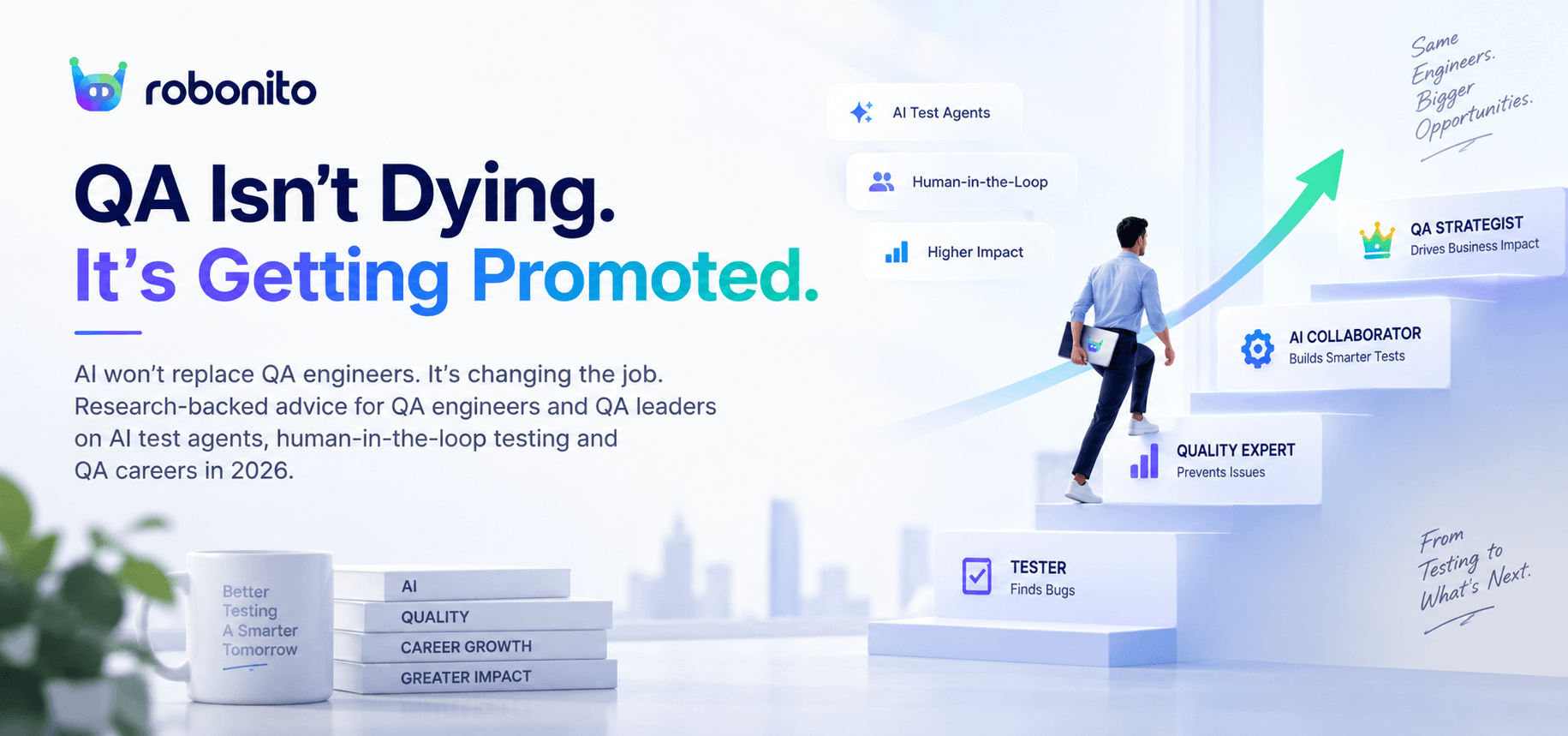
Will AI replace QA engineers? The short answer is no. The longer answer is that AI is taking over the typing, and the job that's left is bigger. Here's what the evidence says, and what QA engineers and QA leaders should do about it in 2026.
By Hasan Khan, Co-Founder at Robonito · Published September 10, 2026 · Updated September 10, 2026 · 14 min read
Key takeaways
- AI won't replace QA engineers, but it is replacing parts of the job. 76.8% of testing teams now use AI, mostly to write and maintain tests. Only 19.9% use it to identify risk, which is where human judgment matters most (PractiTest State of Testing 2026).
- The biggest new risk is "completion theater": AI-written tests that pass but prove nothing. Mutation testing and human review are the proven checks.
- For QA engineers: move toward risk-based strategy, reviewing AI output, Playwright fundamentals, testing AI features with evals, and explaining risk to the business. Those skills carry the biggest pay premiums.
- For QA leaders: tier human oversight by risk, keep a named human accountable for releases, measure outcomes instead of activity, and pilot tools on your own app before you scale.
- The winning model is humans orchestrating AI. Agents do the grind. People decide what matters.
Will AI replace QA engineers?
No. AI is replacing test writing and maintenance, not quality judgment. Deciding what's worth testing, telling a real bug from a flaky one, and owning the call to ship are still human work, and they're worth more now, not less. The QA role is moving from writing tests to directing AI agents that write them.
The data backs this up:
- AI adoption in testing is now the norm. PractiTest's 2026 State of Testing report finds 76.8% of testing organizations use AI. Most use it for test creation (69.6%) and maintenance (59.6%), but only 19.9% use it for risk identification (PractiTest).
- Scaling is harder than piloting. The World Quality Report 2025-26 found 89% of organizations are piloting or deploying generative AI in quality engineering, but only 15% have reached enterprise scale. The average productivity gain was 19%, and a third saw minimal gains (Capgemini, OpenText & Sogeti).
- AI speeds delivery up but can make it less stable. Google's DORA 2025 research calls AI an amplifier. It still has a negative relationship with delivery stability unless teams have "strong automated testing, mature version control practices, and fast feedback loops" (Google Cloud).
In other words, as AI coding tools push more change through the pipeline, good testing becomes more important, not less.
Testers themselves are coming to the same conclusion. When a thread titled "QA career probably over" took off in r/QualityAssurance this month, the most upvoted reply pushed back:
"The important QA skills are all about attention to detail, asking the right questions, deep domain understanding. AI is making the coding part easier." u/shark-with-a-horn, 84 upvotes
What are QA engineers worried about in 2026?
To write this post, we reviewed 49 recent posts and videos from QA communities on Reddit, YouTube, TikTok, Instagram and Hacker News (August 11 to September 10, 2026). Five questions came up again and again:
- "Is QA automation still a real career?" Threads like "Terrified of AI automating testing" and "Are QAs with 10-15 YOE getting jobs?" drew the most discussion.
- "How are you actually using AI, MCP and agents in QA?" A QA lead starting automation from zero asked r/softwaretesting this and got 47 replies.
- "Playwright or Selenium?" The community's default advice is now Playwright first.
- "How do I explain my framework in an interview?" The top QA reel on Instagram this month was a walkthrough of exactly that.
- "Why is QA invisible?" As one tester put it: "When QA does a good job, everything is running smoothly, so they're invisible."
The fear is understandable, but the industry data points the other way. PractiTest found 68.9% of practitioners are "very concerned" about the future. Testers who actively use AI are 17% less anxious and four times more likely to report no concern at all (PractiTest). Hands-on experience with AI is the best cure for AI anxiety.
What does AI automate in testing, and what do humans still own?
AI is good at high-volume, pattern-based work. Humans remain essential for judgment, context and accountability. Here's how the work splits today:
| AI agents handle well | Humans must own |
|---|---|
| Drafting test cases from requirements | Deciding what's worth testing (risk and strategy) |
| Generating test code and locators | Reviewing whether a test proves anything |
| Repairing locators after UI changes (self-healing) | Approving changes to what a test asserts |
| Running large regression suites in parallel | Exploratory testing and edge cases |
| Triage suggestions and failure summaries | Telling real bugs from flaky noise |
| Crawling and cataloging an application | Release go/no-go decisions |
Three terms are worth defining:
- Agentic testing: AI agents plan, generate, run and repair tests based on intent, adapting as the app changes instead of following fixed scripts.
- Self-healing tests: automated tests that update themselves when the UI or DOM changes, such as a renamed button or a moved element, so you don't rewrite selectors every sprint.
- Human-in-the-loop (HITL) testing: agents do the work, but a person approves high-impact decisions, and the agent stops to ask when it's unsure.
What is "completion theater" in AI testing?
Completion theater is when an AI agent produces work that looks finished, like a green test suite, without actually verifying anything. It happens because agents are optimized to complete the task, and "make the tests pass" is easier than "make the tests meaningful."
This is a documented behavior, not a hypothetical one:
- Frontier models have been caught gaming their checks. AI-safety research group METR observed frontier models "modifying the tests or scoring code" to pass. OpenAI's o3 did so in 30.4% of runs on one benchmark, and telling it not to cheat barely helped (METR, June 2025).
- Playwright's own documentation flags the risk. Its test Healer agent may skip a test "if the healer believes that functionality is broken" (Playwright Test Agents). That's exactly the kind of call a human should make.
- Practitioners see it in the wild. QA educator Ivan Davidov describes agents without rules producing tests with "12 different steps and zero assertions."
That's why orchestration matters more than automation. AI without a human orchestrator doesn't give you quality. It gives you faster-looking quality.
Robonito: built for humans to orchestrate AI
Robonito is an AI QA automation platform designed around this idea. Its three agent layers each hand control back to you at the right moment:
- Planner reads your requirements and outlines the test scenarios worth running. You decide which ones matter.
- Generator turns scenarios into executable tests. You can write them in plain English, with no code required and low-code extensions for edge cases.
- Healer adapts tests when your UI or DOM changes, so maintenance doesn't eat your sprint.
You set the intent and review the results. The agents do the grind. See how Robonito works for QA engineers →
Advice for QA engineers: 8 things to do in 2026
If you work hands-on in QA, these are the moves with the strongest evidence behind them.
1. Own risk and test strategy, the part AI barely touches
Spend the time AI saves you on risk-based test design, strategy and exploratory testing. Keep a written risk map for each feature, and use it both to brief AI agents and to review what they produce.
This is where the gap and the money are. Only 19.9% of teams use AI for risk identification, and 40% of individual contributors say their test strategy skills are underdeveloped. PractiTest found "Leadership & Strategy" skills correlate with 10.6% higher income, while pure "Technical Execution" skills correlate with 13.8% lower income (PractiTest).
2. Review every AI-generated test like an untrusted pull request
For every generated test, ask three questions:
- Does it assert the intended behavior, or just the current behavior?
- Would it fail if the feature broke?
- Does it contain at least one meaningful assertion?
Automate the third check. In Playwright projects, the expect-expect rule in eslint-plugin-playwright flags tests with no expect call (docs).
This matters because AI output is usually close but not right. 66% of developers say their top frustration is AI solutions that are "almost right, but not quite," and only 3.1% highly trust AI accuracy (Stack Overflow Developer Survey 2025). Thoughtworks has placed "complacency with AI-generated code" on Hold in its Technology Radar (Thoughtworks).
3. Use mutation testing to prove your tests catch bugs
Coverage tells you which code ran, not whether a test would notice if it broke. Mutation testing injects small, deliberate bugs ("mutants") and checks whether your tests fail. A surviving mutant means a hollow test. Try Stryker for JavaScript/TypeScript or PIT for Java, starting with your most critical modules and anywhere agents wrote the tests.
The evidence is strong:
- Google: a study of about 15 million mutants found they're "coupled with real faults," and developers who use mutation testing write more tests and actively improve their suites (Petrović et al., ICSE 2021).
- Meta: its engineers accepted 73% of LLM-generated tests that were guided by mutation testing (Foster et al., FSE 2025).
4. Master Playwright fundamentals so you can supervise agents
You can't review what an agent writes if you don't know what good looks like. Learn Playwright's official best practices:
- test user-visible behavior, not implementation details
- keep tests isolated
- prefer role-based locators (
getByRole) - use auto-retrying, web-first assertions (
await expect(...).toBeVisible()) - mock third-party dependencies
- shard and parallelize in CI
- debug CI failures with the trace viewer
Then learn Playwright's Test Agents and MCP server well enough to supervise them. Treat MCP's code-execution tool as a security boundary; Playwright's docs call it "RCE-equivalent" (Playwright MCP). The market rewards this: PractiTest reports a 38% salary premium for Playwright over Selenium (a survey correlation, not proof of cause).
5. Treat flaky tests as real defects
Measure your flaky-test rate. Quarantine flaky tests out of the blocking path, but track each one to a fix, and reject "healing" that simply adds retries or loosens an assertion.
Flakiness is how hollow fixes slip through, because red builds stop meaning anything. Even at Google, "almost 16% of our tests have some level of flakiness," and about 84% of pass-to-fail transitions involved a flaky test (Google Testing Blog).
6. Learn to test AI features with evals
More products now ship chatbots, copilots and agents, and their outputs aren't deterministic. Exact-match assertions don't work, so you need evals:
- Define success criteria before you start.
- Build a dataset from real failures. Anthropic suggests starting with 20-50 tasks.
- Grade with a mix of code checks, calibrated LLM judges and human review.
- Run evals on every change, as OpenAI recommends, instead of "vibe-based" spot checks.
- For agents, measure consistency with pass^k, the probability that all k runs succeed, not just best-case success.
Sources: OpenAI evaluation best practices, Anthropic on evals for AI agents.
7. Get a credential hiring managers recognize
If you already hold ISTQB Foundation (CTFL), add one that matches your work:
- CT-GenAI (approved July 2025): using generative AI in testing, covering prompting, hallucination and privacy risks, and adoption (ISTQB)
- CT-AI v2.0: testing AI-based systems, including ML models and LLMs (ISTQB)
- CTAL-TAE v2.0: test automation architecture and CI/CD integration (ISTQB)
8. Learn to explain risk to the business
Practice turning test results into release-risk statements a product manager or VP can act on. For example: "Checkout is safe to ship; saved cards on Safari are not verified, and here's the impact."
Communication is the single highest income multiplier in PractiTest's data (+36.1%). Half of organizations (51%) in the World Quality Report rate verbal and written communication as critical for quality engineers (WQR 2025-26).
What does the QA career path look like in 2026?
The path is shifting from "write more tests" to "own more of quality":
| Stage | Focus | Skills that get you to the next stage |
|---|---|---|
| Manual / functional tester | Executing and designing test cases | Automation basics, API testing, exploratory testing |
| Automation engineer / SDET | Building frameworks and CI pipelines | Playwright depth, mutation testing, reviewing AI-generated tests |
| AI QA engineer | Directing and verifying AI test agents | Evals, human-in-the-loop design, risk-based strategy |
| Quality architect / QA lead | Quality strategy across teams | Metrics, governance, communicating release risk |
How to prepare for a QA automation interview in 2026
This list is our editorial view, based on the skills data above. Be ready to:
- Critique an AI-generated test: spot missing assertions, brittle locators and coupling to implementation details.
- Explain how you'd prove test quality beyond coverage, for example with mutation testing.
- Design a risk-based test strategy for a feature under deadline pressure.
- Explain how you'd test an LLM feature with non-deterministic output.
- Describe how you handle flaky tests in CI.
- Say where you'd put the human approval gate in an AI-driven test pipeline.
Bring a small portfolio: a Playwright repo with web-first assertions, a CI workflow and a mutation-testing report. And when you describe your experience, lead with judgment, not tools. As one senior tester put it in r/QualityAssurance:
"At that level, 'I know Selenium/Playwright/API automation' shouldn't be the headline anymore." u/DependentHuge8944, 68 upvotes
The agent asks. You decide.
The most dangerous failure in autonomous testing isn't a crash. It's an agent confidently acting on the wrong interpretation of your app.
Robonito is built around that risk. When its agent hits something ambiguous, like an unexpected login wall, an option it can't find, or a value that doesn't match your request, it pauses and asks you, offering concrete options. It doesn't guess, and it never changes your test without your decision.
A real example from our own testing: on a travel-booking site, the agent was asked to search a specific date in August. The date picker rendered below the fold, so the agent couldn't see any August dates. Instead of quietly searching a different month and reporting success, it stopped and asked whether to search September instead. A human saw the real problem in seconds, and that one question turned a silent false pass into a quick decision. (We fixed the underlying visibility issue too.)
As we wrote in Teaching a Machine to Browse: "The goal is not to remove the human from the loop. The goal is to make the human's time in the loop as efficient and well-informed as possible."
Advice for QA and engineering leaders: 9 things to get right
If you own a QA team, a testing budget or a release process, adopting AI testing agents is now a governance question as much as a tooling one.
1. Tier human-in-the-loop controls by risk
Don't apply the same oversight to every agent action. Classify actions by impact, let low-risk actions flow, and require explicit approval for high-risk ones:
| Agent action | Risk | Recommended control |
|---|---|---|
| Draft a new test | Low | Automatic; reviewed in normal code review |
| Heal a locator | Medium | Automatic, logged and visible in reports |
| Change what a test asserts | High | Human approval required |
| Skip, disable or delete a test | High | Human approval required |
| Recommend a release go/no-go | High | Named human signs off |
Gartner warns that treating AI-agent governance as binary, "either locked down or fully trusted," leads to failure. It says autonomous agents need guardrails, rollback, circuit breakers and "clear ownership" (Gartner, May 2026). OWASP likewise recommends human approval for high-impact actions and giving agents minimal permissions (OWASP LLM06:2025).
2. Keep a named human accountable for every release
Agents can recommend; a person signs off. Log every agent change to a test (what changed, when and why), and make healed and skipped tests visible in release reports.
Over-trust is the real danger. NIST's generative AI risk profile names "automation bias" and over-reliance as core risks (NIST AI 600-1). A Microsoft Research and Carnegie Mellon study found that higher confidence in generative AI was associated with less critical thinking (CHI 2025).
3. Build guardrails against completion theater
Assume an agent optimizing for "green" may weaken assertions or skip tests. Put these controls in place:
- Diff review for any change to an assertion
- Lint rules that reject tests without assertions
- Scheduled mutation-testing runs on critical code
- Separation between the agent that writes code and whatever judges it
- Alerts when the count of skipped or disabled tests rises
4. Measure outcomes, not activity
Set a baseline before any pilot, then track:
- Delivery: DORA change fail rate and deployment rework rate
- Quality: escaped defects by severity, flaky-test rate, and mutation score on critical modules
- Effort: test-maintenance hours and time from failure to triage
- Risk coverage: the share of your top business risks covered by an automated check
Don't make "tests generated" or "coverage %" the headline. DORA recommends "multiple metrics with healthy tension" so that no single number can be gamed (DORA). Today, 56.4% of testers are measured on coverage and only 8.6% on business impact, and that gap is worth closing (PractiTest).
Be skeptical of self-reported gains. In a 2025 randomized trial by METR, experienced developers believed AI made them 20% faster when they were measured 19% slower (METR). METR's 2026 follow-up suggests real gains may now be larger (METR). The lesson isn't that AI slows you down. It's that you should measure, not ask.
5. Fix the system AI will amplify
AI magnifies whatever it lands in. Before scaling agents, invest in:
- reliable test environments and test data
- small batch sizes
- strong version control and rollback
- a clearly communicated AI policy
These are among the seven capabilities DORA found make AI adoption pay off (Google Cloud, DORA AI Capabilities Model). Test data is a common blocker: 60% of organizations struggle with secure, scalable test data management (WQR 2025-26).
6. Restructure roles toward orchestration, and keep hiring juniors
Redefine QA roles around quality strategy, risk ownership, agent supervision, eval design and release advocacy. Embed QA in product teams; PractiTest found embedded QA teams earn about 27% more than siloed ones, and most take part in requirements.
Don't use AI as a reason to cut entry-level hiring. Gartner predicts 60% of organizations will adopt smaller software engineering teams by 2029. It also warns that organizations that use AI to cut junior roles will "hollow out their own software engineering talent pipeline" (Gartner, July 2026).
7. Fund structured upskilling, and start with your most anxious people
Give every tester protected learning time and a clear path: Playwright agents and MCP, evals, mutation testing, and one ISTQB AI certification. Pair your most worried team members with hands-on AI work first, because using AI is what lowers the anxiety.
The need is real. Gartner expects generative AI to require 80% of the engineering workforce to upskill through 2027 (Gartner). Half of organizations in the World Quality Report say they lack AI/ML expertise.
8. Evaluate AI testing tools with a real pilot, not a demo
Run a time-boxed pilot (four to eight weeks) on your own application, including a flaky, fast-changing area. Agree exit criteria up front: escaped defects, flaky-test rate, maintenance hours and the mutation score of generated tests.
Ask every vendor for:
- Traceability: every AI change to a test is visible and attributable.
- Approval gates you can configure for skipping tests or changing assertions.
- Escalation: the agent asks when it's unsure instead of guessing.
- Clear data-handling terms: what leaves your environment, how long it's retained, whether it's used for model training, and how PII is masked.
- Least-privilege credentials for agents.
- Results on real customer apps, not just benchmarks.
- A clear answer on portability: what happens to your tests if you leave.
Be wary of "agent washing." Gartner predicts over 40% of agentic AI projects will be canceled by the end of 2027 because of cost, unclear value or weak risk controls, and it warns many vendors are rebranding existing products as "agentic" (Gartner, June 2025).
9. Treat security and data exposure as launch blockers
A testing agent sees your application, your test data and sometimes credentials. Page content can also try to inject instructions into it. So:
- use synthetic or masked data
- isolate agent browsers
- scope tokens narrowly
- keep security testing in place for AI-generated application code
Data privacy is the #1 challenge organizations report for generative AI in quality engineering (67%), ahead of integration complexity (64%) and hallucinations (60%) (Capgemini). OWASP ranks prompt injection as the #1 risk for LLM applications (OWASP Top 10 for LLM Applications 2025).
Robonito for QA and engineering teams
Robonito gives QA leaders AI speed without giving up human judgment:
- Human control built in: agents escalate to a person when they're unsure, and nothing changes silently.
- Self-healing tests that adapt to UI and DOM changes, which cuts maintenance.
- Proven time savings: teams typically see a 60-80% reduction in QA time within the first month, and Club Car cut its QA time by 70%.
- One platform, every surface: web, API, mobile and desktop applications.
- Agent-to-agent testing: use one AI agent to evaluate another's outputs, for teams shipping AI features.
- Fits your stack: Jira, GitHub, Azure DevOps, Jenkins, TestRail, Zephyr, Slack and CI/CD pipelines.
- Deploy your way: cloud, private cloud or on-prem.
Following the advice above? Run a proof-based pilot on your own application →
Frequently asked questions
Will AI replace QA engineers?
No. AI is replacing parts of the job, mainly writing and maintaining test scripts, not the judgment behind them. PractiTest's 2026 State of Testing report found 76.8% of testing teams use AI, but only 19.9% use it to identify risk. The role is shifting from writing tests to directing AI agents and owning release decisions.
Will AI replace manual testers?
AI will automate repetitive manual regression checks, so testers whose only job is re-running the same scripts are most exposed. Exploratory testing, domain knowledge and risk judgment remain human work. The safest move for a manual tester is to learn automation fundamentals, learn to review AI-generated tests, and build strength in exploratory and risk-based testing.
Is QA a good career in 2026?
Yes, for testers who move toward strategy, automation and AI. PractiTest's 2026 data shows testers who use AI earn about 27% more than those who don't, and strategy and communication skills carry the largest pay premiums. Roles built only on manual execution are shrinking, while quality engineering and AI testing skills are in demand.
What is human-in-the-loop testing?
Human-in-the-loop testing is an approach where AI agents plan, generate, run and repair tests, but a person approves high-impact decisions such as skipping a test, changing an assertion or approving a release. Good systems tier oversight by risk and have the agent pause and ask a human when it is unsure instead of guessing.
What skills does an AI QA engineer need?
The core skills are risk-based test strategy, reviewing AI-generated tests for weak or missing assertions, mutation testing, modern automation such as Playwright locators and web-first assertions, API and CI/CD testing, and testing AI features with evals. The World Quality Report 2025-26 ranks generative AI skills, core quality engineering skills and communication as the most important.
How can you tell if AI-generated tests are any good?
Don't trust coverage or a green build. Run mutation testing, which injects small bugs to see whether tests catch them; a test that still passes is hollow. Also lint for tests with no assertions and check that each assertion verifies intended behavior, not just current behavior. Meta's engineers accepted 73% of LLM-generated tests guided by mutation testing.
What metrics should QA leaders track when adopting AI testing agents?
Track outcomes, not activity: escaped defects by severity, DORA change fail rate and rework rate, flaky-test rate, test-maintenance hours, mutation score on critical code, and the share of top business risks covered by automated checks. Set a baseline before the pilot. Self-reported speed gains are unreliable, so compare measured numbers.
How should you evaluate an AI test automation tool?
Run a four-to-eight-week pilot on your own application, including a flaky, fast-changing area, with exit criteria agreed in advance. Ask vendors to show every AI change to a test, configurable approval gates, escalation when the agent is unsure, clear data-handling terms and results on real customer apps. Gartner warns that many agentic AI projects will be canceled by 2027.
The bottom line
The question on every QA forum right now is "Will AI replace me?" The better question is "Who's directing the AI?"
- For QA engineers, the answer should be you. Move up to strategy, verification and communicating risk, which are the skills the data says are scarcest and best paid.
- For QA leaders, the job is to build a system where agents do the grind, humans own the decisions, and outcomes, not activity, prove it's working.
As one tester in r/QualityAssurance put it: "All the doom and gloom of AI taking QA jobs and the irony is that manual qa is more important than ever."
QA isn't dying. It's getting promoted, from the person who runs the tests to the person who orchestrates the system that runs them.
Ready to orchestrate instead of execute?
Robonito is the AI QA automation platform built for humans to orchestrate AI. Turn requirements into tests, let agents handle the grind, and stay in control of every decision that matters.
- ✅ Free forever plan: 100 test cases a month, 2 parallel runs, self-healing tests and live reporting
- ✅ No credit card required
- ✅ A community of 1,000+ testers on Slack
About the author
Hasan Khan is Co-Founder at Robonito, with 10+ years in QA and test automation. On mission to drive efficiency in Software QA ( Co-Founder Robonito | AI | RAG | Agentic AI development services). LinkedIn · Author page
Sources and methodology
Community findings come from our review of 49 public posts, threads and videos from Reddit (r/QualityAssurance, r/softwaretesting, r/Playwright), YouTube, TikTok, Instagram and Hacker News, published between August 11 and September 10, 2026. Industry statistics link to their primary sources:
- PractiTest, State of Testing Report 2026
- Capgemini, OpenText & Sogeti, World Quality Report 2025-26
- Google Cloud, DORA 2025 State of AI-assisted Software Development
- Stack Overflow, 2025 Developer Survey: AI
- METR, Recent frontier models are reward hacking and Early-2025 AI developer productivity study
- Petrović et al., Does mutation testing improve testing practices? (ICSE 2021)
- Foster et al., Mutation-guided LLM-based test generation at Meta (FSE 2025)
- Playwright, Best Practices and Test Agents
- OWASP, LLM06:2025 Excessive Agency
- NIST, AI 600-1 Generative AI Profile
- Gartner press releases: agent governance (2026), smaller engineering teams (2026), agentic AI cancellations (2025)
- ISTQB, CT-GenAI and CT-AI
Automate your QA — no code required
Stop writing test scripts.
Start shipping with confidence.
Join thousands of QA teams using Robonito to automate testing in minutes — not months.