
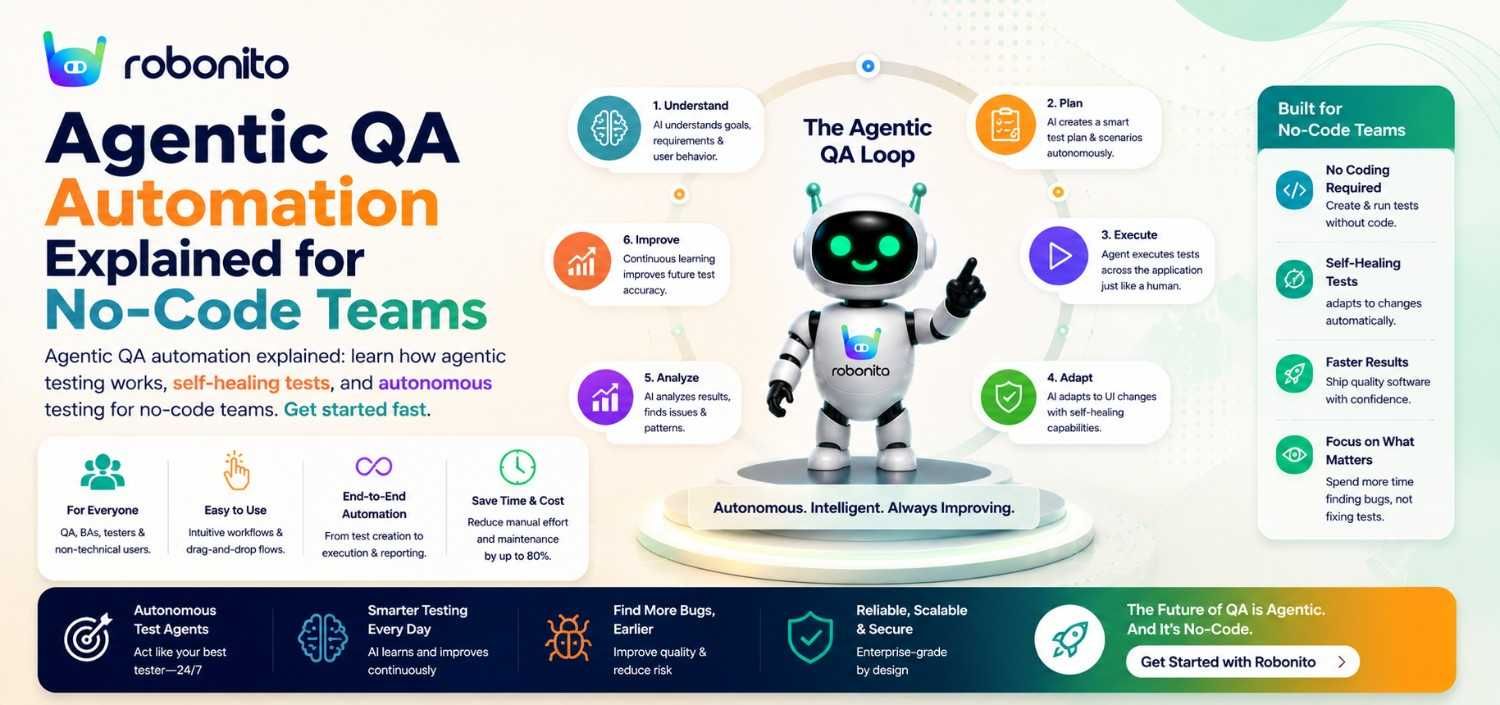
The term "agentic" has become the hottest buzzword in software testing circles this year — and for good reason. As AI models grow more capable, the promise of tests that don't just run but actually think, adapt, and make decisions on their own is shifting from science fiction to production reality. But here's the problem: most of the conversation around agentic QA automation is being shaped by enterprise vendors pitching complex, engineering-heavy solutions that look impressive in demos and collect dust in practice. If you're a QA leader running a no-code testing team, you're right to wonder — does any of this actually apply to me? The answer is yes. In fact, your team may be closer to true agentic testing than you think. This post breaks down what agentic QA automation really means, separates the substance from the hype, and shows you why no-code teams aren't just participants in this shift — they're leading it.
What Is Agentic Automation in QA Testing?
At its core, agentic automation refers to AI systems that can operate with a degree of autonomy — perceiving their environment, making decisions, and taking actions to achieve a goal without step-by-step human instruction. In QA testing, this translates to test agents that can do things like:
- Explore an application and identify testable flows without being explicitly told what to test
- Adapt to changes in the UI without failing or requiring manual updates
- Make judgment calls, such as determining whether a visual change is a bug or an intentional design update
- Chain together actions across multiple steps to complete complex end-to-end scenarios
Think of it this way. A traditional automated test is like a GPS route with every turn hardcoded. If a road is closed, it breaks. An agentic test is more like a driver who knows the destination, understands traffic patterns, and reroutes on the fly.
For example, imagine your team has a checkout flow test. A traditional test clicks a specific button with ID #submit-order-btn. If a developer changes that ID to #place-order-btn, the test fails. An agentic test, however, understands the intent — "click the button that submits the order" — and finds the right element regardless of what it's called in the DOM.
This isn't theoretical. Agentic testing explained in practical terms simply means: tests that understand what you want to verify and figure out how to do it themselves.
The important distinction is between AI that assists (autocomplete, suggestion engines) and AI that acts. AgenticAgentic systems don't simply execute instructions—they interpret goals, make decisions within defined boundaries, adapt to changing conditions, and continuously improve through feedback. They don't wait for you to fix a broken selector — they fix it, log the change, and keep running.
Industry analysts are also seeing this transition. According to DORA's 2025 State of DevOps research, teams with stable, trustworthy automated test suites deploy 2.4× more frequently than those with high flakiness rates — a direct measure of what agentic QA stability enables. For QA teams, the conversation is moving beyond simple automation toward intelligent systems that can reason, adapt, and continuously improve.
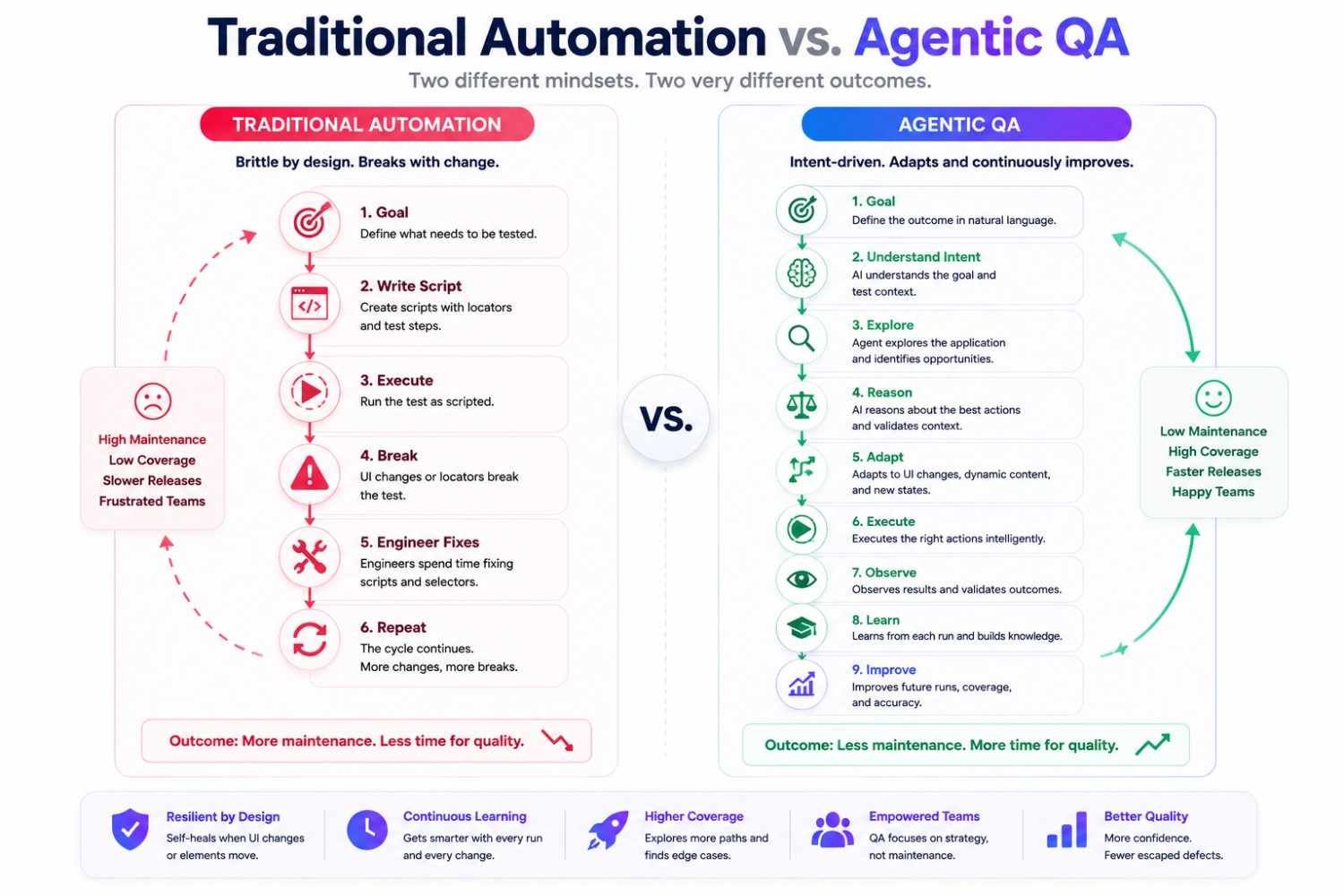
How Agentic QA Differs from Traditional Test Automation
To understand why agentic QA matters, it helps to see exactly where traditional automation falls short — and where agentic approaches pick up the slack.
Traditional test automation operates on a rigid script model. You define every step, every locator, every assertion. Tools like Selenium, Cypress, and Playwright give you enormous power and flexibility, but they demand engineering expertise and constant maintenance. When your app changes — and it always changes — your tests break. Capgemini World Quality Report 2025 studies consistently show that QA teams spend 30–40% of their time on test maintenance alone, not on finding actual bugs.
Agentic QA automation flips this model. Instead of brittle scripts, you get intelligent agents that:
| Dimension | Traditional Automation | Agentic Automation |
|---|---|---|
| Test creation | Write code or record exact steps | Describe intent in natural language |
| Element identification | CSS selectors, XPath | Visual + semantic understanding |
| Handling UI changes | Tests break; manual fix needed | Self-heals automatically |
| Test coverage decisions | Humans decide what to test | Agent suggests and generates tests |
| Maintenance burden | High and ongoing | Minimal — agent adapts |
Here's a real-world scenario. A fintech company we've spoken with had 1,200 Selenium tests. After a front-end migration from Angular to React, over 60% of those tests broke overnight. Their QA team spent three full sprints — six weeks — rewriting tests instead of testing new features. With an agentic approach, the vast majority of those tests would have self-healed, because the agent understands application behavior, not just DOM structure.
It's also worth addressing the distinction between autonomous testing vs agentic testing. Autonomous testing typically refers to tests that run without human intervention — scheduled, CI-triggered, headless. That's table stakes in 2026. Agentic testing goes further: the tests themselves have agency. They make decisions during execution, adapt to unexpected states, and can even generate new test scenarios based on observed application behavior. Autonomy is about when tests run. Agency is about how they think.
traditional vs AI-powered test automation comparison
// ─── Traditional automation: bound to implementation ─────────────────
// Test step: "click the order submission button"

// What gets written:
driver.findElement(By.cssSelector("#checkout-form .submit-btn")).click();

// What happens when developer refactors:
// ##checkout-form renamed → .order-form
// .submit-btn renamed → .btn-primary
// Result: NoSuchElementException → test fails → engineer called
// Fix time: 10-15 minutes per broken element × N tests affected

// ─── Agentic no-code: bound to intent ────────────────────────────────
// Test step: "click the button that submits the order"

// What the agent evaluates at runtime:
// Signal 1: Is there a button? (ARIA role)      confidence: 1.00
// Signal 2: Does it say "submit" or "place"?     confidence: 0.94
// Signal 3: Is it the primary action on the form? confidence: 0.91
// Signal 4: Is it near the order summary?        confidence: 0.89

// Combined confidence: 0.93 → above threshold → executes correctly
// When developer refactors: same signals match → test continues
// Fix time: 0 minutes

// ─── The key architectural difference ───────────────────────────────
// Traditional: test describes HOW to reach the goal (specific DOM path)
// Agentic: test describes WHAT the goal is (intent to be achieved)
// The HOW is handled by the AI — and AI can reroute when roads close
Why No-Code Teams Are Best Positioned for Agentic Testing
Here's the counterintuitive truth that most enterprise vendors won't tell you: no-code teams are naturally closer to agentic QA than code-heavy teams are.
Why? Because no-code testing has always been about expressing intent rather than implementation. When a no-code tester creates a test that says "log in as admin, navigate to the dashboard, and verify the revenue chart is visible," they're already thinking in the language that agentic systems understand. They're not tangled up in driver.findElement(By.xpath("//div[@class='chart-container']")). They're describing what the application should do in human terms.
Code-based teams, by contrast, face a harder transition. Their entire test architecture is built on explicit instructions and precise locators. Moving to agentic behavior means rearchitecting not just tools but mindsets — and that takes time, budget, and organizational buy-in.
Consider this scenario. A mid-sized SaaS company has a QA team of four — none of them write code. They use a no-code platform to create and maintain 300 tests across their web application. When agentic capabilities become available in their tool, adoption is seamless. The tests already express intent. The AI layer simply adds intelligence underneath: self-healing locators, smart waits, automatic retries with context, and even suggested new test cases based on recent deployments.
Now compare that with an enterprise team running 5,000 Playwright tests. To adopt agentic capabilities, they need to refactor test architecture, integrate new AI SDKs, Playwright documentation, retrain engineers, and manage a months-long migration. The ROI is real but the time-to-value is measured in quarters, not days.
No-code agentic QA isn't a compromise. It's the most direct path to agentic testing because the abstraction layer is already in place. You don't need to translate from code to intent — you started with intent.
why no-code QA teams ship faster
Self-Healing Tests: The Foundation of Agentic QA
If agentic QA is a building, self-healing tests are the foundation. Without them, everything else — autonomous test generation, intelligent exploration, adaptive assertions — crumbles the moment your UI changes.
Self-healing tests use AI to automatically detect when a locator strategy fails and find the correct element using alternative signals: visual appearance, surrounding context, element role, text content, position on the page, and historical patterns. Instead of a hard failure and a Jira ticket, you get a successful test run and a logged note: "Element locator updated from #old-id to #new-id — test continued."
Here's why this matters in numbers. A typical web application undergoes UI changes in 20–30% of its pages per sprint. If you have 500 tests and 25% of them reference elements on changed pages, that's 125 potentially broken tests every two weeks. At an average of 15 minutes to diagnose and fix each broken test, you're looking at over 31 hours of maintenance per sprint — nearly an entire work week consumed by keeping tests alive, not improving them.
Self-healing eliminates the majority of this burden. Not all of it — there are still legitimate failures that need human judgment — but the noise reduction is dramatic. Teams using self-healing capabilities consistently report 60–80% reductions in test maintenance time.
A practical example: an e-commerce team runs nightly regression tests on their product catalog. The front-end team ships a redesign of the product card component — new class names, restructured HTML, updated button labels. Without self-healing, the QA team arrives Monday morning to a wall of red. With self-healing, the tests ran green, and the QA team sees a clean summary: "12 element locators were automatically updated across 8 tests. All assertions passed."
That's not just convenience. That's the difference between a QA team that's reactive and one that's proactive — catching real bugs instead of chasing phantom failures.
how self-healing tests work in Robonito
What QA Leaders Should Actually Look for in an Agentic Tool
The market for AI QA automation in 2026 is crowded and noisy. Every vendor claims to be "agentic." Here's a practical framework for evaluating whether a tool delivers genuine agentic capability or is just wrapping basic automation in AI marketing.
1. Does it understand intent, or just replay actions?
Ask the vendor: "If I change a button's label from 'Submit' to 'Place Order,' does the test still pass?" If the answer involves manual updates, it's not agentic. A truly agentic tool interprets the purpose of each step and finds the right path dynamically.
2. Can non-engineers create and maintain tests independently?
Agentic QA should reduce your dependency on engineering resources, not increase it. If the tool requires developers to configure AI models, write custom selectors as fallbacks, or manage complex YAML configurations, it's agentic in theory but traditional in practice.
3. Does it learn and improve over time?
A genuine agentic test automation tool should get smarter with use. It should learn which elements are stable, which are volatile, and which test patterns correlate with real defects. Ask for specific examples of how the tool's AI improves with usage data.
4. How does it handle unexpected application states?
Applications don't always behave predictably. Modals pop up. Loading spinners hang. Session tokens expire. An agentic tool should handle these gracefully — dismissing unexpected dialogs, waiting intelligently for content to load, and recovering from transient errors without human intervention.
5. What's the actual time-to-value?
If onboarding takes weeks and requires dedicated implementation engineers, the tool is optimizing for the vendor's services revenue, not your team's productivity. The best agentic test automation tools get teams productive in hours.
A helpful litmus test: ask your least technical QA team member to create a test using the tool. If they can do it confidently in their first session, you're looking at a real no-code agentic QA solution.
How Robonito Delivers Agentic Automation Without a Single Line of Code
Robonito was built on the principle that powerful QA automation shouldn't require a computer science degree. And as the industry moves toward agentic testing, that principle becomes more important than ever — because agentic QA only delivers value when it's accessible to the people who understand your application best: your QA team.
Here's how Robonito makes agentic automation practical and immediate:
Natural language test creation. You describe what your test should do in plain English. "Go to the login page, enter valid credentials, click sign in, and verify the dashboard loads with the user's name displayed." Robonito's AI translates this into a robust, executable test — no selectors, no scripting, no configuration files.
Self-healing at every layer. Robonito doesn't rely on a single locator strategy. It uses a multi-signal approach — visual recognition, semantic analysis, DOM structure, and historical patterns — to find the right element every time. When your developers rename a CSS class or restructure a component, your tests keep running.
Works on any web application out of the box. You don't need to install SDKs, add test attributes to your source code, or configure browser drivers. Point Robonito at your application, and it works. This is critical for teams testing third-party integrations, legacy applications, or platforms where you don't control the codebase.
CI/CD integration that takes minutes. Robonito plugs into all major CI/CD pipelines — GitHub Actions, GitLab CI, Jenkins, CircleCI, Azure DevOps — so your agentic tests run automatically on every deployment. No custom scripting. No fragile webhook configurations.
Transparent AI decisions. When Robonito self-heals a test or makes an adaptive decision, it logs exactly what changed and why. Your team always has full visibility into what the AI did, so you maintain confidence in your test results.
A concrete example: a B2B SaaS company with a 15-person product team and 2 dedicated QA engineers used Robonito to build 200 end-to-end tests in their first month. Over the next quarter, their application underwent a significant front-end redesign. Of those 200 tests, 174 self-healed automatically. The QA team spent less than a day updating the remaining 26, which involved genuinely changed functionality that required new assertions. Total maintenance time for the quarter: approximately 8 hours. Their previous Selenium suite would have required an estimated 3-4 weeks of rework.
That's what agentic QA looks like when it's built for real teams, not analyst demos.
When Agentic QA Is Not the Right Choice
Agentic QA isn't the right fit for every scenario.
Traditional scripted automation may still be preferable when:
- Regulatory requirements mandate completely fixed execution paths
- Legacy desktop applications expose very limited UI metadata
- Teams need highly customized code-level assertions
- Specialized hardware testing requires proprietary SDKs
For most modern web and SaaS applications, however, agentic testing significantly reduces maintenance while improving release confidence.
Frequently Asked Questions
What is agentic QA automation?
Agentic QA automation refers to AI testing systems that operate with genuine autonomy — perceiving the application, making decisions, and adapting to achieve a testing goal without step-by-step human instruction. Unlike traditional automation, which replays a fixed script and fails when anything changes, agentic tests understand the intent behind each step ("click the button that submits the order") and figure out the current path to accomplish it independently. Key capabilities include self-healing element identification, intelligent handling of unexpected application states (modals, loading spinners, session expiry), and the ability to suggest or generate new test scenarios based on observed application behaviour.
How is agentic testing different from autonomous testing?
Autonomy describes when tests run — scheduled, CI-triggered, and headless without requiring a human to press a button. That is standard in modern CI/CD and is not what "agentic" means. Agency describes how tests think during execution — whether they can make decisions, adapt to unexpected states, and pursue a goal dynamically rather than following a rigid script. An autonomous test runs without human intervention. An agentic test reasons without human instruction. A well-designed no-code agentic testing platform provides both: tests run automatically in CI and adapt intelligently when the application changes.
Are no-code QA teams better positioned for agentic testing than engineering-heavy teams?
Yes, for a specific reason. No-code testing has always been built around expressing intent ("log in as admin and verify the dashboard loads") rather than implementation ("find element by CSS selector, click, wait for network idle, assert text content"). Agentic AI operates in exactly that same intent-based language. No-code QA teams do not need to rearchitect their test logic to adopt agentic capabilities — the abstraction layer is already in place. Engineering-heavy teams with thousands of selector-based Playwright or Selenium tests face a harder transition because their entire test architecture is built on explicit instructions that must be refactored before agentic AI can operate beneath them.
What should QA leaders look for when evaluating agentic testing tools?
Five criteria reliably separate genuine agentic capability from AI marketing: first, the tool must understand intent rather than replay actions — if changing a button label breaks a test, it is not agentic. Second, non-engineers must be able to create and maintain tests independently without developer support. Third, the tool should learn and improve over time — identifying which elements are stable and which are volatile based on usage patterns. Fourth, it must handle unexpected application states (modals, timeouts, session expiry) gracefully without human intervention. Fifth, time-to-value should be hours, not weeks — if onboarding requires implementation engineers, the tool optimises for vendor revenue, not team productivity. A reliable test: ask your least technical QA team member to create their first test. If they succeed independently in their first session, the tool is genuinely accessible.
How long does it take to get started with agentic no-code testing?
A QA team can create their first agentic test in under ten minutes without engineering support. The practical sequence: sign up and access the platform (two minutes), enter the application URL (no source code access or SDK installation required), describe the first test in plain language such as "log in with valid credentials and verify the dashboard loads" (three minutes), run the test and review step-by-step results with screenshots (two minutes), and confirm self-healing by making a small UI change and re-running (two minutes). The larger investment — integrating with CI/CD, migrating existing test cases, and building comprehensive coverage — typically takes one to three working days with platform support, not weeks of implementation engagement.
Getting Started: Your First Agentic Test in Under 10 Minutes
If you've read this far and you're wondering whether agentic QA automation is something your team can start using today — not next quarter, not after a proof-of-concept engagement — here's a straightforward path.
Step 1: Sign up for Robonito's free trial (2 minutes). No credit card, no sales call required. You'll have access to the full platform immediately.
Step 2: Enter your application URL (30 seconds). Robonito doesn't need access to your source code, your repository, or your CI pipeline to get started. Just your app's URL.
Step 3: Create your first test in natural language (3 minutes). Describe a critical user flow. Start with something you test frequently — login, checkout, form submission, data export. Write it the way you'd explain it to a new team member.
Step 4: Run the test and review results (2 minutes). Robonito executes the test, generates a step-by-step report with screenshots, and highlights any failures with clear context.
Step 5: Make a small UI change and re-run (2 minutes). This is the moment you'll see the agentic difference. Change a button label, move an element, update a class name. Run the test again. Watch it pass.
That's it. Five steps, under ten minutes, and you've experienced what agentic QA actually feels like in practice — not in a pitch deck.
For teams that want to go deeper, Robonito's onboarding support can help you map your existing test cases, prioritize critical flows, and integrate with your CI/CD pipeline — typically within a single working day.
The agentic QA revolution isn't coming. It's here. But the winners won't be the teams with the most complex infrastructure or the biggest automation engineering budgets. They'll be the teams that move fastest — the ones that put agentic capabilities in the hands of the people who actually know what quality looks like.
Your QA team doesn't need to learn Python to benefit from AI. They just need the right tool.
Start your free Robonito trial today → and Build your first self-healing, agentic test in under 10 minutes—and spend more time improving quality instead of maintaining automation.
Automate your QA — no code required
Stop writing test scripts.
Start shipping with confidence.
Join thousands of QA teams using Robonito to automate testing in minutes — not months.