01The organization
Think of a logistics provider running 15 warehouses for e-commerce and wholesale clients. Clients send orders through APIs, warehouse staff receive, pick and pack with an Android handheld app, clients track stock in a portal, and storage and handling charges are billed in Oracle Cloud.
Each system is tested on its own, so most defects appear at the joins: an order that never reaches the handheld, or a charge billed at last year's rate.
Logistics runs on hand-offs: from client to warehouse, from warehouse to carrier, from operations to billing. Each system usually has an owner and its own tests. The hand-offs between them usually have neither, and that is where most incidents start.
02Business objectives
- Test a shipment end to end across APIs, the handheld app, the portal and billing
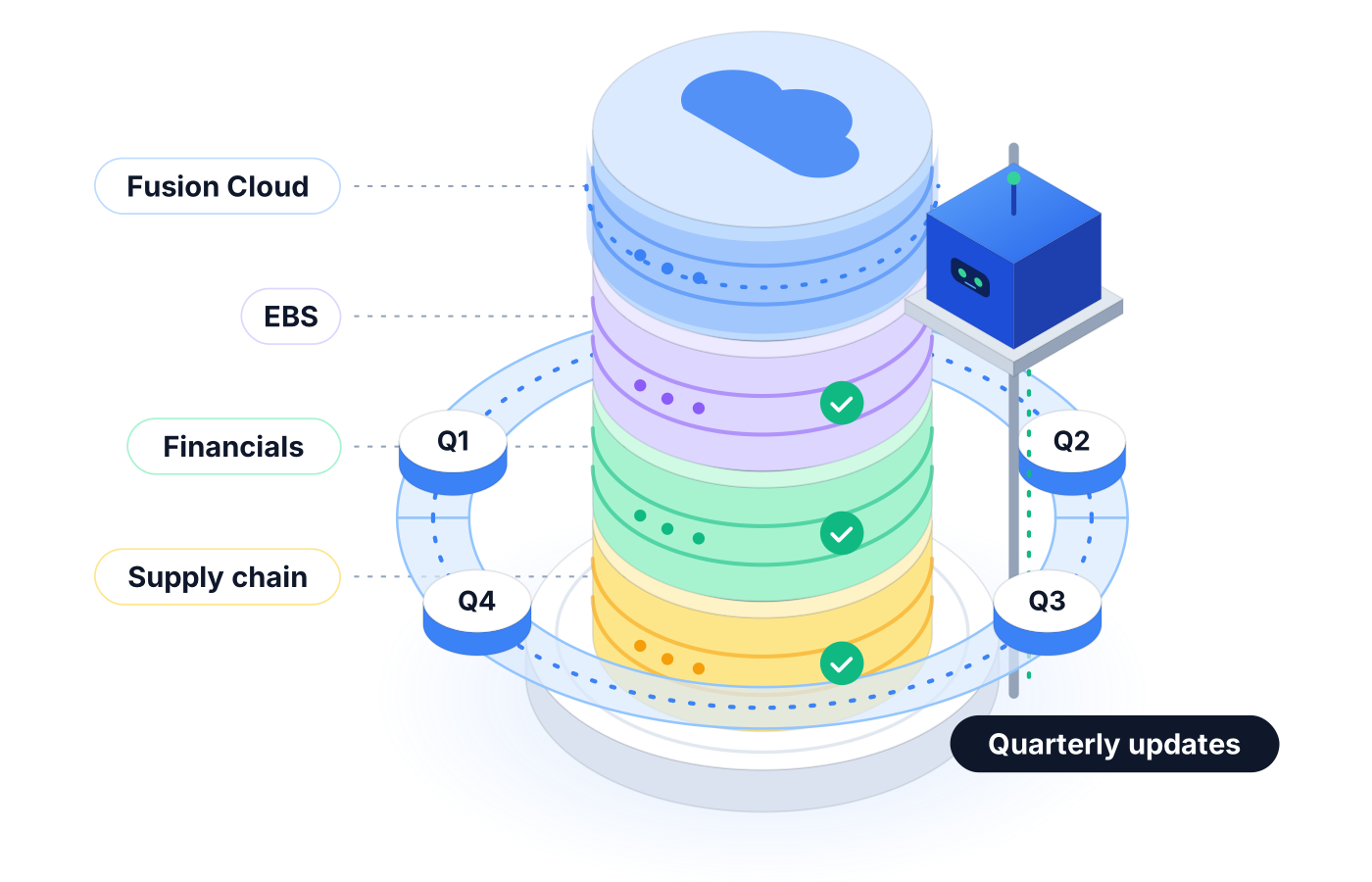
- Regression-test each quarterly Oracle update before it reaches production
- Cover exceptions such as damaged goods and substitutions
- Give client onboarding a repeatable test pack
03Testing challenges
Defects at the joins
Each system passes its own tests while the hand-offs between them fail.
Quarterly updates
Oracle Cloud updates arrive on a fixed schedule on top of the team's own changes.
Handheld workflows
Scanning, receiving and picking on the handheld are tested by walking the warehouse floor.
Client variations
Each client has its own rate card, SKUs and service levels.
04Before and after
How the testing work would change once the journeys run in Robonito.
- Integration
- Today:Each system passes its own tests; the joins aren't tested.
- With Robonito:One test follows a shipment across all four systems.
- Handhelds
- Today:Testers walk the floor with scanners before each release.
- With Robonito:Receiving, picking and exceptions run on the Android app as tests.
- Oracle updates
- Today:Quarterly updates tested in a rush, by hand.
- With Robonito:Billing and finance processes run before each update.
- New clients
- Today:Each onboarding needs new test cases.
- With Robonito:Reusable steps plus the client's data make a test pack.
05How Robonito would test it
- 1
Cross-system journeys
One test creates an order through the client API, works it on the handheld app and checks the portal and the Oracle invoice.
- 2
Handheld app testing
Receiving, picking and exception flows run on the Android app as ordinary test steps.
- 3
Oracle regression per update
Billing and finance processes in Oracle Cloud run before each quarterly update reaches production.
- 4
Client packs
Reusable steps make a new client's test pack a matter of new data, not new tests.
06Test scenarios, in plain language
Tests you'd write in Robonito on day one. Each one is typed as written; the agent works through the app and saves the steps.
- InboundCreate an inbound shipment through the client API, receive it on the handheld app, and confirm the stock appears in the client portal.
- ExceptionsScan a pallet as damaged on receipt and confirm it is placed on hold and flagged in the portal.
- FulfillmentPick an order where one SKU is short, substitute an approved alternative, and confirm the shipment notice lists the substitute.
- CarrierRequest a shipping label through the carrier API and confirm the tracking number appears on the order in the portal.
- BillingRun monthly storage billing in Oracle Cloud and confirm the invoice amount matches the client's rate card.
07What the pilot measures
No made-up numbers: a pilot measures these against your current baseline, on your own app.
Hand-off defects
Integration defects caught in testing, against today's production incidents.
Oracle update regression
Hours to regression-test each quarterly update.
Floor time
Manual handheld test passes replaced by automated runs.
Client onboarding
Time to stand up a test pack for a new client.
08Rolling it out: the first month
A realistic plan for a team starting from zero, with the baseline comparison built in.
- Week 1
Follow one shipment
The team maps one client's order from API to handheld to portal to invoice and writes it as a single test.
- Week 2
Add the exceptions
Damaged goods, short picks and substitutions are added on the handheld app.
- Week 3
Cover Oracle billing
Storage and handling billing in Oracle Cloud is added and scheduled ahead of the next quarterly update.
- Week 4
Template for clients
Reusable steps become a client test pack, and the team counts integration defects against last quarter.
09Frequently asked questions
Can Robonito test warehouse handheld apps?
Robonito tests Android and iOS apps on the Pro and Custom plans, so receiving, picking and exception flows on a handheld app run as ordinary test steps.
Does Robonito support Oracle Cloud?
Yes. Robonito tests Oracle Fusion Cloud and E-Business Suite flows across modules, and can run them before each quarterly update reaches production.
Can one test span APIs, mobile, web and Oracle?
Yes. A single journey can call a client API, act on the mobile app, check the web portal and confirm the invoice in Oracle, so the hand-offs between systems are tested too.
How do we test many clients without many scripts?
Build common steps once and reuse them with each client's data, such as SKUs, rate cards and service levels. A new client then needs new data, not new tests.