The release is ready on Thursday afternoon. The regression suite has 800 tests, takes five hours, and 60 of them failed. Most failures are a renamed button and a slow test environment, but nobody can say which ones until Friday, so the release slips again.
That is the real job of regression testing tools. Any tool can replay a test. The hard part is a suite that stays green when the UI changes, runs fast enough to block a release, and tells you clearly what broke.
The best regression testing tools in 2026 are Playwright, Selenium and Cypress for developer-owned suites, Katalon and Ranorex for mixed teams, Tricentis Tosca for large enterprise estates, and mabl, testRigor, Testsigma and Robonito for AI-driven, low-maintenance suites. Choose by who maintains the suite, which platforms you test, and how you pay.
Key takeaways
- A regression tool earns its keep on maintenance, parallel runs and failure evidence, not on how fast it records the first test.
- Open-source frameworks have no licence fee but need engineers to build healing, reporting and infrastructure around them.
- AI platforms widen who can maintain the suite. Check how each one lets you review what it healed.
- Run a trial on your own regression suite, with your real UI changes, before you compare price lists.
What do regression testing tools need to do?
Regression testing re-runs existing tests after every change to confirm that working features still work. If you need the basics first, start with our guide to regression testing in software testing.
A test runner can execute tests. A regression tool has to keep a growing suite useful release after release. These are the criteria that matter:
| Criterion | What to check |
|---|---|
| Maintenance after UI changes | Do tests survive renamed labels and moved elements? Is healing reviewable? |
| Parallel execution | How many tests run at once, and at what cost? |
| CI integration | Does it run from your pipeline and fail the build on real regressions? |
| Failure evidence | Video, screenshots, logs and network traces for every failure |
| Flaky test handling | Retries, flake detection and quarantine, not silent reruns |
| Test selection | Can you run a smoke subset, a risk-based subset or the full suite? |
| Platforms | Web only, or also mobile, desktop and API in the same suite |
| Who can author and fix tests | Developers only, or testers and analysts too |
| Pricing model | Per seat, per run, per minute, or open source plus infrastructure |
Maintenance is the line that grows fastest. Our post on flaky test debt explains how unreliable tests erode trust in a regression suite.
Code frameworks or platforms: which kind of regression tool fits?
Code frameworks (Selenium, Playwright, Cypress) give you a library and a runner. Tests live in your repository and go through code review. They are free to license, flexible and well documented. You build or buy the rest: parallel infrastructure, reporting, flake tracking and healing.
Commercial suites (Katalon, Ranorex, Tricentis Tosca) add recording, keyword or model-based authoring, management and reporting on top. They suit mixed-skill teams and larger estates with desktop or enterprise apps.
AI-driven platforms (mabl, testRigor, Testsigma, Robonito) let testers describe tests in plain language and use AI to keep them working as the app changes. They suit teams where testers outnumber automation engineers, at the cost of some low-level control.
What are the best regression testing tools in 2026?
Facts below come from each vendor's own website or docs, as of November 2026.
1. Selenium
Selenium is an open-source project with WebDriver for browser automation, Grid for remote and parallel runs, and IDE for record and playback. Selenium Grid routes commands to remote browsers so tests can run in parallel across machines, browser versions and platforms.
Best for: teams with existing Selenium skills and suites, or broad language needs. Watch out for: healing, reporting and grid upkeep are yours to build or buy. See Robonito vs Selenium.
2. Playwright
Playwright is open source and supports Chromium, WebKit and Firefox on Windows, Linux and macOS, in Node.js, Python, Java and .NET. Tests run in parallel by default, with built-in sharding and retries. Its Test Agents include a healer that reruns failing tests and proposes patches.
Best for: developer-owned web regression suites with a modern stack. Watch out for: it's web only, and healed patches are code changes someone has to review. See Robonito vs Playwright.
3. Cypress
The Cypress app is open source under the MIT licence. Test retries are off by default and set in configuration, and Cypress Cloud adds flaky test detection. Cloud has a free Starter plan (500 test results a month), Team from $67 a month and Business from $267 a month (billed annually), with Enterprise custom.
Best for: JavaScript front-end teams that want fast feedback while developing. Watch out for: flake detection and run history sit in the paid Cloud. See Robonito vs Cypress.
4. Katalon
Katalon Studio covers web, mobile, API and desktop testing with recording, low-code keywords, or Groovy and Java scripting. Its self-healing tries other stored locators when one fails, then an AI layer, and suggestions are approved or discarded in Self-healing Insights. Professional is $1,800 per seat per year; Enterprise is custom.
Best for: mixed-skill teams that want one tool with a scripting escape hatch. Watch out for: per-seat pricing grows with the number of authors. See Robonito vs Katalon.
5. Tricentis Tosca
Tosca uses a model-based, codeless approach: it separates an application's technical details from the automation model, so tests inherit changes from the model. Its supported technologies include SAP Fiori and SAP GUI. Its risk-based testing feature helps choose which tests to run by business risk. Pricing is on request.
Best for: large enterprises testing SAP, packaged apps and many technologies in one estate. Watch out for: it's a significant platform to roll out, with a learning curve and enterprise pricing.
6. mabl
mabl covers web, mobile, API, performance and accessibility testing, with auto-healing that uses several AI models and visual context. Its pricing page shows no figures: cloud runs use credits starting at 500 a month, local and CI runs are unlimited, and cloud concurrency is unlimited. Mobile is an add-on.
Best for: QA teams that want a low-code platform with unlimited cloud concurrency. Watch out for: you need a quote to compare costs.
7. testRigor
testRigor writes tests in plain English and finds elements by how an end user would describe them, with AI-based self-healing that labels healed tests and allows rollback. Its sign-up page lists a free plan where tests and results are public, pay-as-you-go with no published price, and custom Enterprise.
Best for: teams where manual testers will own regression. Watch out for: free-plan tests are public, and paid prices aren't listed.
8. Testsigma
Testsigma's agents plan, generate, run, heal and analyse tests, with a person approving changes. It covers web, mobile, API and Salesforce, and lists Windows desktop and SAP. Both its Pro and Enterprise plans are custom-priced.
Best for: teams that want agentic regression across web, mobile and enterprise apps. Watch out for: no published prices.
9. Ranorex
Ranorex Studio tests Windows desktop (Windows Forms and WPF), web and mobile (iOS and Android), with Selenium integration for web. Licences are annual concurrent-user subscriptions: Studio Enterprise to create and run tests, and Studio Runtime to execute only. Pricing is on request.
Best for: teams with Windows desktop apps in their regression scope. Watch out for: quote-based licensing, and test creation needs a full Studio licence.
10. Robonito
Robonito's AI agents create, run and maintain regression tests, with self-healing that logs each healed step for review. Web is on every plan; mobile, desktop and API are on Pro and Enterprise. More detail in the Robonito section below.
How do the regression testing tools compare?
| Tool | Type | Who maintains tests | Platforms | Healing | Pricing (as published, Nov 2026) |
|---|---|---|---|---|---|
| Selenium | Code framework | Developers, SDETs | Web | Add-on libraries | Open source |
| Playwright | Code framework | Developers, SDETs | Web | Test Agents healer (code patches) | Open source |
| Cypress | Code framework plus Cloud | Front-end developers | Web | Retries; flake detection in Cloud | App free; Cloud free to $267/mo, Enterprise custom |
| Katalon | Low-code plus scripting | QA, SDETs | Web, mobile, API, desktop | Locator fallback plus AI, approved in Insights | Professional $1,800/seat/year; Enterprise custom |
| Tricentis Tosca | Model-based, codeless | QA, test architects | Broad enterprise estate | Model-based updates | Pricing on request |
| mabl | Low-code, AI | QA | Web, API; mobile add-on | Multi-layer auto-healing | Pricing on request |
| testRigor | No-code, plain English | QA, manual testers | Web, mobile, desktop, API | AI self-healing with rollback | Free public plan; pay-as-you-go; Enterprise custom |
| Testsigma | Agentic, plain English | QA | Web, mobile, API, Salesforce | Agent heals, person approves | Custom pricing |
| Ranorex | Desktop-first suite | QA, SDETs | Windows desktop, web, mobile | Not covered here | Pricing on request |
| Robonito | No-code, AI agents | QA, product, developers | Web; mobile, desktop, API on Pro | Self-healing with logged heals | Free; Starter $20/mo; Pro $199/mo; Enterprise custom |
No tool wins every row. Open-source frameworks are cheapest to license and most flexible but need engineers. Commercial suites cover more technologies. AI platforms cut the skill barrier and differ mostly in how they heal and how they charge.
How do you choose a regression testing tool?
Use this checklist during a trial. Run it on your own suite, not the vendor's demo app.
- Pick 20 real regression tests, including your flakiest ones, and rebuild them in the tool.
- Change the UI on purpose: rename a label, move a button, add a step. Count how many tests break and how long fixes take.
- Review the healing. Can you see what changed, approve it and roll it back?
- Run the 20 in parallel from CI. Note total time and what blocks the build.
- Break something real and read the failure report. Can someone outside QA tell what broke?
- Check platform fit. Does it cover every UI your journeys touch?
- Model the cost at your scale: seats, runs or minutes for a full suite every night for a year.
- Check the exit path. Can you export tests or code if you leave?
Our guide on automated regression testing covers what to automate first once you've picked a tool.
Which regression testing tool fits which team?
| Team situation | Tools to shortlist |
|---|---|
| Developers own tests, web only, code-first culture | Playwright, Cypress |
| Large existing Selenium suite and skills | Selenium, with a grid and healing add-on |
| Mixed skills, want scripting when needed | Katalon |
| Desktop apps in scope | Ranorex, Katalon, Robonito (Pro) |
| Large enterprise estate, SAP and packaged apps | Tricentis Tosca, Testsigma |
| Manual testers moving to automation | testRigor, Robonito |
| Web, mobile and API in one suite with AI healing | mabl, Testsigma, Robonito |
| Small team, tight budget, needs to start now | Playwright (if you code) or Robonito Free (if you don't) |
Many teams run two: developer-owned Playwright or Cypress tests for fast feedback, and a platform for the full cross-platform regression owned by QA.
How do you automate a regression test suite?
Moving from manual to automated regression works best in stages. Our manual regression testing guide covers what to keep manual.
- List your regression scope and rank it by business risk.
- Automate the top 20 to 30 journeys first, the ones that block a release if they break.
- Run them in CI on every merge, in parallel, and fail the build on real regressions.
- Run the full suite nightly and before each release.
- Track flaky tests and fix or quarantine them visibly. Never rerun until green.
- Review healed steps weekly, so the suite keeps testing what you meant.
- Grow the suite with each release, retiring tests for features that no longer exist.
For automated web regression testing, keep tests at the journey level, such as "customer completes checkout", rather than one test per screen. Journey tests survive redesigns better.
Regression testing with Robonito
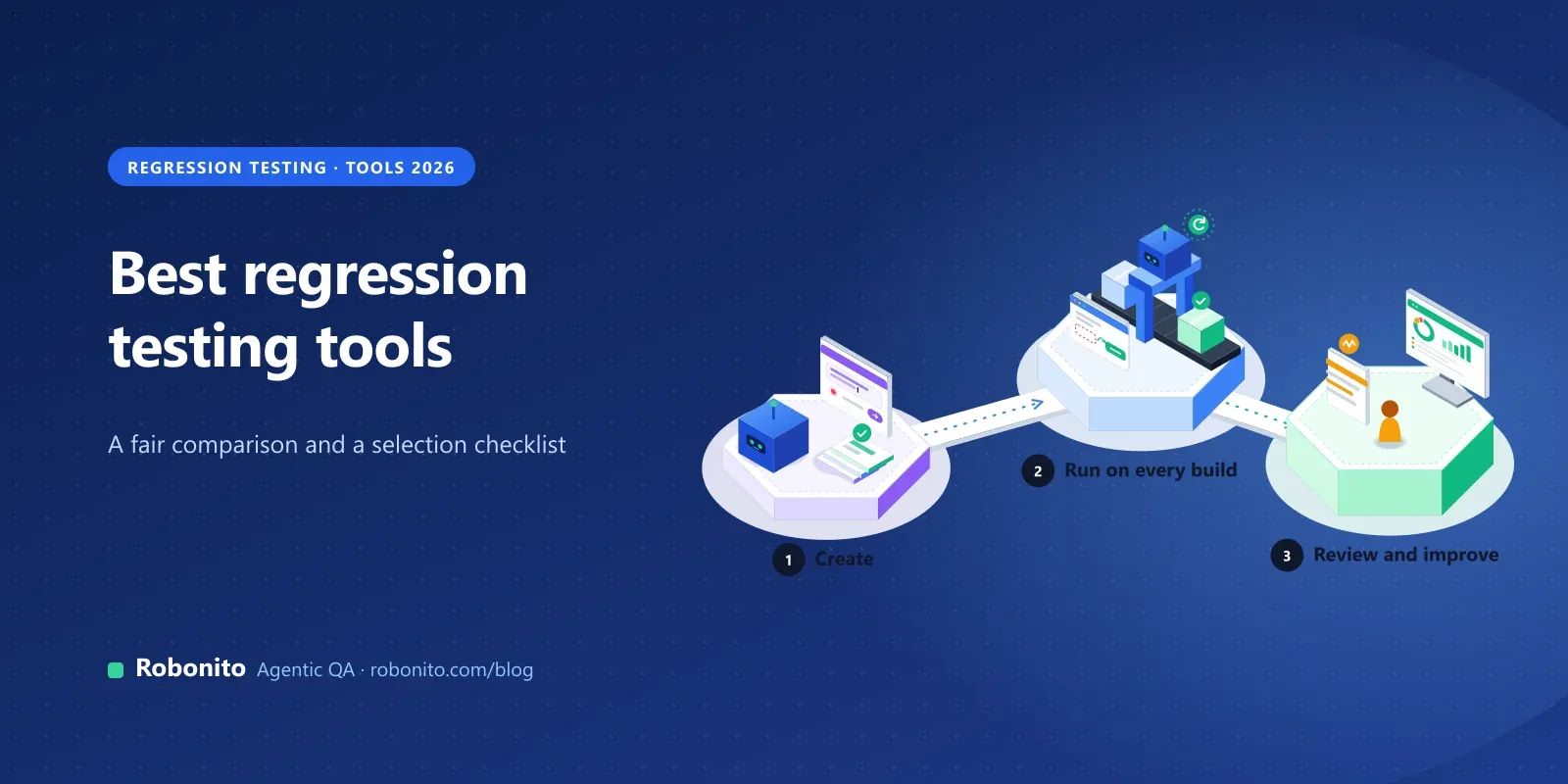
Robonito is an agentic QA platform: AI agents create, run and maintain end-to-end tests. For regression, it is built to keep a large suite green as the app changes.
- Plain-language authoring. In AI Studio, describe what to test, paste a URL or reference a Jira issue, and the agent works through the app. It can also generate tests from requirement documents, Jira stories and epics. You can record flows in the desktop app or build no-code tests from reusable steps.
- Self-healing with an audit trail. Steps adapt when labels, layouts or locators change, and healed steps are logged for review. Our self-healing test automation guide explains how to review heals.
- Parallel runs. Tests run in isolated cloud workers: 1 parallel run on Free, 2 on Starter, 10 on Pro and custom on Enterprise. Local runs on the desktop app or your own CI runners are free on every plan.
- Evidence for every failure. Video, network traces and an AI root cause, plus pass rates, trends and risk analysis across runs.
- CI and tools. Jenkins, GitHub Actions, GitLab CI, Azure DevOps and CircleCI, plus Jira, Slack, TestRail and Zephyr. CI/CD, Jira and Slack are on Starter and above.
- One suite across platforms. Web on every plan; mobile (Android and iOS), desktop and API on Pro and Enterprise.
Proof. FocusSoft, an enterprise ERP vendor, automated 260 complex ERP test cases against a target of 200. It now runs its full end-to-end regression in under 30 minutes, with more than 8,600 executions logged. Club Car cut QA testing time by over 70% on CPQ and 3D configurator testing.
Pricing. Free covers web with 100 test cases and 1 parallel run. Starter is $20 a month ($16 billed annually) with 1,000 test cases, 2 parallel runs and CI/CD. Pro is $199 a month ($159.20 billed annually) with unlimited test cases, 10 parallel runs and mobile, desktop and API. Enterprise is custom. See pricing.
Where it doesn't fit. If your developers want every regression test in the repository as code, Playwright or Cypress may suit you better and cost less. The Free plan has no CI integration, so a pipeline trial needs Starter or above. And Robonito isn't for unit or component tests; keep those in your framework.
with the regression journeys you fix most often, or on your web app.
Frequently asked questions
What is the best regression testing tool?
It depends on who maintains the suite. Playwright and Cypress suit developer-owned web suites. Selenium suits teams with existing skills and suites. Katalon and Ranorex suit mixed teams, and Tosca suits large enterprise estates. mabl, testRigor, Testsigma and Robonito suit teams that want AI-driven, low-maintenance regression without much code.
Which regression testing tools are free?
Selenium, Playwright and the Cypress app are open source and free to license, though you pay for infrastructure and engineer time. testRigor has a free plan where tests and results are public. Robonito has a free-forever plan for web testing with 100 test cases and unlimited local runs. Cypress Cloud's Starter plan includes 500 test results a month.
How do you automate a regression test suite?
Rank your regression scope by business risk, automate the top 20 to 30 journeys first, and run them in CI on every merge. Run the full suite nightly and before releases, in parallel. Track flaky tests visibly, review any healed steps, and grow the suite with each release while retiring tests for removed features.
What is automated web regression testing?
It is re-running a saved set of browser tests after every change to a web app, to confirm existing features still work. Tools such as Playwright, Selenium and Cypress do it in code; platforms such as mabl, testRigor and Robonito do it with low-code or plain-language tests. Keeping tests at the journey level makes them survive redesigns.
How do regression testing tools handle flaky tests?
In different ways. Playwright and Cypress offer retries, and Cypress Cloud flags flaky tests. Katalon falls back to other locators and suggests fixes for approval. AI platforms such as mabl, testRigor, Testsigma and Robonito heal steps when the UI changes. Whatever the tool, track flakiness visibly and review heals, rather than rerunning until green.
Do I need a commercial regression testing tool?
Not always. If developers own the suite, the product is web only and you already run CI well, Playwright or Cypress may be enough. A commercial tool pays off when testers outnumber engineers, journeys cross mobile, desktop or APIs, or maintenance and flaky-test triage take more time than writing new tests.
Keep your regression suite green release after release. to run your own regression journeys in parallel, or and compare plans on our pricing page.