
AI agents can now generate test scripts, execute dynamic user journeys, and repair broken selectors on the fly. But as software teams put them into delivery pipelines, QA leaders are running into a harder question: who is verifying the agents? A green build only has value if you can trust what produced it. In agentic testing, that confidence, not test-creation speed, has become the real bottleneck.
Key Takeaways
- The Trust Deficit: Agentic testing shifts the primary QA challenge from test creation speed to execution confidence and output verification.
- The Silent Failure Trap: Unmonitored agents can pass broken user flows by altering step logic, or silently ignore visual regressions.
- Deterministic Guardrails: Teams that want trustworthy pipelines pair agentic autonomy with self-healing, visual-DOM hybrid assertions to maintain high pipeline confidence.
- Actionable Governance: Implementing a multi-tiered test evaluation model ensures autonomous agents operate within strict behavioral boundaries.
Why Confidence, Not Speed, Is the Bottleneck in Agentic Testing
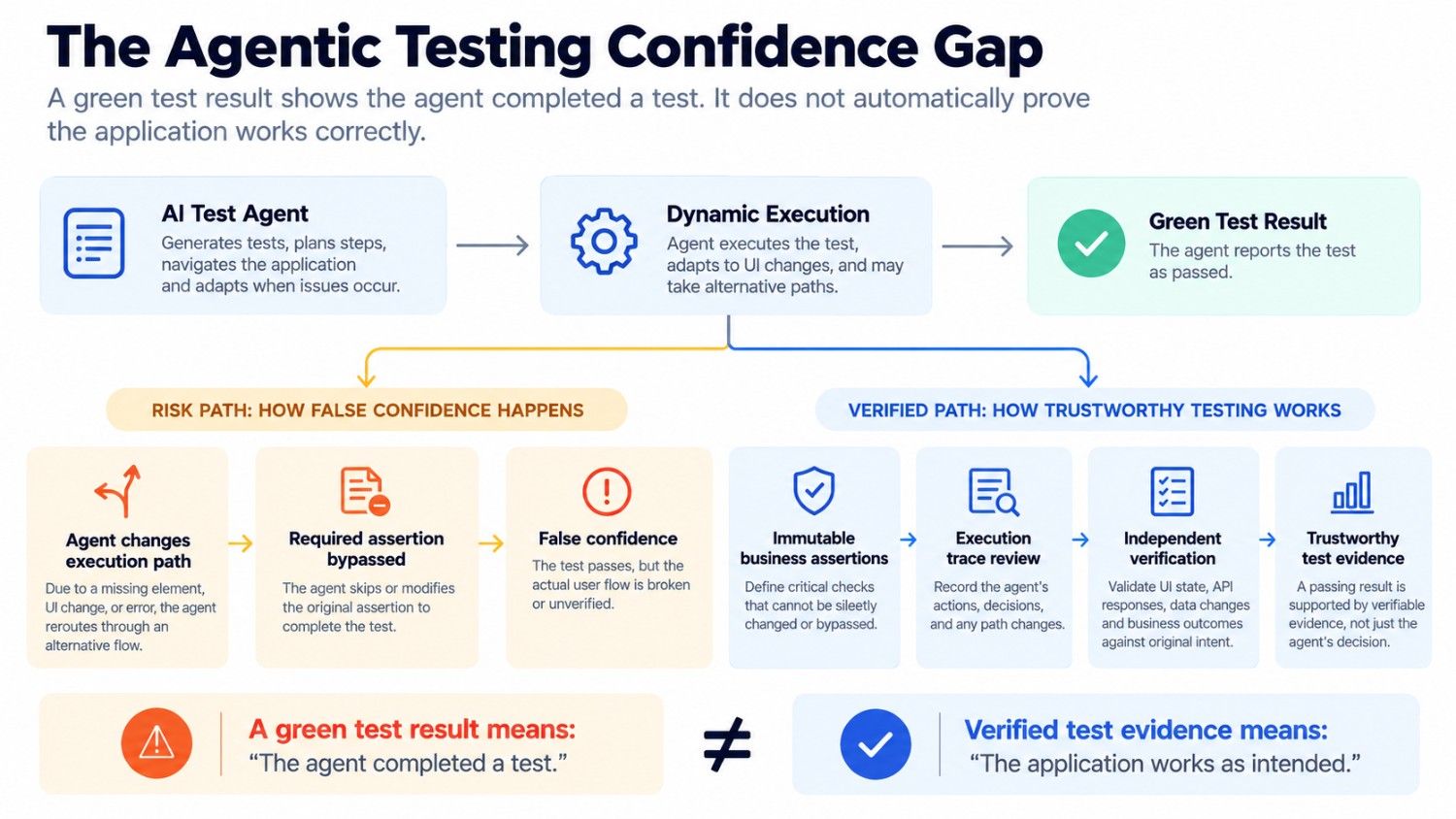
The primary bottleneck in agentic testing is not test generation speed—it is test verification confidence. When autonomous AI agents are given free rein to navigate web applications, mutate test steps, or dynamically infer user intent, engineering teams lose visibility into whether a "green build" signifies a working feature or an overly permissive agent.
In traditional test automation, a test script is a deterministic contract: click button X, assert state Y. In agentic testing, the agent acts as an adaptive executor. If button X changes its ID or moves behind a dynamic modal, an unanchored agent might reroute through a side panel, bypass the intended assertion, and report a passing test. The test passed, but the actual user flow failed.
An agent that both executes a test and decides whether it passed is grading its own homework.
The Capgemini World Quality Report tracks how much QA effort goes to maintenance and false-failure triage even in conventional automation. Agents add a new variable: when execution paths can differ between runs, every unexplained failure takes longer to diagnose, because you first have to establish which path the agent actually took.
When agents introduce non-deterministic execution paths into CI/CD pipelines, investigating failures can become more complex because teams must reconstruct the actions and decisions taken during execution. True confidence requires establishing immutable verification layers—combining visual verification, DOM validation, and strict boundary rules—that ensure agents validate actual product behavior rather than their own assumptions.
       [ Autonomous Agent Execution ]
                     │
        ┌────────────┴────────────┐
        ▼                         ▼
 [ Dynamic Flow ]         [ Visual + DOM ]
 [ Path Rerouting ]       [ Guardrail Verification ]
        │                         │
        ▼                         ▼
 (Risk: Silent Passage)  (Target: High Confidence)
Why Agentic Testing Needs Verification Now
The shift toward autonomous software delivery is accelerating rapidly. Development teams are shipping code multiple times per day using AI coding assistants like GitHub Copilot and Cursor. However, quality assurance processes remain bound by human verification limits.
The pressure is already measurable. In the Xray / Sembi Software Quality Pulse Report (May 2026, nearly 4,000 respondents), as summarised in TestDino's 2026 trends roundup, 53% of code was AI-generated or AI-assisted, and 61% of respondents reported moderate to dramatic increases in testing demand. Confidence is not keeping pace. In DeviQA's 2026 survey of 300 QA practitioners, none rated AI-generated code as fully trustworthy, and mean trust was 3.16 out of 5.
This rapid adoption exposes three critical challenges for fast-moving web app teams:
- Velocity Mismatch: Developers generate PRs in minutes, but QA teams spend hours triaging complex agentic execution logs to determine if an AI agent found a bug or simply got lost.
- DOM Complexity: Modern web frameworks (React, Vue, Web Components) frequently mutate class names and DOM structures, causing naive AI agents to repeatedly re-interpret UI state.
- Flakiness Inflation: Unbounded AI agents introduce subtle flaky behaviors by retrying steps under variable network conditions without surfacing root-cause performance delays.
Consider a multi-tenant B2B web application launching a billing workflow update. An autonomous agent tasked with verifying checkout might complete the transaction by leveraging a direct API fallback or bypassing a broken client-side validation script. To the pipeline, the test is green. To the customer, the credit card input form is completely non-responsive on mobile viewports.
What Most Agentic Testing Guidance Misses: Controlled Self-Healing
Much of the current conversation about AI in QA clusters around two approaches: visual comparison and prompt-to-test generation. Both are useful. Neither is sufficient on its own.
Existing vendor guidance often misses the critical middle ground: controlled, self-healing determinism.
    [ Pure Visual Comparison ]           [ Prompt-to-Test AI ]
(Pixel-diff noise, dynamic data bugs)   (Unbounded, flaky rerouting)
                   \                     /
                    \                   /
                     ▼                 ▼
          [ Missing Layer: Controlled Self-Healing ]
            - Deterministic state anchors
            - Hybrid DOM + visual assertions
            - Human-in-the-loop review
- Over-reliance on visual snapshotting: Pure visual diffing flags every minor dynamic content shift (e.g., changing timestamp, micro-animation, avatar loading) as a failure, flooding QA leads with noise.
- Unbounded prompt-to-test execution: Generating tests purely from natural language prompts without deterministic state anchors causes agents to craft brittle assertions that break as soon as application state shifts slightly.
- Ignoring low-code maintenance realities: Telling teams to "simply inspect AI logs" ignores the daily operational burden on engineering managers. Teams don't need raw agent traces; they need actionable, self-healing test flows that fix brittle selectors while preserving assertion intent.
The practical gap is simple: an agent can adapt how a step is performed, but nothing stops it from changing what the step proves. To build real pipeline trust, teams need web app automation tools that pair adaptive step resolution with strict execution guardrails.
A Decision Framework: Agent Autonomy vs. Verification Rigor
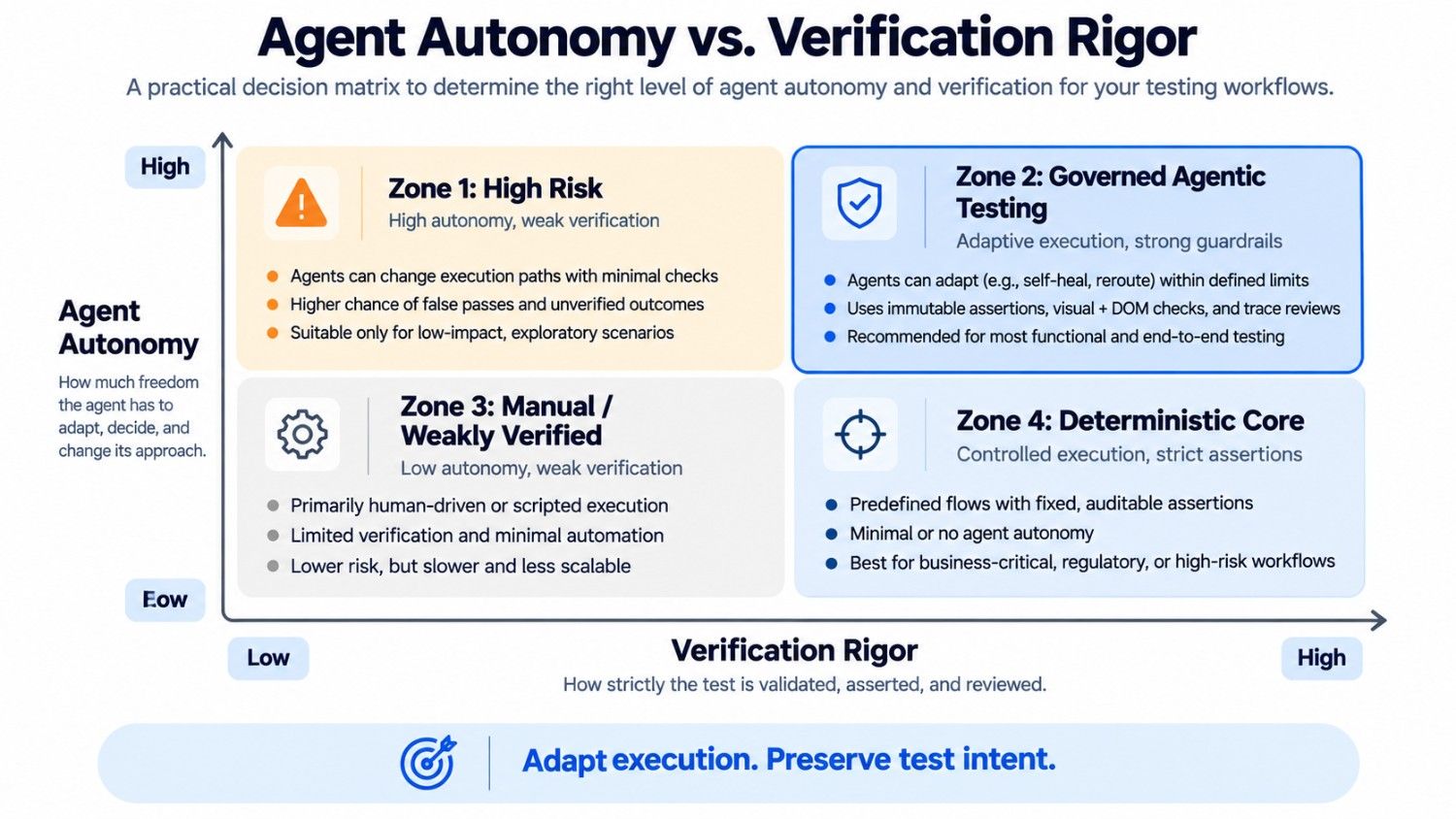
To prevent autonomous agents from running amok while still capturing the efficiency gains of AI testing, engineering leaders need a structured decision matrix. You should categorize test suites based on Execution Autonomy versus Verification Rigor.
                    VERIFICATION RIGOR
               Low                    High
         ┌───────────────┬────────────────────────┐
    High │  ZONE 1:      │  ZONE 2:               │
         │  High Risk    │  Target Agentic Zone   │
AUTONOMY │  (Unbounded)  │  (Self-healing + DOM)  │
         ├───────────────┼────────────────────────┤
     Low │  ZONE 3:      │  ZONE 4:               │
         │  Legacy Manual│  Deterministic Core    │
         └───────────────┴────────────────────────┘
Below is a framework for categorizing and governing tests in an agentic QA workflow:
| Test Category | Zone | Agent Autonomy | Primary Verification | Governance Rule |
|---|---|---|---|---|
| Critical Core Paths (Auth, Checkout, Data Export) | Zone 4: Deterministic Core | Low | Visual + DOM + self-healing anchors | Zero path mutation; fail fast on step deviations |
| Dynamic Feature Flows (Dashboards, Filters) | Zone 2: autonomy limited to selector healing | Medium | Self-healing locators with DOM snapshot matching | Allow selector healing; lock assertion logic |
| Exploratory & Edge Flows (Localization, Cross-browser) | Zone 2 only with human review; otherwise Zone 1 | High | Semantic assertion matching plus mandatory review of deviations | Every step variation is flagged for QA review |
The principle is simple: let agents adapt how a step is performed, never what the step must prove.
By assigning appropriate boundary limits to each layer of your testing stack, you empower agents to auto-heal selector shifts without letting them rewrite business logic on the fly.
How to Implement High-Confidence Agentic Testing in 4 Steps
Transitioning to high-confidence agentic testing requires a practical, step-by-step rollout plan. Here is how fast-moving engineering teams can operationalize agentic testing while keeping control over pipeline trust.
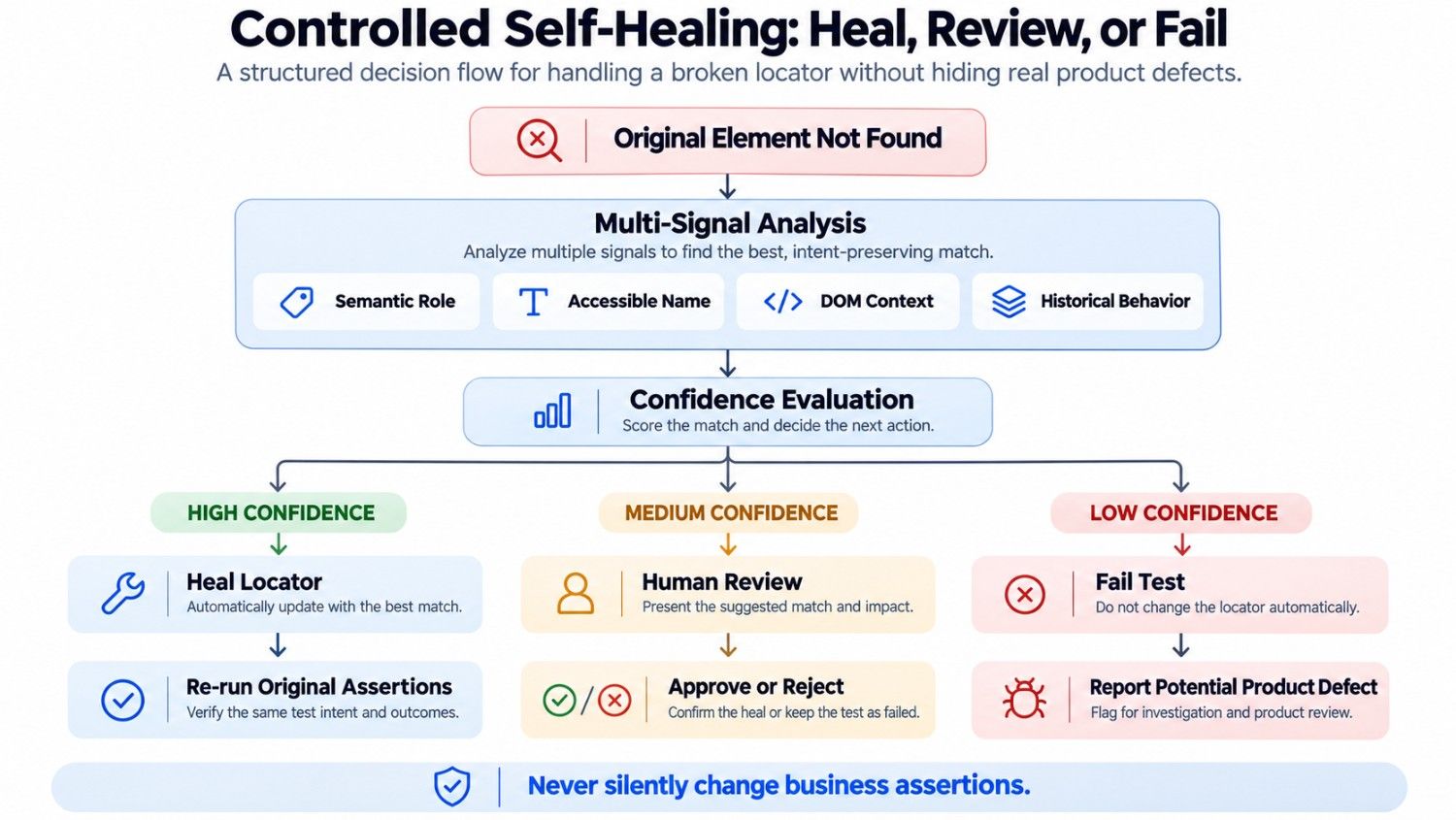
Step 1: Define Immutable Anchors ──► Step 2: Enable Self-Healing ──► Step 3: Implement Visual-DOM Verification ──► Step 4: Configure Human-in-the-Loop Triage
Step 1: Define Immutable State Anchors
Before enabling autonomous execution, mark key state checkpoints within your application. An anchor is an explicit assertion that cannot be bypassed by an agent (e.g., verifying an HTTP 200 response header alongside a specific data-testid).
Step 2: Implement Self-Healing Selector Layers
Rather than letting an agent invent new steps when an element changes, equip your test engine with self-healing tests capabilities. When a DOM update alters a button's selector path, the test engine automatically evaluates semantic attributes, tree position, and text content to re-bind the locator dynamically without straying from the original step intent.
Step 3: Combine DOM Assertions with Visual Verification
Ensure your automation stack validates both functional state and visual layout simultaneously.
Scenario: E-Commerce Inventory Checkout
- Problem: A promotional overlay covers the "Purchase" button for real users. Standard actionability checks would refuse the click, but an unanchored agent gets past it by force-clicking, dispatching the click through JavaScript, or falling back to the checkout API directly.
- Unanchored Agent Behavior: Passes the test because the checkout endpoint responded with 200 OK, even though no real user could have clicked the button.
- High-Confidence Agentic Behavior: Performs a visual overlay check and DOM visibility assertion. Because the button was covered by a rogue CSS modal, the runner flags a visual blockage error, preventing a broken UX from reaching production.
Traditional Agent Validation:
[Click Purchase] ──► [API Returns 200] ──► PASSED (Misses UI Overlay Bug!)

Robonito Hybrid Validation:
[Click Purchase] ──► [DOM Check: Visible?] ──► [Visual Layer: Covered by Modal?] ──► FAILED (Bug Captured!)
Once false failures stop blocking the pipeline, release decisions get faster, because a green build starts to mean something again.
A Three-Question Confidence Test
For any passing test, you should be able to answer:
- What did it actually assert? The result should provide independently verifiable evidence.
- Could the agent have changed that assertion? Any changes to required assertions must be explicitly authorized and recorded.
- Were execution-path changes recorded, justified, and checked against the original acceptance criteria?
If these questions cannot be answered, the passing result needs further verification before it can support a release decision.
How to Measure Confidence in Agentic Testing
Confidence in agentic testing should be supported by observable evidence, not simply by a passing test result.
Engineering teams can evaluate the reliability of their AI testing workflows using five practical metrics:
| Metric | What It Measures | Why It Matters |
|---|---|---|
| False-Pass Rate | Known defects incorrectly reported as successful test runs | Reveals whether agents are masking product failures |
| Assertion Integrity | Percentage of required assertions preserved throughout execution | Helps detect unauthorized changes to test intent |
| Execution Trace Completeness | Percentage of runs with sufficient action logs, screenshots, assertions, and decision records | Makes agent decisions auditable |
| Self-Healing Review Rate | Percentage of proposed locator repairs requiring human validation | Shows where automated adaptation remains uncertain |
| Escaped Defect Rate | Defects discovered after release despite passing automated quality gates | Connects testing confidence with real product outcomes |
These metrics should be interpreted together. A low failure rate is not necessarily a sign of strong quality assurance if the test suite is missing important assertions.
For example, a team may report that 98% of agentic tests pass consistently. That sounds encouraging, but it provides limited confidence if agents can modify acceptance criteria or skip difficult steps without recording those decisions.
A more meaningful question is:
Can every passing result be traced back to an unchanged requirement, a verified assertion, and an auditable execution path?
That is the difference between automation that produces green dashboards and automation that produces trustworthy evidence.
4 Agentic Testing Mistakes That Destroy Pipeline Trust
Even experienced QA leaders fall into common traps when deploying AI agents into automated testing workflows. Avoid these four critical mistakes:
- Treating Agents as Full "Black-Box" Executors
Allowing an agent to handle both test step execution and test pass/fail determination without independent guardrails creates an inherent conflict of interest. Always enforce external assertion rules that the agent cannot modify. - Relying Solely on Natural Language Prompts for Critical Assertions
Prompt-based assertions ("Verify that the total price is correct") introduce fuzzy logic errors. Use concrete data matches (e.g., checking$149.00against calculated cart state) for monetary, security, and authentication steps. - Ignored Flakiness Triage (Accepting "Auto-Pass on Retry")
Flakiness is a well-documented problem: Google has reported that about 1.5% of its test runs were flaky and almost 16% of its tests showed some flakiness. Over-reliance on dynamic waiting and loose, fuzzy-matching assertions only makes it worse. If an agent fails on attempt 1 but passes on attempt 2 after altering its locator path, record the auto-heal event and inspect the selector delta. - Disconnecting QA Automation from No-Code Product Workflows
Forcing product managers and manual QA testers to read complex Python or JavaScript stack traces when an agent fails slows down shipping velocity. Leverage intuitive, no-code test creation platforms so non-technical team members can inspect execution steps and update workflows visually.
Recommended next steps
Restoring confidence in your test suite does not mean abandoning AI automation—it means upgrading to intelligent, transparent, and resilient testing workflows.
- Audit Your Current Pipeline Flakiness: Identify the top 20% of test scripts responsible for false positives in your current CI/CD runs.
- Establish Guardrail Assertions: Transition critical end-to-end user flows from unguided dynamic scripts to deterministic, self-healing test paths.
- Adopt Visual-DOM Hybrid Validation: Implement tools that verify element visibility, layout structure, and DOM state in a single execution step.
- Empower Cross-Functional Teams: Enable QA leaders, engineering managers, and product owners to build, inspect, and maintain tests collaboratively without writing brittle framework code.
Frequently Asked Questions
What is agentic testing in software QA?
Agentic testing refers to the use of autonomous AI agents to design, execute, and adapt end-to-end software tests. Unlike static scripts, agents dynamically navigate web applications, locate DOM elements, and adjust execution paths based on real-time application behavior.
Why do autonomous QA agents cause false positives and test flakiness?
False positives and flakiness occur when agents lack rigid assertion guardrails. If an element's selector changes or a DOM structure mutates, an unanchored agent may reroute around the intended assertion or accept soft matches, marking tests as "passed" even when key product features fail visually or functionally.
How does self-healing automation differ from unmonitored AI agents?
Self-healing test automation uses machine learning to update selector locators (like IDs, XPath, or CSS classes) when UI elements change, while strictly preserving the test step's business logic and assertions. Unmonitored AI agents, by contrast, may alter both the locators and the underlying execution steps, compromising test fidelity.
Can non-technical team members manage agentic test suites?
Yes. Modern AI-powered no-code QA platforms allow product managers, manual QA testers, and business analysts to create, review, and maintain automated test flows through visual interfaces. Self-healing capabilities handle locator maintenance automatically without requiring custom code updates.
How do visual and DOM-based assertions work together?
DOM assertions verify that elements exist, carry correct attributes, and return expected backend data. Visual assertions capture screenshots to verify that those elements are actually visible, correctly formatted, and unobscured by dynamic overlays on real screens. Combining both catches failures that either check alone would miss.
Take the Next Step
Building fast, reliable web applications requires an automated QA stack you can actually trust. Unverified AI agents create pipeline noise, but Robonito gives engineering and QA teams speed with guardrails.
With Robonito's AI-powered no-code QA automation platform, your team can:
- Create End-to-End Tests in Minutes: Build complex web app automation workflows visually without writing brittle framework code.
- Cut Test Maintenance: Leverage built-in self-healing locator engines that automatically adapt to DOM and UI layout mutations.
- Ship with Confidence You Can Verify: Combine functional DOM assertions and visual checks so a green run reflects real application behaviour.
Ready to stop guessing and start trusting your test automation?
Book a demo with the Robonito team today or Start free trial to experience AI-powered, self-healing QA automation built for modern software teams.
Written by the Robonito Engineering Team. Product behaviour described here reflects the Robonito platform as of November 2026.
Automate your QA — no code required
Stop writing test scripts.
Start shipping with confidence.
Join thousands of QA teams using Robonito to automate testing in minutes — not months.