Most teams don't have a testing strategy. They have a set of habits: unit tests where developers remember to write them, a regression pass before release, and manual checks wherever something broke last time.
That works until releases speed up. Then the habits can't keep pace, and nobody can say which risks the testing actually covers.
A software testing strategy is the set of decisions about what to test, how, when and by whom, chosen to match your product's risks. Most teams combine three or four strategies: risk-based testing to set priorities, shift-left testing to catch defects early, automated regression testing to protect what already works, and exploratory or agentic testing to find what nobody thought to script.
This guide covers the 10 strategies teams actually use, when each one pays off, how to combine them as your team grows, and how to turn the strategy into tests that run on every release.
Key takeaways
- A strategy is a set of choices about risk, not a list of test types. Start by ranking your user journeys by likelihood and impact of failure.
- Every team needs at least four: static checks, shift-left checks on pull requests, automated regression in CI, and some form of exploration.
- Regression suites usually fail through maintenance, not missing tests. Plan for how tests survive UI changes.
- AI agents make the strategy cheaper to carry out, but you still decide what "correct" means.
What is a software testing strategy?
A testing strategy is the high-level approach to quality for a product or organisation. It answers questions such as:
- Which risks matter most, and which can we accept?
- Which testing happens before code is merged, and which after?
- What do we automate, and what do we keep manual?
- Which environments, data and devices do we test on?
- Who owns quality: developers, QA engineers, or both?
How is a test strategy different from a test plan?
A test strategy is long-lived and covers the whole product or organisation. A test plan applies the strategy to one release, feature or project: scope, schedule, people, entry and exit criteria.
If you need the document itself, our guide to writing a test strategy document walks through each section.
The 10 software testing strategies
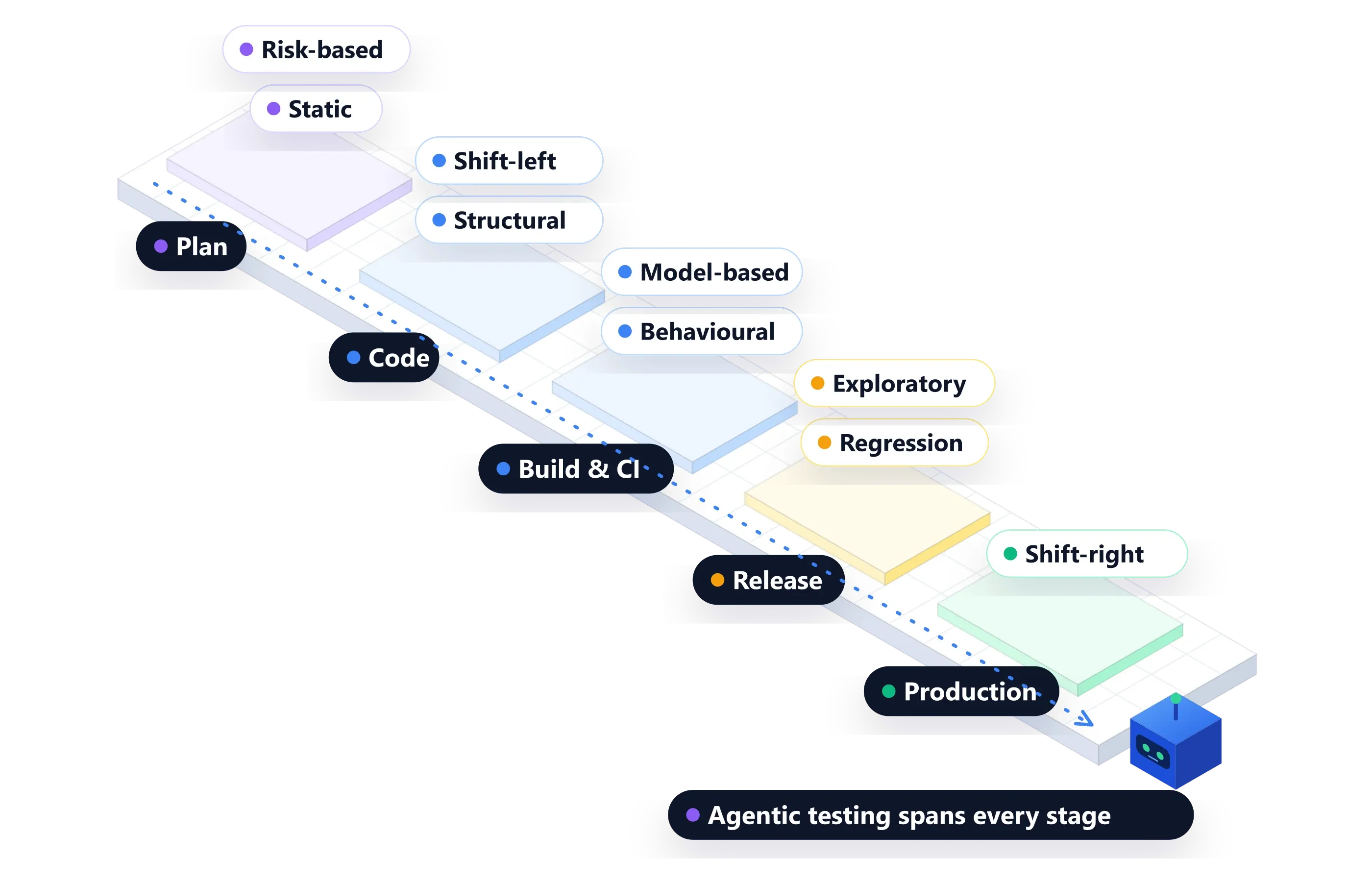
Each strategy does its best work at a different point in the delivery lifecycle. The map below shows where each one fits, from planning to production.
1. Static testing
Static testing finds defects without running the code: requirement reviews, design reviews, code reviews, linters and static analysis.
- Use it when: you want the cheapest possible defect removal. A wrong requirement caught in review costs a conversation; caught in production, it costs a release.
- What to automate first: linters and static analysis in CI, so every pull request gets checked before a person reviews it.
- Limits: it can't tell you whether the running system behaves correctly.
2. Structural (white-box) testing
Structural testing designs tests from the code's internal structure: statements, branches and paths. Unit tests and code-coverage targets belong here.
- Use it when: logic is complex, such as pricing rules, calculations or state machines, and you need confidence in every branch.
- What to automate first: unit tests on the riskiest modules, run on every commit.
- Limits: high code coverage doesn't prove the product does what users need. You can cover every line of the wrong behaviour.
3. Behavioural (black-box) testing
Black-box testing checks behaviour against requirements without looking at the code. It includes equivalence partitioning, boundary-value analysis, decision tables and state-transition testing.
- Use it when: you're validating features from the user's or the business's point of view.
- What to automate first: the core user journeys, such as sign-up, checkout, or the main transaction your product exists for.
- Limits: test design quality varies by tester, and suites grow quickly.
4. Risk-based testing
Risk-based testing ranks features by likelihood of failure × impact of failure, and spends testing effort in that order.
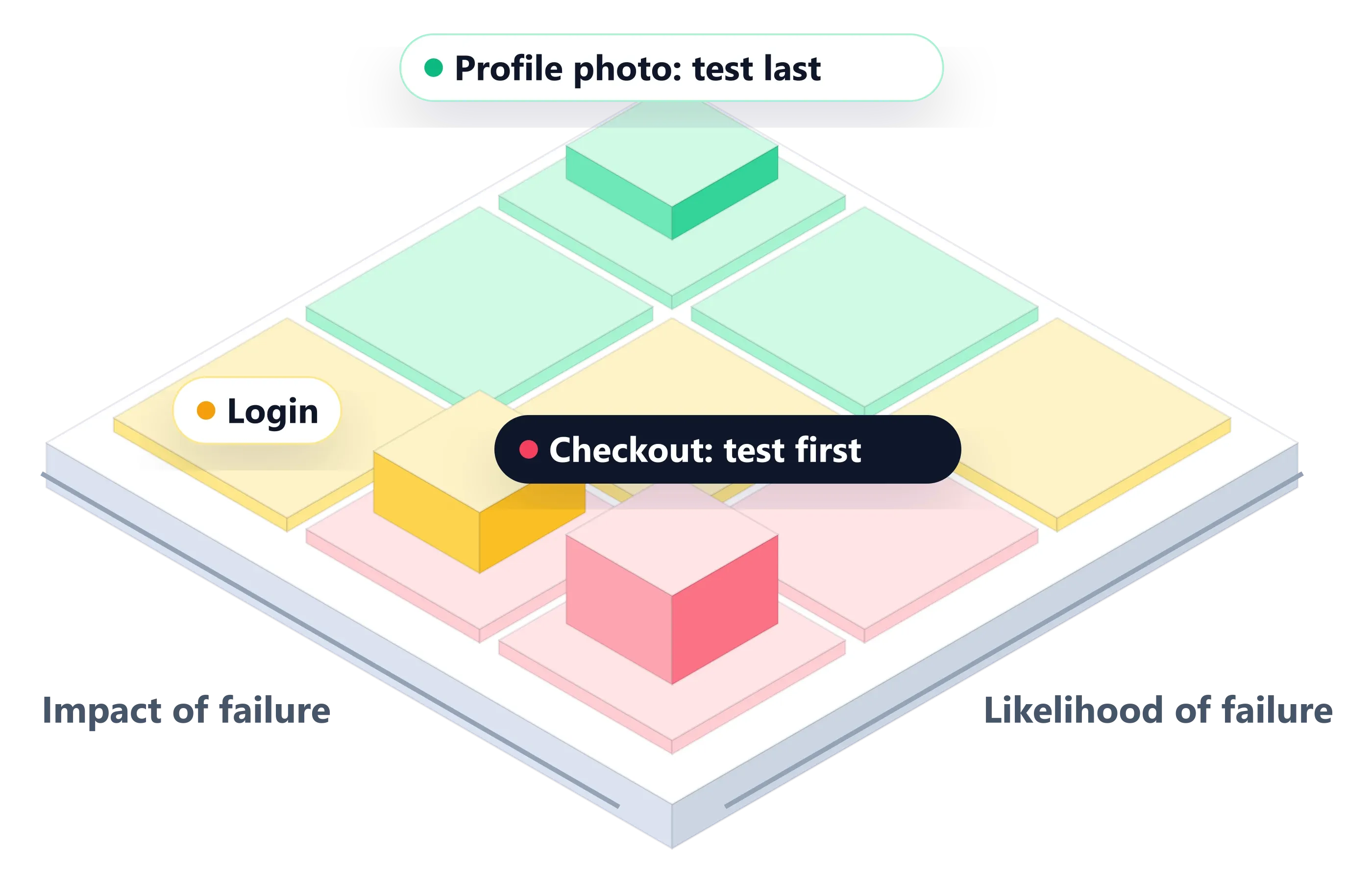
- Use it when: you can't test everything before every release. That describes almost every team.
- How to start: list your top 20 user journeys and score each from 1 to 5 for likelihood (recent changes, complexity, defect history) and impact (revenue, compliance, customer count). Multiply the two and test from the top of the list down.
- Limits: the scores are judgement calls. Revisit them after incidents.
A scoring sheet can be this simple:
| Journey | Likelihood (1–5) | Impact (1–5) | Risk score | Test |
|---|---|---|---|---|
| Checkout with a saved card | 4 | 5 | 20 | Every merge |
| Refund a partially shipped order | 3 | 4 | 12 | Every merge |
| Log in with single sign-on | 2 | 5 | 10 | Every release |
| Change notification settings | 2 | 2 | 4 | Weekly |
| Upload a profile photo | 1 | 1 | 1 | Exploratory only |
The scores above are an example. Use your own defect history and business impact.
Risk-based ordering also applies at run time. Our test execution guide shows how to order a CI run so the riskiest tests fail first.
5. Shift-left testing
Shift-left moves testing earlier in the lifecycle. Testers join requirement discussions, acceptance criteria are written before code, and developers run fast tests before merging.
- Use it when: defects are being found late and fixes keep delaying releases.
- What to automate first: checks on pull requests (unit, API contract and a small smoke suite) that finish in minutes.
- Limits: shift-left catches what you anticipated. It doesn't replace testing the integrated system.
6. Shift-right testing and production monitoring
Shift-right tests in, or close to, production: canary releases, feature flags, A/B tests, synthetic monitoring and observability.
- Use it when: real-world conditions such as traffic, data and third-party services are hard to reproduce in staging.
- What to automate first: synthetic checks that run your critical journeys against production every few minutes and alert on failure.
- Limits: you're finding problems after release, so it needs fast rollback and good monitoring.
7. Regression-averse testing
Regression-averse testing protects what already works. Every change triggers a re-run of the tests that cover existing behaviour.
- Use it when: you release often and a broken old feature costs more than a delayed new one.
- What to automate first: a regression suite of your most important journeys, running in CI on every merge to the main branch.
- Limits: regression suites grow and get brittle. Maintenance, not writing, becomes the real cost. This is where self-healing test automation earns its place.
Our guide to automated regression testing covers how to build the suite.
8. Exploratory testing
In exploratory testing, a skilled tester designs and runs tests at the same time, guided by a charter such as "explore refunds for partially shipped orders".
- Use it when: the feature is new, requirements are thin, or you suspect problems nobody has written down.
- How to run it: time-boxed sessions (60–90 minutes) with a charter and short notes on what was covered and found.
- Limits: results depend on the tester and are hard to repeat. Turn what you find into automated regression tests.
9. Model-based testing
Model-based testing describes the system as a model, often a state machine or flow, and generates tests from it.
- Use it when: the system has many states and transitions, such as booking flows, telecom systems or embedded software.
- Limits: building and maintaining the model takes specialist skill, and the model can drift from the product.
10. Agentic and AI-assisted testing
Agentic testing uses AI agents that understand a goal written in plain language, such as "buy a gift card with a saved card", and work out the steps in the application. They then run, repeat and repair those tests as the product changes.
- Use it when: your team can't write and maintain scripts as fast as the product changes, or when you need to test AI features whose answers vary from run to run.
- What it adds: tests written in plain language that non-developers can review, exploration beyond recorded steps, and repair when the UI changes.
- Limits: you still decide what matters. An agent can explore, but your risk priorities and acceptance criteria tell it what "correct" means.
Agentic testing vs autonomous testing explains the difference between the two terms.
Software testing strategies compared
| Strategy | Finds defects | Main cost | Automation fit | Best for |
|---|---|---|---|---|
| Static | Before code runs | Review time | High (linters, analysis) | Every team |
| Structural (white box) | In units of code | Developer time | High | Complex logic |
| Behavioural (black box) | In features | Test design | High | Core journeys |
| Risk-based | Where it matters most | Analysis | Applies to the others | Limited time |
| Shift-left | Before merge | Process change | High | Late-defect teams |
| Shift-right | In production | Tooling, monitoring | High | Hard-to-reproduce conditions |
| Regression-averse | In existing behaviour | Maintenance | Very high | Frequent releases |
| Exploratory | Unknown problems | Skilled testers | Low | New features |
| Model-based | Across states | Modelling skill | High once modelled | Stateful systems |
| Agentic / AI-assisted | Across journeys and AI output | Platform | Very high | Fast-changing products |
How do you choose a testing strategy?
Start from your risks and constraints, not from a list of techniques. Four questions decide most of it:
- How often do you release? Weekly or faster means regression testing has to be automated and run in CI.
- What does a failure cost? Payments, healthcare and regulated data push you toward risk-based testing with evidence for every run.
- Who will maintain the tests? If you don't have dedicated automation engineers, choose approaches that don't depend on code-heavy scripts.
- How much of the product is AI? Chatbots and agents give different answers to the same question, so they need semantic grading, not exact-match assertions.
Combining strategies by team stage
| Stage | Core strategies | What to add next |
|---|---|---|
| Startup (1–2 releases a week, no dedicated QA) | Static checks, a small regression suite of 10–20 journeys, exploratory sessions before big launches | Plain-language or agentic tests so product people can add coverage |
| Scale-up (daily releases, a small QA team) | Risk-based priorities, shift-left checks on pull requests, automated regression in CI | Parallel execution so regression stays under 30 minutes |
| Enterprise (many teams, regulated data) | All of the above, plus shift-right monitoring and audit-ready evidence | Agentic testing across web, mobile, API and enterprise apps such as SAP and Salesforce |
Four mistakes that sink a testing strategy
- Automating in the wrong order. Teams often automate what's easy, not what's risky. Start from the top of your risk list, even if those journeys are harder to automate.
- Treating coverage as the goal. Hitting a code-coverage target says little about whether checkout works on a phone. Measure coverage of risky journeys, not lines.
- Ignoring maintenance until it's a crisis. A suite that fails for cosmetic reasons trains everyone to ignore red builds. Budget for how tests survive UI changes from day one.
- No evidence. When a release goes wrong, "the tests passed" isn't enough. Keep a record of what ran, against which build, with recordings for failures.
How to put your strategy into practice with Robonito
A strategy only pays off when it runs on every release. Robonito is an agentic QA platform that turns the risk-ranked journeys from your strategy into tests your whole team can read, without writing scripts.
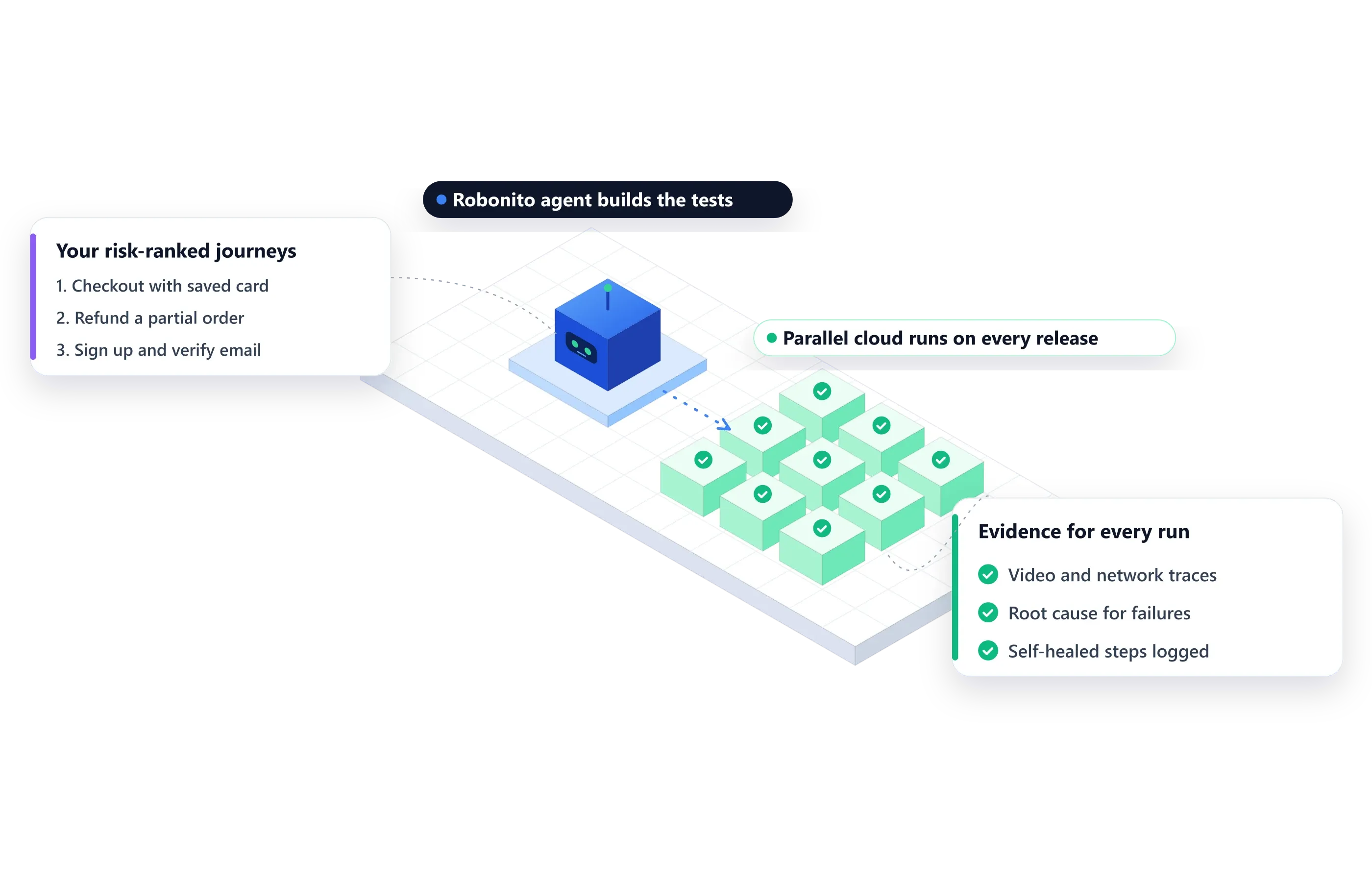
Here's how the strategies above map to Robonito:
- Risk-based testing: start from your top journeys. Describe each one in plain language, or point Robonito's AI Studio at a requirement document, a Jira story or the live app, and review the test it builds.
- Shift-left and regression: run the suite from your CI/CD pipeline (Jenkins, GitHub Actions, GitLab CI or Azure DevOps) on every merge. Tests run in parallel in isolated cloud workers, so a large regression suite doesn't hold up the release.
- Keeping regression alive: when a label or layout changes, self-healing adapts the step instead of failing everything downstream.
- Behavioural coverage across surfaces: the same plain-language approach covers web, mobile, API and desktop apps, plus testing AI chatbots and voice agents.
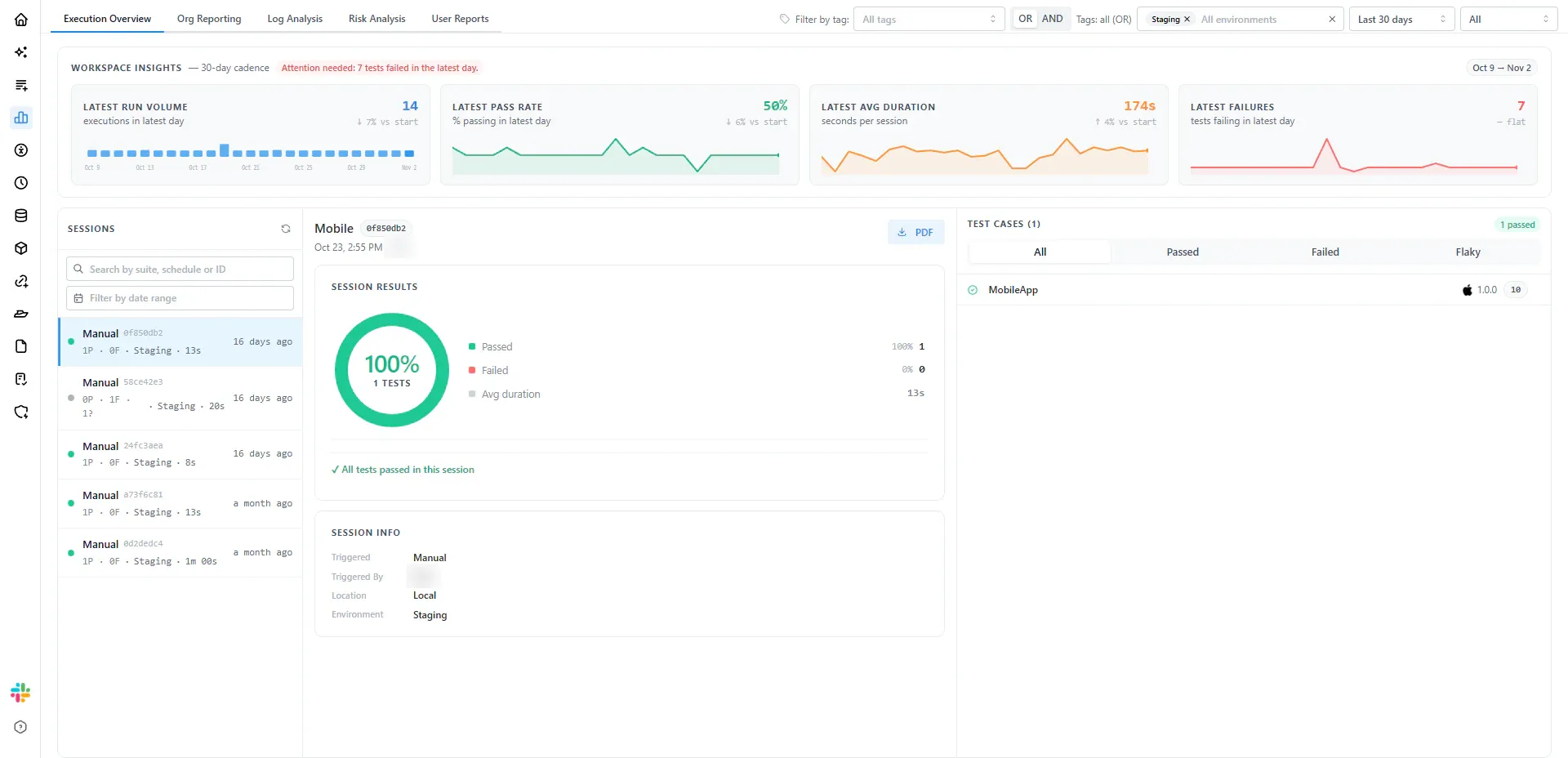
- Evidence: every run keeps video, network traces and a root cause for each failure, with pass rates, trends and risk analysis across runs.
Club Car moved its CPQ and 3D configurator testing to Robonito and cut QA testing time by over 70%.
Want to see it on your own app? and bring your top five journeys, or and automate your first one today.
How AI agents change the mix
Three shifts matter in 2026:
- Writing tests is no longer the bottleneck. AI can draft tests from requirements, user stories or a live application. The constraint moves to deciding what to test and checking that results are right.
- Maintenance falls. Self-healing tests adapt when labels and layouts change, so regression suites stop decaying with every release.
- New things need testing. AI features such as chatbots, voice agents and agentic workflows need their own strategy: grounding checks, rubric grading and regression after every model or prompt change.
What doesn't change is the strategy's job: knowing which risks you cover, and proving it on every release.
Frequently asked questions
What are the main types of software testing strategies?
The main strategies are static, structural (white-box), behavioural (black-box), risk-based, shift-left, shift-right, regression-averse, exploratory, model-based and agentic testing. Most teams combine three or four of them rather than choosing one.
What is the difference between a test strategy and a test approach?
The terms are often used interchangeably. Where they're distinguished, the strategy is the overall set of decisions for the organisation or product, and an approach is how that strategy is applied to a specific project or test level.
Which testing strategy is best for agile teams?
Agile teams usually combine shift-left testing (acceptance criteria and checks before merge), automated regression in CI, and short exploratory sessions on new stories. Risk-based priorities keep each sprint's testing focused on what changed.
How often should a test strategy be updated?
Review it when something big changes: a new product line, a new platform, a major incident, a jump in release frequency, or new regulations. Otherwise, a quarterly check that priorities still match real risks is enough.
Can AI replace a testing strategy?
No. AI agents can write, run and repair tests, but they need to know what matters and what "correct" means. The strategy supplies that. AI makes a good strategy cheaper to carry out.
Do I need a separate strategy for testing AI features?
Yes, at least in part. AI features give different answers to the same question, so exact-match assertions don't work. Add grounding checks against approved sources, rubric-based grading, and a regression suite you rerun after every model or prompt change.
Turn your strategy into running tests: describe a journey in plain language and Robonito builds, runs and repairs it. or see pricing.